





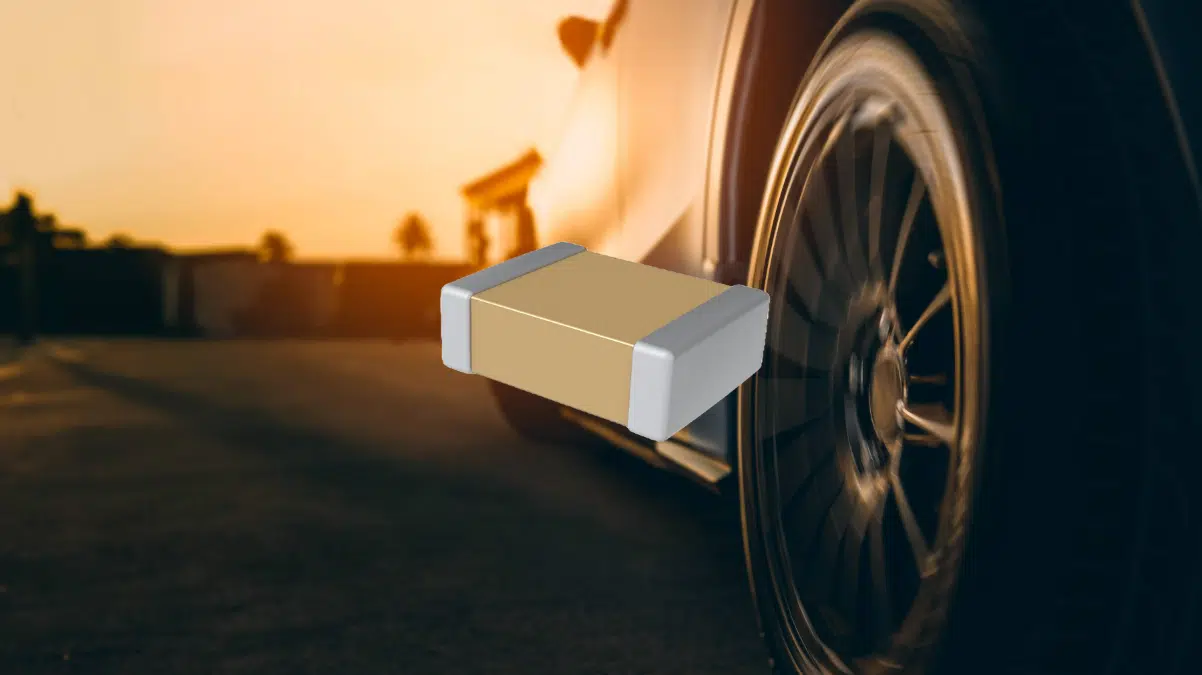
YAGEO introduces VW80808 automotive grade multilayer ceramic capacitors (MLCCs) with flexible terminations and C0G dielectric designed for high‑reliability operation in demanding automotive environments.
They target applications where vibration, board flex and thermal cycling can otherwise cause cracking and latent failures in conventional MLCCs.
Key features and benefits
- Flexible termination construction to decouple PCB bending and mechanical stress from the rigid ceramic body, significantly reducing the risk of flex‑induced cracks and resulting insulation resistance loss or short circuits.
- Automotive grade qualification according to AEC‑Q200 and VW80808 specifications, supporting use in mission‑critical and safety‑relevant automotive control units.
- C0G dielectric option with negligible capacitance change over time and voltage, and a tight temperature coefficient of ±30 ppm/°C from −55 °C to +125 °C, supporting precision timing, filtering and sensing functions.
- Wide capacitance range from 1000 pF up to 6.8 µF (according to the manufacturer product brief), allowing both small‑signal and higher‑value decoupling and filtering roles in one qualified family.
- Broad voltage ratings from 6.3 V up to 1000 V DC, enabling usage from low‑voltage logic rails through to high‑voltage DC‑link, inverter and powertrain nodes in the same MLCC platform.
- Multiple case sizes in standard EIA 0603, 0805, 1206 and 1210 footprints, simplifying PCB library reuse and second‑sourcing strategies.
- Improved robustness in the field with higher crack resistance, better thermal cycling endurance, and enhanced humidity‑with‑bias reliability, helping reduce warranty returns and field failures.
- RoHS and REACH compliance, supporting global automotive and industrial environmental requirements.
For engineers familiar with standard MLCCs, the main value proposition is a combination of C0G‑class electrical stability with mechanical stress robustness that is often associated with soft‑termination X7R devices.
Typical applications
The YAGEO VW80808 C0G flexible termination MLCCs are targeted at automotive systems where vibration, board flex and wide temperature swings are present, and where system‑level safety and reliability requirements are stringent.
Typical use cases include:
- Flex mitigation locations on large or mechanically constrained PCBs, such as near mounting holes, connectors or heavy components.
- Electric power steering (EPS) ECUs, where high vibration and steering column movement can induce repeated board flex.
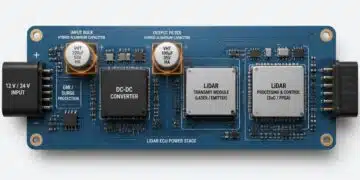
- ADAS controllers for camera, radar and lidar modules, which may be mounted in exposed vehicle locations subject to temperature cycling and mechanical shock.
- Powertrain ECUs for engine and transmission control, as well as other under‑hood modules where ambient temperatures and vibration are elevated.
- DC‑DC converters and inverters, where the capacitors can be used in filtering and snubber networks that see repetitive high‑frequency stress and thermal cycling.
- Battery management systems (BMS) and on‑board chargers (OBC), particularly in circuits sensitive to humidity plus applied bias, where long‑term dielectric and insulation resistance stability is critical.
Beyond automotive, similar stress conditions exist in industrial drives, transportation electronics and harsh‑environment control systems, making the series attractive wherever automotive‑grade robustness is desired.
Technical highlights
The table below summarizes the main technical positioning of the VW80808 MLCC family according to the YAGEO information and product brief.
| Parameter | VW80808 C0G flexible termination MLCCs |
|---|---|
| Dielectric system | C0G; X7R also available in the broader VW80808 family according to YAGEO |
| Capacitance range | 1000 pF to 6.8 µF (per manufacturer product brief) |
| Voltage ratings | 6.3 V DC to 1000 V DC |
| Temperature range | −55 °C to +125 °C |
| Temperature coefficient | ±30 ppm/°C (C0G) |
| Case sizes | EIA 0603, 0805, 1206, 1210 |
| Qualification | AEC‑Q200 and VW80808 |
| Compliance | RoHS and REACH compliant |
| Construction | Flexible termination (FT CAP) |
C0G dielectric and temperature stability
The C0G dielectric used in this series provides minimal capacitance variation over temperature, time and applied DC voltage. This behavior is important in precision analog paths, timing networks and reference filtering where capacitance drift could translate into offset, gain error or timing skew over the vehicle lifetime. Compared with Class II dielectrics such as X7R, C0G devices generally trade capacitance density for higher stability and lower loss, which is acceptable in many sensing and control circuits.
Flexible termination for crack mitigation
The flexible termination structure introduces a compliant layer between the ceramic body and external terminations. In practice, this allows the capacitor to tolerate PCB bending up to approximately 5 mm without a significant change in capacitance according to the manufacturer. In real assemblies this means:
- Reduced risk of flex cracks during PCB depanelization, manual handling or screw tightening.
- Improved robustness under in‑service vibration and temperature‑induced expansion mismatch between PCB and housing.
- Lower probability of latent micro‑cracks that can progress into dielectric breakdown under humidity and bias.
By reducing susceptibility to mechanical damage, the series supports more stable long‑term insulation resistance and helps avoid intermittent or catastrophic short‑circuit failures in safety‑relevant modules.
Design‑in notes for engineers
- Select dielectric according to function: Use the C0G versions for precision and low‑loss nodes such as reference filtering, timing, high‑Q RF networks or sensing front ends; use X7R variants from the same VW80808 family where higher capacitance density is needed and some parameter drift is acceptable.
- Place flexible termination parts in high‑stress regions: Prefer these MLCCs near board edges, mounting holes, high‑mass components and connectors where bending and vibration are strongest, while standard MLCCs can remain in low‑stress interior regions.
- Apply appropriate voltage derating: Even with ratings up to 1000 V DC, adopt suitable derating margins based on the application (for example in DC‑link, snubber and flyback circuits) to account for transient overvoltage, surge and long‑term reliability.
- Consider thermal environment carefully: The −55 °C to +125 °C range supports typical automotive under‑hood use, but local hot spots near power semiconductors can be significantly higher, so layout and cooling should keep MLCC body temperatures within specification.
- Account for mechanical stack‑up: When targeting up to 5 mm board flex performance, ensure that enclosure, stiffeners, fasteners and assembly processes do not introduce additional unexpected mechanical constraints that negate the benefits of flexible terminations.
- Validate in humidity and bias conditions: In BMS, OBC and other high‑humidity environments, perform life testing with DC bias applied to confirm insulation resistance and dielectric strength over time using the exact part numbers and lot codes intended for production.
- Use consistent case sizes across platforms: Sticking to EIA 0603/0805/1206/1210 footprints across multiple ECU designs can simplify qualification and stocking while still leveraging the different electrical options available in the VW80808 family.
By combining appropriate part selection, careful placement and realistic derating, designers can use the VW80808 C0G flexible termination MLCCs to improve long‑term reliability of critical automotive and industrial electronics without major PCB or BOM changes.
Source
This article is based on information provided by YAGEO Group in their VW80808 C0G automotive grade flexible termination MLCC product brief and online resource library, interpreted and reorganized for design engineers and component purchasers.