












Power electronics teams entering 2026 face tighter space, efficiency and time‑to‑market constraints, while magnetics must still behave predictably across thermal and frequency extremes. This webinar from Frenetic’s first 2026 series shares real usage data from their simulation and planar design tools, offering a grounded view of how engineers actually design today and where the bottlenecks really are.
Rather than promoting a single “trend”, it highlights how topology choices, planar transformers and improved thermal modeling interact in day‑to‑day design work.
Key takeaways from the webinar
The session combines three perspectives: product management, tool development and application engineering. Together they outline how engineers are using Frenetic’s magnetics tools and what they are asking for in 2026.
Major points include:
- Flyback converters remain ubiquitous as auxiliary supplies and sub‑100 W workhorses, and are still one of the first topologies every magnetics engineer must master.
- Dual active bridge (DAB) and other bidirectional topologies are no longer “exotic”; they are now among the most simulated standard topologies in Frenetic’s tools.
- Roughly one third of recent customer designs could plausibly migrate to planar technology, depending on mechanical and manufacturing constraints rather than pure electrical performance.
- Thermal behavior, not magnetic characteristics alone, often defines the real design limit, especially at high power and high frequency.
- Frenetic’s roadmap for 2026 focuses on closing modeling gaps: better thermal models, improved high‑frequency loss and parasitic estimation, and tighter coupling to PCB manufacturing and circuit simulation.
For design engineers and component buyers, the message is that magnetics choices must be made in the context of system‑level constraints, thermal limits and manufacturability, not just datasheet efficiency numbers.
How engineers are really using topologies
The webinar includes anonymized statistics from Frenetic’s simulator showing which topologies users simulated most frequently in 2025. While exact counts are not broken down by part number, the distribution gives a realistic sense of where engineering time goes.
Custom waveforms and “other” topologies
- The single largest category in Frenetic’s simulator is “custom”, where users upload arbitrary waveforms (CSV) instead of choosing a predefined topology.
- This reflects how often real projects involve variations of standard topologies or entirely custom converters that don’t fit canned templates.
- Even small variations – for example a modified gate pattern or interleaving scheme – are enough for engineers to model designs as “custom” rather than forcing them into a standard waveform.
For passive component selection, this means generic “one‑topology” application notes are often an approximate match at best; real designs may see different ripple profiles, harmonic content and duty cycles than textbook examples.
Flyback remains everywhere
- Flyback converter is the second most simulated topology in Frenetic’s data, with on the order of tens of thousands of simulations over 2025.
- It appears both as the main power stage in sub‑100 W designs (USB chargers, consumer appliances) and as the default auxiliary supply in larger systems.
- Engineers often revisit flyback repeatedly during their career: it is the first topology many learn for magnetics design, and it remains a common reference point when validating new tools or cores.
In practice, this means procurement teams can expect long‑term, stable demand for flyback‑optimized magnetics and related passive components, even as newer topologies gain attention.
Dual active bridge and other bidirectional stages
- Dual active bridge appears as the third most simulated topology, close behind flyback, despite being one of the more complex architectures supported.
- Its main attraction is bidirectional power flow for applications such as UPS systems, energy storage interfaces and other scenarios where power must move both to and from a DC bus.
- Engineers value DAB as a flexible building block: with appropriate modulation and filtering, it can serve in multiple roles across EV, industrial and grid‑connected systems.
Design teams specifying DC link capacitors, snubbers and EMI components for DAB must account for bidirectional energy flow and often harsher transient conditions than in unidirectional converters.
Planar magnetics: from trend to necessity
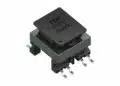
A recurring theme is that planar transformers are no longer a futuristic curiosity. They have become a practical necessity in many high‑density and automotive‑adjacent designs.
How much of the market can go planar?
- Based on Frenetic’s experience across customer projects, roughly 30 percent of designs could realistically migrate to planar implementations.
- This estimate is conditioned on mechanical constraints: designs with tight height or footprint limits, strict repeatability requirements, or well‑defined cooling paths are the natural candidates.
- The proportion is not fixed; it varies with application sector and power level, but the general message from the field is that “a surprising fraction” of designs at least merits a planar feasibility check.
From a purchasing perspective, this suggests that both traditional wound magnetics and planar solutions should be evaluated side‑by‑side during early sourcing, especially for new platforms that will be produced in volume.
When planar is a good fit
Engineers on the webinar outline several rules of thumb for when planar makes sense:
- Clear space or height limitations, especially low‑profile designs where vertical height is the primary constraint.
- Strong need for repeatability in manufacturing, for example in automotive, medical or industrial drives where tight tolerances and low variability are important.
- Availability of suitable cooling paths such as cold plates or direct PCB‑attached heatsinks, enabling efficient heat extraction from flat structures.
- Desire to integrate magnetics more tightly with the PCB layout, for example to shorten loops, improve EMC, or simplify assembly.
Conversely, if a design has no space limitation, lacks appropriate cooling options or will be built in very small quantities, planar may not justify its additional complexity and cost.
Comparing planar and traditional magnetics
The speakers emphasize that engineers increasingly want to compare planar and traditional designs before committing. In Frenetic’s customer base, more than half of engineers working with relevant applications now explicitly ask to compare a standard part with a planar alternative before making a decision.
Typical comparison axes include:
- Volume and outline: whether planar can reduce height or better fit available board area.
- Thermal performance: how well each option manages losses under realistic boundary conditions.
- Cost structure: trade‑offs between one‑time tooling and recurring unit price, especially at different volumes.
- Manufacturability: PCB fabrication tolerances, assembly flow and quality control for planar vs. traditional winding processes.
For passive component specifiers, this reinforces the value of maintaining approved vendor lists that include both planar and wound options, and of standardizing thermal test conditions so results can be compared fairly.
What limits designs today: thermal, not just magnetics
A core message of the webinar is that in many modern converters, thermal behavior is the primary bottleneck rather than magnetic saturation or classic core selection issues.
Thermal modeling improvements
Frenetic’s product manager describes several ongoing enhancements to the thermal aspects of their tools:
- Expansion of thermal models to handle more realistic boundary conditions beyond simple natural or forced convection, including configurations with cooling plates and encapsulated (potted) designs.
- Integration of core‑loss calculations directly into the planner application so designers no longer need to export data to external tools just to estimate thermal effects.
- Development of a temperature model for planar designs based on finite element analysis, implemented in COMSOL on the backend and currently under validation with real magnetic components.
For engineers, the practical implication is that design tools are converging toward temperature predictions that align more closely with lab measurements, reducing the need for conservative over‑design margins.
High‑frequency effects and parasitics
At higher switching frequencies, parasitic elements and proximity effects dominate component behavior. The webinar highlights several specific modeling initiatives:
- A more detailed capacitor model to estimate parasitic and inter‑winding capacitances in high‑frequency magnetics.
- A dedicated loss model for toroidal windings, where proximity effects and uneven current distribution can dramatically alter losses compared with simple analytical estimates.
- Better estimation of self‑resonant frequencies and parasitic capacitances so designers can predict EMI behavior and filter interactions earlier in the process.
These improvements support better selection of EMI filters, snubber capacitors and surge protection components, since engineers can anticipate more realistic voltage and current spectra at the magnetics terminals.
Tool updates that matter for passive component design
While the webinar is nominally about “what’s next in product development” at Frenetic, many of the specific updates are directly relevant to how engineers choose and validate passive components.
Core material and parameter realism
- In the planner tool, users can now select from multiple core materials more explicitly, aligning designs more closely with actual manufacturer specifications.
- This helps engineers design with parameters that reflect real catalog cores and toroids, reducing the number of iterations required later when they match against vendor part numbers.
- By reducing the gap between idealized models and real parts, engineers are less likely to discover late in the design that the core they assumed is not available in the desired size, material or tolerance.
For component buyers, this means the designs being handed over for sourcing are more likely to be directly matched to standard catalog items.
Winding configuration and units
- The planner supports more extended winding configurations, including mixed PCB and copper‑stamp transformers, which accommodate more “extreme” or high‑power use cases.
- Conversion between copper thickness units (ounces vs. millimeters) is now fully synchronized and bidirectional in the UI, reducing user errors when specifying PCB copper layers.
- Considering PCB copper tolerances remains non‑trivial; the Q&A section notes that fully modeling layer‑by‑layer tolerance stacks in an automated way would require heavy iteration and long computation times, making it a poor fit as a general‑purpose UI feature.
Instead, engineers are encouraged to use realistic tolerance figures from PCB manufacturers and, where necessary, run scenario‑based simulations or dedicated test builds rather than relying on a single “nominal” model.
Circuit simulation integration
- After simulations, the planner and simulator can now export valid LTspice‑compatible models, producing files ready for immediate use in system‑level circuit simulations.
- This reduces the friction between magnetics design and broader converter validation, avoiding manual model construction or parameter transcription.
- The roadmap includes reinforcing and extending this export capability, making it easier for engineers to include detailed magnetics models in their converter schematics without extra scripting.
For passive component selection, integrated models allow more accurate stress and lifetime analyses on capacitors, resistors and protection elements under realistic waveforms.
Bridging to PCB manufacturing
The roadmap also touches on closing the loop between magnetics design and PCB fabrication:
- For planar designs, Frenetic is exploring automated generation of Gerber files, which would directly feed into PCB manufacturing processes.
- This would let engineers move from validated planar designs to manufacturable PCB layouts with less manual translation, reducing both errors and lead time.
- Combined with improved thermal modeling, this promises a more reliable path from simulation to hardware, supporting confident early commitments to specific planar transformer and inductor designs.
Procurement and manufacturing teams stand to benefit from clearer, more standardized outputs at the interface between design and fabrication.
Design‑in notes for engineers and buyers
Although the webinar focuses on tools and trends rather than individual part numbers, several practical design‑in lessons emerge for those working with passive components.
Choosing a topology in context
One pointed question in the webinar asks whether engineers truly know how to choose the right topology for a given application. The consensus answer is nuanced:
- Many engineers are experienced and choose appropriate topologies, but a significant share of designs are constrained by legacy choices inherited from older products.
- In some cases, engineers select more complex topologies than necessary because they are familiar or previously used, rather than because they are optimal for the new requirements.
- The recommendation is to evaluate topology and magnetics choices at the converter level, not just within the magnetics themselves, and to involve cross‑functional perspectives early in the process.
From a passive components standpoint, this means that early topology decisions strongly influence capacitor stress, resistor dissipation, EMI filtering complexity and surge protection requirements – and may deserve re‑evaluation when major new platforms are started.
When to consider planar vs. traditional
The webinar provides several practical guidelines that can be translated into a decision checklist:
- If there is no significant space or height constraint, and the design will be manufactured in modest volumes, a traditional wound transformer is often the simpler, safer choice.
- If height, footprint or volumetric efficiency are pressing constraints, or if there is a clear cooling strategy via cold plate or thermal interface materials, then planar should be evaluated.
- For applications where repeatability and automated assembly are critical, planar magnetics can offer advantages in tolerance control and process monitoring.
- In borderline cases, engineers are encouraged to run comparative simulations and, if possible, prototype both options before locking the design.
For buyers, it is advisable to ask design teams early whether planar alternatives have been considered, and whether the design team is using tools capable of modeling planar thermal behavior accurately.
Managing thermal margins
Thermal uncertainty is repeatedly identified as a pain point:
- Historically, designers have had to make assumptions about thermal behavior when simulation tools did not capture real boundary conditions.
- Improved models and direct core loss calculations now allow a closer match between simulation and lab data, but early designs should still include sensible margins.
- For high‑power or high‑frequency designs, it is worth investing time in realistic thermal boundary definitions – including potting, cold plates and airflow – in the simulation stage.
Component selection should therefore be guided by both electrical and thermal ratings “according to manufacturer datasheet”, but with additional verification in the specific mechanical and cooling context of the end product.
Considering PCB copper tolerances
A question from the Q&A section asks whether PCB copper tolerances can be explored directly in the planner. The response underscores practical constraints:
- Modeling layer‑by‑layer copper thickness variation within the tool would require repeated iterations per design point, leading to long computation times and a poor interactive experience.
- Instead, engineers are encouraged to take realistic tolerance data from PCB vendors (for example, standard stackups from low‑cost manufacturers versus premium RF materials) and perform separate analyses or test builds where tolerance sensitivity is critical.
- For most designs, typical PCB tolerances do not radically change magnetics behavior, but sensitive high‑frequency or high‑density applications may warrant explicit worst‑case checks.
This is a reminder that datasheet values and “nominal” simulations should be complemented by practical understanding of manufacturing variation for both PCBs and passive components.
Source
This article is based on a Frenetic webinar titled “Frenetic updates for 2026 and topology market trends”, which presents their internal usage data, customer feedback and 2026 product roadmap. Technical details and qualitative statements about design practices reflect the content of that session and should be cross‑checked against the latest manufacturer datasheets and tool documentation for specific designs.
References
- Frenetic webinar – Frenetic updates for 2026 and topology market trends (YouTube): https://youtu.be/gUvDGGPOsQU
FAQ: 2026 Power Magnetics Design Trends
Flyback remains one of the most widely used topologies because it is a simple, robust building block for auxiliary power supplies and sub‑100 W converters such as USB chargers and consumer appliances. Engineers also tend to start their magnetics design experience with flyback and repeatedly return to it as a known reference when validating new tools, cores and design approaches.
Dual active bridge has become a mainstream choice for bidirectional power flow in applications like UPS systems and energy storage interfaces. It offers flexible control of power transfer in both directions, which is increasingly important where designers need one topology that can both charge and discharge storage elements efficiently under varying grid and load conditions.
According to Frenetic’s project experience, roughly 30 percent of recent customer designs could realistically migrate to planar magnetics, provided the mechanical and manufacturing constraints are suitable. Typical candidates are designs with tight height or footprint limits, strong repeatability requirements and clearly defined cooling paths via cold plates or PCB‑attached heatsinks.
Planar magnetics make most sense when there are strict space or height constraints, high production volumes and a strong need for repeatability and automated assembly. They are also attractive when the mechanical design supports efficient heat extraction from flat structures and when integrating magnetics into the PCB layout helps reduce loop areas and improve EMC.
In modern high‑power and high‑frequency converters the limiting factor is frequently temperature rather than core saturation or simple electrical ratings. Losses from core materials, copper and parasitics interact with real cooling conditions, so inadequate thermal paths or unrealistic boundary assumptions can cap output power or lifetime well before magnetic limits are reached.
Frenetic is expanding its tools with more advanced thermal modeling that covers boundary conditions beyond simple natural and forced convection. This includes configurations with cooling plates and encapsulated designs, plus finite‑element‑based temperature models for planar magnetics that aim to align simulated temperatures more closely with measured lab data.
At higher switching frequencies, parasitic capacitances, inter‑winding coupling and proximity effects in conductors strongly influence losses and EMI behavior. Improved models for parasitic capacitances, self‑resonant frequency and toroidal winding losses help engineers size EMI filters, snubbers and surge protection more accurately for the actual waveforms present in the converter.
Updated planner and simulator features provide more realistic core material options, extended winding configurations and direct export of LTspice‑compatible models. This lets engineers design magnetics around real manufacturer parameters and then run system‑level simulations that reveal true stresses on capacitors, resistors and protection components before committing to BOM decisions.
Not every design needs planar magnetics, but a growing share of projects benefit from an explicit comparison between planar and traditional wound solutions. If a project has space constraints, high volumes or strict manufacturing repeatability targets, it is increasingly advisable to evaluate both options early using realistic thermal and electrical models.
How‑to: Evaluate Planar vs. Traditional Magnetics for a New Power Converter
- Step 1: Define system‑level requirements
Start by collecting the key converter specifications, including input and output voltages, power range, isolation requirements and whether power flow must be bidirectional. Include mechanical targets such as maximum allowed height, available PCB area, target efficiency and expected thermal environment (natural convection, forced air, cold plate or potting).
- Step 2: Choose a suitable topology candidate
Based on the system requirements, shortlist one or two converter topologies such as flyback for sub‑100 W auxiliary supplies or dual active bridge for higher‑power bidirectional stages. Avoid defaulting to a complex legacy topology just because it was used in an older design; reassess whether a simpler or more modern alternative can meet the new constraints.
- Step 3: Model magnetics in a dedicated planner tool
Use a magnetics planner tool to design the transformer or inductor with realistic core materials and winding configurations that correspond to available catalog parts.
Leverage the tool’s support for both traditional wound and planar implementations so that turns, layers and copper arrangements are based on manufacturable geometries, not idealized assumptions. - Step 4: Include thermal and high‑frequency effects
Enable the thermal and high‑frequency options in the planner so core losses, copper losses and parasitic capacitances are estimated under realistic boundary conditions. Define boundary conditions that match the intended mechanical design, including cooling plates, encapsulation or airflow, and examine how temperature rise differs between planar and traditional options.
- Step 5: Export models to circuit simulation
Export the resulting magnetics models, for example as LTspice‑compatible files, and integrate them into the full converter schematic for system‑level simulation. Use these simulations to observe real current and voltage waveforms across capacitors, resistors and protection components so you can size EMI filters, snubbers and surge arresters based on realistic stress profiles.
- Step 6: Compare planar and traditional implementations
Run parallel simulations using both the planar and traditional magnetics designs and compare metrics such as efficiency, temperature rise, volume, height and estimated cost. Pay special attention to manufacturability factors such as PCB copper tolerances and assembly flows, and weigh any planar tooling costs against long‑term benefits in automated production and repeatability.
- Step 7: Validate assumptions with prototypes
For the most promising option, build a prototype and measure temperatures, losses and EMI to confirm that the behavior matches the simulated results within acceptable margins. If time and budget allow, prototype both the planar and traditional variants at least once, particularly for high‑volume platforms where early validation can prevent costly redesigns later in the product lifecycle.