





Passive Components Blog
No Result
View All Result
  • Home
  • NewsFilter
    • All
    • Aerospace & Defence
    • Antenna
    • Applications
    • Automotive
    • Capacitors
    • Circuit Protection Devices
    • electro-mechanical news
    • Filters
    • Fuses
    • Inductors
    • Industrial
    • Integrated Passives
    • inter-connect news
    • Market & Supply Chain
    • Market Insights
    • Medical
    • Modelling and Simulation
    • New Materials & Supply
    • New Technologies
    • Non-linear Passives
    • Oscillators
    • Passive Sensors News
    • Resistors
    • RF & Microwave
    • Telecommunication
    • Weekly Digest

    Circuit Protection Technology Annual Dossier

    ESA SPCD 26 Registration Open

    Capacitances of Nonlinear MLCCs: What Datasheets Don’t Tell You

    Stackpole Releases Automotive Wide‑Termination Resistors

    How a Digital Structural Twin Can Predict Tantalum Capacitor Reliability

    SCHURTER Buys Biaodi to Boost High-Voltage Protection Portfolio

    Binder Hybrid Connector Simplifies One Cable Automation

    Tapped Inductor Buck Converter Fundamentals

    TAIYO YUDEN Releases Mini Metal Power Inductors

    Trending Tags

    • Ripple Current
    • RF
    • Leakage Current
    • Tantalum vs Ceramic
    • Snubber
    • Low ESR
    • Feedthrough
    • Derating
    • Dielectric Constant
    • New Products
    • Market Reports
  • VideoFilter
    • All
    • Antenna videos
    • Capacitor videos
    • Circuit Protection Video
    • Filter videos
    • Fuse videos
    • Inductor videos
    • Inter-Connect Video
    • Non-linear passives videos
    • Oscillator videos
    • Passive sensors videos
    • Resistor videos

    Capacitances of Nonlinear MLCCs: What Datasheets Don’t Tell You

    Tapped Inductor Buck Converter Fundamentals

    Planar vs Conventional Transformer: When it Make Sense

    Modeling Fringing Field Losses in Inductors & Transformers

    Why Power Inductors Use a Ferrite Core With an Air Gap

    Transformer-Based Power-Line Harvester Magnetic Design

    Thermal Modeling of Magnetics

    Standard vs Planar LLC transformers Comparison for Battery Chargers

    How Modern Tools Model Magnetic Components for Power Electronics

    Trending Tags

    • Capacitors explained
    • Inductors explained
    • Resistors explained
    • Filters explained
    • Application Video Guidelines
    • EMC
    • New Products
    • Ripple Current
    • Simulation
    • Tantalum vs Ceramic
  • Knowledge Blog
  • DossiersNew
  • Suppliers
    • Who is Who
  • PCNS
    • PCNS 2025
    • PCNS 2023
    • PCNS 2021
    • PCNS 2019
    • PCNS 2017
  • Events
  • Home
  • NewsFilter
    • All
    • Aerospace & Defence
    • Antenna
    • Applications
    • Automotive
    • Capacitors
    • Circuit Protection Devices
    • electro-mechanical news
    • Filters
    • Fuses
    • Inductors
    • Industrial
    • Integrated Passives
    • inter-connect news
    • Market & Supply Chain
    • Market Insights
    • Medical
    • Modelling and Simulation
    • New Materials & Supply
    • New Technologies
    • Non-linear Passives
    • Oscillators
    • Passive Sensors News
    • Resistors
    • RF & Microwave
    • Telecommunication
    • Weekly Digest

    Circuit Protection Technology Annual Dossier

    ESA SPCD 26 Registration Open

    Capacitances of Nonlinear MLCCs: What Datasheets Don’t Tell You

    Stackpole Releases Automotive Wide‑Termination Resistors

    How a Digital Structural Twin Can Predict Tantalum Capacitor Reliability

    SCHURTER Buys Biaodi to Boost High-Voltage Protection Portfolio

    Binder Hybrid Connector Simplifies One Cable Automation

    Tapped Inductor Buck Converter Fundamentals

    TAIYO YUDEN Releases Mini Metal Power Inductors

    Trending Tags

    • Ripple Current
    • RF
    • Leakage Current
    • Tantalum vs Ceramic
    • Snubber
    • Low ESR
    • Feedthrough
    • Derating
    • Dielectric Constant
    • New Products
    • Market Reports
  • VideoFilter
    • All
    • Antenna videos
    • Capacitor videos
    • Circuit Protection Video
    • Filter videos
    • Fuse videos
    • Inductor videos
    • Inter-Connect Video
    • Non-linear passives videos
    • Oscillator videos
    • Passive sensors videos
    • Resistor videos

    Capacitances of Nonlinear MLCCs: What Datasheets Don’t Tell You

    Tapped Inductor Buck Converter Fundamentals

    Planar vs Conventional Transformer: When it Make Sense

    Modeling Fringing Field Losses in Inductors & Transformers

    Why Power Inductors Use a Ferrite Core With an Air Gap

    Transformer-Based Power-Line Harvester Magnetic Design

    Thermal Modeling of Magnetics

    Standard vs Planar LLC transformers Comparison for Battery Chargers

    How Modern Tools Model Magnetic Components for Power Electronics

    Trending Tags

    • Capacitors explained
    • Inductors explained
    • Resistors explained
    • Filters explained
    • Application Video Guidelines
    • EMC
    • New Products
    • Ripple Current
    • Simulation
    • Tantalum vs Ceramic
  • Knowledge Blog
  • DossiersNew
  • Suppliers
    • Who is Who
  • PCNS
    • PCNS 2025
    • PCNS 2023
    • PCNS 2021
    • PCNS 2019
    • PCNS 2017
  • Events
No Result
View All Result
Passive Components Blog
No Result
View All Result

2D thermo-functional nano-material cool surfaces and wafers effectively without energy consumption

15.11.2019
Reading Time: 3 mins read
A A

Researchers from the ICN2 and the ICMM-CSIC have developed a new material able to cool another one by emitting infrared radiation. The results are published in Small and are expected to be used in devices where an increase in temperature has drastic effects on performance, like solar panels and computer systems, among other applications.

Refrigeration is a central issue in current societies: be it in a supermarket or on your personal computer, the regulation of temperature is necessary to keep human beings comfortable or just machines working reliably. Cooling systems account for 15% of the global energy consumption and are responsible for 10% of greenhouse gas emissions. One could say that the cure is worse than the disease, as greenhouse gases generate global warming, thus requiring even more refrigeration.

RelatedPosts

Circuit Protection Technology Annual Dossier

ESA SPCD 26 Registration Open

Capacitances of Nonlinear MLCCs: What Datasheets Don’t Tell You

A way out of this loop has been found by researchers from the Catalan Institute of Nanoscience and Nanotechnology (ICN2) in collaboration with researchers from the Instituto de Ciencia de Materiales de Madrid (ICMM-CSIC). Members of the ICN2 Phononic and Photonic Nanostructures Group, led by ICREA Prof. Dr Clivia M. Sotomayor Torres, and the ICMM Photonic Crystals Group have reported a novel two-dimensional material able to remove heat, cooling down the surface in which it is placed without energy consumption or gas emissions of any kind. The work has been published in Small, with Dr Juliana Jaramillo-Fernández, who is a Marie Slodowska-Curie COFUND Postdoctoral Researcher at the ICN2, as its first author.

The material is inspired by the Earth’s efficient temperature-regulation mechanism, named radiative sky cooling. Although the Earth is heated by the Sun, it also emits infrared radiation to the outer space, as this kind of radiation is not captured by the atmosphere. The sand grains in deserts are among the major contributors to this phenomenon, which keeps the average temperature of our planet stable as long as we do not consider human activities.

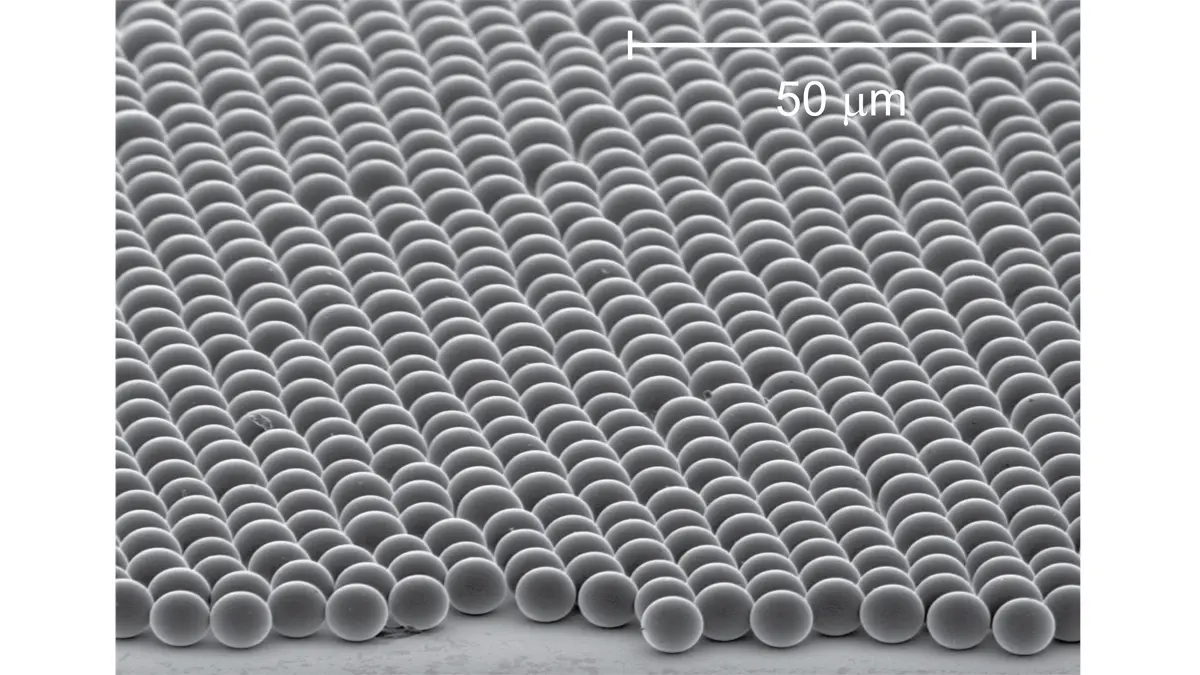
The proposed material takes advantage of the same principle. The researchers have shown that it is able to cool down a silicon wafer under direct sunlight irradiation by 14 ºC, whereas an ordinary soda-lime glass just lowers it by 5 ºC. The material is formed by a self-assembled array of 8 µm-diameter silica spheres, like sand grains a million times smaller in volume. This layer behaves almost as an ideal infrared emitter, providing a radiative cooling power of up to 350 W/m2 for a hot surface, such as a solar panel.

To put this into context, this would remove half of the heat accumulated in a typical solar panel in a regular clear day, which is enough to increase the relative efficiency of a solar cell by 8%. Considering the global solar energy production in 2017, such an efficiency increase represents enough energy to power the city of Paris during an entire year.

The researchers have unravelled the radiative sky cooling potential of self-assembled crystals, showing that only a single-layer of microspheres is necessary for achieving the best cooling performance, which is of great interest for future up-scaling and applicability. This is in sharp contrast to current state-of-the-art radiative cooling materials, since it is six times thinner than the existing glass-polymer films and it avoids the use of plastics.

The potential impact of this kind of technologies has not gone unnoticed. Dr Juliana Jaramillo, Dr Achille Francone and Dr Nikolaos Kehagias, from the aforementioned ICN2 group, have also developed another material that is easily up-scalable and is capable of providing both radiative cooling and self-cleaning. The Collider, a technology transfer programme promoted by Mobile World Capital Barcelona that connects scientific research with entrepreneurial initiative, has awarded this project The Collider Tech Award 2019, a prize that encourages further development of this research line on radiative cooling materials. A European patent protecting the intellectual property rights of this technology was filed on 31 July 2019 by the ICN2 and ICREA.

Aside from use on solar panels, other conceivable applications include refrigeration of thermoelectric modules —devices that convert temperature differences into electric current—, cooling computer systems in data centres or even smart windows that would refresh themselves and their surroundings, saving air conditioning costs.

Featured image source: ICN2

Article reference:

Juliana Jaramillo‐Fernandez, Guy L. Whitworth, Jose Angel Pariente, Alvaro Blanco, Pedro D. Garcia, Cefe Lopez, Clivia M. Sotomayor‐Torres. A Self‐Assembled 2D Thermofunctional Material for Radiative Cooling. Small, 2019; 1905290. https://doi.org/10.1002/smll.201905290
Related

Source: ICN2

Recent Posts

Molecular Memristor Shows Record 145 kH Emergent Inductance

12.5.2026
36

Researchers Propose Next‑Gen Compact Memory Using Ultra-thin Ferroelectric Capacitors

11.5.2026
49

Electrocaloric Multilayer Capacitors: Towards Quiet, Solid‑State Cooling Around Room Temperature

7.5.2026
209

High-Crystallinity Nanocrystalline Composites for MHz Chip Inductors

7.5.2026
67

Nanocrystalline Cores for Low‑Loss MHz Chip Inductors

25.3.2026
86
Schematic illustration of the electric double layer of porous carbon electrodes at elevated potentials in a a conventional electrolyte and b a weakly solvating electrolyte; source: authors

Researchers Presented Lignin-based Electrolyte for 4V Supercapacitors with Low Self‑Discharge

19.3.2026
40
Researchers developed a polymer capacitor by combining two cheap, commercially available plastics. The new polymer capacitor makes use of the transparent material — pictured here, with vintage Penn State athletic marks visible through it — to store four times the energy and withstand significantly more heat.  Credit: Penn State

Penn State Demonstrated Polymer Alloy Capacitor Film with 4× Energy Density up to 250C

19.2.2026
86

TU Wien Sets New Benchmark in Superconducting Vacuum Gap nanoCapacitors

16.2.2026
31

Researchers Demonstrated 32nm Aluminum Vacuum Gap Capacitor

20.1.2026
61

Upcoming Events

May 19
16:00 - 17:00 CEST

Designing Qi2 Wireless Power Systems: Practical Development and EMC Optimization

Jun 2
16:00 - 17:00 CEST

Calculation, Simulation and Measurement of 800V EMC Filters

Jun 16
16:00 - 17:00 CEST

EMC with EMC – EMC‑compliant design with electromechanical connectors

View Calendar

Popular Posts

  • Buck Converter Design and Calculation

    0 shares
    Share 0 Tweet 0
  • Boost Converter Design and Calculation

    0 shares
    Share 0 Tweet 0
  • Flyback Converter Design and Calculation

    0 shares
    Share 0 Tweet 0
  • LLC Resonant Converter Design and Calculation

    0 shares
    Share 0 Tweet 0
  • MLCC and Ceramic Capacitors

    0 shares
    Share 0 Tweet 0
  • Capacitor Charging and Discharging

    0 shares
    Share 0 Tweet 0
  • What Electronics Engineer Needs to Know About Passive Low Pass Filters

    0 shares
    Share 0 Tweet 0
  • Dual Active Bridge (DAB) Topology

    0 shares
    Share 0 Tweet 0
  • Ripple Current and its Effects on the Performance of Capacitors

    3 shares
    Share 3 Tweet 0
  • Samsung Electro-Mechanics Releases High-Capacitance MLCCs for AI Server Applications

    0 shares
    Share 0 Tweet 0

Newsletter Subscription


Passive Components Blog

© EPCI - Leading Passive Components Educational and Information Site

  • Home
  • Privacy Policy
  • EPCI Membership & Advertisement
  • About

No Result
View All Result
  • Home
  • Knowledge Blog
  • PCNS

© EPCI - Leading Passive Components Educational and Information Site

This website uses cookies. By continuing to use this website you are giving consent to cookies being used. Visit our Privacy and Cookie Policy.
Go to mobile version