















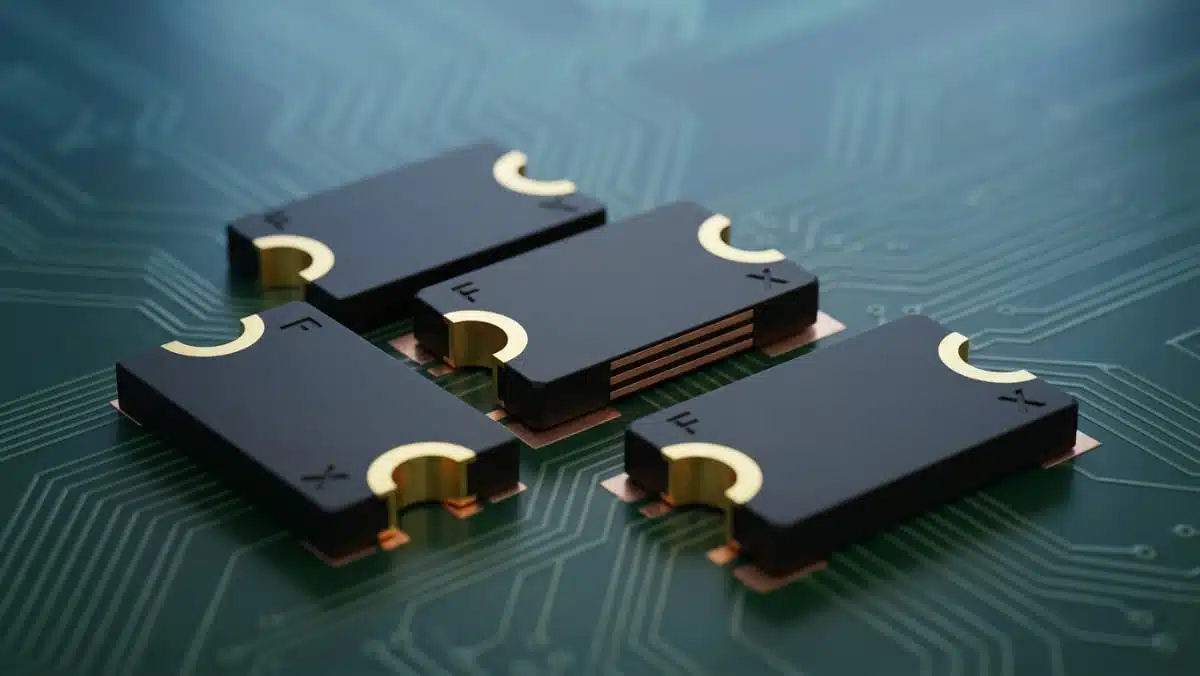
Bourns has introduced new Multifuse polymeric positive temperature coefficient (PPTC) resettable fuse models that extend its MF2603 and MF‑LSMF families toward higher power rating and higher voltage operation in a standard surface‑mount footprint.
These devices target robust, resettable overcurrent and overtemperature protection in telecom, networking, power port and general industrial electronics where space, safety and serviceability are critical.
Key features and benefits
The new Multifuse models in the MF2603 and MF‑LSMF ranges are designed as resettable overcurrent protectors using PPTC technology in compact surface‑mount formats. From an engineering perspective, they combine relatively high hold currents with elevated maximum voltage ratings and fast trip behavior.
Key characteristics include:
- PPTC resettable fuse construction (Multifuse technology) enabling automatic reset after fault removal and cooling, which simplifies service and avoids fuse replacement.
- High power rating and elevated Vmax values intended for low‑voltage DC systems with higher fault energy, such as 48 VDC power ports and PoE infrastructure.
- Surface‑mount packages with industry‑standard footprints (MF‑LSMF in 2920 outline) to ease layout and allow drop‑in design into existing footprints where appropriate.
- Fast time‑to‑trip behavior designed to limit fault energy during overcurrent events, helping to protect downstream ICs, connectors and cabling.
- Agency recognition and safety standard coverage (including IEC‑based fuse and control standards) that supports use in safety‑relevant circuits, subject to correct application design.
- RoHS‑compliant and halogen‑free construction in line with current environmental and OEM requirements.
From a practical point of view, using a PPTC instead of a one‑shot fuse can improve field reliability in systems that must survive occasional overloads, cable faults or mis‑wiring, while reducing truck‑rolls and service visits.
| Model | Size (EIA) | Ihold (A) | Vmax (VDC) | Imax (A) | cUL Listed | TÜV Listed |
|---|---|---|---|---|---|---|
| MF-LSMF035/72X | 2920 | 0.35 | 72 | 20 | ||
| MF-LSMF050/72X | 2920 | 0.50 | 72 | 20 | ||
| MF-LSMF075/72X | 2920 | 0.75 | 72 | 20 | ||
| MF-LSMF200/33X | 2920 | 2.0 | 33 | 40 | ||
| MF-LSMF260/33X | 2920 | 2.6 | 33 | 40 | E174545 | R50256634 |
| MF-LSMF450/16X | 2920 | 4.5 | 16 | 40 | ||
| MF-LSMF550/16X | 2920 | 5.5 | 16 | 40 | ||
| MF-LSMF600/16X | 2920 | 6.0 | 16 | 40 | ||
| MF-LSMF700/12X | 2920 | 7.0 | 12 | 50 |
Typical applications
Bourns positions these MF2603 and MF‑LSMF Multifuse models for a broad range of low‑voltage DC equipment where fault currents can be substantial and where ports must remain field‑serviceable:
- Low‑voltage telecom equipment and line cards.
- Power over Ethernet (PoE) ports compliant with IEEE 802.3af and related specifications.
- 48 VDC power port protection in networking and distributed power shelves.
- USB power protection in POS terminals and industrial PCs.
- Industrial control modules and PLC I/O cards.
- Security and surveillance systems powered over structured cabling.
- Other DC supply rails where board space is constrained and resettable overcurrent protection is preferred.
In these systems, the PPTC is typically placed in series with the supply or port line to limit current during fault conditions, coordinate with upstream power supplies, and prevent overheating of traces, connectors or cable harnesses.
Technical highlights
While detailed numerical values should always be taken directly from the manufacturer datasheet, several technical aspects of the MF2603 and MF‑LSMF series are particularly relevant for design‑in:
- Hold current (Ihold) and trip current (Itrip):
The extended MF‑LSMF portfolio spans Ihold values from low sub‑ampere ratings up to several amperes, with corresponding Itrip values chosen to ensure reliable protection while tolerating inrush and normal operating surges according to the specific model. Exact Ihold/Itrip combinations are according to the manufacturer datasheet for each part number. - Maximum voltage (Vmax) and maximum fault current (Imax):
New MF‑LSMF entries expand the supported Vmax range up to tens of volts DC, including device options intended for 48 VDC and PoE port protection. Imax ratings in the tens of amperes allow the device to safely interrupt high short‑circuit currents within its specified time‑to‑trip. - Time‑to‑trip behavior:
The Multifuse construction and free‑expansion design used in MF‑LSMF aim at relatively swift trip times, especially at higher overcurrent levels, minimizing I²t energy into loads. For accurate coordination, engineers should consult the time‑to‑trip curves given for each model. - Temperature performance:
PPTC hold current decreases with rising ambient temperature. Bourns provides thermal derating information per model so designers can dimension Ihold at the worst‑case operating temperature, not only at 23 °C. This is essential for reliable operation inside sealed enclosures and high‑density racks. - Package and terminals:
The MF‑LSMF series uses an industry‑standard 2920 SMD footprint with a low‑profile body, helping to save PCB area and height in crowded boards. ENIG (electroless nickel immersion gold) terminal plating supports robust solderability and assembly. - Compliance and quality:
The series includes agency recognition from organizations such as UL/CSA and TÜV for relevant resettable fuse standards and is manufactured in an IATF 16949 certified facility. This can simplify qualification for automotive‑adjacent and high‑reliability industrial projects where process quality evidence is required.
In practice, engineers should pay close attention to Vmax, Imax, Ihold and Itrip when comparing these PPTCs against existing designs or alternative protection strategies such as polymer fuses from other series or traditional wire‑in‑air fuses.
Design‑in notes for engineers
When designing MF2603 or MF‑LSMF Multifuse PPTC devices into a circuit, several engineering considerations are important to ensure robust performance:
- Dimensioning Ihold vs. load current:
Choose a device whose Ihold exceeds the maximum continuous current under worst‑case ambient temperature and supply tolerance, but remains low enough that the PPTC reliably trips under a fault. Always apply the manufacturer’s thermal derating curves, rather than sizing only at room temperature. - Verifying Vmax and Imax margin:
Confirm that Vmax comfortably exceeds the highest DC voltage that can appear across the fuse during a fault, including transient overshoots, and that Imax covers the worst‑case short‑circuit current at the supply node. If multiple supplies or hot‑plug events are involved, simulate or calculate the worst case carefully. - Coordinating with upstream protection:
Time‑to‑trip and resistance characteristics should be considered together with upstream circuit breakers, power‑supply foldback or hot‑swap controllers. The goal is to ensure selective coordination where possible, so that the PPTC trips as intended and does not cause undesired nuisance tripping elsewhere. - Layout and thermal environment:
Because PPTCs are thermally activated, PCB copper area, airflow and neighboring hot components will influence actual Ihold and trip behavior. A generous copper pad and good airflow can increase effective current capability; densely packed hot zones may require additional derating. - Reset characteristics and service strategy:
After a fault, the PPTC cools before returning close to its pre‑trip resistance. System firmware and fault‑management strategy should take this into account (for example, limiting automatic restart attempts or logging repeated trips as a maintenance event).
Source
This article is based on information provided in the official Bourns Multifuse product bulletin covering the MF2603 and MF‑LSMF PPTC resettable fuse series extension, complemented by the associated MF‑LSMF series datasheet and product overview documentation from Bourns.