







Passive Components Blog
No Result
View All Result
  • Home
  • NewsFilter
    • All
    • Aerospace & Defence
    • Antenna
    • Applications
    • Automotive
    • Capacitors
    • Circuit Protection Devices
    • electro-mechanical news
    • Filters
    • Fuses
    • Inductors
    • Industrial
    • Integrated Passives
    • inter-connect news
    • Market & Supply Chain
    • Market Insights
    • Medical
    • Modelling and Simulation
    • New Materials & Supply
    • New Technologies
    • Non-linear Passives
    • Oscillators
    • Passive Sensors News
    • Resistors
    • RF & Microwave
    • Telecommunication
    • Weekly Digest

    Tantalum Capacitor Anode Manufacturing Quality Management

    Middle East Conflict: The Potential Impact to Passive Components

    Wk 12 Electronics Supply Chain Digest

    Designing a 2 kW LLC Transformer with Integrated Resonant Inductor

    Inductor Technology Dossier

    Coilcraft Releases TLVR Inductors for High Density VRMs and PoL Converters

    Rutheniums Critical Role in Passive Component Supply Chains

    Bourns Expands its Modular Contacts for Power-Dense Systems

    Murata to Decouple China Rare Earth Supply in 3 Years

    Trending Tags

    • Ripple Current
    • RF
    • Leakage Current
    • Tantalum vs Ceramic
    • Snubber
    • Low ESR
    • Feedthrough
    • Derating
    • Dielectric Constant
    • New Products
    • Market Reports
  • VideoFilter
    • All
    • Antenna videos
    • Capacitor videos
    • Circuit Protection Video
    • Filter videos
    • Fuse videos
    • Inductor videos
    • Inter-Connect Video
    • Non-linear passives videos
    • Oscillator videos
    • Passive sensors videos
    • Resistor videos

    Thermal Modeling of Magnetics

    Standard vs Planar LLC transformers Comparison for Battery Chargers

    How Modern Tools Model Magnetic Components for Power Electronics

    Advanced Loss Modeling for Planar Magnetics in the Frenetic Planar Tool

    2026 Power Magnetics Design Trends: Flyback, DAB and Planar

    Enabling Software‑Defined Vehicle Architectures: Automotive Ethernet and Zonal Smart Power

    Calculating Resistance Value of a Flyback RC Snubber 

    One‑Pulse Characterization of Nonlinear Power Inductors

    Thermistor Linearization Challenges

    Trending Tags

    • Capacitors explained
    • Inductors explained
    • Resistors explained
    • Filters explained
    • Application Video Guidelines
    • EMC
    • New Products
    • Ripple Current
    • Simulation
    • Tantalum vs Ceramic
  • Knowledge Blog
  • DossiersNew
  • Suppliers
    • Who is Who
  • PCNS
    • PCNS 2025
    • PCNS 2023
    • PCNS 2021
    • PCNS 2019
    • PCNS 2017
  • Events
  • Home
  • NewsFilter
    • All
    • Aerospace & Defence
    • Antenna
    • Applications
    • Automotive
    • Capacitors
    • Circuit Protection Devices
    • electro-mechanical news
    • Filters
    • Fuses
    • Inductors
    • Industrial
    • Integrated Passives
    • inter-connect news
    • Market & Supply Chain
    • Market Insights
    • Medical
    • Modelling and Simulation
    • New Materials & Supply
    • New Technologies
    • Non-linear Passives
    • Oscillators
    • Passive Sensors News
    • Resistors
    • RF & Microwave
    • Telecommunication
    • Weekly Digest

    Tantalum Capacitor Anode Manufacturing Quality Management

    Middle East Conflict: The Potential Impact to Passive Components

    Wk 12 Electronics Supply Chain Digest

    Designing a 2 kW LLC Transformer with Integrated Resonant Inductor

    Inductor Technology Dossier

    Coilcraft Releases TLVR Inductors for High Density VRMs and PoL Converters

    Rutheniums Critical Role in Passive Component Supply Chains

    Bourns Expands its Modular Contacts for Power-Dense Systems

    Murata to Decouple China Rare Earth Supply in 3 Years

    Trending Tags

    • Ripple Current
    • RF
    • Leakage Current
    • Tantalum vs Ceramic
    • Snubber
    • Low ESR
    • Feedthrough
    • Derating
    • Dielectric Constant
    • New Products
    • Market Reports
  • VideoFilter
    • All
    • Antenna videos
    • Capacitor videos
    • Circuit Protection Video
    • Filter videos
    • Fuse videos
    • Inductor videos
    • Inter-Connect Video
    • Non-linear passives videos
    • Oscillator videos
    • Passive sensors videos
    • Resistor videos

    Thermal Modeling of Magnetics

    Standard vs Planar LLC transformers Comparison for Battery Chargers

    How Modern Tools Model Magnetic Components for Power Electronics

    Advanced Loss Modeling for Planar Magnetics in the Frenetic Planar Tool

    2026 Power Magnetics Design Trends: Flyback, DAB and Planar

    Enabling Software‑Defined Vehicle Architectures: Automotive Ethernet and Zonal Smart Power

    Calculating Resistance Value of a Flyback RC Snubber 

    One‑Pulse Characterization of Nonlinear Power Inductors

    Thermistor Linearization Challenges

    Trending Tags

    • Capacitors explained
    • Inductors explained
    • Resistors explained
    • Filters explained
    • Application Video Guidelines
    • EMC
    • New Products
    • Ripple Current
    • Simulation
    • Tantalum vs Ceramic
  • Knowledge Blog
  • DossiersNew
  • Suppliers
    • Who is Who
  • PCNS
    • PCNS 2025
    • PCNS 2023
    • PCNS 2021
    • PCNS 2019
    • PCNS 2017
  • Events
No Result
View All Result
Passive Components Blog
No Result
View All Result

EMI Suppression by PP Film Capacitor in OBC Automotive Application

8.8.2022
Reading Time: 5 mins read
A A

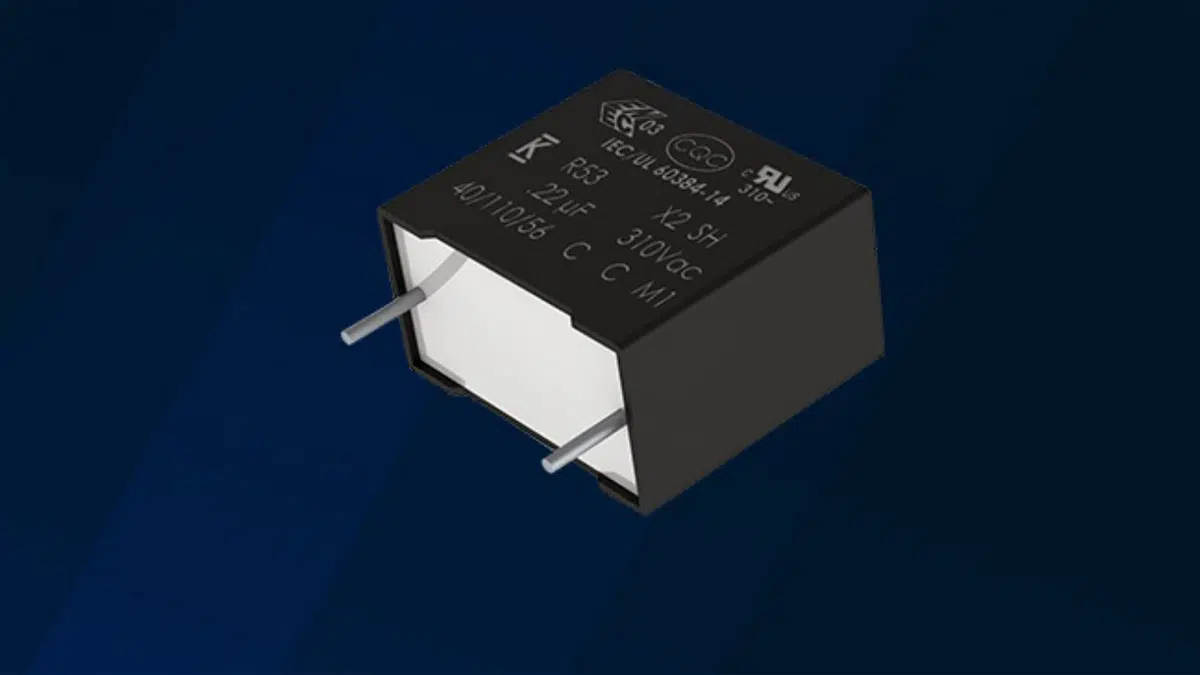
Meeting the emission requirements of regulatory agencies becomes more and more complex for the designers, and EMI suppression capacitors play a crucial role. They are required to be miniaturized, but at the same time meet high-reliability requirements under critical electrical and environmental conditions. Kemet application note shows polypropylene (PP) film capacitor (KEMET R53 series) design considerations in OBC EMI input filter as a typical application example.

One of the most enduring trends in the electronics industry is miniaturization. Power electronic designers are targeting to increase conversion efficiency by using WBG semiconductor devices. WBG devices can operate at high switching frequencies and high temperatures. Their use allows reducing the size of passive components bringing an overall more compact design and increasing power density volumes of the converters, thus making miniaturization mandatory. WBG devices also operate with extremely high voltage slew rates producing more high-frequency emissions.

RelatedPosts

Tantalum Capacitor History

Understanding the Influence of ESR and Ripple Current for the Capacitor Selection

Resonant OBC Capacitors

If electronic components are required to be more and more miniaturized, most of the applications linked to the latest market trends face the challenge of operating under severe environmental conditions without compromising on reliability and long life.

One perfect example is represented by the onboard charger (OBC) application below – see Figure 1.
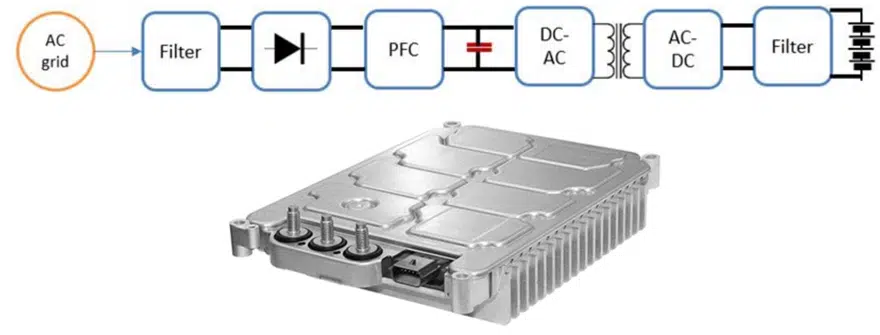
Figure 1. Typical onboard charger (OBC) block design

Designers need to ensure that their products pass the THB evaluation. Emission certification has encountered several challenges. In some applications like the Onboard Charger, many EMI capacitors are required in the input stage to meet the emission requirements. Space is always limited in these applications, and designers are looking for miniaturized capacitors that meet the requirements of the AEC-Q200 and the THB highest grades.

PP Film Capacitors Capabilities in Harsh Environmental Conditions

A well-accepted accelerated life test standard for active and passive components in the electronics industry is the Temperature-Humidity-Bias (THB) test, with levels of 85°C and 85% relative humidity under AC or DC bias conditions. For many years, designers in various industries (including automotive, energy, consumer, and industrial) have used this test to ascertain the reliability of their final products for up to 25 years of operation under severe climatic conditions. More recently, the THB test has been recognized as an IEC standard for EMI suppression film capacitors. The capacitor manufacturers must indicate the THB category for their certified solutions.

The table below shows the different Temperature-Humidity-Bias (THB) testing conditions per IEC Standard.
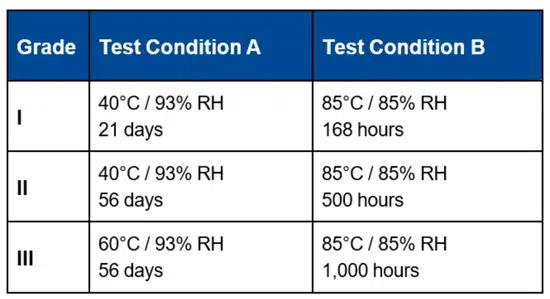
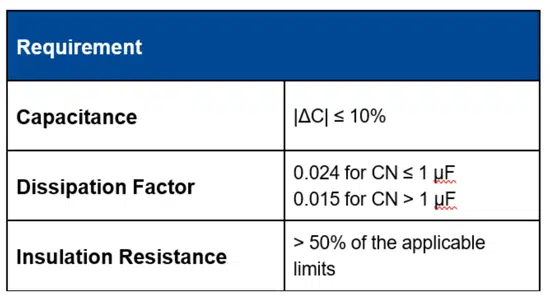
Table 1: 60384-14 Am. 1 Ed.4 Fixed capacitors, .2 Humidity Robustness Grades
Table 2: Capacitance, Dissipation Factor, and Insulation Resistance requirements

PP Film Capacitor KEMET R53 X2 series exceeds previous solutions and meets the IEC-60384-14 humidity robustness test with a Class IIIB classification. R53 achieves 1,000 hours during an accelerated life test under 85°C and 85% relative humidity at its rated AC (310 Vac) and DC (560Vdc) voltages.

Application Example

In the following example, we analyze the requirements of X2 rated capacitors for the input EMI filter of a 3-phase 11 kW OBC. The customer has designed a multi-stage input EMI filter with nine X2 capacitors – see Figure 2.
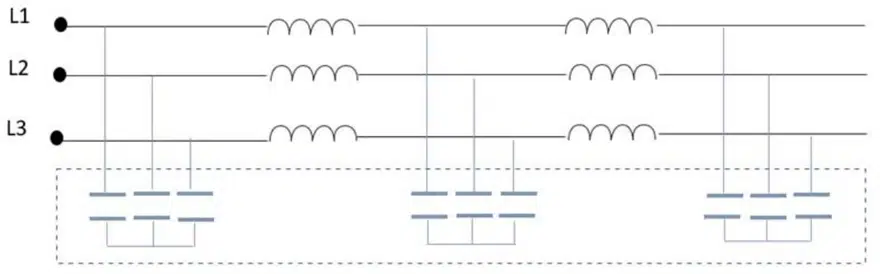
Figure 2. Multi-stage input EMI filter with nine X2 capacitors

The capacitance required is 4.7 μF for every capacitor. The voltage applied across the capacitors during operation is 240 Vac at 50 Hz.During operation, the maximum ambient temperature is 100°C, and the ripple current is 2 A at a frequency of 60 kHz. Due to the high reliability required, customers need an AECQ-200 and THB Grade IIIB qualified solution. The tolerance of the capacitance is required to be ±10%. One additional requirement is a free or low halogen content solution.

Miniature metallized polypropylene film capacitor encapsulated with self-extinguishing resin, KEMET R53 X2 310 Vac series is the ideal choice for this application. More precisely, the PN R533R447000P2K meets the requirements for capacitance, tolerance and has a low halogen content.

To verify the current capability of the selected solution, customers can use the KEMET online simulation tool, KSIM. The ambient temperature can be set at 100°C, as per the worst-case application scenario.

As it is visible on the KSIM Ripple Voltage and Current plot below in Figure 3., the ripple current capability of the R533R447000P2K exceeds the design’s required value of 2 A at the frequency of 60 kHz and the ambient temperature of 100°C.
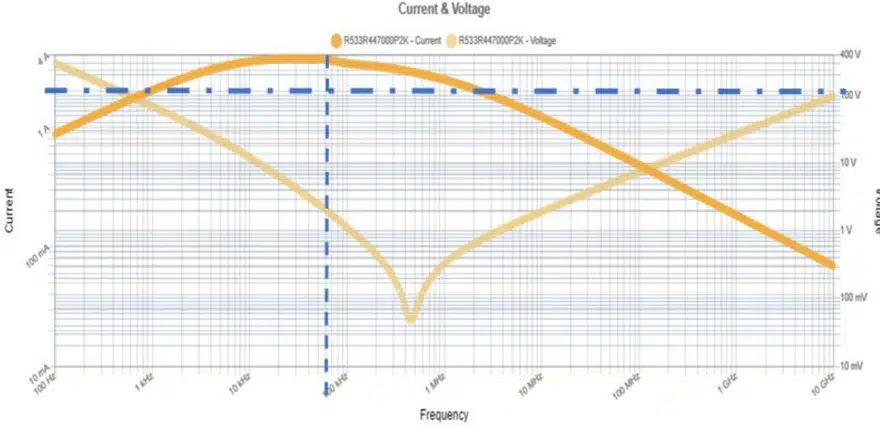
Figure 3. KSIM ripple voltage and current of the R533R447000P2K PP film capacitor

Additionally, it is essential to underline that the R53 solution occupies 25% less PCB area than similar solutions from the competition.

Summary

In the above example, we analyzed how the polypropylene film capacitors – specifically the KEMET R53 series – can meet the highest THB class in a miniaturized size. These key characteristics bring significant advantages to the designers in terms of space occupation on the board. Additionally, the R53 AEC-Q200 qualification makes this series an ideal EMI suppression solution for automotive applications.

Related

Source: KEMET

Recent Posts

Tantalum Capacitor Anode Manufacturing Quality Management

23.3.2026
4

Middle East Conflict: The Potential Impact to Passive Components

23.3.2026
50

Designing a 2 kW LLC Transformer with Integrated Resonant Inductor

20.3.2026
22

Inductor Technology Dossier

19.3.2026
39

Coilcraft Releases TLVR Inductors for High Density VRMs and PoL Converters

19.3.2026
32

Murata to Decouple China Rare Earth Supply in 3 Years

19.3.2026
138
Schematic illustration of the electric double layer of porous carbon electrodes at elevated potentials in a a conventional electrolyte and b a weakly solvating electrolyte; source: authors

Researchers Presented Lignin-based Electrolyte for 4V Supercapacitors with Low Self‑Discharge

19.3.2026
22

Samsung Outlines Growth Roadmap at its 52nd General Shareholders Meeting

19.3.2026
21

Samsung Electro-Mechanics Enters LEO Satellite Market With High‑Reliability MLCCs

19.3.2026
24

Upcoming Events

Mar 24
9:00 - 10:00 CET

Power protection in the digital age – eFuse and hot-swap strategies for modern data center design

Apr 21
16:00 - 17:00 CEST

Heatsink Solutions: Thermal Management in electronic devices

May 5
16:00 - 17:00 CEST

Understanding and Selecting Capacitors – Fundamentals, Technologies and Latest Trends

View Calendar

Popular Posts

  • Buck Converter Design and Calculation

    0 shares
    Share 0 Tweet 0
  • Boost Converter Design and Calculation

    0 shares
    Share 0 Tweet 0
  • Flyback Converter Design and Calculation

    0 shares
    Share 0 Tweet 0
  • LLC Resonant Converter Design and Calculation

    0 shares
    Share 0 Tweet 0
  • MLCC Manufacturers Consider Price Increase as AI Demand Outpaces Supply

    0 shares
    Share 0 Tweet 0
  • MLCC and Ceramic Capacitors

    0 shares
    Share 0 Tweet 0
  • Dual Active Bridge (DAB) Topology

    0 shares
    Share 0 Tweet 0
  • Ripple Current and its Effects on the Performance of Capacitors

    3 shares
    Share 3 Tweet 0
  • MLCC Case Sizes Standards Explained

    0 shares
    Share 0 Tweet 0
  • What is a Dielectric Constant and DF of Plastic Materials?

    4 shares
    Share 4 Tweet 0

Newsletter Subscription


Passive Components Blog

© EPCI - Leading Passive Components Educational and Information Site

  • Home
  • Privacy Policy
  • EPCI Membership & Advertisement
  • About

No Result
View All Result
  • Home
  • Knowledge Blog
  • PCNS

© EPCI - Leading Passive Components Educational and Information Site

This website uses cookies. By continuing to use this website you are giving consent to cookies being used. Visit our Privacy and Cookie Policy.
Go to mobile version