




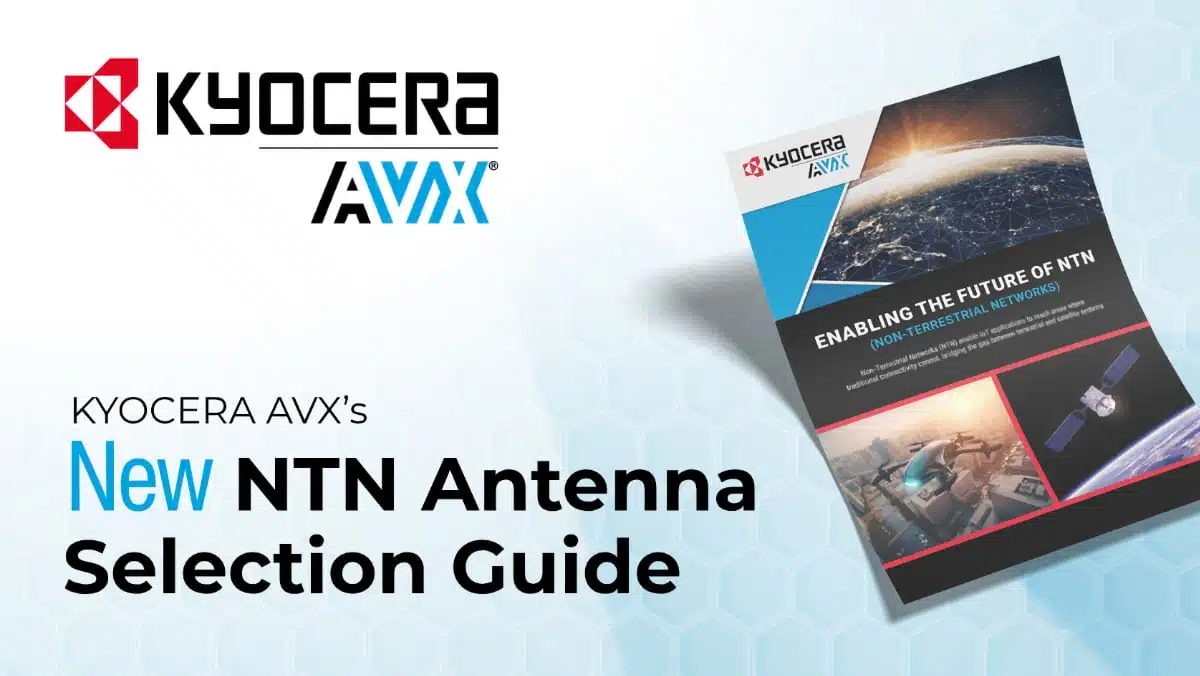
Non‑terrestrial networks (NTN) are rapidly becoming a core connectivity option for IoT and wireless devices operating beyond the reach of terrestrial cellular networks. KYOCERA AVX’s new NTN antenna brochure consolidates its satellite‑focused antenna portfolio and provides a structured way to select suitable solutions for GEO, LEO and hybrid network environments.
This guide shows how design and purchasing teams can use that brochure effectively as a practical antenna selection tool.
Understanding your NTN use case
Before opening the brochure, clarify the basic system context; this will drive all antenna choices.
- Target orbit and service: GEO, LEO, or hybrid satellite network, and whether connectivity is primary or backup.
- Coverage scenario: stationary, mobile, or mixed operation, and typical device orientation relative to the sky.
- Regulatory and commercial constraints: supported satellite services, regional regulations and cost targets.
With these points defined, the brochure can be used to narrow down antenna candidates that match the required networks and operating conditions, rather than starting from a purely component‑level view.
Using the KYOCERA AVX NTN brochure as a selection tool
The KYOCERA AVX NTN literature is published as an interactive flipbook and is intended as the central reference for antenna selection and integration for satellite‑enabled IoT devices. It highlights the antenna portfolio and design expertise, focusing on parameters that matter directly for NTN link reliability and device efficiency.
How to navigate the brochure efficiently
- Start at the overview pages to understand the supported NTN scenarios (GEO, LEO, hybrid) and the main antenna families.
- Use section headings and navigation to jump to antennas grouped by application or form factor that matches your device concept.
- Note references to gain, bandwidth and polarization in each family; these parameters are the foundation for comparing options and building your link budget.
For purchasing teams, the brochure provides a top‑level map of KYOCERA AVX’s NTN antenna offerings, which can be cross‑checked with component search tools and distributor listings during sourcing.
Key performance parameters and what they mean
There are three primary antenna parameters: gain, bandwidth and polarization. These are central to antenna selection in NTN designs context.
Gain
Antenna gain describes how effectively the antenna directs radiated energy in space.
- Higher gain can improve received signal strength at the satellite and reduce required transmit power in the device.
- Directional gain is useful when device orientation and satellite position are well defined, while more omnidirectional patterns may be preferred for mobile or randomly oriented devices.
- When reading the brochure, use gain values in conjunction with radiation pattern notes to judge whether an antenna matches your expected device orientation and usage profile.
Exact gain values and radiation plots are “according to manufacturer datasheet” and should be taken from the detailed technical documentation linked from the brochure.
Bandwidth
Bandwidth defines the range of frequencies over which the antenna maintains acceptable performance.
- Sufficient bandwidth is needed to cover the allocated satellite uplink and downlink bands.
- Multi‑constellation or multi‑service devices may require broader operating ranges or distinct antenna options.
- In the brochure, look for bandwidth indications relative to specific NTN services; this helps avoid mismatches where an antenna fits mechanically but does not fully cover the required bands.
For designs that combine satellite and terrestrial connectivity, bandwidth and matching strategy must accommodate both, and the brochure can help identify antenna families suited to such hybrid operation.
Polarization
Polarization describes the orientation of the electromagnetic field from the antenna.
- Matching polarization with the satellite system improves link robustness and reduces fading.
- Incorrect polarization can lead to significant real‑world loss even if gain and bandwidth appear sufficient on paper.
- When reviewing the NTN literature, pay attention to polarization notes and any guidance on compatibility with specific GEO, LEO or hybrid network architectures.
As with other parameters, exact polarization details and recommended use cases remain specified in individual datasheets and application notes referenced by the brochure.
Typical NTN antenna applications
NTN antennas are suitable for a broad range of satellite‑enabled IoT and wireless products. From a selection perspective, each application class maps to distinct constraints.
- Remote sensing and monitoring nodes: Often stationary or semi‑fixed, with opportunities for careful antenna placement and clear sky view.
- Asset tracking and logistics devices: Mobile, orientation‑agnostic, and frequently size‑constrained, requiring compact antennas with stable performance across changing environments.
- Mission‑critical communication and safety systems: Require high link reliability and redundancy, with antennas selected for robustness and consistent performance under harsh conditions.
- General IoT devices with satellite fallback: Combine terrestrial and satellite links, using antenna solutions that can coexist on the PCB and within the enclosure without excessive coupling.
Practical selection workflow
The following step‑by‑step workflow aligns typical engineering practice for NTN antenna design-in.
Step 1 – Define system and link requirements
- Specify satellite service providers, frequency bands and required data rates.
- Determine whether the satellite link is continuous or event‑driven (e.g., periodic telemetry bursts).
- Estimate link margin targets, including allowances for environmental losses and device orientation.
Step 2 – Use the brochure to shortlist antenna families
- Open the NTN flipbook and locate the sections relevant to your orbit type and application.
- Record antenna families whose gain, bandwidth and polarization align with your preliminary link budget.
- Filter out options that clearly conflict with mechanical or environmental constraints, such as size or operating environment.
Step 3 – Consult detailed datasheets and tools
- For each shortlisted family, access the corresponding datasheet via KYOCERA AVX’s component search or brochure links.
- Confirm electrical characteristics, mechanical dimensions and recommended matching networks.
- Use available design tools and simulation resources, where provided, to estimate performance in your PCB and enclosure context.
Step 4 – Prototype and measure
- Select one or more candidate antennas for prototype builds.
- Measure key parameters such as return loss and radiation pattern in representative device configurations.
- Compare measured performance with expectations based on brochure and datasheet data, and iterate if needed.
For purchasing and component engineering teams, these steps can be mirrored with a focus on supplier availability, lead times and qualification status.
Aligning requirements with parameters
The following table summarizes how core NTN system requirements translate into antenna parameters.
| System requirement | Relevant brochure parameter | Practical implication for selection |
|---|---|---|
| Target satellite bands | Bandwidth | Ensure antenna covers uplink and downlink bands defined by the service. |
| Required link margin | Gain | Higher gain may reduce device transmit power or increase margin. |
| Device orientation and motion | Radiation pattern & gain | Choose directional or more omnidirectional patterns based on motion profile. |
| Network architecture (GEO/LEO/hybrid) | Polarization & coverage notes | Match polarization and design notes to the chosen network topology. |
| Mechanical envelope | Form factor & dimensions | Select antennas that fit enclosure and keep‑out areas without compromising performance. |
Use this table as a quick checklist while navigating the brochure, to ensure that shortlisted antennas are aligned with real system constraints rather than only headline specifications.
Design‑in notes for engineers
From a practical design standpoint, the NTN literature is most effective when combined with sound RF layout and system‑level planning.
- Reserve antenna placement and ground clearance early in the mechanical design, guided by recommendations in the brochure and related documentation.
- Keep matching network components close to the antenna feed as suggested by typical layouts, and follow any guidance on stack‑up and ground plane segmentation.
- Consider coexistence with other radios (cellular, Wi‑Fi, GNSS) and passive components, using the brochure to select antenna structures that minimize coupling in your chosen form factor.
- Validate performance in both controlled lab environments and realistic usage scenarios; satellite links are sensitive to orientation and obstructions that may not appear in idealized tests.
When in doubt, refer back to the NTN brochure sections on integration capabilities and design support, and coordinate with KYOCERA AVX’s technical contacts for project‑specific guidance.
Source
This selection guide is based on the KYOCERA AVX press information announcing the “Enabling the Future of NTN” antenna literature and the associated interactive brochure, used as the primary technical reference.