






Passive Components Blog
No Result
View All Result
  • Home
  • NewsFilter
    • All
    • Aerospace & Defence
    • Antenna
    • Applications
    • Automotive
    • Capacitors
    • Circuit Protection Devices
    • electro-mechanical news
    • Filters
    • Fuses
    • Inductors
    • Industrial
    • Integrated Passives
    • inter-connect news
    • Market & Supply Chain
    • Market Insights
    • Medical
    • Modelling and Simulation
    • New Materials & Supply
    • New Technologies
    • Non-linear Passives
    • Oscillators
    • Passive Sensors News
    • Resistors
    • RF & Microwave
    • Telecommunication
    • Weekly Digest

    Littelfuse Unveils Ultra-Low-Power TMR Magnetic Switches

    DC/DC Push‑Pull Converter vs PSFB Design Guide

    Wk 2 Electronics Supply Chain Digest

    Rubycon PMLCAP DC‑Link Film Capacitors in Mass Production

    Bourns SSD‑1000A AEC‑Q Digital Current Sensors

    YAGEO High‑Capacitance X7R Automotive MLCC Extensions

    How Metal Prices Are Driving Passive Component Price Hikes

    Modelithics COMPLETE Library v25.8 for Keysight ADS

    Taiyo Yuden Releases 165C Automotive Multilayer Metal Power Inductor in 1608 Size

    Trending Tags

    • Ripple Current
    • RF
    • Leakage Current
    • Tantalum vs Ceramic
    • Snubber
    • Low ESR
    • Feedthrough
    • Derating
    • Dielectric Constant
    • New Products
    • Market Reports
  • VideoFilter
    • All
    • Antenna videos
    • Capacitor videos
    • Circuit Protection Video
    • Filter videos
    • Fuse videos
    • Inductor videos
    • Inter-Connect Video
    • Non-linear passives videos
    • Oscillator videos
    • Passive sensors videos
    • Resistor videos

    One‑Pulse Characterization of Nonlinear Power Inductors

    Thermistor Linearization Challenges

    Coaxial Connectors and How to Connect with PCB

    PCB Manufacturing, Test Methods, Quality and Reliability

    Transformer Behavior – Current Transfer and Hidden Feedback

    Choosing the Right Capacitor: The Importance of Accurate Measurements

    RF Inductors: Selection and Design Challenges for High-Frequency Circuits

    Transformer Safety IEC 61558 Standard

    3-Phase EMI Filter Design, Simulation, Calculation and Test

    Trending Tags

    • Capacitors explained
    • Inductors explained
    • Resistors explained
    • Filters explained
    • Application Video Guidelines
    • EMC
    • New Products
    • Ripple Current
    • Simulation
    • Tantalum vs Ceramic
  • Knowledge Blog
  • Suppliers
    • Who is Who
  • PCNS
    • PCNS 2025
    • PCNS 2023
    • PCNS 2021
    • PCNS 2019
    • PCNS 2017
  • Events
  • Home
  • NewsFilter
    • All
    • Aerospace & Defence
    • Antenna
    • Applications
    • Automotive
    • Capacitors
    • Circuit Protection Devices
    • electro-mechanical news
    • Filters
    • Fuses
    • Inductors
    • Industrial
    • Integrated Passives
    • inter-connect news
    • Market & Supply Chain
    • Market Insights
    • Medical
    • Modelling and Simulation
    • New Materials & Supply
    • New Technologies
    • Non-linear Passives
    • Oscillators
    • Passive Sensors News
    • Resistors
    • RF & Microwave
    • Telecommunication
    • Weekly Digest

    Littelfuse Unveils Ultra-Low-Power TMR Magnetic Switches

    DC/DC Push‑Pull Converter vs PSFB Design Guide

    Wk 2 Electronics Supply Chain Digest

    Rubycon PMLCAP DC‑Link Film Capacitors in Mass Production

    Bourns SSD‑1000A AEC‑Q Digital Current Sensors

    YAGEO High‑Capacitance X7R Automotive MLCC Extensions

    How Metal Prices Are Driving Passive Component Price Hikes

    Modelithics COMPLETE Library v25.8 for Keysight ADS

    Taiyo Yuden Releases 165C Automotive Multilayer Metal Power Inductor in 1608 Size

    Trending Tags

    • Ripple Current
    • RF
    • Leakage Current
    • Tantalum vs Ceramic
    • Snubber
    • Low ESR
    • Feedthrough
    • Derating
    • Dielectric Constant
    • New Products
    • Market Reports
  • VideoFilter
    • All
    • Antenna videos
    • Capacitor videos
    • Circuit Protection Video
    • Filter videos
    • Fuse videos
    • Inductor videos
    • Inter-Connect Video
    • Non-linear passives videos
    • Oscillator videos
    • Passive sensors videos
    • Resistor videos

    One‑Pulse Characterization of Nonlinear Power Inductors

    Thermistor Linearization Challenges

    Coaxial Connectors and How to Connect with PCB

    PCB Manufacturing, Test Methods, Quality and Reliability

    Transformer Behavior – Current Transfer and Hidden Feedback

    Choosing the Right Capacitor: The Importance of Accurate Measurements

    RF Inductors: Selection and Design Challenges for High-Frequency Circuits

    Transformer Safety IEC 61558 Standard

    3-Phase EMI Filter Design, Simulation, Calculation and Test

    Trending Tags

    • Capacitors explained
    • Inductors explained
    • Resistors explained
    • Filters explained
    • Application Video Guidelines
    • EMC
    • New Products
    • Ripple Current
    • Simulation
    • Tantalum vs Ceramic
  • Knowledge Blog
  • Suppliers
    • Who is Who
  • PCNS
    • PCNS 2025
    • PCNS 2023
    • PCNS 2021
    • PCNS 2019
    • PCNS 2017
  • Events
No Result
View All Result
Passive Components Blog
No Result
View All Result

Evaluation and Modeling of Supercapacitors for Reliability of Lifetime Predictions

4.8.2025
Reading Time: 3 mins read
A A

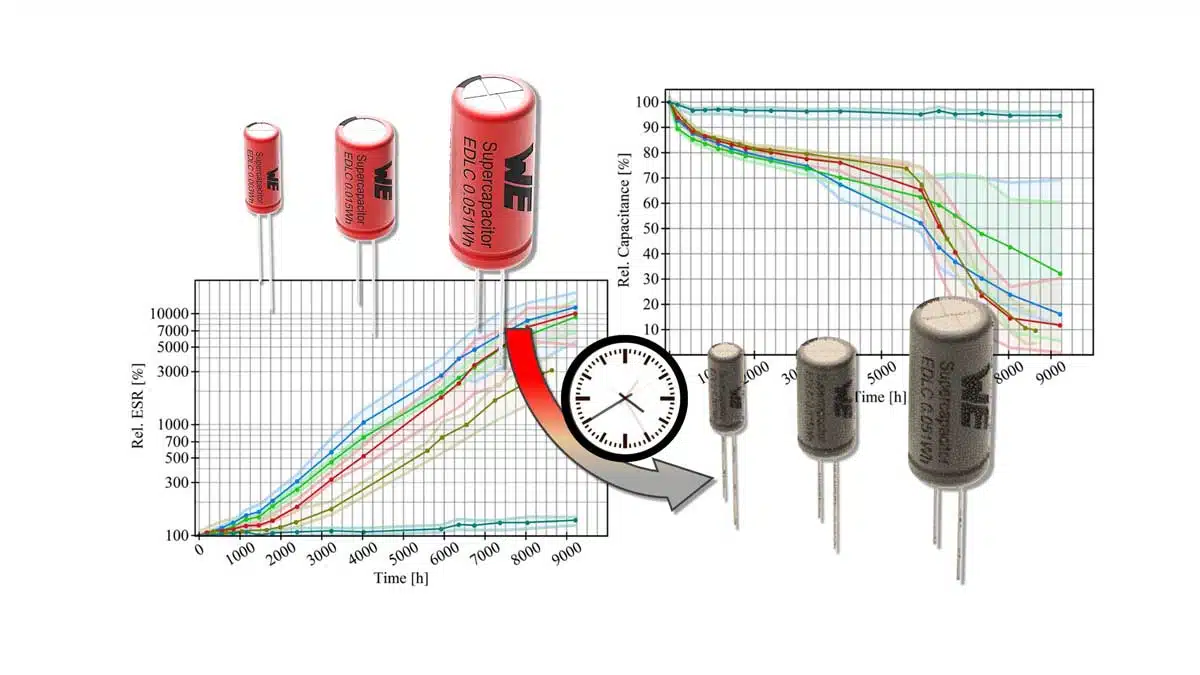
This article written by René Kalbitz, Würth Elektronik published by Intelligent and Sustainable Manufacturing Journal, discussed evaluation and modeling of long-term endurance measurement on electric double layer supercapacitors to increase reliability of its lifetime predictions.

ABSTRACT: Sustainability in the electrical industry and product reliability are fundamentally dependent on product lifetime predictions. Long-term DC voltage endurance measurements at two different temperatures on various commercial electric double-layer supercapacitors are presented, discussed, and used to develop a deterioration model suitable for estimating lifetime.

RelatedPosts

Coaxial Connectors and How to Connect with PCB

PCB Manufacturing, Test Methods, Quality and Reliability

Würth Elektronik Extends its Safety Film Capacitors

Capacitors were tested under constant voltage for approximately 1 year at 65 °C and about 4 years at room temperature. To describe the deterioration in terms of capacitance and the ESR equivalent series resistance, a phenomenological model is proposed and tested against measurements taken at room temperature. The proposed model is based on a general exponential relation with a time-dependent deterioration rate.

The model is tested against long-term measurements with constant and time-dependent temperature acceleration factors. Analysis of capacitance and equivalent series resistance measurements shows a time or deterioration dependence in the temperature acceleration factor and different phases of deterioration.

Key Points

  • Importance of product lifetime predictions for sustainability and reliability.
  • Long-term DC voltage endurance tests conducted at 65°C and room temperature.
  • Development of a phenomenological model to describe deterioration.
  • Model tested against long-term measurements with both constant and time-dependent temperature acceleration factors.
  • Analysis includes capacitance and equivalent series resistance (ESR) measurements.

Extended Summary

The reliability and sustainability of products in the electrical industry are critically dependent on the ability to predict product lifetimes accurately. This study focuses on electric double-layer capacitors (EDLCs), which have been subjected to long-term DC voltage endurance testing at two different temperatures: approximately one year at 65°C and around four years at room temperature. These endurance tests help understand the deterioration mechanisms of capacitors under stress.

To quantify deterioration, the study proposes a phenomenological model that describes changes in capacitance and equivalent series resistance (ESR) over time. This model is grounded in a general exponential relationship with a time-dependent deterioration rate, allowing it to account for the complex dynamics of capacitor aging. The model’s validation involves comparing its predictions against actual measurements taken at room temperature, providing insights into its accuracy and reliability.

The study also explores the impact of temperature on the deterioration process. The model incorporates temperature acceleration factors, both constant and time-dependent, to evaluate how temperature influences degradation rates. Measurements of capacitance and ESR reveal that the temperature acceleration factor itself changes over time, indicating different phases of deterioration. This time or deterioration dependence highlights the need for models that can adapt to changing conditions rather than relying on static assumptions.

Conclusion

This article underscores the importance of accurate lifetime prediction models for electric double-layer capacitors to enhance sustainability and reliability in the electrical industry. The proposed phenomenological model offers a robust framework for estimating capacitor lifespan, accounting for both constant and variable temperature effects. By validating the model through long-term endurance tests, the study provides valuable insights into the deterioration mechanisms of capacitors, paving the way for more reliable electronic products.

Read the full paper online:

Evaluation and Modeling of Long-Term Endurance Measurement on Electric Double Layer Capacitors to Increase Reliability of Lifetime Predictions; René Kalbitz, Intell. Sustain. Manuf. 2025, 2(2), 10023; DOI: 10.70322/ism.2025.10023
Related

Source: Intell.Sustain. Manuf.

Recent Posts

DC/DC Push‑Pull Converter vs PSFB Design Guide

12.1.2026
24

Rubycon PMLCAP DC‑Link Film Capacitors in Mass Production

9.1.2026
33

YAGEO High‑Capacitance X7R Automotive MLCC Extensions

8.1.2026
46

How Metal Prices Are Driving Passive Component Price Hikes

8.1.2026
230

Modelithics COMPLETE Library v25.8 for Keysight ADS

7.1.2026
29

Energy-Controlled Structural Evolution of Amorphous Ta₂O₅ in Tantalum Anodes

6.1.2026
45

Jianghai Vibration‑Resistant Aluminum Capacitors Guidelines for Industrial Electronics

6.1.2026
29

2025 Top Passive Components Blog Articles

5.1.2026
104
Credit: Institute of Science Tokyo

Researchers Demonstrated 30nm Ferroelectric Capacitor for Compact Memory

2.1.2026
36

Upcoming Events

Jan 27
16:00 - 17:00 CET

Simplifying Vehicle Development with Automotive Ethernet and Zonal Smart Switch Technologies

Feb 24
16:00 - 17:00 CET

Designing Qi2 Wireless Power Systems: Practical Development and EMC Optimization

View Calendar

Popular Posts

  • Buck Converter Design and Calculation

    0 shares
    Share 0 Tweet 0
  • Boost Converter Design and Calculation

    0 shares
    Share 0 Tweet 0
  • LLC Resonant Converter Design and Calculation

    0 shares
    Share 0 Tweet 0
  • Flyback Converter Design and Calculation

    0 shares
    Share 0 Tweet 0
  • Ripple Current and its Effects on the Performance of Capacitors

    3 shares
    Share 3 Tweet 0
  • MLCC and Ceramic Capacitors

    0 shares
    Share 0 Tweet 0
  • Dual Active Bridge (DAB) Topology

    0 shares
    Share 0 Tweet 0
  • What Electronics Engineer Needs to Know About Passive Low Pass Filters

    0 shares
    Share 0 Tweet 0
  • SEPIC Converter Design and Calculation

    0 shares
    Share 0 Tweet 0
  • What is a Dielectric Constant and DF of Plastic Materials?

    4 shares
    Share 4 Tweet 0

Newsletter Subscription


Passive Components Blog

© EPCI - Leading Passive Components Educational and Information Site

  • Home
  • Privacy Policy
  • EPCI Membership & Advertisement
  • About

No Result
View All Result
  • Home
  • Knowledge Blog
  • PCNS

© EPCI - Leading Passive Components Educational and Information Site

This website uses cookies. By continuing to use this website you are giving consent to cookies being used. Visit our Privacy and Cookie Policy.
Go to mobile version