





Passive Components Blog
No Result
View All Result
  • Home
  • NewsFilter
    • All
    • Aerospace & Defence
    • Antenna
    • Applications
    • Automotive
    • Capacitors
    • Circuit Protection Devices
    • electro-mechanical news
    • Filters
    • Fuses
    • Inductors
    • Industrial
    • Integrated Passives
    • inter-connect news
    • Market & Supply Chain
    • Market Insights
    • Medical
    • Modelling and Simulation
    • New Materials & Supply
    • New Technologies
    • Non-linear Passives
    • Oscillators
    • Passive Sensors News
    • Resistors
    • RF & Microwave
    • Telecommunication
    • Weekly Digest

    binder Releases Tool‑Tightenable M12 Connectors for Improved Reliability

    Vishay Introduced Thin Film Submount Platform for Optical and RF Modules

    Murata Introduces Crystal and NTC Set for Automotive UWB Timing

    Kyocera Developed Multilayer Ceramic Core Substrate for AI Packages

    Modeling Fringing Field Losses in Inductors & Transformers

    YMIN Introduces Polymer Tantalum Capacitors for AI Server SSDs

    Littelfuse Expands High-Voltage TVS Diodes

    DigiKey Adds 31k New In‑Stock Parts in Q1 2026

    Miniaturization of Tantalum Capacitors: Structural Limit Under Constant Rating

    Trending Tags

    • Ripple Current
    • RF
    • Leakage Current
    • Tantalum vs Ceramic
    • Snubber
    • Low ESR
    • Feedthrough
    • Derating
    • Dielectric Constant
    • New Products
    • Market Reports
  • VideoFilter
    • All
    • Antenna videos
    • Capacitor videos
    • Circuit Protection Video
    • Filter videos
    • Fuse videos
    • Inductor videos
    • Inter-Connect Video
    • Non-linear passives videos
    • Oscillator videos
    • Passive sensors videos
    • Resistor videos

    Modeling Fringing Field Losses in Inductors & Transformers

    Why Power Inductors Use a Ferrite Core With an Air Gap

    Transformer-Based Power-Line Harvester Magnetic Design

    Thermal Modeling of Magnetics

    Standard vs Planar LLC transformers Comparison for Battery Chargers

    How Modern Tools Model Magnetic Components for Power Electronics

    Advanced Loss Modeling for Planar Magnetics in the Frenetic Planar Tool

    2026 Power Magnetics Design Trends: Flyback, DAB and Planar

    Enabling Software‑Defined Vehicle Architectures: Automotive Ethernet and Zonal Smart Power

    Trending Tags

    • Capacitors explained
    • Inductors explained
    • Resistors explained
    • Filters explained
    • Application Video Guidelines
    • EMC
    • New Products
    • Ripple Current
    • Simulation
    • Tantalum vs Ceramic
  • Knowledge Blog
  • DossiersNew
  • Suppliers
    • Who is Who
  • PCNS
    • PCNS 2025
    • PCNS 2023
    • PCNS 2021
    • PCNS 2019
    • PCNS 2017
  • Events
  • Home
  • NewsFilter
    • All
    • Aerospace & Defence
    • Antenna
    • Applications
    • Automotive
    • Capacitors
    • Circuit Protection Devices
    • electro-mechanical news
    • Filters
    • Fuses
    • Inductors
    • Industrial
    • Integrated Passives
    • inter-connect news
    • Market & Supply Chain
    • Market Insights
    • Medical
    • Modelling and Simulation
    • New Materials & Supply
    • New Technologies
    • Non-linear Passives
    • Oscillators
    • Passive Sensors News
    • Resistors
    • RF & Microwave
    • Telecommunication
    • Weekly Digest

    binder Releases Tool‑Tightenable M12 Connectors for Improved Reliability

    Vishay Introduced Thin Film Submount Platform for Optical and RF Modules

    Murata Introduces Crystal and NTC Set for Automotive UWB Timing

    Kyocera Developed Multilayer Ceramic Core Substrate for AI Packages

    Modeling Fringing Field Losses in Inductors & Transformers

    YMIN Introduces Polymer Tantalum Capacitors for AI Server SSDs

    Littelfuse Expands High-Voltage TVS Diodes

    DigiKey Adds 31k New In‑Stock Parts in Q1 2026

    Miniaturization of Tantalum Capacitors: Structural Limit Under Constant Rating

    Trending Tags

    • Ripple Current
    • RF
    • Leakage Current
    • Tantalum vs Ceramic
    • Snubber
    • Low ESR
    • Feedthrough
    • Derating
    • Dielectric Constant
    • New Products
    • Market Reports
  • VideoFilter
    • All
    • Antenna videos
    • Capacitor videos
    • Circuit Protection Video
    • Filter videos
    • Fuse videos
    • Inductor videos
    • Inter-Connect Video
    • Non-linear passives videos
    • Oscillator videos
    • Passive sensors videos
    • Resistor videos

    Modeling Fringing Field Losses in Inductors & Transformers

    Why Power Inductors Use a Ferrite Core With an Air Gap

    Transformer-Based Power-Line Harvester Magnetic Design

    Thermal Modeling of Magnetics

    Standard vs Planar LLC transformers Comparison for Battery Chargers

    How Modern Tools Model Magnetic Components for Power Electronics

    Advanced Loss Modeling for Planar Magnetics in the Frenetic Planar Tool

    2026 Power Magnetics Design Trends: Flyback, DAB and Planar

    Enabling Software‑Defined Vehicle Architectures: Automotive Ethernet and Zonal Smart Power

    Trending Tags

    • Capacitors explained
    • Inductors explained
    • Resistors explained
    • Filters explained
    • Application Video Guidelines
    • EMC
    • New Products
    • Ripple Current
    • Simulation
    • Tantalum vs Ceramic
  • Knowledge Blog
  • DossiersNew
  • Suppliers
    • Who is Who
  • PCNS
    • PCNS 2025
    • PCNS 2023
    • PCNS 2021
    • PCNS 2019
    • PCNS 2017
  • Events
No Result
View All Result
Passive Components Blog
No Result
View All Result

Fluorescence Microscopy + dye penetrant test on EEE Parts

1.10.2018
Reading Time: 4 mins read
A A

Source: Alter Technology article

by Francisco Javier Aparicio Rebollo
The Fluorescence Microscopy + dye penetrant test is a technique that combines two inspection methods commonly used for the detection of surface anomalies such as cracks, porosity, laps, delaminations, and other discontinuities.

RelatedPosts

binder Releases Tool‑Tightenable M12 Connectors for Improved Reliability

Vishay Introduced Thin Film Submount Platform for Optical and RF Modules

Murata Introduces Crystal and NTC Set for Automotive UWB Timing

This joint approach is intended to highlight and resolve surface anomalies thanks to the irreversible infiltration with a fluorescent marker. Hence, fluorescent-based inspection methods are mandatory or highly recommended by different international regulations and reference books for space materials in the case of non-porous surfaces: ASTM international (ASTM E1417), MIL-STD standards MIL-STD-750 and MIL-STD-833 (USA Defense and Logistics Agency) and “Materials and Processes for Spacecraft and High Reliability Applications” (Barrie Dunn, Springer 2015).

Other characteristics of the technique are:

  • Non-destructive character.
  • Cost effective.
  • Requires sample preparation.
  • Higher sensitivity than conventional optical-microscopy methods.

Practical examples.
Main advantages of the technique lie on the dual specificity of the fluorescence phenomena which is exclusively activated under specific illumination wavelength (excitation light colour) and provides wavelength-specific light emission (specific emission colour). This allows us to unambiguously identify surface anomalies difficult to be resolved by naked-eye inspection. Due to the simplicity, the non-destructive character and the high sensitivity both conventional dye penetration test and the fluorescent microscopy dye-penetration test are commonly used not only in the space and aerospace sectors but also in other fields requiring of completely crack free materials such as oil and gas industry and power generation.

In Alter Technology dye penetrant testes are routinely used to verify the hermeticity of EEE parts by visual fluorescence inspection.

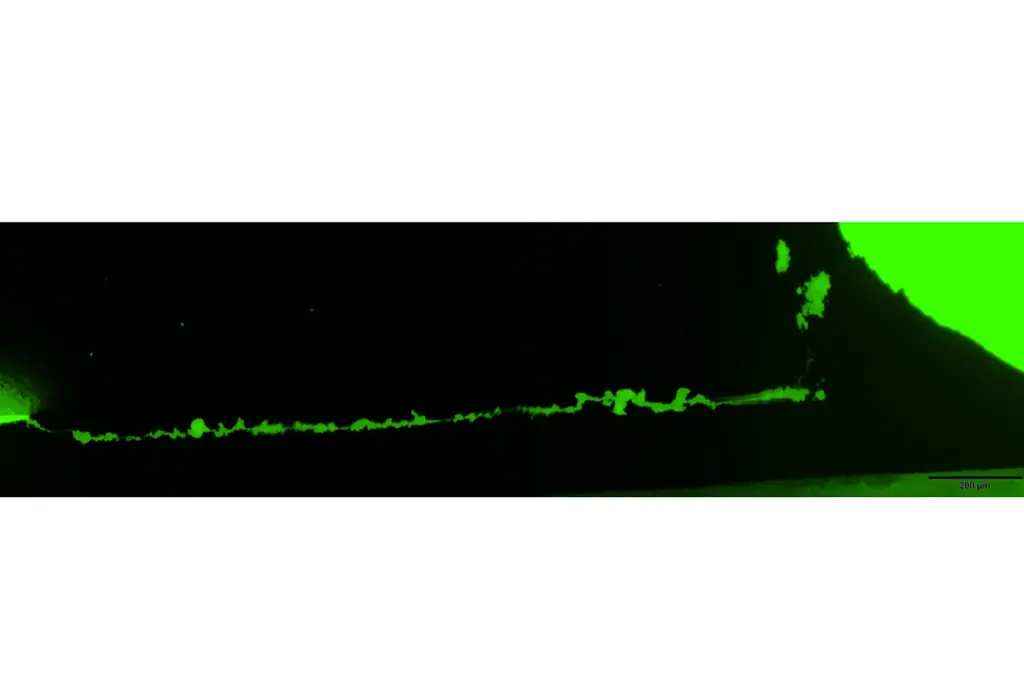
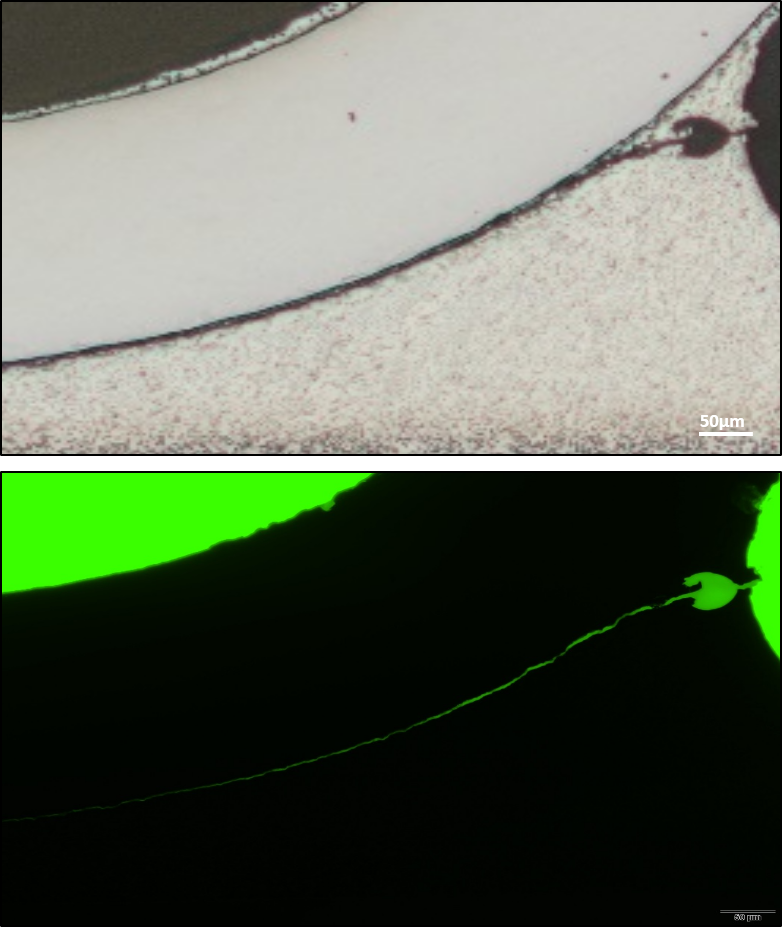
To improve the quality of our inspections processes they are also included within the verification protocol of high reliability surface mounted devices and other PCB systems. The figure shows one representative example of the latter application. Pictures at the left correspond to the cross-section of a soldered SMD leaded-device. In the figure on the top it is evident the presence of a crack at the solder however this optical image does not reveal the actual crack length. In this case fluorescence microscopy is used to disclose how the crack extend along the solder lead interface and determine the length of the crack which is a critical rejection/acceptance criteria.

Optical Image
Fluorescence MicroscopyFluorescence Microscopy

Fluorescence microscopy after dye infiltration

Fluorescence Microscopy


As an additional advantage related to this example, since dye infiltration is conducted before microsection only those crack present before cutting are outlined. Therefore, fluorescent inspection allows us to discard other features that eventually might be produced during microsection. This and other characterises makes it a valuable tool for failure analyses. In other application (picture beside) the technique is used to analyse wire separation in crimped connectors.


Figure: Wire separation in crimped connectors


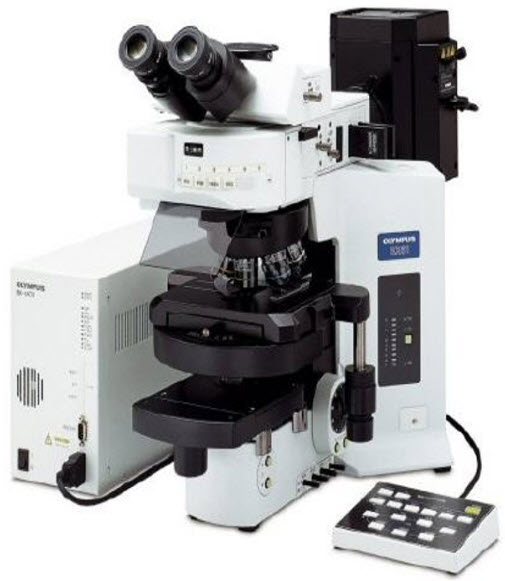
Due to the fluorescent mechanism (see next section) proper fluorescence inspection requires the suitable selection of the fluorescent tag and the optical systems adapted to the fluorescence characteristics of the fluorophore (excitation lamps, fluorescence filters, and others). With this concerns Alter Technology team consist of experienced researchers in materials science and fluorescence techniques.Fluorescence Microscopy
How it works

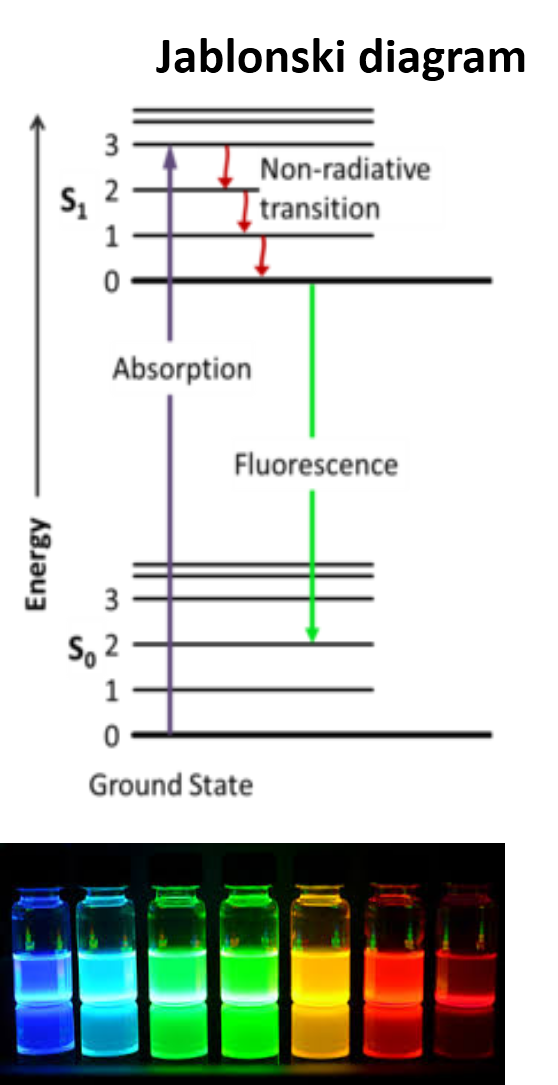
Fluorescence is the emission of light observed when some chemical elements (rare earths) organic compounds (organics dyes) and other confined materials (Quantum dots) are irradiated, typically with short-wavelength (UV) light. Taking as example an organic fluorophore, fluorescence emission is excited when a photon is absorbed by substance. Subsequent to this excitation process the fluorophore is promoted to a high electronic level as illustrated by the Jablosnki diagram (picture beside). In the excited state the molecule undergoes very fast non-emitting dissipation processes and transition toward the lower sub-vibration level of the exited state. In fluorescent compounds, the remaining excess of energy is released in form of light at wavelengths characteristic the used fluorophore. In general, fluorescence emission the is less energetic (longer wavelength) that the excitation beam as consequences of the previously mentioned excited-state dissipation processes. The wavelength difference between the excitation and emission wavelength is denominated stokes shift. This is an important factor for the de selection of the suitable fluorophore depending on the intending application. For marking proposes large stokes shift is very recommended to filter out the reflection of the excitation beam from the emission signal.


Featured image: crack extending along the base on a SMD device, image credit: Alter Technology
Related

Recent Posts

Modeling Fringing Field Losses in Inductors & Transformers

30.4.2026
5

YMIN Introduces Polymer Tantalum Capacitors for AI Server SSDs

29.4.2026
11

Miniaturization of Tantalum Capacitors: Structural Limit Under Constant Rating

27.4.2026
25

Heatsink Design and Thermal Interface Materials for Reliable Electronics

27.4.2026
8

Murata New MLCC Bulk Case Packaging Cuts Packaging Material by 99%

27.4.2026
43

Exxelia Introduces SMD High‑Voltage Mica Capacitors

28.4.2026
19

Modelithics Releases COMPLETE v26.1 for Keysight ADS

23.4.2026
13

April 2026 Interconnect, Passives and Electromechanical Components Market Insights

22.4.2026
75

KYOCERA AVX Introduces Traction‑Grade DC Link Film Capacitors

21.4.2026
47

Upcoming Events

May 5
16:00 - 17:00 CEST

Understanding and Selecting Capacitors – Fundamentals, Technologies and Latest Trends

May 7
17:00 - 18:00 CEST

From Grid to Motion: How Industrial Electrification is Redefining Power System Design

May 12
8:00 - 15:00 CEST

ESCC Space Splice connectors

View Calendar

Popular Posts

  • Buck Converter Design and Calculation

    0 shares
    Share 0 Tweet 0
  • Boost Converter Design and Calculation

    0 shares
    Share 0 Tweet 0
  • Flyback Converter Design and Calculation

    0 shares
    Share 0 Tweet 0
  • LLC Resonant Converter Design and Calculation

    0 shares
    Share 0 Tweet 0
  • MLCC and Ceramic Capacitors

    0 shares
    Share 0 Tweet 0
  • Dual Active Bridge (DAB) Topology

    0 shares
    Share 0 Tweet 0
  • What Electronics Engineer Needs to Know About Passive Low Pass Filters

    0 shares
    Share 0 Tweet 0
  • Capacitor Charging and Discharging

    0 shares
    Share 0 Tweet 0
  • MLCC Case Sizes Standards Explained

    0 shares
    Share 0 Tweet 0
  • Ripple Current and its Effects on the Performance of Capacitors

    3 shares
    Share 3 Tweet 0

Newsletter Subscription


Passive Components Blog

© EPCI - Leading Passive Components Educational and Information Site

  • Home
  • Privacy Policy
  • EPCI Membership & Advertisement
  • About

No Result
View All Result
  • Home
  • Knowledge Blog
  • PCNS

© EPCI - Leading Passive Components Educational and Information Site

This website uses cookies. By continuing to use this website you are giving consent to cookies being used. Visit our Privacy and Cookie Policy.
Go to mobile version