













Passive Components Blog
No Result
View All Result
  • Home
  • NewsFilter
    • All
    • Aerospace & Defence
    • Antenna
    • Applications
    • Automotive
    • Capacitors
    • Circuit Protection Devices
    • electro-mechanical news
    • Filters
    • Fuses
    • Inductors
    • Industrial
    • Integrated Passives
    • inter-connect news
    • Market & Supply Chain
    • Market Insights
    • Medical
    • Modelling and Simulation
    • New Materials & Supply
    • New Technologies
    • Non-linear Passives
    • Oscillators
    • Passive Sensors News
    • Resistors
    • RF & Microwave
    • Telecommunication
    • Weekly Digest

    How Modern Tools Model Magnetic Components for Power Electronics

    Inductors and Ferrite Beads Price Hikes 

    TDK Extends Compact ThermoFuse Varistors up to 50 kA

    Samtec ANSI/VITA 90 Connectors: Rugged Small Form Factor Standard

    Resistor Technology Dossier

    Würth Elektronik IQD Awarded by EcoVadis Gold Sustainability Medal

    Advanced Loss Modeling for Planar Magnetics in the Frenetic Planar Tool

    AI Servers Demand is Driving Tantalum Capacitor Price Hikes

    DMASS Reports Europe Components Up 9.8% in Q4 2025

    Trending Tags

    • Ripple Current
    • RF
    • Leakage Current
    • Tantalum vs Ceramic
    • Snubber
    • Low ESR
    • Feedthrough
    • Derating
    • Dielectric Constant
    • New Products
    • Market Reports
  • VideoFilter
    • All
    • Antenna videos
    • Capacitor videos
    • Circuit Protection Video
    • Filter videos
    • Fuse videos
    • Inductor videos
    • Inter-Connect Video
    • Non-linear passives videos
    • Oscillator videos
    • Passive sensors videos
    • Resistor videos

    How Modern Tools Model Magnetic Components for Power Electronics

    Advanced Loss Modeling for Planar Magnetics in the Frenetic Planar Tool

    2026 Power Magnetics Design Trends: Flyback, DAB and Planar

    Enabling Software‑Defined Vehicle Architectures: Automotive Ethernet and Zonal Smart Power

    Calculating Resistance Value of a Flyback RC Snubber 

    One‑Pulse Characterization of Nonlinear Power Inductors

    Thermistor Linearization Challenges

    Coaxial Connectors and How to Connect with PCB

    PCB Manufacturing, Test Methods, Quality and Reliability

    Trending Tags

    • Capacitors explained
    • Inductors explained
    • Resistors explained
    • Filters explained
    • Application Video Guidelines
    • EMC
    • New Products
    • Ripple Current
    • Simulation
    • Tantalum vs Ceramic
  • Knowledge Blog
  • DossiersNew
  • Suppliers
    • Who is Who
  • PCNS
    • PCNS 2025
    • PCNS 2023
    • PCNS 2021
    • PCNS 2019
    • PCNS 2017
  • Events
  • Home
  • NewsFilter
    • All
    • Aerospace & Defence
    • Antenna
    • Applications
    • Automotive
    • Capacitors
    • Circuit Protection Devices
    • electro-mechanical news
    • Filters
    • Fuses
    • Inductors
    • Industrial
    • Integrated Passives
    • inter-connect news
    • Market & Supply Chain
    • Market Insights
    • Medical
    • Modelling and Simulation
    • New Materials & Supply
    • New Technologies
    • Non-linear Passives
    • Oscillators
    • Passive Sensors News
    • Resistors
    • RF & Microwave
    • Telecommunication
    • Weekly Digest

    How Modern Tools Model Magnetic Components for Power Electronics

    Inductors and Ferrite Beads Price Hikes 

    TDK Extends Compact ThermoFuse Varistors up to 50 kA

    Samtec ANSI/VITA 90 Connectors: Rugged Small Form Factor Standard

    Resistor Technology Dossier

    Würth Elektronik IQD Awarded by EcoVadis Gold Sustainability Medal

    Advanced Loss Modeling for Planar Magnetics in the Frenetic Planar Tool

    AI Servers Demand is Driving Tantalum Capacitor Price Hikes

    DMASS Reports Europe Components Up 9.8% in Q4 2025

    Trending Tags

    • Ripple Current
    • RF
    • Leakage Current
    • Tantalum vs Ceramic
    • Snubber
    • Low ESR
    • Feedthrough
    • Derating
    • Dielectric Constant
    • New Products
    • Market Reports
  • VideoFilter
    • All
    • Antenna videos
    • Capacitor videos
    • Circuit Protection Video
    • Filter videos
    • Fuse videos
    • Inductor videos
    • Inter-Connect Video
    • Non-linear passives videos
    • Oscillator videos
    • Passive sensors videos
    • Resistor videos

    How Modern Tools Model Magnetic Components for Power Electronics

    Advanced Loss Modeling for Planar Magnetics in the Frenetic Planar Tool

    2026 Power Magnetics Design Trends: Flyback, DAB and Planar

    Enabling Software‑Defined Vehicle Architectures: Automotive Ethernet and Zonal Smart Power

    Calculating Resistance Value of a Flyback RC Snubber 

    One‑Pulse Characterization of Nonlinear Power Inductors

    Thermistor Linearization Challenges

    Coaxial Connectors and How to Connect with PCB

    PCB Manufacturing, Test Methods, Quality and Reliability

    Trending Tags

    • Capacitors explained
    • Inductors explained
    • Resistors explained
    • Filters explained
    • Application Video Guidelines
    • EMC
    • New Products
    • Ripple Current
    • Simulation
    • Tantalum vs Ceramic
  • Knowledge Blog
  • DossiersNew
  • Suppliers
    • Who is Who
  • PCNS
    • PCNS 2025
    • PCNS 2023
    • PCNS 2021
    • PCNS 2019
    • PCNS 2017
  • Events
No Result
View All Result
Passive Components Blog
No Result
View All Result

How Modern Tools Model Magnetic Components for Power Electronics

5.3.2026
Reading Time: 7 mins read
A A

Magnetic components such as inductors and transformers are central to every switched‑mode power supply, yet their design is notoriously difficult to get right without extensive prototyping.

This article based on Frenetic webinar explains, in practical engineering terms, how a modern simulator can model magnetics and inductors from first principles, using Frenetic’s approach as a concrete example while keeping the concepts general enough for design engineers and component specialists.

RelatedPosts

Advanced Loss Modeling for Planar Magnetics in the Frenetic Planar Tool

2026 Power Magnetics Design Trends: Flyback, DAB and Planar

Power Electronics Tools for Passives and Magnetic Designs

Why Magnetic Modeling Matters

Designers rely on models to predict inductance, losses and temperature before committing to hardware, PCB layouts and mechanical integration. Good models help reduce the number of prototype spins, avoid overheating, and prevent last‑minute surprises around saturation or unexpected leakage. Understanding the assumptions behind these models also shows when analytical formulas are sufficient and when more advanced numerical methods such as finite‑element analysis (FEM) are justified.

Analytical Models vs FEM in Magnetics

In industry, FEM simulations have a reputation for being “the most accurate” way to model inductors and transformers, but the reality is more nuanced. FEM excels at solving electromagnetic fields for arbitrary geometries and is particularly strong for winding losses in complex arrangements, yet it struggles with nonlinear core losses and can be slow for everyday design work. Analytical and semi‑empirical models, when used within their validity range, can be both accurate and far more efficient, making them better suited for iterative design and optimization.

Modeling Approaches at a Glance

AspectAnalytical / Semi‑empirical modelFEM‑based model
GeometryStandard cores, regular windingsArbitrary, complex geometries
Losses handled wellCore loss (IGS), many winding typesDetailed winding loss, local field effects
Computation timeFast, suitable for iterationSlower, heavier setup
Typical useEarly design, parametric sweepsPlanar magnetics, edge cases, validation
Main limitationAssumptions on field distributionNonlinear loss modeling, simulation effort

A practical strategy is to use analytical methods for the bulk of designs and reserve FEM for difficult geometries, especially in planar magnetics.

Building a Magnetic Circuit Model

Reluctance as the Magnetic “Resistance”

The starting point for many magnetic models is the reluctance network, which is the magnetic analogue of an electrical resistance network. The magnetomotive force is given by MMF=N⋅I\text{MMF} = N \cdot I and drives a magnetic flux through a network of reluctances representing the core, air gaps and leakage paths. Once the network is set up, the simulator can compute inductance as a function of current, flux density distribution in different core sections, and stray fields near the air gap.

Air Gap and Fringing

Air gaps are often the most critical and tricky part of the magnetic circuit, because the magnetic field “fringes” into the surrounding space instead of staying confined to the core cross‑section. Ignoring fringing leads to large errors in both inductance and saturation‑current predictions. A practical approach is to decompose the air‑gap region into analytical “building blocks” whose reluctances are known and assemble them like Lego bricks to approximate the real geometry, including fringing.

Core and Winding Losses in Practice

Core Loss with Improved Steinmetz Equations

Core losses depend on flux density, frequency, waveform shape and material properties. Many modern tools use improved generalized Steinmetz (IGS‑type) equations, which better handle non‑sinusoidal waveforms typical of switched‑mode power supplies. In practice, the simulator takes the flux‑density waveform, splits it into segments, applies the material‑specific IGS parameters to each segment, and integrates over one period to obtain total core loss.

Winding Losses, Skin and Proximity Effects

Copper loss is not just I2RI^2 RI2R when switching at tens or hundreds of kilohertz. Skin and proximity effects increase effective AC resistance and can dominate total loss, especially in tightly packed transformers and inductors. Analytical formulas exist for standard conductor types (solid wire, litz, some foil geometries) as long as the external magnetic field around each conductor is known.

One efficient method computes this external field by:

  • Replacing the air gap with an equivalent current source that reproduces the same field.
  • Using the method of images to mirror conductors across core boundaries, building an infinite periodic arrangement.

The field at each conductor follows from superposition of all real and image conductors, after which known AC‑loss formulas provide winding losses.

When Planar Magnetics Need FEM

Planar magnetics, particularly PCB‑based transformers and inductors with thin rectangular traces, are a difficult case for pure analytical models. Strong field components orthogonal to the traces can drive high eddy currents, and deriving general closed‑form expressions for arbitrary PCB patterns is challenging. For these components, it is practical to move to FEM‑based models for losses and capacitances, while still using analytical or semi‑analytical methods for conventional wound components.

Compact Thermal Modeling and Iteration

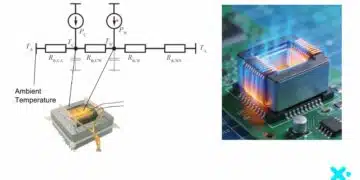
After obtaining core and copper losses, the simulator needs to estimate temperature rise, which feeds back into material properties and loss coefficients. A simplified thermal equivalent circuit with thermal resistances between winding, core and ambient is often sufficient. Losses are applied as heat sources, temperatures are computed, and the process is iterated because losses themselves depend on temperature (for example through copper resistivity and core‑loss coefficients).

Electrical to Thermal Flow

StepWhat happens in the model
1. Electrical excitationVoltage, current, frequency defined
2. Magnetic solutionFlux, inductance, fields, gap/fringing
3. Loss calculationCore loss, copper loss (AC and DC components)
4. Thermal solutionHotspot temperatures from RC thermal network
5. IterationUpdate temperature‑dependent parameters and repeat

For early design screening and optimization, this compact thermal loop is usually accurate enough to highlight thermal bottlenecks and guide geometry changes.

Design‑In Notes for Engineers

When using or reviewing results from a tool that follows this approach, consider:

  • Check the core material and loss model; results rely on correct Steinmetz/IGS parameters.
  • Look at how air gaps are modeled; poor fringing treatment can make inductance and saturation current too optimistic.
  • For high‑frequency designs, pay attention to conductor type and how AC resistance is modeled (wire, litz, foil, PCB).
  • Verify thermal boundary conditions such as cooling method, orientation and ambient temperature.
  • For planar magnetics or very compact designs, confirm that FEM or equivalent advanced field modeling is used for loss and capacitance.

Understanding these blocks helps design engineers interpret simulation reports and gives component engineers a better basis for discussing custom magnetics proposals.

Typical Applications

The modeling concepts described here are directly relevant to:

  • Flyback, forward, LLC and other isolated DC‑DC converters.
  • PFC chokes and boost inductors.
  • Output chokes and filter inductors in point‑of‑load regulators.
  • Planar transformers in high‑density, low‑profile supplies.
  • Magnetics in automotive and industrial drives with tight thermal margins.

Source

This article is based on a technical webinar presentation by Jonas Mühlethaler, CTO of Frenetic and Professor of Electrical Engineering at Lucerne University of Applied Sciences and Arts, describing a practical framework for modeling magnetic components from reluctance and loss calculations through to thermal predictions, and explaining why planar magnetics often require FEM due to their geometric complexity.
References

  1. How Frenetic Models Magnetics: A transparent deep‑dive (YouTube)

Related

Source: Frenetic

Recent Posts

Inductors and Ferrite Beads Price Hikes 

5.3.2026
2

Advanced Loss Modeling for Planar Magnetics in the Frenetic Planar Tool

4.3.2026
11

DMASS Reports Europe Components Up 9.8% in Q4 2025

3.3.2026
13

Mastering Galvanic Isolation in Power Electronics: Methods, Standards, and Implementation

2.3.2026
22

Bourns Releases Compact Automotive Isolation Power Transformer

2.3.2026
10

Würth Elektronik Present in IEEE APEC

24.2.2026
19

Bourns Releases High Clearance Transformer for Isolated DC/DC Supplies

24.2.2026
25

Earthing Systems and IEC Classification Explained

26.2.2026
86

Modelithics Library for MATLAB: Measurement-Based Models for Microwave and RF Passive Components

20.2.2026
19

Upcoming Events

Mar 19
13:00 - 14:00 CDT

Smart Consideration of Inductor Thermal Performance

Mar 21
All day

PSMA Capacitor Workshop 2026

Apr 21
16:00 - 17:00 CEST

Heatsink Solutions: Thermal Management in electronic devices

View Calendar

Popular Posts

  • Buck Converter Design and Calculation

    0 shares
    Share 0 Tweet 0
  • Boost Converter Design and Calculation

    0 shares
    Share 0 Tweet 0
  • Flyback Converter Design and Calculation

    0 shares
    Share 0 Tweet 0
  • LLC Resonant Converter Design and Calculation

    0 shares
    Share 0 Tweet 0
  • MLCC Manufacturers Consider Price Increase as AI Demand Outpaces Supply

    0 shares
    Share 0 Tweet 0
  • Dual Active Bridge (DAB) Topology

    0 shares
    Share 0 Tweet 0
  • Ripple Current and its Effects on the Performance of Capacitors

    3 shares
    Share 3 Tweet 0
  • MLCC and Ceramic Capacitors

    0 shares
    Share 0 Tweet 0
  • What is a Dielectric Constant and DF of Plastic Materials?

    4 shares
    Share 4 Tweet 0
  • MLCC Case Sizes Standards Explained

    0 shares
    Share 0 Tweet 0

Newsletter Subscription


Passive Components Blog

© EPCI - Leading Passive Components Educational and Information Site

  • Home
  • Privacy Policy
  • EPCI Membership & Advertisement
  • About

No Result
View All Result
  • Home
  • Knowledge Blog
  • PCNS

© EPCI - Leading Passive Components Educational and Information Site

This website uses cookies. By continuing to use this website you are giving consent to cookies being used. Visit our Privacy and Cookie Policy.
Go to mobile version