




Passive Components Blog
No Result
View All Result
  • Home
  • NewsFilter
    • All
    • Aerospace & Defence
    • Antenna
    • Applications
    • Automotive
    • Capacitors
    • Circuit Protection Devices
    • electro-mechanical news
    • Filters
    • Fuses
    • Inductors
    • Industrial
    • Integrated Passives
    • inter-connect news
    • Market & Supply Chain
    • Market Insights
    • Medical
    • Modelling and Simulation
    • New Materials & Supply
    • New Technologies
    • Non-linear Passives
    • Oscillators
    • Passive Sensors News
    • Resistors
    • RF & Microwave
    • Telecommunication
    • Weekly Digest

    Molecular Memristor Shows Record 145 kH Emergent Inductance

    Planar vs Conventional Transformer: When it Make Sense

    Researchers Propose Next‑Gen Compact Memory Using Ultra-thin Ferroelectric Capacitors

    Nichicon ADN Automotive Hybrid Aluminum Capacitors Now Available in EMEA

    Wk 19 Electronics Supply Chain Digest

    Electrocaloric Multilayer Capacitors: Towards Quiet, Solid‑State Cooling Around Room Temperature

    High-Crystallinity Nanocrystalline Composites for MHz Chip Inductors

    European Components Distribution Shows Strong Q1 2026 Growth Amid Geopolitical Uncertainty

    Stackpole Expanded its AlN Thick Film Chip Resistors

    Trending Tags

    • Ripple Current
    • RF
    • Leakage Current
    • Tantalum vs Ceramic
    • Snubber
    • Low ESR
    • Feedthrough
    • Derating
    • Dielectric Constant
    • New Products
    • Market Reports
  • VideoFilter
    • All
    • Antenna videos
    • Capacitor videos
    • Circuit Protection Video
    • Filter videos
    • Fuse videos
    • Inductor videos
    • Inter-Connect Video
    • Non-linear passives videos
    • Oscillator videos
    • Passive sensors videos
    • Resistor videos

    Planar vs Conventional Transformer: When it Make Sense

    Modeling Fringing Field Losses in Inductors & Transformers

    Why Power Inductors Use a Ferrite Core With an Air Gap

    Transformer-Based Power-Line Harvester Magnetic Design

    Thermal Modeling of Magnetics

    Standard vs Planar LLC transformers Comparison for Battery Chargers

    How Modern Tools Model Magnetic Components for Power Electronics

    Advanced Loss Modeling for Planar Magnetics in the Frenetic Planar Tool

    2026 Power Magnetics Design Trends: Flyback, DAB and Planar

    Trending Tags

    • Capacitors explained
    • Inductors explained
    • Resistors explained
    • Filters explained
    • Application Video Guidelines
    • EMC
    • New Products
    • Ripple Current
    • Simulation
    • Tantalum vs Ceramic
  • Knowledge Blog
  • DossiersNew
  • Suppliers
    • Who is Who
  • PCNS
    • PCNS 2025
    • PCNS 2023
    • PCNS 2021
    • PCNS 2019
    • PCNS 2017
  • Events
  • Home
  • NewsFilter
    • All
    • Aerospace & Defence
    • Antenna
    • Applications
    • Automotive
    • Capacitors
    • Circuit Protection Devices
    • electro-mechanical news
    • Filters
    • Fuses
    • Inductors
    • Industrial
    • Integrated Passives
    • inter-connect news
    • Market & Supply Chain
    • Market Insights
    • Medical
    • Modelling and Simulation
    • New Materials & Supply
    • New Technologies
    • Non-linear Passives
    • Oscillators
    • Passive Sensors News
    • Resistors
    • RF & Microwave
    • Telecommunication
    • Weekly Digest

    Molecular Memristor Shows Record 145 kH Emergent Inductance

    Planar vs Conventional Transformer: When it Make Sense

    Researchers Propose Next‑Gen Compact Memory Using Ultra-thin Ferroelectric Capacitors

    Nichicon ADN Automotive Hybrid Aluminum Capacitors Now Available in EMEA

    Wk 19 Electronics Supply Chain Digest

    Electrocaloric Multilayer Capacitors: Towards Quiet, Solid‑State Cooling Around Room Temperature

    High-Crystallinity Nanocrystalline Composites for MHz Chip Inductors

    European Components Distribution Shows Strong Q1 2026 Growth Amid Geopolitical Uncertainty

    Stackpole Expanded its AlN Thick Film Chip Resistors

    Trending Tags

    • Ripple Current
    • RF
    • Leakage Current
    • Tantalum vs Ceramic
    • Snubber
    • Low ESR
    • Feedthrough
    • Derating
    • Dielectric Constant
    • New Products
    • Market Reports
  • VideoFilter
    • All
    • Antenna videos
    • Capacitor videos
    • Circuit Protection Video
    • Filter videos
    • Fuse videos
    • Inductor videos
    • Inter-Connect Video
    • Non-linear passives videos
    • Oscillator videos
    • Passive sensors videos
    • Resistor videos

    Planar vs Conventional Transformer: When it Make Sense

    Modeling Fringing Field Losses in Inductors & Transformers

    Why Power Inductors Use a Ferrite Core With an Air Gap

    Transformer-Based Power-Line Harvester Magnetic Design

    Thermal Modeling of Magnetics

    Standard vs Planar LLC transformers Comparison for Battery Chargers

    How Modern Tools Model Magnetic Components for Power Electronics

    Advanced Loss Modeling for Planar Magnetics in the Frenetic Planar Tool

    2026 Power Magnetics Design Trends: Flyback, DAB and Planar

    Trending Tags

    • Capacitors explained
    • Inductors explained
    • Resistors explained
    • Filters explained
    • Application Video Guidelines
    • EMC
    • New Products
    • Ripple Current
    • Simulation
    • Tantalum vs Ceramic
  • Knowledge Blog
  • DossiersNew
  • Suppliers
    • Who is Who
  • PCNS
    • PCNS 2025
    • PCNS 2023
    • PCNS 2021
    • PCNS 2019
    • PCNS 2017
  • Events
No Result
View All Result
Passive Components Blog
No Result
View All Result

How to Manage Supercapacitors Leakage Current and Self Discharge 

1.10.2025
Reading Time: 4 mins read
A A

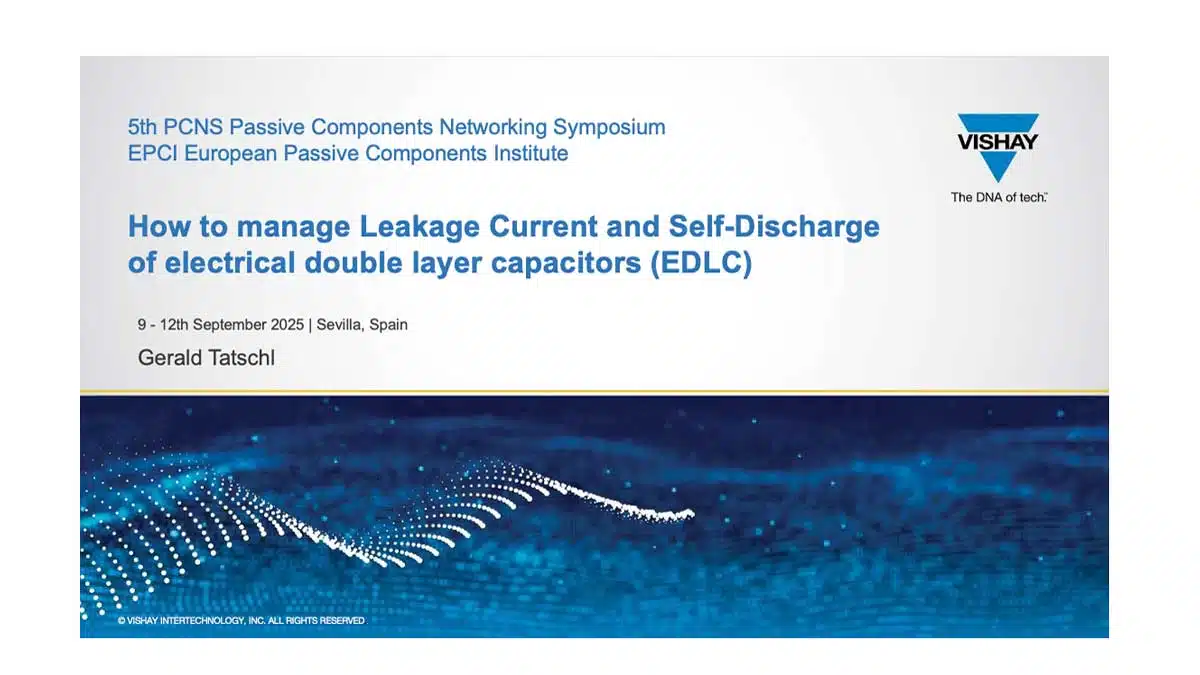
The paper “How to Manage Leakage Current and Self Discharge of EDLC Capacitors” was presented by Gerald Tatschl, Vishay BCcomponents, Klagenfurt am Wörthersee, Austria at the 5th PCNS Passive Components Networking Symposium 9-12th September 2025, Seville, Spain as paper No. 6.3.

Introduction

Electric double-layer capacitors (EDLCs), also known as supercapacitors, have been in use for more than 50 years, offering a bridge between traditional aluminum electrolytic capacitors and rechargeable batteries.

RelatedPosts

SPICE Simulation of Non-Linear Resistors: Vishay’s Thermistor and PPTC Modelling Ecosystem

Vishay Extends Power Inductors for DC/DC with 1212 Compact Case

Vishay Releases 2-Way Wilkinson Divider / Combiner for 15–20 GHz RF Front Ends

Their extremely high capacitance is achieved through a combination of activated carbon with a large surface area, highly conductive liquid electrolytes, and the physical phenomenon of double layers. These devices deliver high discharge currents, making them useful in applications ranging from energy storage to backup power and energy harvesting systems.

Key Points

  • EDLCs store energy through the double-layer effect, allowing rapid and reversible charge exchange.
  • They can endure over one million charge and discharge cycles without significant degradation.
  • Self-discharge and leakage current are critical factors affecting long-term energy retention.
  • Both self-discharge and leakage current are highly influenced by temperature and charging history.
  • Leakage current declines over time but increases with higher temperatures.

Extended Summary

EDLCs serve as effective energy storage solutions where rapid energy delivery and high peak currents are required. Their large capacitance comes from the separation of charges in an atomic-scale double layer within the porous activated carbon electrodes. This architecture allows the stored charge to be accessed quickly and repeatedly with minimal performance loss.

One of the primary considerations in EDLC design is self-discharge, which refers to the natural voltage decay that occurs once a charged capacitor is disconnected from its power source. This phenomenon is driven by residual leakage current and is sensitive to several factors, including the charging duration, the applied voltage, and the ambient temperature. A fully charged EDLC may retain its charge for weeks at room temperature, but this holding time decreases significantly at higher temperatures, sometimes dropping to hours. Moreover, the initial voltage drop is more prominent at higher charging voltages, and longer charging periods generally improve self-discharge performance.

Leakage current is another critical aspect of EDLC behavior, defined as the small, residual current that persists after a capacitor has stabilized at a constant voltage. This current is influenced by the internal structure and materials of the capacitor, including electrode properties, electrolyte composition, and aging effects. Leakage current is initially high but decays exponentially over time. It is typically specified at 72 hours and at room temperature, often in the microampere-per-farad range, decreasing to nanoampere levels after extended charging.

Temperature plays a dual role in EDLC performance. It accelerates both self-discharge and leakage current, effectively acting as a multiplier rather than resetting the current behavior. Even when the temperature cycles between high and low values, the leakage current returns to its previous state at the respective conditions within hours. This characteristic underscores the importance of thermal management in applications requiring long energy retention.

EDLCs are highly scalable and can be configured in series and parallel to meet various voltage and energy requirements. They are increasingly used in automotive systems, renewable energy applications, and critical backup solutions in medical and data storage sectors, where understanding and managing self-discharge and leakage current is essential for reliable performance.

Conclusion

Self-discharge and leakage current are key factors that define the long-term energy retention of EDLC supercapacitors. While both are influenced heavily by temperature and charging conditions, they are distinct phenomena that must be considered separately in system design. By optimizing charging strategies and managing thermal conditions, engineers can maximize the performance and reliability of EDLC-based energy storage systems.


6_3_Vishay How to Manage Leakage Current and Self Discharge of EDLC CapacitorsDownload

Related

Source: PCNS

Recent Posts

Planar vs Conventional Transformer: When it Make Sense

11.5.2026
28

Researchers Propose Next‑Gen Compact Memory Using Ultra-thin Ferroelectric Capacitors

11.5.2026
22

Nichicon ADN Automotive Hybrid Aluminum Capacitors Now Available in EMEA

11.5.2026
21

Electrocaloric Multilayer Capacitors: Towards Quiet, Solid‑State Cooling Around Room Temperature

7.5.2026
180

Stackpole Expanded its AlN Thick Film Chip Resistors

6.5.2026
22

KYOCERA 10 µF 0201 MLCC Brings High‑Capacitance into Mobile Designs

6.5.2026
50

Würth Elektronik Introduces Compact Flat-wire SMT Power Inductors for Automotive

5.5.2026
48

KYOCERA AVX Extends MLV Varistors for 48V Automotive Protection

5.5.2026
23

Energy Localization in Tantalum Anode Formation: A Structural Perspective

4.5.2026
46

Upcoming Events

May 13
17:00 - 17:30 CEST

Winding Loss Modeling for Toroidal Magnetics – Including Gapped Cores

May 19
16:00 - 17:00 CEST

Designing Qi2 Wireless Power Systems: Practical Development and EMC Optimization

Jun 2
16:00 - 17:00 CEST

Calculation, Simulation and Measurement of 800V EMC Filters

View Calendar

Popular Posts

  • Buck Converter Design and Calculation

    0 shares
    Share 0 Tweet 0
  • Boost Converter Design and Calculation

    0 shares
    Share 0 Tweet 0
  • Flyback Converter Design and Calculation

    0 shares
    Share 0 Tweet 0
  • LLC Resonant Converter Design and Calculation

    0 shares
    Share 0 Tweet 0
  • MLCC and Ceramic Capacitors

    0 shares
    Share 0 Tweet 0
  • Dual Active Bridge (DAB) Topology

    0 shares
    Share 0 Tweet 0
  • Capacitor Charging and Discharging

    0 shares
    Share 0 Tweet 0
  • What Electronics Engineer Needs to Know About Passive Low Pass Filters

    0 shares
    Share 0 Tweet 0
  • Ripple Current and its Effects on the Performance of Capacitors

    3 shares
    Share 3 Tweet 0
  • MLCC Case Sizes Standards Explained

    0 shares
    Share 0 Tweet 0

Newsletter Subscription


Passive Components Blog

© EPCI - Leading Passive Components Educational and Information Site

  • Home
  • Privacy Policy
  • EPCI Membership & Advertisement
  • About

No Result
View All Result
  • Home
  • Knowledge Blog
  • PCNS

© EPCI - Leading Passive Components Educational and Information Site

This website uses cookies. By continuing to use this website you are giving consent to cookies being used. Visit our Privacy and Cookie Policy.
Go to mobile version