







Passive Components Blog
No Result
View All Result
  • Home
  • NewsFilter
    • All
    • Aerospace & Defence
    • Antenna
    • Applications
    • Automotive
    • Capacitors
    • Circuit Protection Devices
    • electro-mechanical news
    • Filters
    • Fuses
    • Inductors
    • Industrial
    • Integrated Passives
    • inter-connect news
    • Market & Supply Chain
    • Market Insights
    • Medical
    • Modelling and Simulation
    • New Materials & Supply
    • New Technologies
    • Non-linear Passives
    • Oscillators
    • Passive Sensors News
    • Resistors
    • RF & Microwave
    • Telecommunication
    • Weekly Digest

    YAGEO Introduces High‑Current Y2/X1 Film Capacitors for Wide-bandgap Power Systems

    Amphenol Explanded Liquid Cooling Connectors for AI, ESS and EV Systems

    Hirose Introduced BGA connector for PCIe Gen6 for AI and Edge Computing

    YAGEO Introduces High Rel MLCCs Beyond MIL-Spec Limits

    Würth Elektronik Expanded Capacity for Validation and Services in Asia

    Samsung Introduces Ultra-High-Voltage 1500 V MLCCs for xEV Powertrains

    YAGEO Q1 2026 Results: AI Servers and Pricing Power Behind a Moderate Q2 Outlook

    TDK Introduces High‑Voltage Common‑Mode Chokes for Compact 1250 V DC Converters

    Vishay Extends Power Inductors for DC/DC with 1212 Compact Case

    Trending Tags

    • Ripple Current
    • RF
    • Leakage Current
    • Tantalum vs Ceramic
    • Snubber
    • Low ESR
    • Feedthrough
    • Derating
    • Dielectric Constant
    • New Products
    • Market Reports
  • VideoFilter
    • All
    • Antenna videos
    • Capacitor videos
    • Circuit Protection Video
    • Filter videos
    • Fuse videos
    • Inductor videos
    • Inter-Connect Video
    • Non-linear passives videos
    • Oscillator videos
    • Passive sensors videos
    • Resistor videos

    Transformer-Based Power-Line Harvester Magnetic Design

    Thermal Modeling of Magnetics

    Standard vs Planar LLC transformers Comparison for Battery Chargers

    How Modern Tools Model Magnetic Components for Power Electronics

    Advanced Loss Modeling for Planar Magnetics in the Frenetic Planar Tool

    2026 Power Magnetics Design Trends: Flyback, DAB and Planar

    Enabling Software‑Defined Vehicle Architectures: Automotive Ethernet and Zonal Smart Power

    Calculating Resistance Value of a Flyback RC Snubber 

    One‑Pulse Characterization of Nonlinear Power Inductors

    Trending Tags

    • Capacitors explained
    • Inductors explained
    • Resistors explained
    • Filters explained
    • Application Video Guidelines
    • EMC
    • New Products
    • Ripple Current
    • Simulation
    • Tantalum vs Ceramic
  • Knowledge Blog
  • DossiersNew
  • Suppliers
    • Who is Who
  • PCNS
    • PCNS 2025
    • PCNS 2023
    • PCNS 2021
    • PCNS 2019
    • PCNS 2017
  • Events
  • Home
  • NewsFilter
    • All
    • Aerospace & Defence
    • Antenna
    • Applications
    • Automotive
    • Capacitors
    • Circuit Protection Devices
    • electro-mechanical news
    • Filters
    • Fuses
    • Inductors
    • Industrial
    • Integrated Passives
    • inter-connect news
    • Market & Supply Chain
    • Market Insights
    • Medical
    • Modelling and Simulation
    • New Materials & Supply
    • New Technologies
    • Non-linear Passives
    • Oscillators
    • Passive Sensors News
    • Resistors
    • RF & Microwave
    • Telecommunication
    • Weekly Digest

    YAGEO Introduces High‑Current Y2/X1 Film Capacitors for Wide-bandgap Power Systems

    Amphenol Explanded Liquid Cooling Connectors for AI, ESS and EV Systems

    Hirose Introduced BGA connector for PCIe Gen6 for AI and Edge Computing

    YAGEO Introduces High Rel MLCCs Beyond MIL-Spec Limits

    Würth Elektronik Expanded Capacity for Validation and Services in Asia

    Samsung Introduces Ultra-High-Voltage 1500 V MLCCs for xEV Powertrains

    YAGEO Q1 2026 Results: AI Servers and Pricing Power Behind a Moderate Q2 Outlook

    TDK Introduces High‑Voltage Common‑Mode Chokes for Compact 1250 V DC Converters

    Vishay Extends Power Inductors for DC/DC with 1212 Compact Case

    Trending Tags

    • Ripple Current
    • RF
    • Leakage Current
    • Tantalum vs Ceramic
    • Snubber
    • Low ESR
    • Feedthrough
    • Derating
    • Dielectric Constant
    • New Products
    • Market Reports
  • VideoFilter
    • All
    • Antenna videos
    • Capacitor videos
    • Circuit Protection Video
    • Filter videos
    • Fuse videos
    • Inductor videos
    • Inter-Connect Video
    • Non-linear passives videos
    • Oscillator videos
    • Passive sensors videos
    • Resistor videos

    Transformer-Based Power-Line Harvester Magnetic Design

    Thermal Modeling of Magnetics

    Standard vs Planar LLC transformers Comparison for Battery Chargers

    How Modern Tools Model Magnetic Components for Power Electronics

    Advanced Loss Modeling for Planar Magnetics in the Frenetic Planar Tool

    2026 Power Magnetics Design Trends: Flyback, DAB and Planar

    Enabling Software‑Defined Vehicle Architectures: Automotive Ethernet and Zonal Smart Power

    Calculating Resistance Value of a Flyback RC Snubber 

    One‑Pulse Characterization of Nonlinear Power Inductors

    Trending Tags

    • Capacitors explained
    • Inductors explained
    • Resistors explained
    • Filters explained
    • Application Video Guidelines
    • EMC
    • New Products
    • Ripple Current
    • Simulation
    • Tantalum vs Ceramic
  • Knowledge Blog
  • DossiersNew
  • Suppliers
    • Who is Who
  • PCNS
    • PCNS 2025
    • PCNS 2023
    • PCNS 2021
    • PCNS 2019
    • PCNS 2017
  • Events
No Result
View All Result
Passive Components Blog
No Result
View All Result

Jianghai Vibration‑Resistant Aluminum Capacitors Guidelines for Industrial Electronics

6.1.2026
Reading Time: 8 mins read
A A

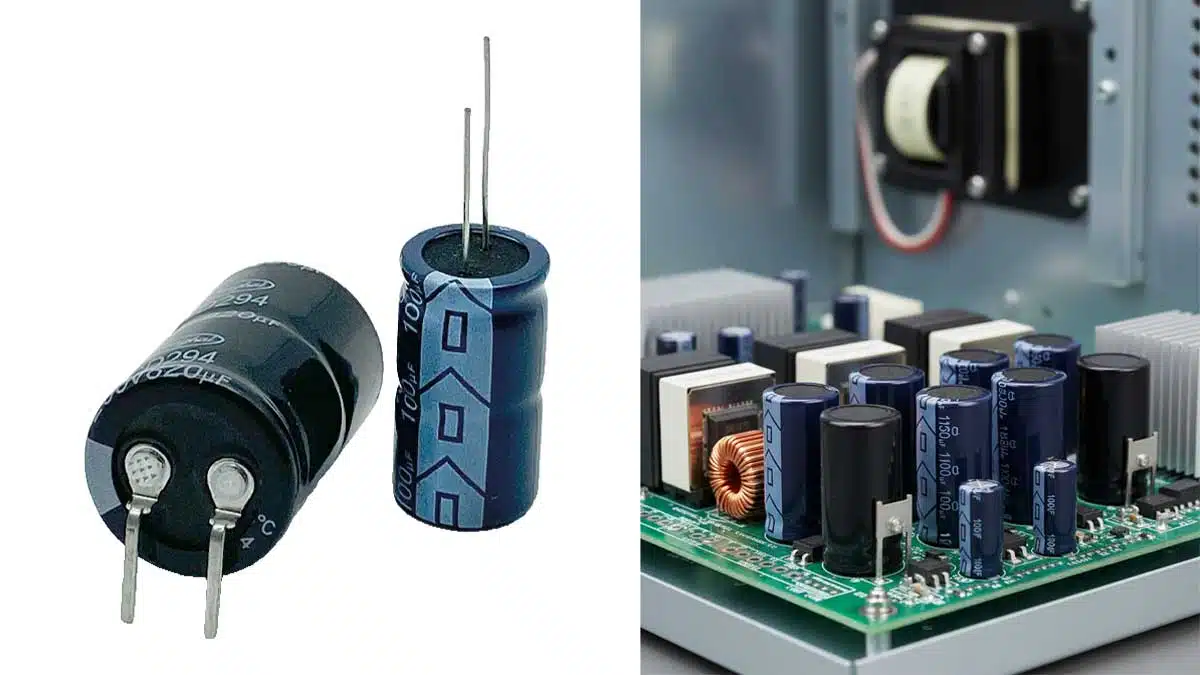
Jianghai Europe has outlined a set of design and mounting measures that significantly increase the vibration stability of radial aluminum e‑caps, helping design engineers and purchasers achieve higher reliability in the field.

Radial aluminum electrolytic capacitors in machine tools and other harsh industrial environments are exposed to continuous vibration, shocks and resonances that can lead to premature failure. This article summarizes the key points and translates them into practical guidance for real-world designs.

RelatedPosts

Jianghai Offers Custom Bottom Cooled Screw Aluminum Capacitors

The Benefits of Using Film Capacitor Modules For Modern Power Semiconductors

Jianghai Europe Introduces Next Generation of Li-ion Supercapacitors with Enhanced Energy Density

Why vibration stability matters

In applications such as machine tool manufacturing, the circuit board is subjected to strong vibrations, mechanical shocks, oscillations and structural resonances that are transferred directly into mounted capacitors. Larger radial electrolytic capacitors are especially critical because their can mass acts as a mechanical flywheel that stresses the solder joints and internal connections. Without appropriate mechanical design and mounting concepts, this can result in cracked leads, internal disconnections and ultimately field failures.

Key design aspects and benefits

There are two main dimensions determine whether a radial electrolytic capacitor will survive in a high‑vibration environment: how it is mounted in the equipment and how the internal structure is engineered.

Mounting of components on the PCB or in the housing

The responsibility for robust mounting typically lies with the hardware development team.

Key considerations include:

  • Ensuring that the leads are not used as mechanical springs
    • Capacitors should be fixed so that the connections are not continuously bent or fatigued by vibration.
  • Evaluating additional mechanical fixation methods
    • If gluing is used, heat dissipation through the sleeve and to the surroundings must be verified so that the component does not overheat.
    • Even firmly glued heat‑shrink tubing around the can does not automatically guarantee long‑term fixation of the can to the board or chassis.
  • Analysing the installation position and vibration direction
    • Axial forces (along the capacitor axis) and radial forces (perpendicular to the axis) excite different vibration modes and lead to different stress patterns.
    • Orientation, clearance to neighbouring components and proximity to mounting screws or stiffeners affect the actual mechanical load.

When designing layouts and mechanical fixtures, engineers should therefore:

  • Place heavy radial capacitors near mechanical supports or stiff parts of the PCB.
  • Avoid mounting them at the free end of long, flexible boards.
  • Consider additional brackets, clamps or adhesive points that transfer mass forces away from the solder joints.

Internal layout of the components

The capacitor manufacturer controls the internal mechanical robustness of the component.

Important optimisation questions include:

  • Film system and mechanical robustness
    • How thick and mechanically break‑resistant are the aluminum foils and separator materials.
  • Number and robustness of internal connections
    • Whether the number of internal tabs and welds can be increased to improve stability of the current path and reduce the risk of internal open circuits.
  • Additional protective layers
    • Whether extra paper layers or similar measures are used to cushion and protect sensitive regions of the winding.
  • Fixation of the internal cell relative to the can
    • How securely the wound element is fixed inside the case so that shocks do not allow it to move relative to the housing.

Over the lifetime of an electrolytic capacitor, the winding gradually dries and shrinks, reducing its weight and altering its mechanical resonance frequency. A design that passes vibration tests on fresh samples can behave differently after years of operation if the internal fixation is inadequate. Avoiding any relative movement between the inner cell and the can is therefore a central design target for high‑vibration applications.

Typical applications

Radial electrolytic capacitors with enhanced vibration stability are particularly relevant wherever:

  • Machine tools and CNC equipment generate continuous mechanical vibration.
  • Industrial drives, pumps and compressors cause structural resonances in control cabinets.
  • Power supplies or control units are mounted directly on vibrating motors or actuators.
  • Transportation and off‑highway equipment expose electronics to shocks and impact loads.

In such environments, these capacitors are typically used in:

  • DC bus buffering and intermediate circuits of motor drives.
  • Input and output filtering of switched‑mode power supplies.
  • Local energy storage in control boards, I/O modules and sensor interfaces.

By specifying parts and mounting concepts optimized for vibration resistance, design teams can extend service life and reduce the risk of intermittent failures that are difficult to diagnose in the field.

Technical highlights

Although the press information focuses on mechanical aspects rather than specific catalog series, some general technical highlights of Jianghai’s vibration‑optimized radial e‑caps can be summarized in engineering terms as:

  • Internal mechanical design tailored for high vibration and shock conditions, with special attention to foil robustness, internal interconnections and winding fixation.
  • Construction intended to minimize relative motion between the wound element and the can across the component lifetime, even as the electrolyte gradually dries and the winding shrinks.
  • Compatibility with common industrial operating conditions, subject to detailed ratings and endurance data given in the relevant manufacturer datasheets.

Exact values for voltage range, capacitance values, temperature range, endurance and vibration test levels should be taken from the specific Jianghai radial e‑cap datasheets for the target series.

Design‑in notes for engineers

When designing radial electrolytic capacitors into high‑vibration applications, engineers can use Jianghai’s guidance as a practical checklist.

During schematic and component selection

  • Identify all positions subjected to increased mechanical stress
    • Components on large, flexible boards or located near strong vibration sources are candidates for vibration‑robust types.
  • Discuss mechanical requirements with the capacitor supplier early
    • Define expected vibration spectra, shock levels and lifetime so the supplier can recommend suitable series and mechanical options.
  • Use datasheets for concrete limits
    • Maximum vibration acceleration, frequency ranges and endurance test conditions should be taken “as per manufacturer datasheet” for the chosen series.

During PCB and mechanical design

  • Avoid relying solely on solder joints for mechanical support
    • For larger can sizes, combine soldering with mechanical fixation (e.g., adhesive spots, brackets or clamps) while keeping thermal paths in mind.
  • Consider the direction of main vibration
    • Align radial capacitors and place them so that the dominant vibration direction excites the mechanically more robust mode whenever possible.
  • Validate with realistic tests
    • If the application is highly demanding, perform vibration tests not only on new samples but also on aged parts, since resonance behavior can shift over time.

Collaboration between developers and manufacturers

Jianghai Europe emphasizes that robust solutions in high‑vibration environments come from early, targeted dialogue between the development team and the capacitor manufacturer. For critical projects, it is advisable to:

  • Share mechanical boundary conditions, fixing concepts and operating profiles with the supplier.
  • Review proposed mounting concepts and internal layouts together.
  • Agree on test plans (vibration, shock and endurance) that reflect real‑world use rather than minimum standard requirements.

This approach helps avoid unpleasant surprises in the field and ensures that the capacitor design and its mounting concept form a coherent, robust system.

Source

This article is based on a Jianghai Europe press release describing the design and application aspects of extremely vibration‑resistant radial aluminum electrolytic capacitors, supplemented with neutral engineering commentary for design‑in and component selection.

References

  1. Smart solution: extremely vibration-resistant radial e-caps – Jianghai Europe

Related

Recent Posts

YAGEO Introduces High‑Current Y2/X1 Film Capacitors for Wide-bandgap Power Systems

17.4.2026
3

Amphenol Explanded Liquid Cooling Connectors for AI, ESS and EV Systems

17.4.2026
2

Hirose Introduced BGA connector for PCIe Gen6 for AI and Edge Computing

17.4.2026
4

YAGEO Introduces High Rel MLCCs Beyond MIL-Spec Limits

16.4.2026
32

Samsung Introduces Ultra-High-Voltage 1500 V MLCCs for xEV Powertrains

16.4.2026
17

YAGEO Q1 2026 Results: AI Servers and Pricing Power Behind a Moderate Q2 Outlook

16.4.2026
46

TDK Introduces High‑Voltage Common‑Mode Chokes for Compact 1250 V DC Converters

16.4.2026
17

Vishay Extends Power Inductors for DC/DC with 1212 Compact Case

16.4.2026
16

YAGEO Releases Ferrite Shielded Power Inductors for High‑Density Designs

15.4.2026
13

Upcoming Events

Apr 21
16:00 - 17:00 CEST

Heatsink Solutions: Thermal Management in electronic devices

Apr 22
17:00 - 17:30 CEST

Magnetics in a high frequency GaN era

Apr 22
17:00 - 18:00 CEST

Derating Tantalum, Film, and Ceramic Capacitors

View Calendar

Popular Posts

  • Buck Converter Design and Calculation

    0 shares
    Share 0 Tweet 0
  • Boost Converter Design and Calculation

    0 shares
    Share 0 Tweet 0
  • Flyback Converter Design and Calculation

    0 shares
    Share 0 Tweet 0
  • LLC Resonant Converter Design and Calculation

    0 shares
    Share 0 Tweet 0
  • Dual Active Bridge (DAB) Topology

    0 shares
    Share 0 Tweet 0
  • MLCC and Ceramic Capacitors

    0 shares
    Share 0 Tweet 0
  • Capacitor Charging and Discharging

    0 shares
    Share 0 Tweet 0
  • Plastic Materials Dielectric Constant and DF

    4 shares
    Share 4 Tweet 0
  • MLCC Case Sizes Standards Explained

    0 shares
    Share 0 Tweet 0
  • Ripple Current and its Effects on the Performance of Capacitors

    3 shares
    Share 3 Tweet 0

Newsletter Subscription


Passive Components Blog

© EPCI - Leading Passive Components Educational and Information Site

  • Home
  • Privacy Policy
  • EPCI Membership & Advertisement
  • About

No Result
View All Result
  • Home
  • Knowledge Blog
  • PCNS

© EPCI - Leading Passive Components Educational and Information Site

This website uses cookies. By continuing to use this website you are giving consent to cookies being used. Visit our Privacy and Cookie Policy.
Go to mobile version