




Passive Components Blog
No Result
View All Result
  • Home
  • NewsFilter
    • All
    • Aerospace & Defence
    • Antenna
    • Applications
    • Automotive
    • Capacitors
    • Circuit Protection Devices
    • electro-mechanical news
    • Filters
    • Fuses
    • Inductors
    • Industrial
    • Integrated Passives
    • inter-connect news
    • Market & Supply Chain
    • Market Insights
    • Medical
    • Modelling and Simulation
    • New Materials & Supply
    • New Technologies
    • Non-linear Passives
    • Oscillators
    • Passive Sensors News
    • Resistors
    • RF & Microwave
    • Telecommunication
    • Weekly Digest

    Researchers Demonstrated 32nm Aluminum Vacuum Gap Capacitor

    Conductive Polymer Capacitor Market and Design‑In Guide to 2035

    TDK Releases High Performance 105C DC Link Film Capacitors

    YAGEO Offers Automotive MOVs for EV and AI power

    YAGEO Acquires 100% of Shares of Shibaura Electronics

    Wk 3 Electronics Supply Chain Digest

    Vishay Extends Aluminum Capacitors Rating Up to 600 V for DC Links

    Würth Elektronik Introduces Product Navigator for Passive Components

    Panasonic Passive Components for Reliable Robotic Arms

    Trending Tags

    • Ripple Current
    • RF
    • Leakage Current
    • Tantalum vs Ceramic
    • Snubber
    • Low ESR
    • Feedthrough
    • Derating
    • Dielectric Constant
    • New Products
    • Market Reports
  • VideoFilter
    • All
    • Antenna videos
    • Capacitor videos
    • Circuit Protection Video
    • Filter videos
    • Fuse videos
    • Inductor videos
    • Inter-Connect Video
    • Non-linear passives videos
    • Oscillator videos
    • Passive sensors videos
    • Resistor videos

    One‑Pulse Characterization of Nonlinear Power Inductors

    Thermistor Linearization Challenges

    Coaxial Connectors and How to Connect with PCB

    PCB Manufacturing, Test Methods, Quality and Reliability

    Transformer Behavior – Current Transfer and Hidden Feedback

    Choosing the Right Capacitor: The Importance of Accurate Measurements

    RF Inductors: Selection and Design Challenges for High-Frequency Circuits

    Transformer Safety IEC 61558 Standard

    3-Phase EMI Filter Design, Simulation, Calculation and Test

    Trending Tags

    • Capacitors explained
    • Inductors explained
    • Resistors explained
    • Filters explained
    • Application Video Guidelines
    • EMC
    • New Products
    • Ripple Current
    • Simulation
    • Tantalum vs Ceramic
  • Knowledge Blog
  • Suppliers
    • Who is Who
  • PCNS
    • PCNS 2025
    • PCNS 2023
    • PCNS 2021
    • PCNS 2019
    • PCNS 2017
  • Events
  • Home
  • NewsFilter
    • All
    • Aerospace & Defence
    • Antenna
    • Applications
    • Automotive
    • Capacitors
    • Circuit Protection Devices
    • electro-mechanical news
    • Filters
    • Fuses
    • Inductors
    • Industrial
    • Integrated Passives
    • inter-connect news
    • Market & Supply Chain
    • Market Insights
    • Medical
    • Modelling and Simulation
    • New Materials & Supply
    • New Technologies
    • Non-linear Passives
    • Oscillators
    • Passive Sensors News
    • Resistors
    • RF & Microwave
    • Telecommunication
    • Weekly Digest

    Researchers Demonstrated 32nm Aluminum Vacuum Gap Capacitor

    Conductive Polymer Capacitor Market and Design‑In Guide to 2035

    TDK Releases High Performance 105C DC Link Film Capacitors

    YAGEO Offers Automotive MOVs for EV and AI power

    YAGEO Acquires 100% of Shares of Shibaura Electronics

    Wk 3 Electronics Supply Chain Digest

    Vishay Extends Aluminum Capacitors Rating Up to 600 V for DC Links

    Würth Elektronik Introduces Product Navigator for Passive Components

    Panasonic Passive Components for Reliable Robotic Arms

    Trending Tags

    • Ripple Current
    • RF
    • Leakage Current
    • Tantalum vs Ceramic
    • Snubber
    • Low ESR
    • Feedthrough
    • Derating
    • Dielectric Constant
    • New Products
    • Market Reports
  • VideoFilter
    • All
    • Antenna videos
    • Capacitor videos
    • Circuit Protection Video
    • Filter videos
    • Fuse videos
    • Inductor videos
    • Inter-Connect Video
    • Non-linear passives videos
    • Oscillator videos
    • Passive sensors videos
    • Resistor videos

    One‑Pulse Characterization of Nonlinear Power Inductors

    Thermistor Linearization Challenges

    Coaxial Connectors and How to Connect with PCB

    PCB Manufacturing, Test Methods, Quality and Reliability

    Transformer Behavior – Current Transfer and Hidden Feedback

    Choosing the Right Capacitor: The Importance of Accurate Measurements

    RF Inductors: Selection and Design Challenges for High-Frequency Circuits

    Transformer Safety IEC 61558 Standard

    3-Phase EMI Filter Design, Simulation, Calculation and Test

    Trending Tags

    • Capacitors explained
    • Inductors explained
    • Resistors explained
    • Filters explained
    • Application Video Guidelines
    • EMC
    • New Products
    • Ripple Current
    • Simulation
    • Tantalum vs Ceramic
  • Knowledge Blog
  • Suppliers
    • Who is Who
  • PCNS
    • PCNS 2025
    • PCNS 2023
    • PCNS 2021
    • PCNS 2019
    • PCNS 2017
  • Events
No Result
View All Result
Passive Components Blog
No Result
View All Result

Jianghai Offers Custom Bottom Cooled Screw Aluminum Capacitors

17.12.2025
Reading Time: 3 mins read
A A

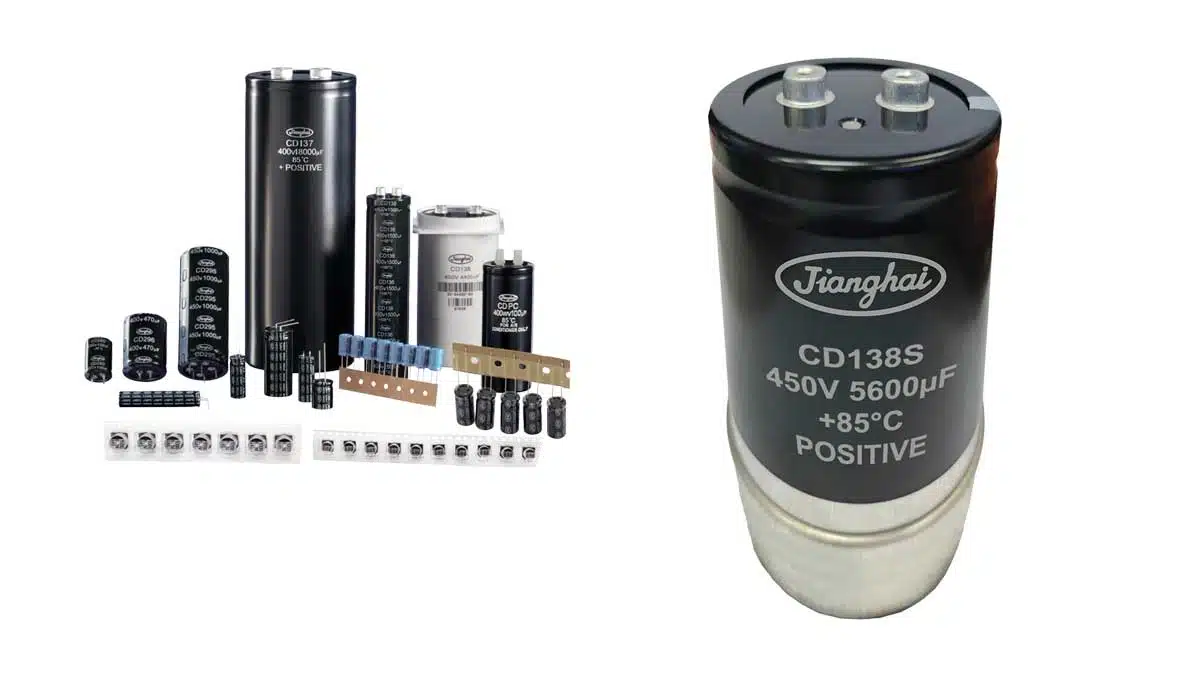
Jianghai Europe offers screw terminal electrolytic capacitors with efficient bottom cooling for high‑power DC link applications.

A widely used method for thermal management in large power converters is active water cooling, where the cooling circuit typically passes first through the DC link capacitors and then through the power semiconductors. By integrating the capacitors directly into the cooling path, system designers can significantly reduce hotspot temperatures and improve overall reliability of the DC link stage.

RelatedPosts

Jianghai Vibration‑Resistant Aluminum Capacitors Guidelines for Industrial Electronics

The Benefits of Using Film Capacitor Modules For Modern Power Semiconductors

Jianghai Europe Introduces Next Generation of Li-ion Supercapacitors with Enhanced Energy Density

Aluminium electrolytic capacitors are particularly suited to this concept because of their intrinsic anisotropic thermal behaviour: due to the winding structure, thermal conductivity in the axial direction is several times higher than in the radial direction. The anode and cathode foils act as efficient heat spreaders, transporting the power losses generated in operation towards the bottom of the can, where they can be extracted via a cold plate or heat sink.

Bottom Cooling With Extended Cathode Design

The Jianghai screw terminal capacitors exploit this axial heat flow by using an extended cathode design that improves the thermal path between the winding and the can bottom. The protruding cathode winding creates a low‑resistance thermal interface to the aluminium base, reducing the temperature rise of the active element under high ripple current and high ambient conditions.

This bottom‑cooling approach allows system developers to decouple electrical and thermal design constraints more effectively. Higher permissible ripple currents or increased ambient temperatures can be accommodated without oversizing the capacitor bank, often leading to fewer components, a smaller footprint, and lower total cost of ownership at system level.

Optimized Thermal Interface To The Heat Sink

For best performance, the heat transfer between the capacitor bottom and the heat sink or cold plate is optimized using thermally conductive interface materials such as pads, foils, or adhesives. In combination with sufficient mechanical clamping force, these materials minimize contact thermal resistance and ensure stable, reproducible cooling conditions over the full service life.

To simplify integration, Jianghai can manufacture the cans with a dedicated embossing and a circumferential metal ring just above the bottom area. This mechanical feature helps designers to apply a defined contact pressure, supports automated assembly processes, and contributes to robust, vibration‑resistant mounting in demanding industrial and traction environments.

Benefits For Demanding DC Link Applications

The screw terminal capacitors with bottom cooling are aimed at applications where very high DC link performance and reliable heat removal are key design drivers. Typical use cases include large drives, wind and solar inverters, traction converters, and other power conversion systems that already employ water or liquid cooling to handle elevated power densities.

  • Higher permissible ripple current and power density thanks to efficient bottom cooling.
  • Reduced capacitor core temperature, contributing to longer expected lifetime and improved reliability.
  • Potential reduction in the number of capacitors required, supporting more compact DC link layouts.
  • Mechanical features enabling secure mounting and consistent thermal contact in series production.

Customer‑Specific Configurations And Cost Efficiency

Jianghai offers these bottom‑cooled screw terminal electrolytic capacitors as customer‑specific variants within the boundaries of what is technically feasible for the respective series and can size. Electrical ratings, mechanical dimensions, and interface details can be adapted to match individual system requirements, as long as they remain within the platform’s design window.

The customized capacitors combine tailored technical solutions with competitive cost efficiency and are available starting from the minimum order quantities specified in the Jianghai catalogue. This makes application‑optimized thermal management accessible not only for large‑volume projects, but also for specialized industrial systems and OEM platforms seeking a differentiated DC link design.

Source: Jinghai-Europe

Related

Source: Jianghai Europe

Recent Posts

Researchers Demonstrated 32nm Aluminum Vacuum Gap Capacitor

20.1.2026
1

Conductive Polymer Capacitor Market and Design‑In Guide to 2035

20.1.2026
1

TDK Releases High Performance 105C DC Link Film Capacitors

19.1.2026
24

YAGEO Offers Automotive MOVs for EV and AI power

19.1.2026
18

Vishay Extends Aluminum Capacitors Rating Up to 600 V for DC Links

15.1.2026
29

Würth Elektronik Introduces Product Navigator for Passive Components

14.1.2026
60

Panasonic Passive Components for Reliable Robotic Arms

14.1.2026
66

Littelfuse Unveils Ultra-Low-Power TMR Magnetic Switches

13.1.2026
29

Rubycon PMLCAP DC‑Link Film Capacitors in Mass Production

9.1.2026
79

Upcoming Events

Jan 21
18:00 - 18:45 CET

To Rogowski or not to Rogowski

Jan 27
16:00 - 17:00 CET

Simplifying Vehicle Development with Automotive Ethernet and Zonal Smart Switch Technologies

Feb 24
16:00 - 17:00 CET

Designing Qi2 Wireless Power Systems: Practical Development and EMC Optimization

View Calendar

Popular Posts

  • Buck Converter Design and Calculation

    0 shares
    Share 0 Tweet 0
  • Boost Converter Design and Calculation

    0 shares
    Share 0 Tweet 0
  • LLC Resonant Converter Design and Calculation

    0 shares
    Share 0 Tweet 0
  • Flyback Converter Design and Calculation

    0 shares
    Share 0 Tweet 0
  • Ripple Current and its Effects on the Performance of Capacitors

    3 shares
    Share 3 Tweet 0
  • MLCC and Ceramic Capacitors

    0 shares
    Share 0 Tweet 0
  • How Metal Prices Are Driving Passive Component Price Hikes

    0 shares
    Share 0 Tweet 0
  • Dual Active Bridge (DAB) Topology

    0 shares
    Share 0 Tweet 0
  • What is a Dielectric Constant and DF of Plastic Materials?

    4 shares
    Share 4 Tweet 0
  • Degradation of Capacitors and its Failure Mechanisms

    0 shares
    Share 0 Tweet 0

Newsletter Subscription


Passive Components Blog

© EPCI - Leading Passive Components Educational and Information Site

  • Home
  • Privacy Policy
  • EPCI Membership & Advertisement
  • About

No Result
View All Result
  • Home
  • Knowledge Blog
  • PCNS

© EPCI - Leading Passive Components Educational and Information Site

This website uses cookies. By continuing to use this website you are giving consent to cookies being used. Visit our Privacy and Cookie Policy.
Go to mobile version