














Passive Components Blog
No Result
View All Result
  • Home
  • NewsFilter
    • All
    • Aerospace & Defence
    • Antenna
    • Applications
    • Automotive
    • Capacitors
    • Circuit Protection Devices
    • electro-mechanical news
    • Filters
    • Fuses
    • Inductors
    • Industrial
    • Integrated Passives
    • inter-connect news
    • Market & Supply Chain
    • Market Insights
    • Medical
    • Modelling and Simulation
    • New Materials & Supply
    • New Technologies
    • Non-linear Passives
    • Oscillators
    • Passive Sensors News
    • Resistors
    • RF & Microwave
    • Telecommunication
    • Weekly Digest

    Modelithics Releases Component Model Library for SIMULIA CST Studio Suite

    Exxelia Publishes Micropen White Papers for Printed Electronics

    Stackpole Releases AlN High‑Power Thick Film Chip Resistors

    Samsung Q4 2025 Results: MLCC focus for AI, Server and Automotive

    Würth Elektronik Developed a Custom Transformer for Active Hand Orthosis

    Wk 4 Electronics Supply Chain Digest

    Capacitor Technology Dossier

    ROHM Extends 2012 Shunt Resistors Power Rating up to 1.25 W

    January 2026 Interconnect, Passives and Electromechanical Components Market Insights

    Trending Tags

    • Ripple Current
    • RF
    • Leakage Current
    • Tantalum vs Ceramic
    • Snubber
    • Low ESR
    • Feedthrough
    • Derating
    • Dielectric Constant
    • New Products
    • Market Reports
  • VideoFilter
    • All
    • Antenna videos
    • Capacitor videos
    • Circuit Protection Video
    • Filter videos
    • Fuse videos
    • Inductor videos
    • Inter-Connect Video
    • Non-linear passives videos
    • Oscillator videos
    • Passive sensors videos
    • Resistor videos

    One‑Pulse Characterization of Nonlinear Power Inductors

    Thermistor Linearization Challenges

    Coaxial Connectors and How to Connect with PCB

    PCB Manufacturing, Test Methods, Quality and Reliability

    Transformer Behavior – Current Transfer and Hidden Feedback

    Choosing the Right Capacitor: The Importance of Accurate Measurements

    RF Inductors: Selection and Design Challenges for High-Frequency Circuits

    Transformer Safety IEC 61558 Standard

    3-Phase EMI Filter Design, Simulation, Calculation and Test

    Trending Tags

    • Capacitors explained
    • Inductors explained
    • Resistors explained
    • Filters explained
    • Application Video Guidelines
    • EMC
    • New Products
    • Ripple Current
    • Simulation
    • Tantalum vs Ceramic
  • Knowledge Blog
  • DossiersNew
  • Suppliers
    • Who is Who
  • PCNS
    • PCNS 2025
    • PCNS 2023
    • PCNS 2021
    • PCNS 2019
    • PCNS 2017
  • Events
  • Home
  • NewsFilter
    • All
    • Aerospace & Defence
    • Antenna
    • Applications
    • Automotive
    • Capacitors
    • Circuit Protection Devices
    • electro-mechanical news
    • Filters
    • Fuses
    • Inductors
    • Industrial
    • Integrated Passives
    • inter-connect news
    • Market & Supply Chain
    • Market Insights
    • Medical
    • Modelling and Simulation
    • New Materials & Supply
    • New Technologies
    • Non-linear Passives
    • Oscillators
    • Passive Sensors News
    • Resistors
    • RF & Microwave
    • Telecommunication
    • Weekly Digest

    Modelithics Releases Component Model Library for SIMULIA CST Studio Suite

    Exxelia Publishes Micropen White Papers for Printed Electronics

    Stackpole Releases AlN High‑Power Thick Film Chip Resistors

    Samsung Q4 2025 Results: MLCC focus for AI, Server and Automotive

    Würth Elektronik Developed a Custom Transformer for Active Hand Orthosis

    Wk 4 Electronics Supply Chain Digest

    Capacitor Technology Dossier

    ROHM Extends 2012 Shunt Resistors Power Rating up to 1.25 W

    January 2026 Interconnect, Passives and Electromechanical Components Market Insights

    Trending Tags

    • Ripple Current
    • RF
    • Leakage Current
    • Tantalum vs Ceramic
    • Snubber
    • Low ESR
    • Feedthrough
    • Derating
    • Dielectric Constant
    • New Products
    • Market Reports
  • VideoFilter
    • All
    • Antenna videos
    • Capacitor videos
    • Circuit Protection Video
    • Filter videos
    • Fuse videos
    • Inductor videos
    • Inter-Connect Video
    • Non-linear passives videos
    • Oscillator videos
    • Passive sensors videos
    • Resistor videos

    One‑Pulse Characterization of Nonlinear Power Inductors

    Thermistor Linearization Challenges

    Coaxial Connectors and How to Connect with PCB

    PCB Manufacturing, Test Methods, Quality and Reliability

    Transformer Behavior – Current Transfer and Hidden Feedback

    Choosing the Right Capacitor: The Importance of Accurate Measurements

    RF Inductors: Selection and Design Challenges for High-Frequency Circuits

    Transformer Safety IEC 61558 Standard

    3-Phase EMI Filter Design, Simulation, Calculation and Test

    Trending Tags

    • Capacitors explained
    • Inductors explained
    • Resistors explained
    • Filters explained
    • Application Video Guidelines
    • EMC
    • New Products
    • Ripple Current
    • Simulation
    • Tantalum vs Ceramic
  • Knowledge Blog
  • DossiersNew
  • Suppliers
    • Who is Who
  • PCNS
    • PCNS 2025
    • PCNS 2023
    • PCNS 2021
    • PCNS 2019
    • PCNS 2017
  • Events
No Result
View All Result
Passive Components Blog
No Result
View All Result

Laser Origami Makes Inductors

20.6.2018
Reading Time: 2 mins read
A A

source: IEEE article

By Samuel K. Moore. Army researchers use a common laser engraver to make inductors and other complex shapes.

RelatedPosts

Modelithics Releases Component Model Library for SIMULIA CST Studio Suite

Exxelia Publishes Micropen White Papers for Printed Electronics

Stackpole Releases AlN High‑Power Thick Film Chip Resistors

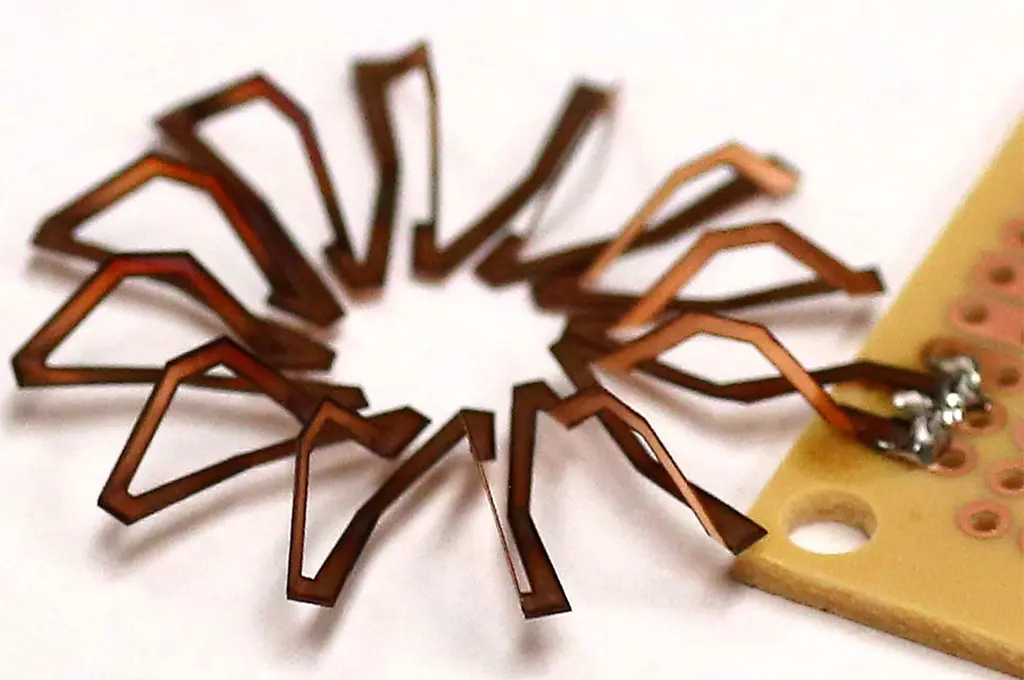
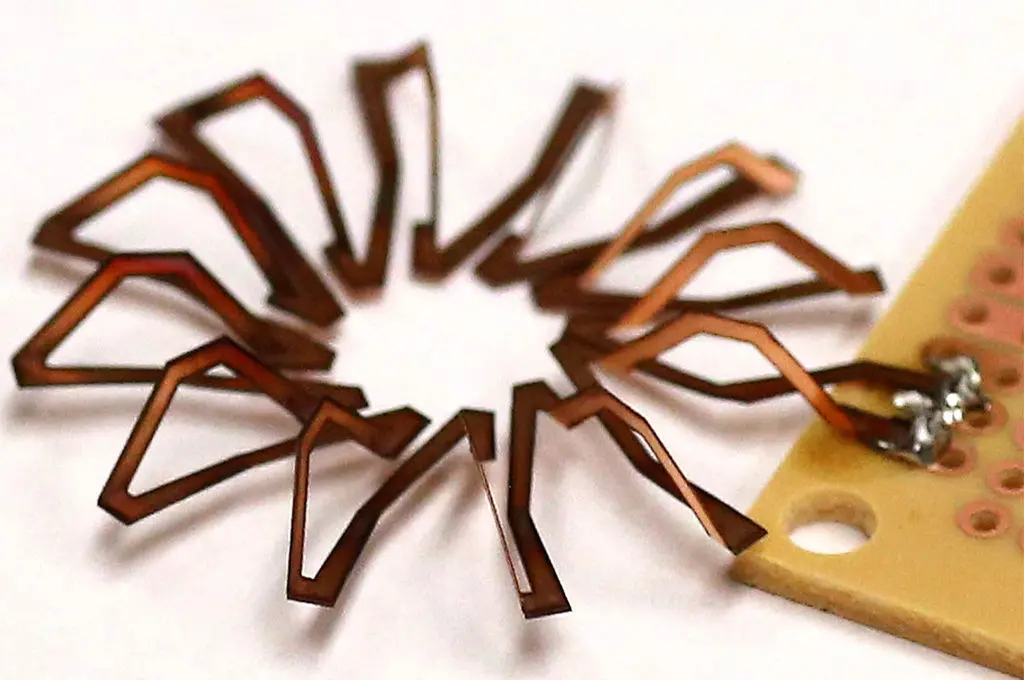
In research reported in an upcoming issue of IEEE Electron Device Letters, researchers at the U.S. Army Research Laboratory, in Adelphi, Md., show how they can make three-dimensional inductors by using a laser to both cut and fold copper. The Army is interested in origami inductors because the technology could give deployed soldiers the ability to make replacement parts rather than rely on what could be a risky and expensive delivery. But never mind its practical purpose; the process is just absolutely mesmerizing to watch.

The laser origami technique exploits a phenomenon called counterbending. Using the laser at half-power (10 watts) and rapid scanning (100 mm/s), the laser heats a spot to be bent. Because of the low power and brief blast, only one side of the copper gets hot. That side temporarily expands, bending away from the laser and producing permanent strain in the cooler, opposite side. When the hot spot contracts again, the strain bends the copper back up toward the laser, folding the copper permanently.

Compared to commercial inductors from Coilcraft that have about the same inductances, the laser-origami components rang in with similar quality factors. (Quality factor is a dimensionless quantity that tells how awesome your inductor is.)

The Army team—Nathan Lazarus, Sarah S. Bedair, and Gabriel L. Smith—are building a planar inductor, which requires a bit of conductor to protrude into the third dimension. It’s about 20 millimeters on a side, and the process took about 12 minutes.

They’re building a toroidal inductor, which is about as 3D as you get. It has an outer diameter of 34 mm, and inductance of 159 nanoHenry.
You can watch some more videos at the link here.


Related

Recent Posts

Würth Elektronik Developed a Custom Transformer for Active Hand Orthosis

26.1.2026
22

Passive Components in Quantum Computing

22.1.2026
93

Exxelia Offers Custom Naval Transformers and Inductors

21.1.2026
15

Researchers Demonstrated 32nm Aluminum Vacuum Gap Capacitor

20.1.2026
35

Conductive Polymer Capacitor Market and Design‑In Guide to 2035

20.1.2026
120

Würth Elektronik Introduces Product Navigator for Passive Components

14.1.2026
83

Panasonic Passive Components for Reliable Robotic Arms

14.1.2026
107

DC/DC Push‑Pull Converter vs PSFB Design Guide

12.1.2026
120

How Metal Prices Are Driving Passive Component Price Hikes

8.1.2026
412

Upcoming Events

Jan 27
16:00 - 17:00 CET

Simplifying Vehicle Development with Automotive Ethernet and Zonal Smart Switch Technologies

Feb 24
16:00 - 17:00 CET

Designing Qi2 Wireless Power Systems: Practical Development and EMC Optimization

Mar 3
16:00 - 17:00 CET

Cybersecurity at the Eleventh Hour – from RED to CRA – Information and Discussion

View Calendar

Popular Posts

  • Buck Converter Design and Calculation

    0 shares
    Share 0 Tweet 0
  • Boost Converter Design and Calculation

    0 shares
    Share 0 Tweet 0
  • LLC Resonant Converter Design and Calculation

    0 shares
    Share 0 Tweet 0
  • Flyback Converter Design and Calculation

    0 shares
    Share 0 Tweet 0
  • Ripple Current and its Effects on the Performance of Capacitors

    3 shares
    Share 3 Tweet 0
  • How Metal Prices Are Driving Passive Component Price Hikes

    0 shares
    Share 0 Tweet 0
  • MLCC and Ceramic Capacitors

    0 shares
    Share 0 Tweet 0
  • What is a Dielectric Constant and DF of Plastic Materials?

    4 shares
    Share 4 Tweet 0
  • Dual Active Bridge (DAB) Topology

    0 shares
    Share 0 Tweet 0
  • Degradation of Capacitors and its Failure Mechanisms

    0 shares
    Share 0 Tweet 0

Newsletter Subscription


Passive Components Blog

© EPCI - Leading Passive Components Educational and Information Site

  • Home
  • Privacy Policy
  • EPCI Membership & Advertisement
  • About

No Result
View All Result
  • Home
  • Knowledge Blog
  • PCNS

© EPCI - Leading Passive Components Educational and Information Site

This website uses cookies. By continuing to use this website you are giving consent to cookies being used. Visit our Privacy and Cookie Policy.
Go to mobile version