















Passive Components Blog
No Result
View All Result
  • Home
  • NewsFilter
    • All
    • Aerospace & Defence
    • Antenna
    • Applications
    • Automotive
    • Capacitors
    • Circuit Protection Devices
    • electro-mechanical news
    • Filters
    • Fuses
    • Inductors
    • Industrial
    • Integrated Passives
    • inter-connect news
    • Market & Supply Chain
    • Market Insights
    • Medical
    • Modelling and Simulation
    • New Materials & Supply
    • New Technologies
    • Non-linear Passives
    • Oscillators
    • Passive Sensors News
    • Resistors
    • RF & Microwave
    • Telecommunication
    • Weekly Digest

    Exxelia to Exhibit at APEC 2026 in San Antonio, Texas

    Würth Elektronik Presents Differential Pressure Sensor for HVAC and Medical

    Thermal Modeling of Magnetics

    ESA SPCD 26 Call for Papers Extended to 30th March

    Wk 11 Electronics Supply Chain Digest

    Binder Extends NCC Circular Connectors for Harsh Environments

    Standard vs Planar LLC transformers Comparison for Battery Chargers

    Würth Elektronik and Grinn Launch Edge AI Cooperation

    Bourns Expanded Semi-Shielded Low Profile Automotive Power Inductor

    Trending Tags

    • Ripple Current
    • RF
    • Leakage Current
    • Tantalum vs Ceramic
    • Snubber
    • Low ESR
    • Feedthrough
    • Derating
    • Dielectric Constant
    • New Products
    • Market Reports
  • VideoFilter
    • All
    • Antenna videos
    • Capacitor videos
    • Circuit Protection Video
    • Filter videos
    • Fuse videos
    • Inductor videos
    • Inter-Connect Video
    • Non-linear passives videos
    • Oscillator videos
    • Passive sensors videos
    • Resistor videos

    Thermal Modeling of Magnetics

    Standard vs Planar LLC transformers Comparison for Battery Chargers

    How Modern Tools Model Magnetic Components for Power Electronics

    Advanced Loss Modeling for Planar Magnetics in the Frenetic Planar Tool

    2026 Power Magnetics Design Trends: Flyback, DAB and Planar

    Enabling Software‑Defined Vehicle Architectures: Automotive Ethernet and Zonal Smart Power

    Calculating Resistance Value of a Flyback RC Snubber 

    One‑Pulse Characterization of Nonlinear Power Inductors

    Thermistor Linearization Challenges

    Trending Tags

    • Capacitors explained
    • Inductors explained
    • Resistors explained
    • Filters explained
    • Application Video Guidelines
    • EMC
    • New Products
    • Ripple Current
    • Simulation
    • Tantalum vs Ceramic
  • Knowledge Blog
  • DossiersNew
  • Suppliers
    • Who is Who
  • PCNS
    • PCNS 2025
    • PCNS 2023
    • PCNS 2021
    • PCNS 2019
    • PCNS 2017
  • Events
  • Home
  • NewsFilter
    • All
    • Aerospace & Defence
    • Antenna
    • Applications
    • Automotive
    • Capacitors
    • Circuit Protection Devices
    • electro-mechanical news
    • Filters
    • Fuses
    • Inductors
    • Industrial
    • Integrated Passives
    • inter-connect news
    • Market & Supply Chain
    • Market Insights
    • Medical
    • Modelling and Simulation
    • New Materials & Supply
    • New Technologies
    • Non-linear Passives
    • Oscillators
    • Passive Sensors News
    • Resistors
    • RF & Microwave
    • Telecommunication
    • Weekly Digest

    Exxelia to Exhibit at APEC 2026 in San Antonio, Texas

    Würth Elektronik Presents Differential Pressure Sensor for HVAC and Medical

    Thermal Modeling of Magnetics

    ESA SPCD 26 Call for Papers Extended to 30th March

    Wk 11 Electronics Supply Chain Digest

    Binder Extends NCC Circular Connectors for Harsh Environments

    Standard vs Planar LLC transformers Comparison for Battery Chargers

    Würth Elektronik and Grinn Launch Edge AI Cooperation

    Bourns Expanded Semi-Shielded Low Profile Automotive Power Inductor

    Trending Tags

    • Ripple Current
    • RF
    • Leakage Current
    • Tantalum vs Ceramic
    • Snubber
    • Low ESR
    • Feedthrough
    • Derating
    • Dielectric Constant
    • New Products
    • Market Reports
  • VideoFilter
    • All
    • Antenna videos
    • Capacitor videos
    • Circuit Protection Video
    • Filter videos
    • Fuse videos
    • Inductor videos
    • Inter-Connect Video
    • Non-linear passives videos
    • Oscillator videos
    • Passive sensors videos
    • Resistor videos

    Thermal Modeling of Magnetics

    Standard vs Planar LLC transformers Comparison for Battery Chargers

    How Modern Tools Model Magnetic Components for Power Electronics

    Advanced Loss Modeling for Planar Magnetics in the Frenetic Planar Tool

    2026 Power Magnetics Design Trends: Flyback, DAB and Planar

    Enabling Software‑Defined Vehicle Architectures: Automotive Ethernet and Zonal Smart Power

    Calculating Resistance Value of a Flyback RC Snubber 

    One‑Pulse Characterization of Nonlinear Power Inductors

    Thermistor Linearization Challenges

    Trending Tags

    • Capacitors explained
    • Inductors explained
    • Resistors explained
    • Filters explained
    • Application Video Guidelines
    • EMC
    • New Products
    • Ripple Current
    • Simulation
    • Tantalum vs Ceramic
  • Knowledge Blog
  • DossiersNew
  • Suppliers
    • Who is Who
  • PCNS
    • PCNS 2025
    • PCNS 2023
    • PCNS 2021
    • PCNS 2019
    • PCNS 2017
  • Events
No Result
View All Result
Passive Components Blog
No Result
View All Result

Lightweight Model for MLCC Appearance Defect Detection

3.11.2025
Reading Time: 4 mins read
A A

Researchers from China and Japan proposed a “lightweight and multi-scale model for MLCC appearance defect detection” in their work published by Optics & Laser Technology Journal.

Introduction

Multilayer ceramic capacitors (MLCCs) are critical components in electronics manufacturing, where surface appearance defects can compromise product reliability and yield.

RelatedPosts

Exxelia to Exhibit at APEC 2026 in San Antonio, Texas

Würth Elektronik Presents Differential Pressure Sensor for HVAC and Medical

Thermal Modeling of Magnetics

Detecting these defects is challenging because they vary widely in shape and size, often have unclear boundaries, and must be found quickly to meet real-time production demands.

The article introduces a new defect inspection vision system and a lightweight, multi-scale deep learning model designed to improve accuracy and speed in MLCC defect detection, addressing the limitations of existing approaches in industrial environments.

Key points

  • Problem focus: MLCC defect detection is hindered by irregular shapes, scale variation, fuzzy boundaries, and the need for rapid inference in production settings.
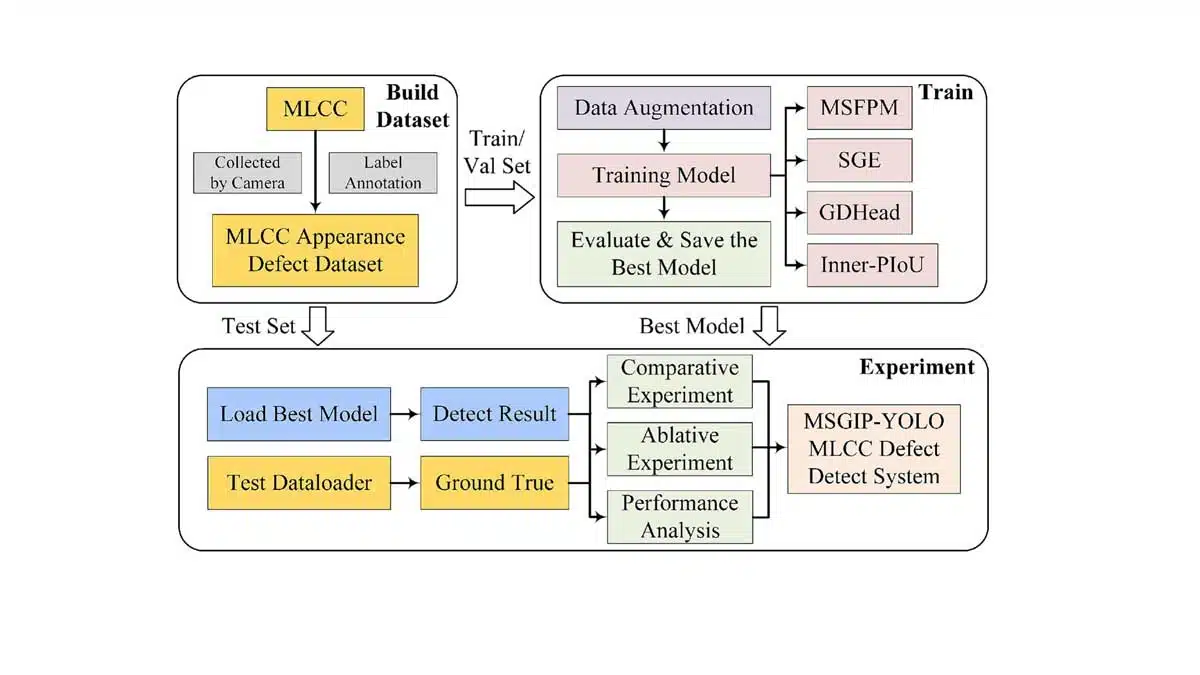
  • System and model: A defect inspection vision system (DIVS) and a lightweight model named MSFPM-SGE-GDHead-InnerPIoU-YOLO (MSGIP-YOLO) are proposed to tackle multi-scale detection efficiently.
  • Multi-scale fusion: The Multi-Scale Fusion Pyramid Module (MSFPM) enables robust multi-scale feature aggregation, enhancing detection across different defect sizes.
  • Spatial enhancement: Spatial Group-wise Enhance (SGE) optimizes spatial feature distributions, improving cross-scale consistency and localization.
  • Lightweight head: The Group Decoupled Head (GDHead) reduces redundant channels to lower parameters without sacrificing accuracy, improving speed.
  • Loss function: Inner-PIoU replaces the standard loss to boost generalization across scales and accelerate convergence.
  • Performance: On the MLCC dataset, the model achieves 93.4% mAP, 89.9% F1, 3.77M parameters, and 150 FPS inference, demonstrating real-time viability.

Extended summary

The article targets core challenges in MLCC appearance defect detection—most notably the high variance in defect geometry and scale, blurred or irregular edges, and stringent speed requirements on production lines. Traditional detectors often struggle with these conditions because their feature pyramids and heads are either too heavy for real-time use or insufficiently expressive for fine-grained, multi-scale localization. To bridge this gap, the authors construct an integrated defect inspection vision system (DIVS) and present a tailored model, MSGIP-YOLO, that balances multi-scale accuracy with inference efficiency.

Central to the approach is the Multi-Scale Fusion Pyramid Module (MSFPM), designed to aggregate features across scales more effectively than standard pyramids. By prioritizing efficient fusion, MSFPM strengthens the representation of both small and large defects while maintaining a compact architecture. Complementing this, Spatial Group-wise Enhance (SGE) refines spatial feature distributions, ensuring that salient defect cues are preserved and enhanced across scales, which is especially useful for defects with unclear boundaries where subtle spatial patterns determine correct localization.

To further streamline inference, the Group Decoupled Head (GDHead) rethinks the detection head architecture by minimizing redundant channels and decoupling tasks to reduce parameter count without degrading accuracy. This design maintains precision while enabling high frame rates suitable for in-line inspection. Additionally, the standard localization loss is replaced with Inner-PIoU, which encourages more robust box regression under scale variation. This loss formulation improves generalization to defects of diverse sizes and speeds up training convergence, leading to more reliable detection under real-world variability.

The experimental validation on an MLCC-specific dataset demonstrates the practical impact of these choices. MSGIP-YOLO achieves 93.4% mean average precision (mAP) and an 89.9% F1 score, indicating strong accuracy and balanced precision-recall performance. With just 3.77 million parameters and an inference speed of 150 frames per second (FPS), the model is sufficiently lightweight for deployment in industrial scenarios where real-time throughput and low latency are critical. These metrics underscore the model’s ability to deliver both speed and robustness, overcoming common barriers in MLCC defect detection such as fuzzy boundaries and irregular shapes.

The article positions MSGIP-YOLO as a practical, deployable solution for modern electronics manufacturing lines. By combining MSFPM for multi-scale feature fusion, SGE for spatial refinement, GDHead for parameter efficiency, and Inner-PIoU for improved regression behavior, the system aligns with industrial constraints while delivering improved detection quality. The dataset results suggest that the architecture is not merely theoretically appealing but also operationally effective within a defect inspection vision system, highlighting its potential for broader use in appearance inspection tasks beyond MLCCs.

Conclusion

MSGIP-YOLO advances MLCC appearance defect detection through targeted architectural innovations that improve multi-scale sensitivity and inference speed. With strong empirical performance and a compact design, it meets the demands of real-time industrial inspection. The combination of MSFPM, SGE, GDHead, and Inner-PIoU offers a cohesive framework that addresses scale variation, spatial clarity, and efficiency—positioning the approach as a promising, practical solution for high-throughput quality assurance in electronics manufacturing.

Read the complete paper:

Junwei Zheng, Xiuhua Cao, Dawei Zhang, Kiyoshi Takamasu, Meiyun Chen,
A lightweight and multi-scale model for MLCC appearance defect detection,
Optics & Laser Technology, Volume 193, Part A, 2026, 114173, ISSN 0030-3992,
https://doi.org/10.1016/j.optlastec.2025.114173.
(https://www.sciencedirect.com/science/article/pii/S0030399225017645)


Related

Source: Science Direct

Recent Posts

Exxelia to Exhibit at APEC 2026 in San Antonio, Texas

17.3.2026
22

ESA SPCD 26 Call for Papers Extended to 30th March

16.3.2026
80

Peak Nano to Develop Fusion Grade High Energy Film Capacitors

11.3.2026
32

Panasonic Expands Automotive PP Film Capacitors Voltage Range

9.3.2026
29

February 2026 Interconnect, Passives and Electromechanical Components Market Insights

9.3.2026
72

Empower Extends Embedded Silicon Capacitors for AI

6.3.2026
46

AI Servers Demand is Driving Tantalum Capacitor Price Hikes

5.3.2026
133

DMASS Reports Europe Components Up 9.8% in Q4 2025

3.3.2026
27

Mastering Galvanic Isolation in Power Electronics: Methods, Standards, and Implementation

2.3.2026
82

Upcoming Events

Mar 19
13:00 - 14:00 CDT

Smart Consideration of Inductor Thermal Performance

Mar 21
All day

PSMA Capacitor Workshop 2026

Mar 24
9:00 - 10:00 CET

Power protection in the digital age – eFuse and hot-swap strategies for modern data center design

View Calendar

Popular Posts

  • Buck Converter Design and Calculation

    0 shares
    Share 0 Tweet 0
  • Boost Converter Design and Calculation

    0 shares
    Share 0 Tweet 0
  • Flyback Converter Design and Calculation

    0 shares
    Share 0 Tweet 0
  • LLC Resonant Converter Design and Calculation

    0 shares
    Share 0 Tweet 0
  • MLCC Manufacturers Consider Price Increase as AI Demand Outpaces Supply

    0 shares
    Share 0 Tweet 0
  • Dual Active Bridge (DAB) Topology

    0 shares
    Share 0 Tweet 0
  • Ripple Current and its Effects on the Performance of Capacitors

    3 shares
    Share 3 Tweet 0
  • MLCC and Ceramic Capacitors

    0 shares
    Share 0 Tweet 0
  • MLCC Case Sizes Standards Explained

    0 shares
    Share 0 Tweet 0
  • 3-Phase EMI Filter Design, Simulation, Calculation and Test

    0 shares
    Share 0 Tweet 0

Newsletter Subscription


Passive Components Blog

© EPCI - Leading Passive Components Educational and Information Site

  • Home
  • Privacy Policy
  • EPCI Membership & Advertisement
  • About

No Result
View All Result
  • Home
  • Knowledge Blog
  • PCNS

© EPCI - Leading Passive Components Educational and Information Site

This website uses cookies. By continuing to use this website you are giving consent to cookies being used. Visit our Privacy and Cookie Policy.
Go to mobile version