






This overview article summarizes the global MLCC market in Q2/2026, outlines the roles of major manufacturers across Japan, Korea, Taiwan, China, Europe/US, and explains the key technology trends and AI requirements.
Multilayer ceramic capacitors (MLCCs) have moved into a new structural upcycle driven by AI servers, high‑performance computing and automotive electrification rather than traditional consumer devices. The present cycle is marked by a clear split: high‑end AI and automotive MLCCs are tight and expensive, while many commodity grades remain closer to balance—a pattern often described as a “K‑shaped recovery”.
Key Takeaways
- The global MLCC market is evolving, driven primarily by AI servers, high-performance computing, and automotive electrification, marking a K-shaped recovery.
- High-capacitance MLCCs for AI demand increased significantly, with industry forecasts estimating a growth of 30% CAGR by 2030 for AI server applications.
- MLCC supply remains concentrated among major manufacturers, with Murata and Samsung together dominating high-end AI server components, controlling around 84% of the market.
- Key technology trends include thinner dielectric layers, higher capacitance at elevated voltages, and integration of MLCCs with other passive components to meet AI and EV needs.
- Sourcing strategies should consider systemic supply risks across passive components, focusing on early alignment with suppliers and developing robust qualification regimes for high-capacitance MLCCs.
Market Environment and Structural Demand
Industry reports place the global MLCC market in the teens–low‑20‑billion by 2030 as communication standards advance and electric vehicles scale. AI infrastructure adds a new, fast‑growing layer of demand: a single AI rack can use hundreds of thousands of MLCCs, and Murata now expects MLCC shipments into AI servers to grow at around 30% CAGR, reaching roughly 3.3× the 2025 level by 2030.
Electric vehicles also remain a structural driver. Multi‑inverter powertrains, onboard chargers and ADAS electronics push demand for high‑voltage, high‑temperature MLCCs and related capacitors, contributing steady growth alongside AI‑driven data‑centre requirements.
K‑Shaped Recovery: Tight High‑End, Balanced Commodity
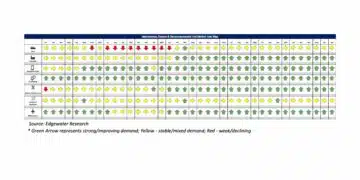
Since late 2025, MLCC demand has shifted from a broad recovery to a more selective, high‑end tightness. AI servers and high‑end automotive platforms are consuming disproportionate capacity via high‑capacitance, high‑voltage and high‑temperature MLCCs, while commodity low‑capacitance parts remain much less constrained.
Lead‑time data points to the same bifurcation. For key AI and automotive MLCC codes, delivery times from major suppliers have extended from roughly 8–10 weeks to about 20–26 weeks or more, especially for high‑capacitance X6S/X7R dielectric and high‑voltage products. In parallel, spot‑market articles describe chaotic pricing, inventory reshuffling and strong divergence between genuine high‑end demand and speculative activity—particularly in parts of the Chinese channel.
Technology Trends Under AI and EV Pressure
Across all regions, similar technology drivers are visible, accelerated by AI and EV requirements:
- Dielectric layer thinning and layer count growth
Computing‑grade MLCCs from leading Japanese and Korean suppliers now use dielectric layers below roughly 0.5 µm and more than 1,500 layers, delivering very high capacitance density in compact footprints. Chinese devices typically reach about 1 µm and 1,000 layers, demonstrating a tangible technology gap that affects AI server self‑sufficiency. - Higher volumetric capacitance at elevated voltages
AI PDNs and EV powertrains demand tens to hundreds of µF at voltages from a few volts up to several tens of volts for buses, snubbers and decoupling positions, pushing MLCCs toward larger case sizes, advanced ceramics and high‑end X6S/X7R systems. - Extended temperature and mission profiles
Automotive and industrial AI platforms operate at 125–150 °C with long mission lifetimes, requiring MLCCs with robust thermal cycling endurance, surge performance and mechanical reliability. - Integration with other passives and silicon capacitors
OEMs increasingly treat MLCCs, resistors, inductors, magnetics and EMI parts as a coupled passive risk domain, often sourcing them from integrated groups such as Murata, Samsung or Yageo. Silicon capacitors from Samsung and others are being inserted at critical package and board nodes to complement MLCC networks where ESL, thermal or space constraints dominate.
AI Hardware High-Capacitance MLCCs Requirements
AI GPU servers are the most MLCC-intensive mainstream electronic systems ever deployed. Industry analyses confirm that while a standard enterprise server uses approximately 2,500 MLCCs, an 8-GPU AI server requires 15,000–25,000 units, and a full NVIDIA GB200 NVL72 rack consumes roughly 440,000 MLCCs. At the next generation, NVIDIA’s VR300 compute node alone is estimated to require ~220,000 passive components, with a further ~110,000 in the power distribution section, bringing per-rack totals to industry estimates ~330,000 units. Google’s TPU v8 is estimated at approximately 600,000 passive components per rack.
The most critical MLCC segment is high-capacitance values (10 µF and above) in compact case sizes 0402 and 0201, predominantly X5R and X7R temperature characteristic. Samsung Electro-Mechanics began mass-producing of 0402 47 µF X6S 2.5 V; 0603 100 µF X6S 2.5 V; 1206 220 µF X6S 4 V and 330 µF in 1210 high capacitance MLCCs specifically to meet AI server needs. For 48 V power architectures, manufacturers have extended MLCC voltage ratings — devices rated at 100 V and above with multi-microfarad capacitance are now standard. For 800 V DC links, large-format 1 kV–2 kV MLCCs handle filtering and snubber functions.
The GB300 platform is estimated to require approximately 30,000 MLCCs per unit — about 30 times the number in a smartphone and three times that in a conventional automobile — illustrating why the AI sub-market has become the dominant driver of premium MLCC allocation.
| MLCC Tier / Application | Technology / Size | Key Requirements | Supply Status (Q2 2026) |
| High-cap decoupling (GPU/HBM POL) | X5R/X7R, 10–100 µF, 2.5–16 V, 0402/0201/01005 | Ultra-low ESL (<100 pH), stable C vs. DC bias, ≥85°C, high ripple current | Most constrained; 26–40 weeks; Murata/Samsung 84% AI share; spot +50–60% |
| Mid-voltage decoupling (48 V bus) | X5R/X7R, 1–22 µF, 25–100 V, 0402–0805 | Low ESR, DC bias stability, thermal stability to 125°C | Tightening; 100 V ratings standard; 16–26 weeks |
| High-voltage filtering (800 V DC link) | C0G/X7R/X7T, 10 nF–1 µF, 1–2 kV, 1206–2220 | High voltage endurance, low DF, stable vs. high dV/dt | Emerging; very few qualified suppliers; long qualification cycles |
| RF/clock stability (SerDes, clocking) | C0G/NP0, 0.1 pF–10 nF, 50–500 V, 01005–0402 | Stable C vs. T, V, f; very low loss (Q>1000 at 1 MHz) | Broadly available; limited AI-specific allocation pressure |
| On-package/embedded (ECAPs) | Silicon, 9–37 µF per die, 0.9–1.8 V, die-attached | ESL <1 pH, process-compatible, highest current density | Emerging; Empower Semi ECAPs in production Feb 2026 |
For AI PDNs, MLCCs have effectively become “hero components” that must be managed as strategically as GPUs and memory. They provide most of the high‑frequency decoupling, shape the impedance profile seen by GPUs and HBM stacks, and buffer transient current spikes that traditional bulk capacitors cannot handle alone. At the point of load (POL), X6S/X7R MLCCs in 0402, 0201 and even 01005 footprints form dense capacitor banks around GPU and accelerator packages, targeting very low impedance (milliohm level) up to several tens of MHz. Designers combine dozens to hundreds of small‑case MLCCs to lower effective ESL and ESR; any reduction in ESL directly widens the frequency band over which the PDN stays within the target impedance.
DC‑bias behaviour and temperature stability are now first‑order constraints. At low bias, a 47 µF 0402 device may deliver close to its nameplate capacitance, but at operating voltages and elevated temperature the effective capacitance can drop dramatically, eroding PDN margin. This is pushing AI platforms toward X6S systems and vendors that can provide detailed C(V,T) curves, allowing PDN engineers to simulate worst‑case impedance rather than relying on nominal values.
Global and AI MLCC Market Share
Recent industry summaries show that the top five global MLCC companies hold around 77% of total market share, with Murata and Samsung Electro‑Mechanics together accounting for more than half of the high‑end segment. Chinese manufacturers collectively reach roughly 10% of global revenue, while Taiwanese suppliers and Western vendors share the remaining mid‑teens.
Japanese MLCC manufacturers remain at the centre of the industry. Murata Manufacturing is widely seen as the global leader, with particularly strong positions in automotive, industrial and ultra‑miniature MLCCs, and a growing focus on AI server PDNs. TDK, Taiyo Yuden, Kyocera AVX and MARUWA add substantial capacity in high‑voltage, high‑frequency and high‑reliability segments. These manufacturers have been first movers in dielectric materials, layer thinning and reliability data, and they continue to dominate the most demanding automotive and computing specifications.
Korean suppliers, led by Samsung Electro‑Mechanics (SEMCO), are consolidating their role in high‑value MLCCs for AI servers and automotive designs. Samsung’s Q4 2025 results highlight growth driven by AI infrastructure and server platforms, along with expanded portfolios for high‑capacitance, high‑voltage and automotive‑grade MLCCs. Samsung is also ramping silicon capacitors targeted at high‑performance semiconductor packages and AI servers, emphasising that these devices complement MLCC arrays rather than fully replacing them. This positions Korea as a dual hub for both conventional MLCCs and advanced silicon capacitors in AI PDNs.
Taiwanese manufacturers bridge the gap between high‑end and mainstream MLCCs. Yageo Group, strengthened by its acquisition of KEMET and Pulse Electronics, now offers integrated portfolios of MLCCs, resistors, inductors and magnetics for automotive, industrial and communications markets. Yageo has invested heavily in new high‑end MLCC capacity in Kaohsiung and is identified as a key supplier of X6S MLCCs for AI servers and high‑performance systems. Walsin Technology and other Taiwanese firms are also benefiting from AI‑linked demand and have implemented price increases on selected resistors and MLCCs as their utilisation rises. Together, Taiwan contributes both AI‑grade MLCCs and large‑volume commodity parts, making it an important region for diversified sourcing.
Western manufacturers such as Vishay and KEMET (within Yageo) remain important in industrial, aerospace and defence niches, with strong offerings in other capacitor families (tantalum, polymer, film) and selected MLCC ranges. Their direct role in AI server MLCC supply is more selective, but they contribute to diversification across the broader passive BOM, particularly where specific reliability or legacy standards are required.
AI Hardware MLCC market concentration
Analyst and media reports indicate that Murata and Samsung are creating AI server MLCC sub-market duopoly. In the current estimation Murata and Samsung together account for ≈80–85% of AI‑grade MLCCs, with Murata in the mid‑40% range and Samsung around 40%. TDK holds ~5%, Taiyo Yuden ~4%, and all others ~7%.
Price increases and lead‑time extensions are already visible across specialised MLCCs, particularly for AI and automotive applications..
| Manufacturer | HQ | Global MLCC Share | AI Server MLCC Share |
| Murata Manufacturing | Japan | ~40% | ~45% |
| Samsung Electro-Mechanics | Korea | ~18% | ~40% |
| TDK | Japan | ~12% | <5% |
| Taiyo Yuden | Japan | ~10% | <4% |
| Yageo | Taiwan | ~10% | ~3% |
| Kyocera AVX | Japan/US | ~5% | <2% |
| Others | Global | ~5% | <1% |
A donut or pie chart based on these ranges (e.g. Murata, Samsung, other Japan, Korea, Taiwan, China, Europe/US) makes the degree of concentration immediately visible below.
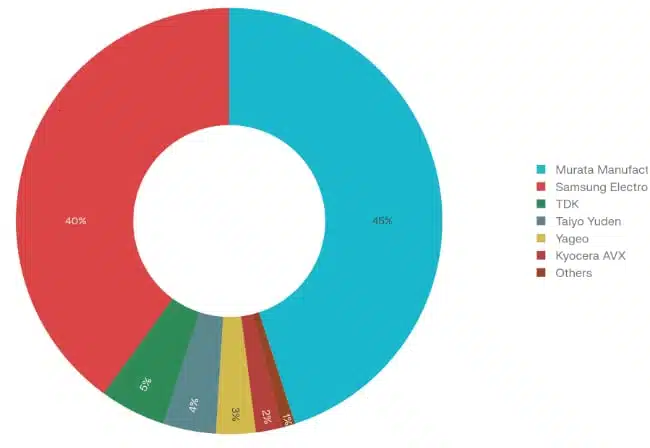
AI Server MLCC Market Share by Manufacturer. (est), source: AI Hardware Passive Components Dossier – Passive Components Blog
Sourcing Implications for AI Hardware
Within capacitors, MLCCs represent the largest value pool and the most concentrated power, but similar patterns appear elsewhere: in inductors, a small group of Japanese and European companies accounts for the bulk of high‑frequency power and TLVR parts, and in resistors, a limited number of vendors supply the AEC‑Q and low‑TCR shunts used in GPU VRMs and busbars. Circuit‑protection and EMI components (TVS diodes, varistors, common‑mode chokes, ferrite beads) show slightly broader supplier diversity, but here too the highest‑performance grades for AI servers and data‑centre powertrains are anchored at a few incumbents with process and materials know‑how that cannot be quickly duplicated.
As a result, supply risk in AI hardware is systemic across the passive BOM, not only an “MLCC problem”, and procurement strategies increasingly treat capacitors, magnetics, resistors, and EMI parts as a single coupled risk domain rather than independent categories.
For AI PDNs, MLCCs have effectively become “hero components” that must be managed as strategically as GPUs and memory. The combination of complex electrical requirements (low impedance, controlled ESR/ESL, high capacitance, voltage and temperature margins) and concentrated supply (Murata/Samsung duopoly in key AI codes, plus selected Japanese/Taiwanese lines) means design and procurement must be tightly coordinated.
Practical implications include:
- Early alignment with supplier roadmaps for high‑capacitance and high‑voltage MLCCs;
- Structured second‑source strategies where feasible, recognising that some cutting‑edge AI parts may remain effectively single‑source;
- Conservative derating and robust qualification regimes for AI and EV mission profiles;
- Monitoring of silicon capacitor deployments and their impact on MLCC arrays and sourcing.
Source and Further Reference:
To learn more about passive components for AI hardware and consequences for passive components selection and requirements lear more from the AI Hardware Passive Components Technology Dossier at Passive Components Blog Dossiers page.
FAQ – MLCCs for AI
The most critical MLCCs are high‑capacitance X6S/X7R devices for GPU/HBM point‑of‑load decoupling, mid‑voltage MLCCs for 12–48 V buses, and high‑voltage MLCCs for input and DC‑link filtering. All must meet strict impedance, DC‑bias, temperature and reliability requirements.
Industry reports suggest that AI‑grade and automotive MLCC lead times will remain elevated and volatile—often 16–20+ weeks and up to 30 weeks or more for certain codes—through late 2026, with structural tightness likely to persist into 2027 as new capacity ramps and qualifications complete.
AI hardware engineers should simulate using effective capacitance at operating voltage and temperature, not nominal nameplate values. That usually means derating by tens of percent based on vendor C(V,T) data, then adding margin through extra devices or higher‑performance dielectrics such as X6S.
On‑package silicon capacitors can significantly lower ESL and improve very high‑frequency impedance close to GPUs and ASICs, reducing some of the burden on MLCC banks. However, they complement rather than replace MLCCs; bulk energy storage and mid‑frequency decoupling still rely on large MLCC arrays and film/tantalum capacitors.
For cutting‑edge AI applications, true second‑source options are limited. Murata and Samsung supply most of the highest‑end MLCCs, while TDK, Taiyo Yuden and Taiwanese vendors can cover parts of the mid‑range. Designers often qualify alternatives for less critical nodes and accept single‑sourcing on the most aggressive MLCC codes.
Effective strategies include early engagement with key suppliers, multi‑year allocation agreements for AI programs, conservative derating and qualification, and designing HW with some flexibility in case size and voltage so that substitute MLCC families can be used if necessary.