





Passive Components Blog
No Result
View All Result
  • Home
  • NewsFilter
    • All
    • Aerospace & Defence
    • Antenna
    • Applications
    • Automotive
    • Capacitors
    • Circuit Protection Devices
    • electro-mechanical news
    • Filters
    • Fuses
    • Inductors
    • Industrial
    • Integrated Passives
    • inter-connect news
    • Market & Supply Chain
    • Market Insights
    • Medical
    • Modelling and Simulation
    • New Materials & Supply
    • New Technologies
    • Non-linear Passives
    • Oscillators
    • Passive Sensors News
    • Resistors
    • RF & Microwave
    • Telecommunication
    • Weekly Digest

    Modelithics Library for MATLAB: Measurement-Based Models for Microwave and RF Passive Components

    Bourns Extends Multilayer Chip Inductors Offer for RF and Wireless Designs

    Researchers developed a polymer capacitor by combining two cheap, commercially available plastics. The new polymer capacitor makes use of the transparent material — pictured here, with vintage Penn State athletic marks visible through it — to store four times the energy and withstand significantly more heat.  Credit: Penn State

    Penn State Demonstrated Polymer Alloy Capacitor Film with 4× Energy Density up to 250C

    ECIA January 2026 Reports Strong Sales Confidence

    Vishay Unveils Ultra-Compact 0201 Thick Film Chip Resistors

    Würth Elektronik Component Data Live in Accuris

    Coilcraft Releases Automotive Common Mode Chokes

    MLCC Manufacturers Consider Price Increase as AI Demand Outpaces Supply

    YAGEO Extends Antenna Portfolio with Wi‑Fi 6E/7 and Tri‑band GNSS Solutions

    Trending Tags

    • Ripple Current
    • RF
    • Leakage Current
    • Tantalum vs Ceramic
    • Snubber
    • Low ESR
    • Feedthrough
    • Derating
    • Dielectric Constant
    • New Products
    • Market Reports
  • VideoFilter
    • All
    • Antenna videos
    • Capacitor videos
    • Circuit Protection Video
    • Filter videos
    • Fuse videos
    • Inductor videos
    • Inter-Connect Video
    • Non-linear passives videos
    • Oscillator videos
    • Passive sensors videos
    • Resistor videos

    2026 Power Magnetics Design Trends: Flyback, DAB and Planar

    Enabling Software‑Defined Vehicle Architectures: Automotive Ethernet and Zonal Smart Power

    Calculating Resistance Value of a Flyback RC Snubber 

    One‑Pulse Characterization of Nonlinear Power Inductors

    Thermistor Linearization Challenges

    Coaxial Connectors and How to Connect with PCB

    PCB Manufacturing, Test Methods, Quality and Reliability

    Transformer Behavior – Current Transfer and Hidden Feedback

    Choosing the Right Capacitor: The Importance of Accurate Measurements

    Trending Tags

    • Capacitors explained
    • Inductors explained
    • Resistors explained
    • Filters explained
    • Application Video Guidelines
    • EMC
    • New Products
    • Ripple Current
    • Simulation
    • Tantalum vs Ceramic
  • Knowledge Blog
  • DossiersNew
  • Suppliers
    • Who is Who
  • PCNS
    • PCNS 2025
    • PCNS 2023
    • PCNS 2021
    • PCNS 2019
    • PCNS 2017
  • Events
  • Home
  • NewsFilter
    • All
    • Aerospace & Defence
    • Antenna
    • Applications
    • Automotive
    • Capacitors
    • Circuit Protection Devices
    • electro-mechanical news
    • Filters
    • Fuses
    • Inductors
    • Industrial
    • Integrated Passives
    • inter-connect news
    • Market & Supply Chain
    • Market Insights
    • Medical
    • Modelling and Simulation
    • New Materials & Supply
    • New Technologies
    • Non-linear Passives
    • Oscillators
    • Passive Sensors News
    • Resistors
    • RF & Microwave
    • Telecommunication
    • Weekly Digest

    Modelithics Library for MATLAB: Measurement-Based Models for Microwave and RF Passive Components

    Bourns Extends Multilayer Chip Inductors Offer for RF and Wireless Designs

    Researchers developed a polymer capacitor by combining two cheap, commercially available plastics. The new polymer capacitor makes use of the transparent material — pictured here, with vintage Penn State athletic marks visible through it — to store four times the energy and withstand significantly more heat.  Credit: Penn State

    Penn State Demonstrated Polymer Alloy Capacitor Film with 4× Energy Density up to 250C

    ECIA January 2026 Reports Strong Sales Confidence

    Vishay Unveils Ultra-Compact 0201 Thick Film Chip Resistors

    Würth Elektronik Component Data Live in Accuris

    Coilcraft Releases Automotive Common Mode Chokes

    MLCC Manufacturers Consider Price Increase as AI Demand Outpaces Supply

    YAGEO Extends Antenna Portfolio with Wi‑Fi 6E/7 and Tri‑band GNSS Solutions

    Trending Tags

    • Ripple Current
    • RF
    • Leakage Current
    • Tantalum vs Ceramic
    • Snubber
    • Low ESR
    • Feedthrough
    • Derating
    • Dielectric Constant
    • New Products
    • Market Reports
  • VideoFilter
    • All
    • Antenna videos
    • Capacitor videos
    • Circuit Protection Video
    • Filter videos
    • Fuse videos
    • Inductor videos
    • Inter-Connect Video
    • Non-linear passives videos
    • Oscillator videos
    • Passive sensors videos
    • Resistor videos

    2026 Power Magnetics Design Trends: Flyback, DAB and Planar

    Enabling Software‑Defined Vehicle Architectures: Automotive Ethernet and Zonal Smart Power

    Calculating Resistance Value of a Flyback RC Snubber 

    One‑Pulse Characterization of Nonlinear Power Inductors

    Thermistor Linearization Challenges

    Coaxial Connectors and How to Connect with PCB

    PCB Manufacturing, Test Methods, Quality and Reliability

    Transformer Behavior – Current Transfer and Hidden Feedback

    Choosing the Right Capacitor: The Importance of Accurate Measurements

    Trending Tags

    • Capacitors explained
    • Inductors explained
    • Resistors explained
    • Filters explained
    • Application Video Guidelines
    • EMC
    • New Products
    • Ripple Current
    • Simulation
    • Tantalum vs Ceramic
  • Knowledge Blog
  • DossiersNew
  • Suppliers
    • Who is Who
  • PCNS
    • PCNS 2025
    • PCNS 2023
    • PCNS 2021
    • PCNS 2019
    • PCNS 2017
  • Events
No Result
View All Result
Passive Components Blog
No Result
View All Result

Murata Introduces World’s Smallest SAW Filters for Denser Circuit Design and 5G Smartphones

16.7.2019
Reading Time: 4 mins read
A A

Source: Murata news

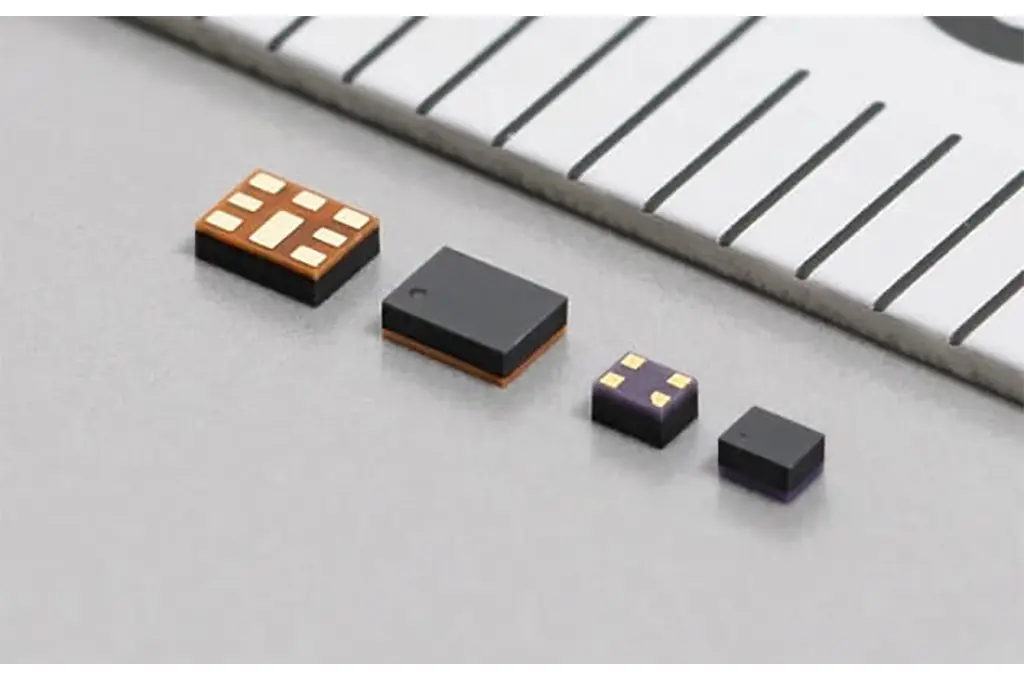
Murata Manufacturing Co., Ltd. has developed and started volume production of the world’s smallest*1 SAW*2 duplexers*3—the SAYAV Series, SAYARV Series, and SAYAP Series; and SAW filters—the SAFFW Series (hereinafter “the Products”).
*1 Based on an internal study, as of the end of June 2019.
*2 An acoustic wave traveling along the surface of a material (SAW: Surface Acoustic Wave).
*3 Devices that allow transmitters and receivers to share a common antenna while electronically splitting the transmission and receiving lines.

RelatedPosts

Modelithics Library for MATLAB: Measurement-Based Models for Microwave and RF Passive Components

Bourns Extends Multilayer Chip Inductors Offer for RF and Wireless Designs

Penn State Demonstrated Polymer Alloy Capacitor Film with 4× Energy Density up to 250C

The steady improvement in smartphone performance is driving the demand for more compact electronic components. In particular, there is an acute need for smaller SAW devices that transmit and receive signals at certain frequencies. In order to support multiple band operation, middle-class smartphones for specific regions use 14 or 15 SAW devices while premium models with global compatibility may adopt as many as 30 to 40 SAW devices.

By fully revising the chip design and packaging approach making use of its own proprietary design and miniaturization technology, Murata has developed the Products with characteristics equal or superior to those of conventional products while simultaneously achieving the world’s smallest size.

Highlights
The key features of the Products are as follows:

The World’s Smallest SAW Devices.

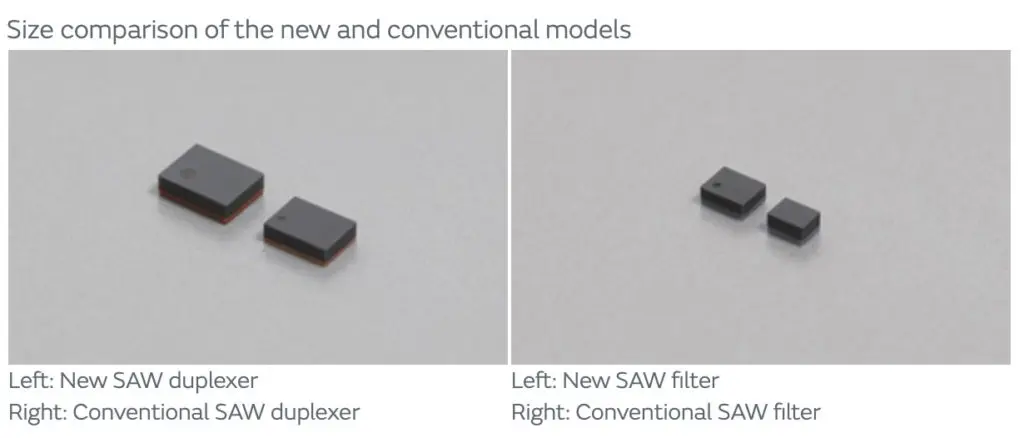
The SAYAV Series, SAYRV Series, and SAYAP Series of SAW duplexers supporting the 700MHz to 2.6GHz bands are packaged in 1.6mm x 1.2mm (length x width) form factor, and SAFFW Series of SAW filters are packaged in a 0.9mm x 0.7mm (length x width) form factor, making the duplexers approx. 24% and the filters approx. 37% smaller than conventional models*4. This makes possible significant reductions in mounting area on electronic circuits and contributes to high-density circuit design.
*4 Compared with a 1.8mm x 1.4mm SAW duplexer and a 1.1mm x 0.9mm SAW filter, respectively
Realizing Characteristics Equal or Superior to Those of Conventional Products

By leveraging its own design and miniaturization technology, Murata has achieved excellent characteristics while minimizing the degradation of characteristics associated with reduced size. The Products exhibit transmission*5 and isolation characteristics*6 equal or superior to those of conventional products. They are also among the first such products to realize improved power durability that meets the higher power requirements that will be required by future smartphones beginning with those being developed for use with the 5th generation mobile communications system (5G).

*5 The degree of transmission loss between the antenna and the transmitting/receiving circuits
*6 A characteristic that separates the filtering functions for transmitting and receiving in duplexers

A Lineup Covering the Major Frequency Bands

The lineup includes products compatible with the major frequency bands of the frequency band classification standard defined by the standardization organization 3GPP*7.

Lineup and supported frequency bands

SAW duplexer SAW filter
Band P/N Band P/N
1 SAYAV1G95BA0F0A 1 SAFFW2G14AA0E0A
2 SAYAP1G88BA0C0A 2 SAFFW1G96AA0E0A
3 SAYRV1G74BC0C0A 3 SAFFW1G84AA0E0A
5 SAYRV836MBA0F0A 5 SAFFW881MAA0E0A
7 SAYRV2G53BA0E0A 7 SAFFW2G65AA0E0A
8 SAYRV897MBA0C0A 8 SAFFW942MAA0E0A
20 SAYAP806MBA0C0A 40 SAFFW2G35AA0E0A
41 SAFFW2G59AA1E0A
GNSS SAFFW1G56AA0E0A
ISM2.4GHz SAFFW2G45MA0E0A

*7 An acronym of Third Generation Partnership Project, a standards organization that studies and develops the standard specifications of mobile communication systems for 3G and beyond.

Murata will expand this product lineup to support major communications bands between 700MHz and 2.6GHz by the end of FY2019. The company is also developing products compatible with the sub-6 GHz and the 3GHz to 6GHz bands that are expected to be used in 5G. Murata will continue developing smaller products that meet the needs of the market and of its customers, in order to contribute to saving space on electronic circuit boards and facilitating high-density circuit design.

Other Technical Information
In the communication environment based on the 4th generation mobile communications system (4G), the range of frequency bands that smartphones need to support has increased, while new wireless technologies designed to improve communications quality such as carrier aggregation*8 and MIMO*9 have been developed. Moreover, the full adoption of 5G is expected to lead to more complex RF circuits that will play a role in both transmission and receiver.

The Products are discrete devices equipped with a single duplexer or filter function. Premium smartphone models that are required to be compatible with a large number of frequency bands employ small modules that incorporate multiple SAW devices corresponding to different frequency bands in a single compact package.

In future, Murata will work to further reduce the size of these modules by harnessing the proprietary design and miniaturization technology employed in the development the Products.

*8 A technology for improving communication speed by combining multiple carriers into one data channel
*9 An acronym of multiple-input and multiple-output, MIMO improves the speed of communication by employing multiple transmitting and receiving antennas.

Related

Recent Posts

Bourns Extends Multilayer Chip Inductors Offer for RF and Wireless Designs

20.2.2026
7

Murata Releases World’s First Inner Cavity-Structure Ultra-Low-Loss LCP Flexible Substrate

10.12.2025
115

Transient Suppression Guide

19.11.2025
167

Overvoltage and Transient Protection for DC/DC Power Modules

13.11.2025
187

3-Phase EMI Filter Design, Simulation, Calculation and Test

6.11.2025
852

Bourns Releases High Current Metal Alloy-based, Multilayer Power Chip Inductors

31.10.2025
54

Littelfuse Releases First Reflow-Compatible Illuminated Tactile Switch

1.10.2025
19

Components Thermal and Frequency Challenges in 6G Base Stations

30.9.2025
85

Kyocera Launches New SAW Filter for GNSS 1.6GHz Satellite Communications

30.9.2025
55

Upcoming Events

Feb 24
16:00 - 17:00 CET

Mastering Galvanic Isolation: Ensuring Safety in Power Electronics

Mar 3
16:00 - 17:00 CET

Cybersecurity at the Eleventh Hour – from RED to CRA – Information and Discussion

Mar 21
All day

PSMA Capacitor Workshop 2026

View Calendar

Popular Posts

  • Buck Converter Design and Calculation

    0 shares
    Share 0 Tweet 0
  • Boost Converter Design and Calculation

    0 shares
    Share 0 Tweet 0
  • LLC Resonant Converter Design and Calculation

    0 shares
    Share 0 Tweet 0
  • Flyback Converter Design and Calculation

    0 shares
    Share 0 Tweet 0
  • Ripple Current and its Effects on the Performance of Capacitors

    3 shares
    Share 3 Tweet 0
  • Dual Active Bridge (DAB) Topology

    0 shares
    Share 0 Tweet 0
  • What is a Dielectric Constant and DF of Plastic Materials?

    4 shares
    Share 4 Tweet 0
  • MLCC and Ceramic Capacitors

    0 shares
    Share 0 Tweet 0
  • MLCC Case Sizes Standards Explained

    0 shares
    Share 0 Tweet 0
  • SEPIC Converter Design and Calculation

    0 shares
    Share 0 Tweet 0

Newsletter Subscription


Passive Components Blog

© EPCI - Leading Passive Components Educational and Information Site

  • Home
  • Privacy Policy
  • EPCI Membership & Advertisement
  • About

No Result
View All Result
  • Home
  • Knowledge Blog
  • PCNS

© EPCI - Leading Passive Components Educational and Information Site

This website uses cookies. By continuing to use this website you are giving consent to cookies being used. Visit our Privacy and Cookie Policy.
Go to mobile version