





Passive Components Blog
No Result
View All Result
  • Home
  • NewsFilter
    • All
    • Aerospace & Defence
    • Antenna
    • Applications
    • Automotive
    • Capacitors
    • Circuit Protection Devices
    • electro-mechanical news
    • Filters
    • Fuses
    • Inductors
    • Industrial
    • Integrated Passives
    • inter-connect news
    • Market & Supply Chain
    • Market Insights
    • Medical
    • Modelling and Simulation
    • New Materials & Supply
    • New Technologies
    • Non-linear Passives
    • Oscillators
    • Passive Sensors News
    • Resistors
    • RF & Microwave
    • Telecommunication
    • Weekly Digest

    Binder Hybrid Connector Simplifies One Cable Automation

    Tapped Inductor Buck Converter Fundamentals

    TAIYO YUDEN Releases Mini Metal Power Inductors

    Molecular Memristor Shows Record 145 kH Emergent Inductance

    Planar vs Conventional Transformer: When it Make Sense

    Researchers Propose Next‑Gen Compact Memory Using Ultra-thin Ferroelectric Capacitors

    Nichicon ADN Automotive Hybrid Aluminum Capacitors Now Available in EMEA

    Wk 19 Electronics Supply Chain Digest

    Electrocaloric Multilayer Capacitors: Towards Quiet, Solid‑State Cooling Around Room Temperature

    Trending Tags

    • Ripple Current
    • RF
    • Leakage Current
    • Tantalum vs Ceramic
    • Snubber
    • Low ESR
    • Feedthrough
    • Derating
    • Dielectric Constant
    • New Products
    • Market Reports
  • VideoFilter
    • All
    • Antenna videos
    • Capacitor videos
    • Circuit Protection Video
    • Filter videos
    • Fuse videos
    • Inductor videos
    • Inter-Connect Video
    • Non-linear passives videos
    • Oscillator videos
    • Passive sensors videos
    • Resistor videos

    Tapped Inductor Buck Converter Fundamentals

    Planar vs Conventional Transformer: When it Make Sense

    Modeling Fringing Field Losses in Inductors & Transformers

    Why Power Inductors Use a Ferrite Core With an Air Gap

    Transformer-Based Power-Line Harvester Magnetic Design

    Thermal Modeling of Magnetics

    Standard vs Planar LLC transformers Comparison for Battery Chargers

    How Modern Tools Model Magnetic Components for Power Electronics

    Advanced Loss Modeling for Planar Magnetics in the Frenetic Planar Tool

    Trending Tags

    • Capacitors explained
    • Inductors explained
    • Resistors explained
    • Filters explained
    • Application Video Guidelines
    • EMC
    • New Products
    • Ripple Current
    • Simulation
    • Tantalum vs Ceramic
  • Knowledge Blog
  • DossiersNew
  • Suppliers
    • Who is Who
  • PCNS
    • PCNS 2025
    • PCNS 2023
    • PCNS 2021
    • PCNS 2019
    • PCNS 2017
  • Events
  • Home
  • NewsFilter
    • All
    • Aerospace & Defence
    • Antenna
    • Applications
    • Automotive
    • Capacitors
    • Circuit Protection Devices
    • electro-mechanical news
    • Filters
    • Fuses
    • Inductors
    • Industrial
    • Integrated Passives
    • inter-connect news
    • Market & Supply Chain
    • Market Insights
    • Medical
    • Modelling and Simulation
    • New Materials & Supply
    • New Technologies
    • Non-linear Passives
    • Oscillators
    • Passive Sensors News
    • Resistors
    • RF & Microwave
    • Telecommunication
    • Weekly Digest

    Binder Hybrid Connector Simplifies One Cable Automation

    Tapped Inductor Buck Converter Fundamentals

    TAIYO YUDEN Releases Mini Metal Power Inductors

    Molecular Memristor Shows Record 145 kH Emergent Inductance

    Planar vs Conventional Transformer: When it Make Sense

    Researchers Propose Next‑Gen Compact Memory Using Ultra-thin Ferroelectric Capacitors

    Nichicon ADN Automotive Hybrid Aluminum Capacitors Now Available in EMEA

    Wk 19 Electronics Supply Chain Digest

    Electrocaloric Multilayer Capacitors: Towards Quiet, Solid‑State Cooling Around Room Temperature

    Trending Tags

    • Ripple Current
    • RF
    • Leakage Current
    • Tantalum vs Ceramic
    • Snubber
    • Low ESR
    • Feedthrough
    • Derating
    • Dielectric Constant
    • New Products
    • Market Reports
  • VideoFilter
    • All
    • Antenna videos
    • Capacitor videos
    • Circuit Protection Video
    • Filter videos
    • Fuse videos
    • Inductor videos
    • Inter-Connect Video
    • Non-linear passives videos
    • Oscillator videos
    • Passive sensors videos
    • Resistor videos

    Tapped Inductor Buck Converter Fundamentals

    Planar vs Conventional Transformer: When it Make Sense

    Modeling Fringing Field Losses in Inductors & Transformers

    Why Power Inductors Use a Ferrite Core With an Air Gap

    Transformer-Based Power-Line Harvester Magnetic Design

    Thermal Modeling of Magnetics

    Standard vs Planar LLC transformers Comparison for Battery Chargers

    How Modern Tools Model Magnetic Components for Power Electronics

    Advanced Loss Modeling for Planar Magnetics in the Frenetic Planar Tool

    Trending Tags

    • Capacitors explained
    • Inductors explained
    • Resistors explained
    • Filters explained
    • Application Video Guidelines
    • EMC
    • New Products
    • Ripple Current
    • Simulation
    • Tantalum vs Ceramic
  • Knowledge Blog
  • DossiersNew
  • Suppliers
    • Who is Who
  • PCNS
    • PCNS 2025
    • PCNS 2023
    • PCNS 2021
    • PCNS 2019
    • PCNS 2017
  • Events
No Result
View All Result
Passive Components Blog
No Result
View All Result

Researchers Developed 2D High‑κ Perovskites Dielectric Nanosheets for High Energy Density of Capacitors

10.10.2023
Reading Time: 4 mins read
A A

A research group led by Professor Minoru Osada at the Institute for Materials and Systems for Sustainability (IMaSS), Nagoya University in Japan, in collaboration with NIMS, has developed a nanosheet device with the highest energy storage performance yet seen. Their results were published in Nano Letters.

Innovations in energy storage technology are vital for the effective use of renewable energy and the mass production of electric vehicles. Current energy storage technology, such as lithium-ion batteries, has long charging times and problems, including electrolyte degradation, lifetime, and even unwanted ignition.

RelatedPosts

Binder Hybrid Connector Simplifies One Cable Automation

Tapped Inductor Buck Converter Fundamentals

TAIYO YUDEN Releases Mini Metal Power Inductors

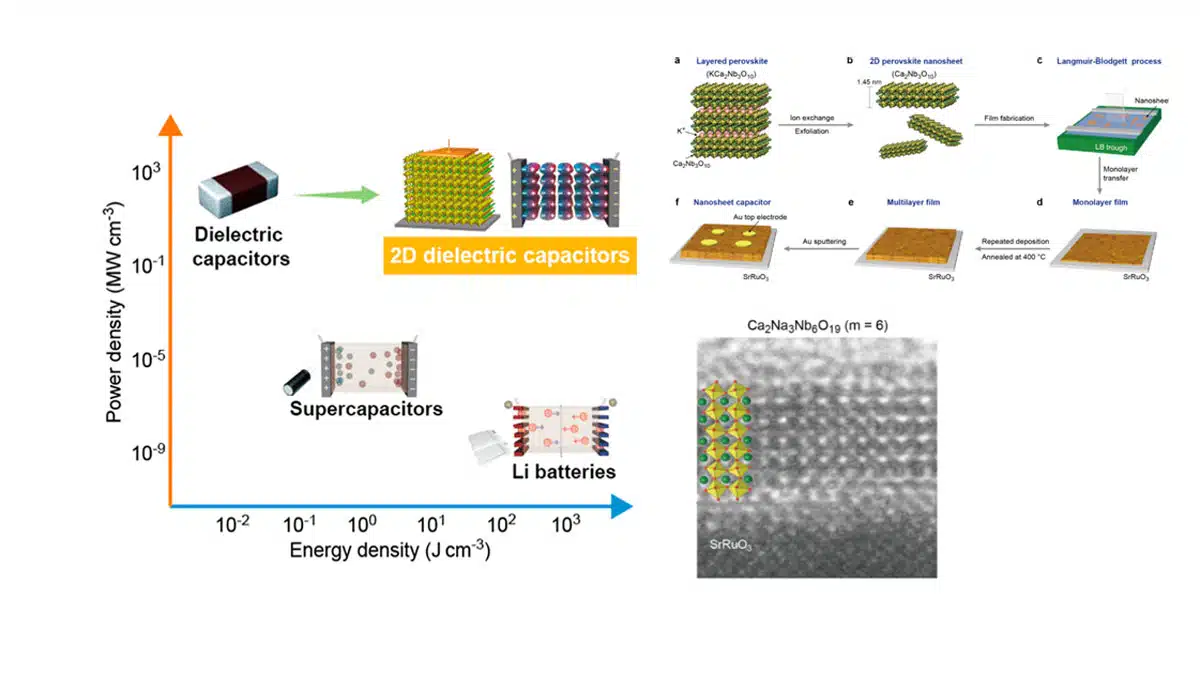
One promising alternative is dielectric energy storage capacitors. The basic structure of the capacitor is a sandwich-like film made of two metal electrodes separated by a solid dielectric film. Dielectrics are materials that store energy through a physical charge displacement mechanism called polarization. When an electric field is applied to the capacitor, the positive charges are attracted towards the negative electrode. The negative charges are attracted towards the positive electrode. Then, storing electrical energy depends on the polarization of the dielectric film by applying an external electric field.

“The dielectric capacitors have many advantages, such as a short charging time of only a few seconds, long life, and high-power density,” Osada said. However, the energy density of current dielectrics falls significantly short of meeting the increasing demands for electrical energy. Enhancing the energy density would help dielectric capacitors compete with other energy storage devices.

Since the energy stored in a dielectric capacitor is related to the amount of polarization, the key to achieving high energy density is to apply as high an electric field as possible to a high dielectric constant material. However, existing materials are limited by the amount of electric field they can handle.

To go beyond conventional dielectric research, the group used layers of nanosheets made of calcium, sodium, niobium, and oxygen with a perovskite crystal structure. “The perovskite structure is known as the best structure for ferroelectrics, as it has excellent dielectric properties such as high polarization,” Osada explains. “We found that by using this property, a high electric field could be applied to dielectric materials with high polarization and converted into electrostatic energy without loss, achieving the highest energy density ever recorded.”

The findings of the research group confirmed that nanosheet dielectric capacitors achieved a 1-2 orders of magnitude higher energy density while maintaining the same high output density. Excitingly, the nanosheet-based dielectric capacitor achieved a high energy density that maintained its stability over multiple cycles of use and was stable even at high temperatures up to 300°C.

“This achievement provides new design guidelines for the development of dielectric capacitors and is expected to apply to all-solid-state energy storage devices that take advantage of the nanosheet’s features of high energy density, high power density, short charging time of as little as a few seconds, long life, and high temperature stability,” Osada said. “Dielectric capacitors possess the ability to release stored energy in an extremely short time and create an intense pulsed voltage or current. These features are useful in many pulsed-discharge and power electronic applications. In addition to hybrid electric vehicles, they would also be useful in high-power accelerators and high-power microwave devices.”

Abstract

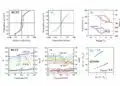
Dielectric capacitors have greater power densities than batteries, and, unlike batteries, they do not utilize chemical reactions during cycling. Thus, they can become ideal, safe energy storage devices. However, dielectric capacitors yield rather low energy densities compared with other energy storage devices such as batteries and supercapacitors. Here, we present a rational approach for designing ultrahigh energy storage capacitors using two-dimensional (2D) high-κ dielectric perovskites (Ca2Nam–3NbmO3m+1; m = 3–6). Individual Ca2Nam–3NbmO3m+1 nanosheets exhibit an ultrahigh dielectric strength (638–1195 MV m–1) even in the monolayer form, which exceeds those of conventional dielectric materials. Multilayer stacked nanosheet capacitors exhibit ultrahigh energy densities (174–272 J cm–3), high efficiencies (>90%), excellent reliability (>107 cycles), and temperature stability (−50–300 °C); the maximum energy density is much higher than those of conventional dielectric materials and even comparable to those of lithium-ion batteries. Enhancing the energy density may make dielectric capacitors more competitive with batteries.
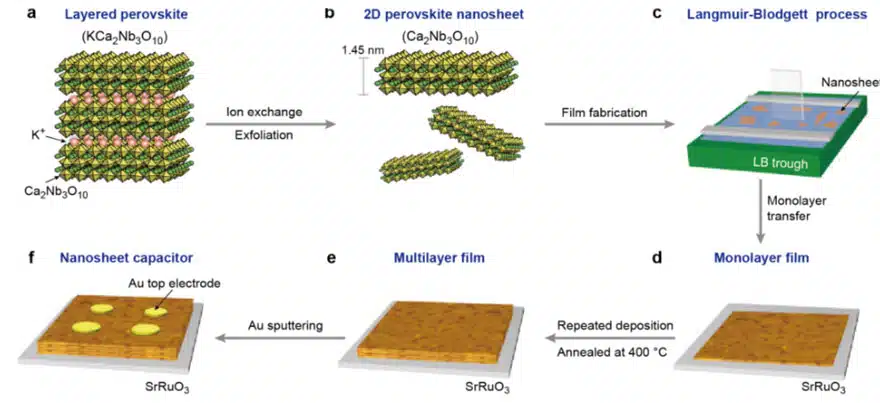
Fabrication procedure for nanosheet capacitors. (a) Structure of layered perovskite (KCa2Nb3O10). (b) Structure of Ca2Nb3O10 nanosheet. (c) LB process for the fabrication of a monolayer film. (d) Monolayer film of Ca2Nb3O10 nanosheets on a SrRuO3 substrate. (e) Multilayer fabrication by repeated depositions. (f) Fabrication of Au top electrodes to form a nanocapacitor. Source

Journal Reference:

Hyung-Jun Kim, Shu Morita, Ki-Nam Byun, Yue Shi, Takaaki Taniguchi, Eisuke Yamamoto, Makoto Kobayashi, Yasuo Ebina, Takayoshi Sasaki, Minoru Osada. Ultrahigh Energy Storage in 2D High-κ Perovskites. Nano Letters, 2023; 23 (9): 3788 DOI: 10.1021/acs.nanolett.3c00079
Related

Source: Science Daily

Recent Posts

Researchers Propose Next‑Gen Compact Memory Using Ultra-thin Ferroelectric Capacitors

11.5.2026
28

Nichicon ADN Automotive Hybrid Aluminum Capacitors Now Available in EMEA

11.5.2026
23

Electrocaloric Multilayer Capacitors: Towards Quiet, Solid‑State Cooling Around Room Temperature

7.5.2026
186

High-Crystallinity Nanocrystalline Composites for MHz Chip Inductors

7.5.2026
63

KYOCERA 10 µF 0201 MLCC Brings High‑Capacitance into Mobile Designs

6.5.2026
54

Energy Localization in Tantalum Anode Formation: A Structural Perspective

4.5.2026
46

YAGEO Introduces C0G Flexible Termination Automotive MLCCs

30.4.2026
41

Kyocera Developed Multilayer Ceramic Core Substrate for AI Packages

30.4.2026
50

YMIN Introduces Polymer Tantalum Capacitors for AI Server SSDs

29.4.2026
93

Upcoming Events

May 19
16:00 - 17:00 CEST

Designing Qi2 Wireless Power Systems: Practical Development and EMC Optimization

Jun 2
16:00 - 17:00 CEST

Calculation, Simulation and Measurement of 800V EMC Filters

Jun 16
16:00 - 17:00 CEST

EMC with EMC – EMC‑compliant design with electromechanical connectors

View Calendar

Popular Posts

  • Buck Converter Design and Calculation

    0 shares
    Share 0 Tweet 0
  • Boost Converter Design and Calculation

    0 shares
    Share 0 Tweet 0
  • Flyback Converter Design and Calculation

    0 shares
    Share 0 Tweet 0
  • LLC Resonant Converter Design and Calculation

    0 shares
    Share 0 Tweet 0
  • MLCC and Ceramic Capacitors

    0 shares
    Share 0 Tweet 0
  • Dual Active Bridge (DAB) Topology

    0 shares
    Share 0 Tweet 0
  • Capacitor Charging and Discharging

    0 shares
    Share 0 Tweet 0
  • What Electronics Engineer Needs to Know About Passive Low Pass Filters

    0 shares
    Share 0 Tweet 0
  • Ripple Current and its Effects on the Performance of Capacitors

    3 shares
    Share 3 Tweet 0
  • MLCC Case Sizes Standards Explained

    0 shares
    Share 0 Tweet 0

Newsletter Subscription


Passive Components Blog

© EPCI - Leading Passive Components Educational and Information Site

  • Home
  • Privacy Policy
  • EPCI Membership & Advertisement
  • About

No Result
View All Result
  • Home
  • Knowledge Blog
  • PCNS

© EPCI - Leading Passive Components Educational and Information Site

This website uses cookies. By continuing to use this website you are giving consent to cookies being used. Visit our Privacy and Cookie Policy.
Go to mobile version