






Passive Components Blog
No Result
View All Result
  • Home
  • NewsFilter
    • All
    • Aerospace & Defence
    • Antenna
    • Applications
    • Automotive
    • Capacitors
    • Circuit Protection Devices
    • electro-mechanical news
    • Filters
    • Fuses
    • Inductors
    • Industrial
    • Integrated Passives
    • inter-connect news
    • Market & Supply Chain
    • Market Insights
    • Medical
    • Modelling and Simulation
    • New Materials & Supply
    • New Technologies
    • Non-linear Passives
    • Oscillators
    • Passive Sensors News
    • Resistors
    • RF & Microwave
    • Telecommunication
    • Weekly Digest

    Würth Elektronik IQD Awarded by EcoVadis Gold Sustainability Medal

    Advanced Loss Modeling for Planar Magnetics in the Frenetic Planar Tool

    AI Servers Demand is Driving Tantalum Capacitor Price Hikes

    DMASS Reports Europe Components Up 9.8% in Q4 2025

    Bourns Extends PPTC Resettable High‑Power, High‑Voltage Protection Fuses

    Mastering Galvanic Isolation in Power Electronics: Methods, Standards, and Implementation

    Bourns Releases Compact Automotive Isolation Power Transformer

    Wk 9 Electronics Supply Chain Digest

    VINATech Targets AI Data Center Supercapacitor Boom

    Trending Tags

    • Ripple Current
    • RF
    • Leakage Current
    • Tantalum vs Ceramic
    • Snubber
    • Low ESR
    • Feedthrough
    • Derating
    • Dielectric Constant
    • New Products
    • Market Reports
  • VideoFilter
    • All
    • Antenna videos
    • Capacitor videos
    • Circuit Protection Video
    • Filter videos
    • Fuse videos
    • Inductor videos
    • Inter-Connect Video
    • Non-linear passives videos
    • Oscillator videos
    • Passive sensors videos
    • Resistor videos

    Advanced Loss Modeling for Planar Magnetics in the Frenetic Planar Tool

    2026 Power Magnetics Design Trends: Flyback, DAB and Planar

    Enabling Software‑Defined Vehicle Architectures: Automotive Ethernet and Zonal Smart Power

    Calculating Resistance Value of a Flyback RC Snubber 

    One‑Pulse Characterization of Nonlinear Power Inductors

    Thermistor Linearization Challenges

    Coaxial Connectors and How to Connect with PCB

    PCB Manufacturing, Test Methods, Quality and Reliability

    Transformer Behavior – Current Transfer and Hidden Feedback

    Trending Tags

    • Capacitors explained
    • Inductors explained
    • Resistors explained
    • Filters explained
    • Application Video Guidelines
    • EMC
    • New Products
    • Ripple Current
    • Simulation
    • Tantalum vs Ceramic
  • Knowledge Blog
  • DossiersNew
  • Suppliers
    • Who is Who
  • PCNS
    • PCNS 2025
    • PCNS 2023
    • PCNS 2021
    • PCNS 2019
    • PCNS 2017
  • Events
  • Home
  • NewsFilter
    • All
    • Aerospace & Defence
    • Antenna
    • Applications
    • Automotive
    • Capacitors
    • Circuit Protection Devices
    • electro-mechanical news
    • Filters
    • Fuses
    • Inductors
    • Industrial
    • Integrated Passives
    • inter-connect news
    • Market & Supply Chain
    • Market Insights
    • Medical
    • Modelling and Simulation
    • New Materials & Supply
    • New Technologies
    • Non-linear Passives
    • Oscillators
    • Passive Sensors News
    • Resistors
    • RF & Microwave
    • Telecommunication
    • Weekly Digest

    Würth Elektronik IQD Awarded by EcoVadis Gold Sustainability Medal

    Advanced Loss Modeling for Planar Magnetics in the Frenetic Planar Tool

    AI Servers Demand is Driving Tantalum Capacitor Price Hikes

    DMASS Reports Europe Components Up 9.8% in Q4 2025

    Bourns Extends PPTC Resettable High‑Power, High‑Voltage Protection Fuses

    Mastering Galvanic Isolation in Power Electronics: Methods, Standards, and Implementation

    Bourns Releases Compact Automotive Isolation Power Transformer

    Wk 9 Electronics Supply Chain Digest

    VINATech Targets AI Data Center Supercapacitor Boom

    Trending Tags

    • Ripple Current
    • RF
    • Leakage Current
    • Tantalum vs Ceramic
    • Snubber
    • Low ESR
    • Feedthrough
    • Derating
    • Dielectric Constant
    • New Products
    • Market Reports
  • VideoFilter
    • All
    • Antenna videos
    • Capacitor videos
    • Circuit Protection Video
    • Filter videos
    • Fuse videos
    • Inductor videos
    • Inter-Connect Video
    • Non-linear passives videos
    • Oscillator videos
    • Passive sensors videos
    • Resistor videos

    Advanced Loss Modeling for Planar Magnetics in the Frenetic Planar Tool

    2026 Power Magnetics Design Trends: Flyback, DAB and Planar

    Enabling Software‑Defined Vehicle Architectures: Automotive Ethernet and Zonal Smart Power

    Calculating Resistance Value of a Flyback RC Snubber 

    One‑Pulse Characterization of Nonlinear Power Inductors

    Thermistor Linearization Challenges

    Coaxial Connectors and How to Connect with PCB

    PCB Manufacturing, Test Methods, Quality and Reliability

    Transformer Behavior – Current Transfer and Hidden Feedback

    Trending Tags

    • Capacitors explained
    • Inductors explained
    • Resistors explained
    • Filters explained
    • Application Video Guidelines
    • EMC
    • New Products
    • Ripple Current
    • Simulation
    • Tantalum vs Ceramic
  • Knowledge Blog
  • DossiersNew
  • Suppliers
    • Who is Who
  • PCNS
    • PCNS 2025
    • PCNS 2023
    • PCNS 2021
    • PCNS 2019
    • PCNS 2017
  • Events
No Result
View All Result
Passive Components Blog
No Result
View All Result

Skeleton Opens €220M Supercapacitor Leipzig Factory

3.12.2025
Reading Time: 2 mins read
A A

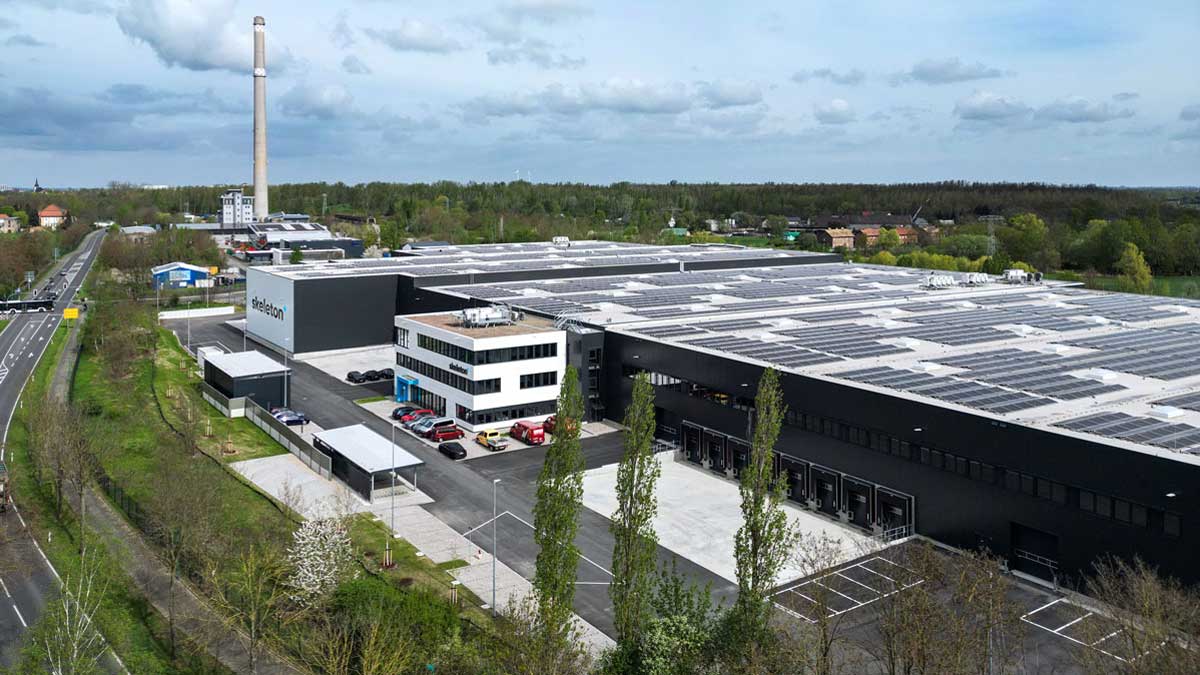
Skeleton Technologies has officially opened its €220 million SuperFactory in Markranstädt, near Leipzig.

The facility is already delivering to Siemens, General Electric, and Hitachi Energy for European electrical grids, and to major US hyperscalers for AI infrastructure.

RelatedPosts

Skeleton Technologies Expands in U.S. to Power AI Data Centers

Skeleton Opens SuperBattery Factory in Finland 

Skeleton Releases GrapheneGPU to Reduce AI Energy Consumption by 44% and Boosts Power by 40%

With a fully European value chain, Skeleton’s supercapacitors use no lithium, cobalt, manganese, or other critical raw materials, and are based on the company’s patented Curved Graphene material.

Skeleton Technologies’ CEO Taavi Madiberk said: “Skeleton’s Leipzig factory addresses both challenges. The plant manufactures our latest graphene-based supercapacitors, used in GrapheneGPU™, enabling AI data centres to cut total electricity consumption by 44% by smoothing power peaks and reducing stress on the electrical grid. At the same time, it keeps a core part of the value chain in Europe. By eliminating power peaks and overheating, GrapheneGPU™ unlocks 40% more computing power from the same investment in other GPUs.”

The opening of this factory helps support Europe’s electrical grids which are already under strain due to the rising share of renewable energy. The combination of fast-growing AI data centre demand and accelerating renewable deployment is creating a perfect storm, pushing grids to their limits and making fast-response technologies such as supercapacitors essential for energy security.

“A vital player in the European electrical grid and AI infrastructure ecosystem, Siemens continues to support Skeleton in the roles of investor, supplier as well as a potential go-to-market partner as they seek to address growing demand in the region,” commented Steffen Grosse, CEO Equity Finance at Siemens Financial Services.

Opening the Leipzig supercapacitor facility follows the recent opening of the company’s SuperBattery facility in Varkaus, Finland. The Leipzig SuperFactory will create 420 jobs in Saxony and is designed for an annual output of up to 12 million cells. Leveraging Siemens Xcelerator, a curated portfolio of services, software, and IoT-enabled hardware from Siemens, the new plant reinforces Europe’s advanced industrial base.

Related

Source: Skeleton

Recent Posts

AI Servers Demand is Driving Tantalum Capacitor Price Hikes

3.3.2026
31

DMASS Reports Europe Components Up 9.8% in Q4 2025

3.3.2026
9

Mastering Galvanic Isolation in Power Electronics: Methods, Standards, and Implementation

2.3.2026
11

VINATech Targets AI Data Center Supercapacitor Boom

26.2.2026
38

TDK Introduces 350V Safety Film Capacitors for Compact EMI Suppression

26.2.2026
34

Samsung Launches Worlds First Automotive 47uF 4V MLCC in 0805 Size

24.2.2026
34

Würth Elektronik Present in IEEE APEC

24.2.2026
19

Samsung Three Pillars MLCC Strategy for AI Hardware Topology

24.2.2026
84

KYOCERA AVX Extends Ultra‑Broadband RF Capacitor Series

24.2.2026
35

Upcoming Events

Mar 21
All day

PSMA Capacitor Workshop 2026

Apr 21
16:00 - 17:00 CEST

Heatsink Solutions: Thermal Management in electronic devices

May 19
16:00 - 17:00 CEST

Designing Qi2 Wireless Power Systems: Practical Development and EMC Optimization

View Calendar

Popular Posts

  • Buck Converter Design and Calculation

    0 shares
    Share 0 Tweet 0
  • Boost Converter Design and Calculation

    0 shares
    Share 0 Tweet 0
  • Flyback Converter Design and Calculation

    0 shares
    Share 0 Tweet 0
  • LLC Resonant Converter Design and Calculation

    0 shares
    Share 0 Tweet 0
  • MLCC Manufacturers Consider Price Increase as AI Demand Outpaces Supply

    0 shares
    Share 0 Tweet 0
  • Dual Active Bridge (DAB) Topology

    0 shares
    Share 0 Tweet 0
  • Ripple Current and its Effects on the Performance of Capacitors

    3 shares
    Share 3 Tweet 0
  • What is a Dielectric Constant and DF of Plastic Materials?

    4 shares
    Share 4 Tweet 0
  • MLCC and Ceramic Capacitors

    0 shares
    Share 0 Tweet 0
  • MLCC Case Sizes Standards Explained

    0 shares
    Share 0 Tweet 0

Newsletter Subscription


Passive Components Blog

© EPCI - Leading Passive Components Educational and Information Site

  • Home
  • Privacy Policy
  • EPCI Membership & Advertisement
  • About

No Result
View All Result
  • Home
  • Knowledge Blog
  • PCNS

© EPCI - Leading Passive Components Educational and Information Site

This website uses cookies. By continuing to use this website you are giving consent to cookies being used. Visit our Privacy and Cookie Policy.
Go to mobile version