














Passive Components Blog
No Result
View All Result
  • Home
  • NewsFilter
    • All
    • Aerospace & Defence
    • Antenna
    • Applications
    • Automotive
    • Capacitors
    • Circuit Protection Devices
    • electro-mechanical news
    • Filters
    • Fuses
    • Inductors
    • Industrial
    • Integrated Passives
    • inter-connect news
    • Market & Supply Chain
    • Market Insights
    • Medical
    • Modelling and Simulation
    • New Materials & Supply
    • New Technologies
    • Non-linear Passives
    • Oscillators
    • Passive Sensors News
    • Resistors
    • RF & Microwave
    • Telecommunication
    • Weekly Digest

    binder Releases Tool‑Tightenable M12 Connectors for Improved Reliability

    Vishay Introduced Thin Film Submount Platform for Optical and RF Modules

    Murata Introduces Crystal and NTC Set for Automotive UWB Timing

    Kyocera Developed Multilayer Ceramic Core Substrate for AI Packages

    Modeling Fringing Field Losses in Inductors & Transformers

    YMIN Introduces Polymer Tantalum Capacitors for AI Server SSDs

    Littelfuse Expands High-Voltage TVS Diodes

    DigiKey Adds 31k New In‑Stock Parts in Q1 2026

    Miniaturization of Tantalum Capacitors: Structural Limit Under Constant Rating

    Trending Tags

    • Ripple Current
    • RF
    • Leakage Current
    • Tantalum vs Ceramic
    • Snubber
    • Low ESR
    • Feedthrough
    • Derating
    • Dielectric Constant
    • New Products
    • Market Reports
  • VideoFilter
    • All
    • Antenna videos
    • Capacitor videos
    • Circuit Protection Video
    • Filter videos
    • Fuse videos
    • Inductor videos
    • Inter-Connect Video
    • Non-linear passives videos
    • Oscillator videos
    • Passive sensors videos
    • Resistor videos

    Modeling Fringing Field Losses in Inductors & Transformers

    Why Power Inductors Use a Ferrite Core With an Air Gap

    Transformer-Based Power-Line Harvester Magnetic Design

    Thermal Modeling of Magnetics

    Standard vs Planar LLC transformers Comparison for Battery Chargers

    How Modern Tools Model Magnetic Components for Power Electronics

    Advanced Loss Modeling for Planar Magnetics in the Frenetic Planar Tool

    2026 Power Magnetics Design Trends: Flyback, DAB and Planar

    Enabling Software‑Defined Vehicle Architectures: Automotive Ethernet and Zonal Smart Power

    Trending Tags

    • Capacitors explained
    • Inductors explained
    • Resistors explained
    • Filters explained
    • Application Video Guidelines
    • EMC
    • New Products
    • Ripple Current
    • Simulation
    • Tantalum vs Ceramic
  • Knowledge Blog
  • DossiersNew
  • Suppliers
    • Who is Who
  • PCNS
    • PCNS 2025
    • PCNS 2023
    • PCNS 2021
    • PCNS 2019
    • PCNS 2017
  • Events
  • Home
  • NewsFilter
    • All
    • Aerospace & Defence
    • Antenna
    • Applications
    • Automotive
    • Capacitors
    • Circuit Protection Devices
    • electro-mechanical news
    • Filters
    • Fuses
    • Inductors
    • Industrial
    • Integrated Passives
    • inter-connect news
    • Market & Supply Chain
    • Market Insights
    • Medical
    • Modelling and Simulation
    • New Materials & Supply
    • New Technologies
    • Non-linear Passives
    • Oscillators
    • Passive Sensors News
    • Resistors
    • RF & Microwave
    • Telecommunication
    • Weekly Digest

    binder Releases Tool‑Tightenable M12 Connectors for Improved Reliability

    Vishay Introduced Thin Film Submount Platform for Optical and RF Modules

    Murata Introduces Crystal and NTC Set for Automotive UWB Timing

    Kyocera Developed Multilayer Ceramic Core Substrate for AI Packages

    Modeling Fringing Field Losses in Inductors & Transformers

    YMIN Introduces Polymer Tantalum Capacitors for AI Server SSDs

    Littelfuse Expands High-Voltage TVS Diodes

    DigiKey Adds 31k New In‑Stock Parts in Q1 2026

    Miniaturization of Tantalum Capacitors: Structural Limit Under Constant Rating

    Trending Tags

    • Ripple Current
    • RF
    • Leakage Current
    • Tantalum vs Ceramic
    • Snubber
    • Low ESR
    • Feedthrough
    • Derating
    • Dielectric Constant
    • New Products
    • Market Reports
  • VideoFilter
    • All
    • Antenna videos
    • Capacitor videos
    • Circuit Protection Video
    • Filter videos
    • Fuse videos
    • Inductor videos
    • Inter-Connect Video
    • Non-linear passives videos
    • Oscillator videos
    • Passive sensors videos
    • Resistor videos

    Modeling Fringing Field Losses in Inductors & Transformers

    Why Power Inductors Use a Ferrite Core With an Air Gap

    Transformer-Based Power-Line Harvester Magnetic Design

    Thermal Modeling of Magnetics

    Standard vs Planar LLC transformers Comparison for Battery Chargers

    How Modern Tools Model Magnetic Components for Power Electronics

    Advanced Loss Modeling for Planar Magnetics in the Frenetic Planar Tool

    2026 Power Magnetics Design Trends: Flyback, DAB and Planar

    Enabling Software‑Defined Vehicle Architectures: Automotive Ethernet and Zonal Smart Power

    Trending Tags

    • Capacitors explained
    • Inductors explained
    • Resistors explained
    • Filters explained
    • Application Video Guidelines
    • EMC
    • New Products
    • Ripple Current
    • Simulation
    • Tantalum vs Ceramic
  • Knowledge Blog
  • DossiersNew
  • Suppliers
    • Who is Who
  • PCNS
    • PCNS 2025
    • PCNS 2023
    • PCNS 2021
    • PCNS 2019
    • PCNS 2017
  • Events
No Result
View All Result
Passive Components Blog
No Result
View All Result

Smoltek Announces Key Step in Production Building of its Ultra-thin CNF-MIM Capacitors

21.3.2022
Reading Time: 2 mins read
A A
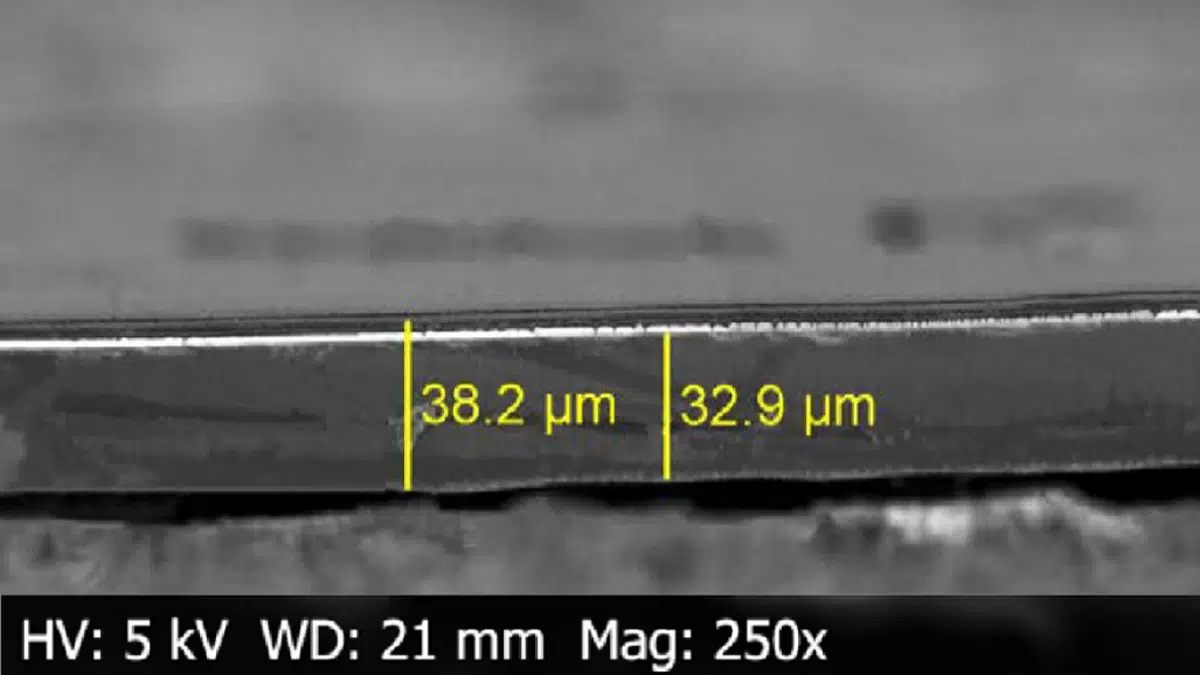
World Thinnest Capacitor; Source: Smoltek

World Thinnest Capacitor; Source: Smoltek

Smoltek Nanotech Holding AB (“Smoltek”) announces that after completed tests and evaluations, the company has now placed an order for a machine for future industrial manufacturing of carbon nanofibers to the company’s ultra-thin CNF-MIM capacitors. 

The machine, which will be installed at a semiconductor foundry, constitutes a central part of the production process that Smoltek is now establishing to be able to manufacture the company’s ultra-thin capacitors.

RelatedPosts

Smoltek CNF-MIM Capacitors Hit 1,000x Lower Leakage

Smoltek CNF-MIM Capacitors Pass 1,000h Reliability Test

Smolteks CNF-MIM Capacitors Meet Thermal and Voltage Stability Industry Requirements

Smoltek conducts business operations within development, industrialization and licensing of technology solutions, based on the company’s patent protected carbon nanofiber technology. The company’s technology solutions for the Semiconductors business area are developed by the Group company Smoltek Semi. The focus is on industrializing and commercializing the company’s ultra-thin CNF-MIM capacitors.

By ordering an industrial carbon growth machine that is in line with the unique specifications – based on Smoltek’s patent protected manufacturing process for growth of carbon nanofibers with very high precision – another important step has been taken in the work of creating a production process to be able to manufacture ultra-thin CNF-MIM capacitors in very high volumes. The machine will be installed and qualified for mass production at a semiconductor foundry.

“It is inspiring that the work with establishing a production process for the manufacturing of our ultra-thin capacitors is proceeding in a satisfactory manner. We are currently in the design phase of the project, which is project phase three of five, where the final phase defines the finalized production process before production can begin,” says Karl Lundahl, VP Industrialization and Product Management, Smoltek Semi.
 

In parallel with the industrialization of the CNF-MIM technology, Smoltek Semi is also working on the development of the first product, which the company believes will be the world’s thinnest decoupling capacitor for application processors for mobile phones. 

Smoltek Semi’s ambition over time is also to expand and broaden the product family of CNF-MIM based capacitors. Primary applications can be found in for example wearables, high performance computing (HPC) and 5G.

“An important aspect of the production process and supply chain that is now being developed by Smoltek Semi, is that it has a high degree of technical flexibility in combination with a scalability for manufacturing in extremely high volumes. The production process, including the carbon growth machine which we are now ordering, will therefore over time be able to be used for manufacturing of several different capacitor types based on Smoltek’s patent protected CNF-MIM technology,” says Ola Tiverman, President of Smoltek Semi.


Related

Source: Smoltek

Recent Posts

YMIN Introduces Polymer Tantalum Capacitors for AI Server SSDs

29.4.2026
13

DigiKey Adds 31k New In‑Stock Parts in Q1 2026

29.4.2026
7

Miniaturization of Tantalum Capacitors: Structural Limit Under Constant Rating

27.4.2026
25

Murata New MLCC Bulk Case Packaging Cuts Packaging Material by 99%

27.4.2026
44

Exxelia Introduces SMD High‑Voltage Mica Capacitors

28.4.2026
19

Modelithics Releases COMPLETE v26.1 for Keysight ADS

23.4.2026
13

April 2026 Interconnect, Passives and Electromechanical Components Market Insights

22.4.2026
75

KYOCERA AVX Introduces Traction‑Grade DC Link Film Capacitors

21.4.2026
47

When More Capacitance Hurts Reliability: The Role of the Metallic Skeleton in Tantalum Anodes

20.4.2026
44

Upcoming Events

May 5
16:00 - 17:00 CEST

Understanding and Selecting Capacitors – Fundamentals, Technologies and Latest Trends

May 7
17:00 - 18:00 CEST

From Grid to Motion: How Industrial Electrification is Redefining Power System Design

May 12
8:00 - 15:00 CEST

ESCC Space Splice connectors

View Calendar

Popular Posts

  • Buck Converter Design and Calculation

    0 shares
    Share 0 Tweet 0
  • Boost Converter Design and Calculation

    0 shares
    Share 0 Tweet 0
  • Flyback Converter Design and Calculation

    0 shares
    Share 0 Tweet 0
  • LLC Resonant Converter Design and Calculation

    0 shares
    Share 0 Tweet 0
  • MLCC and Ceramic Capacitors

    0 shares
    Share 0 Tweet 0
  • Dual Active Bridge (DAB) Topology

    0 shares
    Share 0 Tweet 0
  • What Electronics Engineer Needs to Know About Passive Low Pass Filters

    0 shares
    Share 0 Tweet 0
  • Capacitor Charging and Discharging

    0 shares
    Share 0 Tweet 0
  • MLCC Case Sizes Standards Explained

    0 shares
    Share 0 Tweet 0
  • Ripple Current and its Effects on the Performance of Capacitors

    3 shares
    Share 3 Tweet 0

Newsletter Subscription


Passive Components Blog

© EPCI - Leading Passive Components Educational and Information Site

  • Home
  • Privacy Policy
  • EPCI Membership & Advertisement
  • About

No Result
View All Result
  • Home
  • Knowledge Blog
  • PCNS

© EPCI - Leading Passive Components Educational and Information Site

This website uses cookies. By continuing to use this website you are giving consent to cookies being used. Visit our Privacy and Cookie Policy.
Go to mobile version