












Passive Components Blog
No Result
View All Result
  • Home
  • NewsFilter
    • All
    • Aerospace & Defence
    • Antenna
    • Applications
    • Automotive
    • Capacitors
    • Circuit Protection Devices
    • electro-mechanical news
    • Filters
    • Fuses
    • Inductors
    • Industrial
    • Integrated Passives
    • inter-connect news
    • Market & Supply Chain
    • Market Insights
    • Medical
    • Modelling and Simulation
    • New Materials & Supply
    • New Technologies
    • Non-linear Passives
    • Oscillators
    • Passive Sensors News
    • Resistors
    • RF & Microwave
    • Telecommunication
    • Weekly Digest

    Binder Hybrid Connector Simplifies One Cable Automation

    Tapped Inductor Buck Converter Fundamentals

    TAIYO YUDEN Releases Mini Metal Power Inductors

    Molecular Memristor Shows Record 145 kH Emergent Inductance

    Planar vs Conventional Transformer: When it Make Sense

    Researchers Propose Next‑Gen Compact Memory Using Ultra-thin Ferroelectric Capacitors

    Nichicon ADN Automotive Hybrid Aluminum Capacitors Now Available in EMEA

    Wk 19 Electronics Supply Chain Digest

    Electrocaloric Multilayer Capacitors: Towards Quiet, Solid‑State Cooling Around Room Temperature

    Trending Tags

    • Ripple Current
    • RF
    • Leakage Current
    • Tantalum vs Ceramic
    • Snubber
    • Low ESR
    • Feedthrough
    • Derating
    • Dielectric Constant
    • New Products
    • Market Reports
  • VideoFilter
    • All
    • Antenna videos
    • Capacitor videos
    • Circuit Protection Video
    • Filter videos
    • Fuse videos
    • Inductor videos
    • Inter-Connect Video
    • Non-linear passives videos
    • Oscillator videos
    • Passive sensors videos
    • Resistor videos

    Tapped Inductor Buck Converter Fundamentals

    Planar vs Conventional Transformer: When it Make Sense

    Modeling Fringing Field Losses in Inductors & Transformers

    Why Power Inductors Use a Ferrite Core With an Air Gap

    Transformer-Based Power-Line Harvester Magnetic Design

    Thermal Modeling of Magnetics

    Standard vs Planar LLC transformers Comparison for Battery Chargers

    How Modern Tools Model Magnetic Components for Power Electronics

    Advanced Loss Modeling for Planar Magnetics in the Frenetic Planar Tool

    Trending Tags

    • Capacitors explained
    • Inductors explained
    • Resistors explained
    • Filters explained
    • Application Video Guidelines
    • EMC
    • New Products
    • Ripple Current
    • Simulation
    • Tantalum vs Ceramic
  • Knowledge Blog
  • DossiersNew
  • Suppliers
    • Who is Who
  • PCNS
    • PCNS 2025
    • PCNS 2023
    • PCNS 2021
    • PCNS 2019
    • PCNS 2017
  • Events
  • Home
  • NewsFilter
    • All
    • Aerospace & Defence
    • Antenna
    • Applications
    • Automotive
    • Capacitors
    • Circuit Protection Devices
    • electro-mechanical news
    • Filters
    • Fuses
    • Inductors
    • Industrial
    • Integrated Passives
    • inter-connect news
    • Market & Supply Chain
    • Market Insights
    • Medical
    • Modelling and Simulation
    • New Materials & Supply
    • New Technologies
    • Non-linear Passives
    • Oscillators
    • Passive Sensors News
    • Resistors
    • RF & Microwave
    • Telecommunication
    • Weekly Digest

    Binder Hybrid Connector Simplifies One Cable Automation

    Tapped Inductor Buck Converter Fundamentals

    TAIYO YUDEN Releases Mini Metal Power Inductors

    Molecular Memristor Shows Record 145 kH Emergent Inductance

    Planar vs Conventional Transformer: When it Make Sense

    Researchers Propose Next‑Gen Compact Memory Using Ultra-thin Ferroelectric Capacitors

    Nichicon ADN Automotive Hybrid Aluminum Capacitors Now Available in EMEA

    Wk 19 Electronics Supply Chain Digest

    Electrocaloric Multilayer Capacitors: Towards Quiet, Solid‑State Cooling Around Room Temperature

    Trending Tags

    • Ripple Current
    • RF
    • Leakage Current
    • Tantalum vs Ceramic
    • Snubber
    • Low ESR
    • Feedthrough
    • Derating
    • Dielectric Constant
    • New Products
    • Market Reports
  • VideoFilter
    • All
    • Antenna videos
    • Capacitor videos
    • Circuit Protection Video
    • Filter videos
    • Fuse videos
    • Inductor videos
    • Inter-Connect Video
    • Non-linear passives videos
    • Oscillator videos
    • Passive sensors videos
    • Resistor videos

    Tapped Inductor Buck Converter Fundamentals

    Planar vs Conventional Transformer: When it Make Sense

    Modeling Fringing Field Losses in Inductors & Transformers

    Why Power Inductors Use a Ferrite Core With an Air Gap

    Transformer-Based Power-Line Harvester Magnetic Design

    Thermal Modeling of Magnetics

    Standard vs Planar LLC transformers Comparison for Battery Chargers

    How Modern Tools Model Magnetic Components for Power Electronics

    Advanced Loss Modeling for Planar Magnetics in the Frenetic Planar Tool

    Trending Tags

    • Capacitors explained
    • Inductors explained
    • Resistors explained
    • Filters explained
    • Application Video Guidelines
    • EMC
    • New Products
    • Ripple Current
    • Simulation
    • Tantalum vs Ceramic
  • Knowledge Blog
  • DossiersNew
  • Suppliers
    • Who is Who
  • PCNS
    • PCNS 2025
    • PCNS 2023
    • PCNS 2021
    • PCNS 2019
    • PCNS 2017
  • Events
No Result
View All Result
Passive Components Blog
No Result
View All Result

University of Tokyo creates world’s highest magnetic fields

7.9.2017
Reading Time: 3 mins read
A A

source: Electronics Weekly news

Spectrum’s AWG is helping the University of Tokyo create world’s highest indoor magnetic fields, writes Greg Tate

RelatedPosts

Binder Hybrid Connector Simplifies One Cable Automation

Tapped Inductor Buck Converter Fundamentals

TAIYO YUDEN Releases Mini Metal Power Inductors

The International MegaGauss Science Laboratory is part of the Institute for Solid State Physics (ISSP) at the University of Tokyo.

Its objective is to study the physical properties of solid-state materials (such as semiconductors, magnetic materials, metals, insulators, superconducting materials) as they are subjected to ultra-high magnetic fields. The fields are also used for researching new materials and controlling their phase and functionality.

The laboratory’s pulse magnets can currently generate up to 87 Tesla (T) by non-destructive methods, and from 100T up to 760T (the world record for the strongest field generated indoors) by a destructive process.

As part of a push to optimise the magnetic fields generated by the laboratory’s MegaGauss machine, it is important to synchronise the trigger events that fire banks of large capacitors.

Ideally, the capacitors all need to be triggered within 10ns of one another, so the laboratory must examine the trigger signals for each capacitor to determine their key characteristics and timing relationships. The MegaGauss machine also requires careful control as physical parameters restrict its firing to just a few shots per day.

To capture and analyse the trigger signals, ISSP required a fully synchronous, 10-channel digitiser system that delivers a single shot sampling rate in excess of 1GS/s. The high sampling rate allows the shape and frequency content of individual trigger pulses to be revealed, while fully synchronous sampling ensures inter‑channel timing measurements can be consistently made with sub‑nanosecond precision.

A further complication is the fact that the MegaGauss machine generates dangerously high magnetic fields that are potentially unsafe and can easily interfere with the measuring instrumentation. Great care needs to be taken to shield both equipment and operators.

The measurement system needs to be located in the laboratory while the operator adjusts and monitors the experiments from the safety of a control room. The digitiser system must be able to operate remotely and be controlled over the laboratory’s network.

Spectrum Instruments’ DN6.221-12 ‘digitizerNetbox’ system met all the technical requirements, offering 12 fully synchronous channels, each sampling at 1.25 GS/s. As it is LXI-compliant the instruments allows full remote-control and data transfer over a G-bit Ethernet connection.

The units also come with SBench 6-Pro software that allows the user to quickly set up the system and start making measurements. The software has an easy-to-use GUI that allows multi-channel waveform display, data analysis and documentation.
Spectrum - MegaGauss_4_trigger_signals

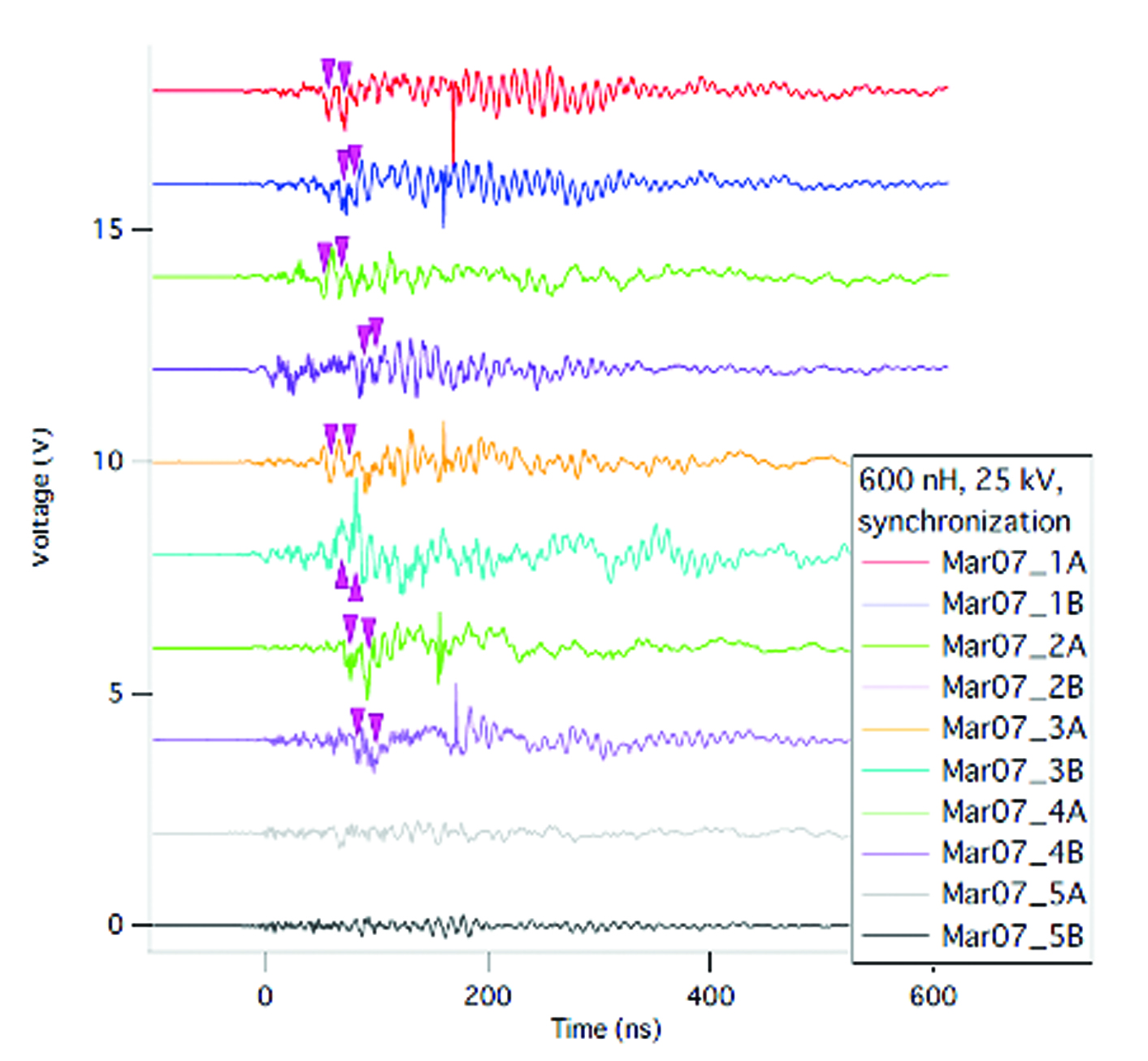
Fig.1. 10 independent trigger signals used to fire the capacitors, captured synchronously

Acquired and analysed signals can be stored and exported to other devices, or other software programs, in a number of formats, including MatLab, ASCII, binary and wave (Figure 1).

The Netbox system provides a turnkey solution to multi-channel acquisition. Users can select the desired number of digitiser channels, as well as setting fundamental specifications such as the sampling rate, resolution and on‑board acquisition memory.

The device provides a multi-channel data acquisition system that matches the requirements of ISSP. The system was quickly installed and integrated into the MegaGauss machine so that trigger timing measurements and analysis could be made with improved precision and detail. The laboratory now expects to be able to generate the highest ever indoor magnetic fields later in 2017.

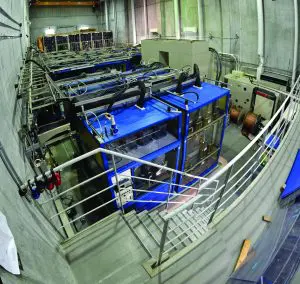
featured image: Large capacitor banks are used to generate the ultra-high magnetic fields of the MegaGauss machine, source: University of Tokyo

Related

Recent Posts

Tapped Inductor Buck Converter Fundamentals

13.5.2026
9

TAIYO YUDEN Releases Mini Metal Power Inductors

13.5.2026
6

Planar vs Conventional Transformer: When it Make Sense

11.5.2026
35

High-Crystallinity Nanocrystalline Composites for MHz Chip Inductors

7.5.2026
63

Würth Elektronik Introduces Compact Flat-wire SMT Power Inductors for Automotive

5.5.2026
49

Modeling Fringing Field Losses in Inductors & Transformers

30.4.2026
53

Modelithics Releases COMPLETE v26.1 for Keysight ADS

23.4.2026
23

April 2026 Interconnect, Passives and Electromechanical Components Market Insights

22.4.2026
141

Why Power Inductors Use a Ferrite Core With an Air Gap

20.4.2026
107

Upcoming Events

May 13
17:00 - 17:30 CEST

Winding Loss Modeling for Toroidal Magnetics – Including Gapped Cores

May 19
16:00 - 17:00 CEST

Designing Qi2 Wireless Power Systems: Practical Development and EMC Optimization

Jun 2
16:00 - 17:00 CEST

Calculation, Simulation and Measurement of 800V EMC Filters

View Calendar

Popular Posts

  • Buck Converter Design and Calculation

    0 shares
    Share 0 Tweet 0
  • Boost Converter Design and Calculation

    0 shares
    Share 0 Tweet 0
  • Flyback Converter Design and Calculation

    0 shares
    Share 0 Tweet 0
  • LLC Resonant Converter Design and Calculation

    0 shares
    Share 0 Tweet 0
  • MLCC and Ceramic Capacitors

    0 shares
    Share 0 Tweet 0
  • Dual Active Bridge (DAB) Topology

    0 shares
    Share 0 Tweet 0
  • What Electronics Engineer Needs to Know About Passive Low Pass Filters

    0 shares
    Share 0 Tweet 0
  • Capacitor Charging and Discharging

    0 shares
    Share 0 Tweet 0
  • Ripple Current and its Effects on the Performance of Capacitors

    3 shares
    Share 3 Tweet 0
  • MLCC Case Sizes Standards Explained

    0 shares
    Share 0 Tweet 0

Newsletter Subscription


Passive Components Blog

© EPCI - Leading Passive Components Educational and Information Site

  • Home
  • Privacy Policy
  • EPCI Membership & Advertisement
  • About

No Result
View All Result
  • Home
  • Knowledge Blog
  • PCNS

© EPCI - Leading Passive Components Educational and Information Site

This website uses cookies. By continuing to use this website you are giving consent to cookies being used. Visit our Privacy and Cookie Policy.
Go to mobile version