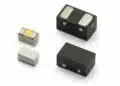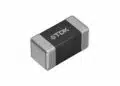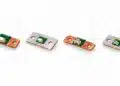

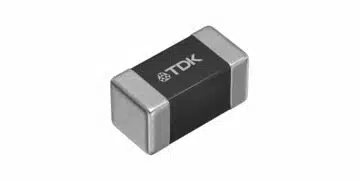




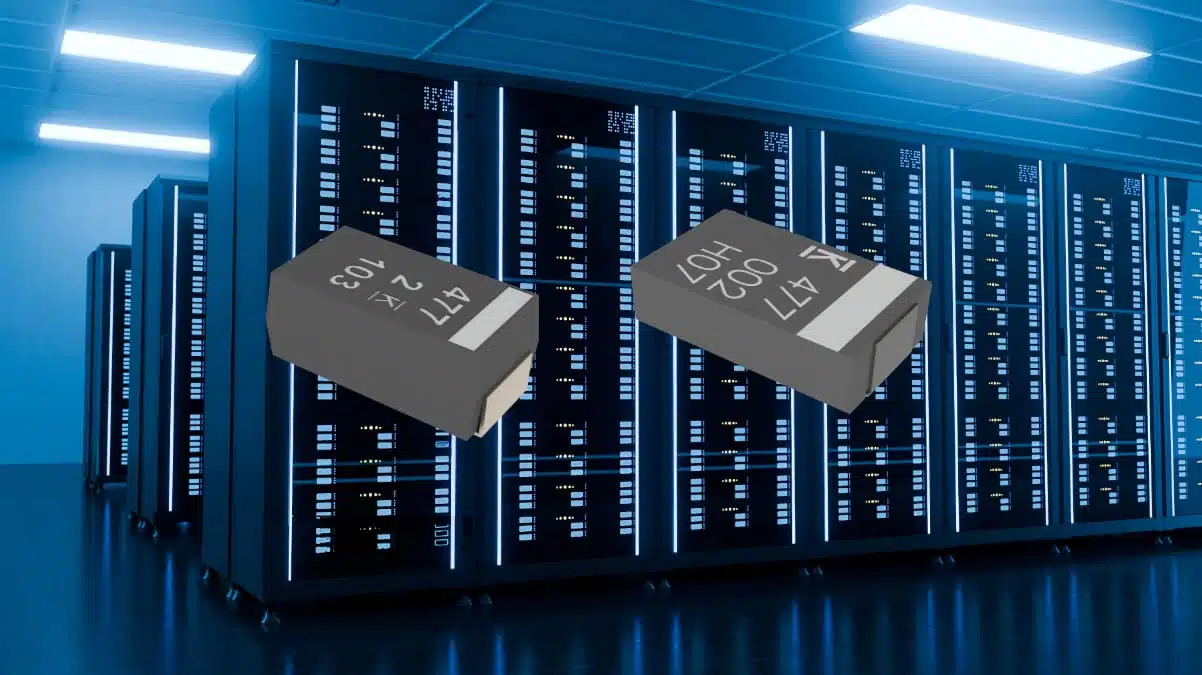
YAGEO Group has expanded its AO-CAP® aluminum polymer SMD capacitor portfolio with new A720 and A798 series options aimed at low-voltage, high-current power rails in AI servers and other demanding digital systems.
The YAGEO SMD aluminum polymer capacitor additions combine capacitance values up to 820 µF with ESR specified down to 3 mΩ at 300 kHz and an extended 125°C, 3,000-hour endurance capability.
Key features and benefits
- Low impedance for fast load transients: The new A720 and A798 options target point-of-load DC/DC converters supplying processors, GPUs, DPUs, switches, and other high-current digital loads. Low ESR helps limit the resistive portion of output-voltage ripple during rapid current changes.
- Extended high-temperature endurance: YAGEO specifies up to 3,000 hours at 125°C and rated voltage for selected 3 mΩ and 4.5 mΩ versions. This is relevant where component temperature, rather than ambient temperature alone, determines the achievable service life.
- Solid conductive-polymer cathode: The AO-CAP construction uses a conductive organic polymer cathode rather than a liquid electrolyte. According to YAGEO, this supports low ESR, high-frequency capacitance retention, and long operational life without an electrolyte dry-out mechanism.
- No steady-state voltage derating stated: YAGEO states that A720/A798 AO-CAP capacitors can operate at steady-state voltages up to 100% of their rated voltage. This is a technology-specific claim and does not remove the need to validate transient overshoot, startup, fault, and system-level reliability margins.
- Humidity-bias capability for A798: The A798 series retains a stated 85°C/85% RH, rated-voltage humidity-bias capability of up to 1,000 hours, which can be important for equipment exposed to high humidity during operation or storage.
- AEC-Q200 alignment for A798: The A798 series follows AEC-Q200, extending its relevance beyond enterprise computing to qualified low-voltage automotive and industrial electronics, subject to the requirements of the final application.
Technical highlights
| Parameter | A720 / A798 expanded portfolio |
|---|---|
| Capacitor technology | Solid-state aluminum polymer SMD capacitor, AO-CAP® |
| Rated voltage | 2 V to 2.5 V |
| Capacitance range | 470 µF to 820 µF |
| Lowest stated ESR | 3 mΩ at room temperature and 300 kHz |
| Other stated ESR options | 4.5 mΩ and 6 mΩ |
| Case construction | EIA 7343-20 |
| New capacitance option | 820 µF at 2 V |
| Endurance enhancement | Up to 3,000 hours at 125°C and rated voltage for selected versions |
| Storage endurance | Up to 3,000 hours at 125°C, unbiased |
| Humidity-bias capability | A798: up to 1,000 hours at 85°C/85% RH/rated voltage |
| Qualification statement | A798 follows AEC-Q200 |
The 820 µF, 2 V option gives designers a higher bulk-capacitance choice in the stated EIA 7343-20 footprint class. The low-voltage ratings place these devices specifically in downstream power-distribution networks rather than on intermediate bus or primary-side converter rails.
The quoted ESR values must be interpreted at their stated test condition: room temperature and 300 kHz. In a switching converter, impedance, ESR, ripple-current heating, and transient response all vary with frequency, temperature, DC operating point, PCB layout, and the number of capacitors connected in parallel.
Typical applications
YAGEO positions the A720 and A798 AO-CAP capacitors for:
- AI servers and data-center compute platforms
- CPU, GPU, DPU, switch, router, and networking power rails
- Server and enterprise storage systems
- Low-voltage DC/DC converters
- Telecommunications equipment
- Industrial electronics and displays
- Robotics and humanoid platforms
For AI and high-performance computing boards, these parts are a potential fit for bulk and mid-frequency decoupling near multiphase voltage-regulator outputs. They complement, rather than automatically replace, local MLCC arrays, which are typically selected to control the highest-frequency portion of the power-distribution-network impedance.
Application fit
| Design requirement | Potential relevance of A720/A798 |
|---|---|
| High bulk capacitance in compact SMD mounting | Up to 820 µF within the stated portfolio |
| Low-frequency to mid-frequency output filtering | Low ESR polymer-aluminum technology can reduce impedance and resistive ripple contribution |
| Sustained elevated temperature | Selected versions specify 125°C/3,000-hour rated-voltage endurance |
| Humidity-stressed low-voltage rail | A798 offers stated 85°C/85% RH/rated-voltage capability |
| Automotive qualification flow | A798 follows AEC-Q200, but the exact part number and test documentation must be checked |
| Very fast switching-edge suppression | Use alongside closely placed MLCCs and verify the combined impedance profile |
Design-in notes for engineers
- Select against the actual rail voltage and transients. Although YAGEO states that continuous operation up to rated voltage is permitted, include regulator tolerance, load-step overshoot, startup, sequencing, fault response, and measurement uncertainty in the voltage-stress assessment.
- Evaluate impedance rather than capacitance alone. In a converter output network, the useful result comes from the combined impedance of polymer capacitors, MLCCs, copper planes, vias, and the regulator control loop. See Capacitors Selection for DC/DC Converters for a practical discussion of ripple current, impedance, and frequency-dependent selection.
- Use ESR at the relevant operating point. The 3 mΩ, 4.5 mΩ, and 6 mΩ values are specified at room temperature and 300 kHz. Confirm the manufacturer’s impedance and ESR curves across the converter switching frequency, harmonics, and operating-temperature range.
- Check self-heating under ripple current. Capacitor losses rise with the RMS ripple current and ESR, so thermal validation should use the real mission profile and board airflow. ESR of Capacitors, Measurements and Applications explains why ESR must be treated as a frequency- and temperature-dependent loss parameter.
- Control layout inductance. Place capacitors close to the load or regulator power stage, use short and wide copper paths, and provide low-inductance return connections. A low-ESR part cannot compensate for excessive mounting or interconnect inductance.
- Check regulator stability. Very low ESR can affect the compensation requirements of some LDOs and converter control loops. Verify the stability criteria in the regulator documentation before replacing an existing capacitor technology.
- Confirm qualification by exact part number. The A798 family follows AEC-Q200, but final component release should be based on the current manufacturer datasheet, qualification report, land-pattern guidance, and applicable customer requirements.
Further reading
- Capacitors Selection for DC/DC Converters
- ESR of Capacitors, Measurements and Applications
- AI Hardware Demand for Passive Components Dossier
- KEMET Extends Lifespan of Chip Aluminum Polymer Capacitors
Source
This article is based on the YAGEO Group manufacturer press release covering the A720 and A798 AO-CAP® portfolio extension. Engineers should consult the current manufacturer datasheet, product brief, qualification documentation, and application guidance for final component selection and design release.