


Passive Components Blog
No Result
View All Result
  • Home
  • News
    • All
    • Aerospace & Defence
    • Antenna
    • Applications
    • Automotive
    • Capacitors
    • Circuit Protection Devices
    • electro-mechanical news
    • Filters
    • Fuses
    • Inductors
    • Industrial
    • Integrated Passives
    • inter-connect news
    • Market & Supply Chain
    • Market Insights
    • Medical
    • Modelling and Simulation
    • New Materials & Supply
    • New Technologies
    • Non-linear Passives
    • Oscillators
    • Passive Sensors News
    • Resistors
    • RF & Microwave
    • Telecommunication
    • Weekly Digest

    Bourns Automotive BMS Signal Transformer Combines Reinforced Isolation and Common-Mode Noise Rejection

    Murata Launches 100V 10 µF Lead-Type MLCCs for 48V Systems

    Bourns Extends Current Sense Resistors for High-Current Power Designs with 0.1 mΩ, 15 W

    KYOCERA AVX Releases Vibration-Proof SMD Aluminum Electrolytic Capacitors for Harsh Industrial Designs

    Vishay Introduces Automotive Low Loss SMD Common-Mode Chokes

    YAGEO Adds X8 Flexible-Termination Automotive MLCCs for 150°C Designs

    Current-Dependent Inductors: Using Non-Linear Inductance in Buck Converters and PFC Stages

    Vishay Releases High-Power Thick Film Resistors for Compact Power Modules

    Wk 32 Electronics Supply Chain Digest

    Trending Tags

    • Ripple Current
    • RF
    • Leakage Current
    • Tantalum vs Ceramic
    • Snubber
    • Low ESR
    • Feedthrough
    • Derating
    • Dielectric Constant
    • New Products
    • Market Reports
  • Video
    • All
    • Antenna videos
    • Capacitor videos
    • Circuit Protection Video
    • Filter videos
    • Fuse videos
    • Inductor videos
    • Inter-Connect Video
    • Non-linear passives videos
    • Oscillator videos
    • Passive sensors videos
    • Resistor videos

    Current-Dependent Inductors: Using Non-Linear Inductance in Buck Converters and PFC Stages

    Current Sense Transformers: Ferrite vs Nanocrystalline Cores for Accurate Current Measurement

    EMC Design Fundamentals: Safe Use of Varistors and Common Mode Chokes in Mains and Data-Line Filters

    Ferrite versus Nanocrystalline Power Inductor Cores: Turns, Gap and Size

    KYOCERA AVX Presents Antenna Integrator Studio Tutorial for Antenna Placement and RF Design

    Power Design Simulation Tools for Faster Inductor Selection and Loss Optimization

    EMC‑Compliant PCB and Connector Design Guidelines

    Why Isolated DC/DC Power Supplies Fail Late, Würth Elektronik Podcast

    Designing 800 V DC EMC Filters: Calculation, Simulation and Measurement

    Trending Tags

    • Capacitors explained
    • Inductors explained
    • Resistors explained
    • Filters explained
    • Application Video Guidelines
    • EMC
    • New Products
    • Ripple Current
    • Simulation
    • Tantalum vs Ceramic
  • Knowledge Blog
  • Dossiers
    • AI Hardware Dossier
    • Automotive Dossier
    • Industrial Robotics Dossier
    • Power Converter Dossier
    • Capacitor Dossier
    • Resistor Dossier
    • Inductor Dossier
    • Circuit Protection Dossier
  • Suppliers
    • Who is Who
  • PCNS
    • PCNS 2025
    • PCNS 2023
    • PCNS 2021
    • PCNS 2019
    • PCNS 2017
  • Events
  • Home
  • News
    • All
    • Aerospace & Defence
    • Antenna
    • Applications
    • Automotive
    • Capacitors
    • Circuit Protection Devices
    • electro-mechanical news
    • Filters
    • Fuses
    • Inductors
    • Industrial
    • Integrated Passives
    • inter-connect news
    • Market & Supply Chain
    • Market Insights
    • Medical
    • Modelling and Simulation
    • New Materials & Supply
    • New Technologies
    • Non-linear Passives
    • Oscillators
    • Passive Sensors News
    • Resistors
    • RF & Microwave
    • Telecommunication
    • Weekly Digest

    Bourns Automotive BMS Signal Transformer Combines Reinforced Isolation and Common-Mode Noise Rejection

    Murata Launches 100V 10 µF Lead-Type MLCCs for 48V Systems

    Bourns Extends Current Sense Resistors for High-Current Power Designs with 0.1 mΩ, 15 W

    KYOCERA AVX Releases Vibration-Proof SMD Aluminum Electrolytic Capacitors for Harsh Industrial Designs

    Vishay Introduces Automotive Low Loss SMD Common-Mode Chokes

    YAGEO Adds X8 Flexible-Termination Automotive MLCCs for 150°C Designs

    Current-Dependent Inductors: Using Non-Linear Inductance in Buck Converters and PFC Stages

    Vishay Releases High-Power Thick Film Resistors for Compact Power Modules

    Wk 32 Electronics Supply Chain Digest

    Trending Tags

    • Ripple Current
    • RF
    • Leakage Current
    • Tantalum vs Ceramic
    • Snubber
    • Low ESR
    • Feedthrough
    • Derating
    • Dielectric Constant
    • New Products
    • Market Reports
  • Video
    • All
    • Antenna videos
    • Capacitor videos
    • Circuit Protection Video
    • Filter videos
    • Fuse videos
    • Inductor videos
    • Inter-Connect Video
    • Non-linear passives videos
    • Oscillator videos
    • Passive sensors videos
    • Resistor videos

    Current-Dependent Inductors: Using Non-Linear Inductance in Buck Converters and PFC Stages

    Current Sense Transformers: Ferrite vs Nanocrystalline Cores for Accurate Current Measurement

    EMC Design Fundamentals: Safe Use of Varistors and Common Mode Chokes in Mains and Data-Line Filters

    Ferrite versus Nanocrystalline Power Inductor Cores: Turns, Gap and Size

    KYOCERA AVX Presents Antenna Integrator Studio Tutorial for Antenna Placement and RF Design

    Power Design Simulation Tools for Faster Inductor Selection and Loss Optimization

    EMC‑Compliant PCB and Connector Design Guidelines

    Why Isolated DC/DC Power Supplies Fail Late, Würth Elektronik Podcast

    Designing 800 V DC EMC Filters: Calculation, Simulation and Measurement

    Trending Tags

    • Capacitors explained
    • Inductors explained
    • Resistors explained
    • Filters explained
    • Application Video Guidelines
    • EMC
    • New Products
    • Ripple Current
    • Simulation
    • Tantalum vs Ceramic
  • Knowledge Blog
  • Dossiers
    • AI Hardware Dossier
    • Automotive Dossier
    • Industrial Robotics Dossier
    • Power Converter Dossier
    • Capacitor Dossier
    • Resistor Dossier
    • Inductor Dossier
    • Circuit Protection Dossier
  • Suppliers
    • Who is Who
  • PCNS
    • PCNS 2025
    • PCNS 2023
    • PCNS 2021
    • PCNS 2019
    • PCNS 2017
  • Events
No Result
View All Result
Passive Components Blog
No Result
View All Result

Murata Launches 100V 10 µF Lead-Type MLCCs for 48V Systems

27.8.2026
Reading Time: 6 mins read
A A

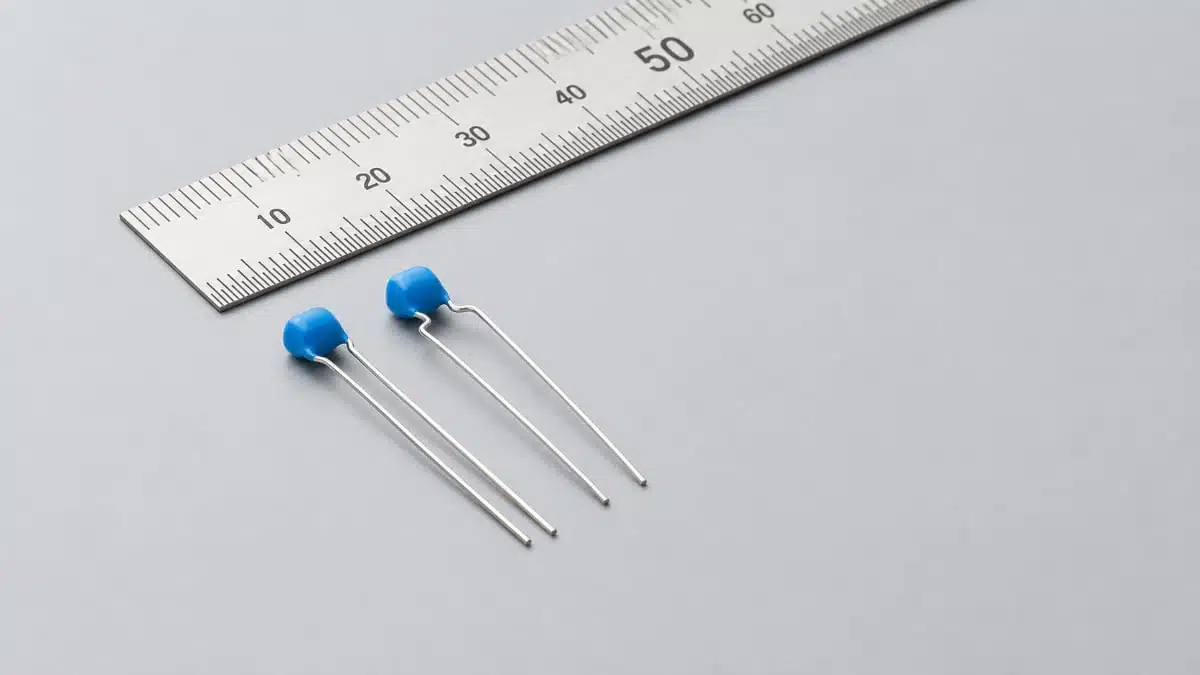
Murata has expanded its lead-type multilayer ceramic capacitor portfolio with new 100 Vdc, 10 µF devices aimed at 48 V power architectures.

The new Murata RCE and RDE series parts combine high capacitance with a resin-molded, leaded MLCC construction intended to reduce stress on the ceramic body in vibration-, flexure-, and thermally demanding assemblies.

RelatedPosts

Single Pair Ethernet for Humanoid Robot In-Robot Networks

Murata Releases 1210 Metal Terminal Common Mode Choke for 10Base‑T1S In‑Vehicle Ethernet

June 2026: AI Demand Pushes Japanese and Korean MLCC Makers to Five‑Year Shipment High

Key features and benefits

  • 100 Vdc rated voltage and 10 µF capacitance address the growing need for higher-voltage bulk and local decoupling capacitance in 48 V electrical systems.
  • Lead-type MLCC construction places a ceramic capacitor element inside a resin-molded package with attached lead wires, rather than soldering a chip MLCC directly to the PCB.
  • Stress relief at the connection can reduce mechanical load transferred to the ceramic element from PCB bending, vibration, and differential thermal expansion.
  • Compact package for the electrical rating: Murata states that the component achieves the smallest volume and height among lead-type MLCCs specified at 100 Vdc and 10 µF, based on its research as of August 26, 2026.
  • Higher capacitance at 100 V: the new device increases Murata’s maximum capacitance in its 100 V lead-type MLCC range from 4.7 µF to 10 µF.
  • Series allocation by market: RCE is positioned for automotive powertrain and safety equipment, while RDE targets consumer and industrial equipment.

The product is particularly relevant where conventional board-mounted MLCCs are exposed to flexure or vibration, or where the capacitor must be located away from the main PCB. For background on ceramic construction and use cases, see the MLCC and Ceramic Capacitors overview.

Technical highlights

ParameterMurata specification
Part numbersRCEC72A106K3*; RDEC72A106K3*
Capacitance10 µF
Capacitance tolerance±10%
Rated voltage100 Vdc
Temperature characteristicX7S
Operating temperature range-55 °C to +125 °C
Dimensions, L × T × W × W15.5 mm × 4.0 mm × 5.0 mm × 7.5 mm
Production statusMass production began in August 2026

The X7S dielectric designation indicates a Class II ceramic capacitor designed for a -55 °C to +125 °C operating range. However, as with other high-capacitance Class II MLCCs, the effective capacitance in a circuit can vary with DC bias, temperature, AC signal level, ageing, and mechanical conditions; designers should evaluate the actual in-circuit capacitance rather than relying only on the nominal 10 µF rating. The temperature, bias and ageing behaviour of MLCCs is therefore an important selection consideration.

Typical applications

Murata identifies the new lead-type capacitors for applications moving toward 48 V power systems.

  • Automotive electric power steering systems
  • Brake-system electronics
  • Electric water pumps and auxiliary drives
  • Automotive powertrain and safety modules
  • 48 V consumer and industrial power electronics
  • Humanoid robots and other higher-power robotic equipment
  • Off-board capacitor locations where direct surface mounting is impractical

In automotive platforms, a 48 V rail can reduce current for a given power level compared with a 12 V system, but it also raises voltage-rating and transient-margin requirements for local energy storage, filtering, and decoupling networks. The wider passive-component context is covered in Passive Automotive Electronics for 48V Systems and V2X.

Application fit

Design situationWhy a lead-type 100 V MLCC may fit
PCB subject to bending or assembly stressLead wires can mechanically decouple the ceramic body from board flexure.
Vibration-exposed moduleThe molded leaded structure is intended to reduce mechanical stress transfer to the capacitor.
Capacitor mounted away from the PCBLeaded construction enables placement where a conventional chip capacitor cannot be directly surface-mounted.
48 V rail decoupling or filteringThe 100 Vdc rating provides a higher nominal voltage class than 50 V parts for a 48 V architecture.
High-temperature automotive electronicsThe stated operating range extends to +125 °C.

Design-in notes for engineers

  • Validate operating voltage margin: A 48 V nominal rail can experience switching, load-dump, inductive, and cable-related transient conditions. Confirm the complete voltage waveform, including abnormal operating cases, against the manufacturer’s current application documentation.
  • Check effective capacitance under bias: The nominal 10 µF value should be verified at the intended DC voltage and temperature, especially if the capacitor supports regulator stability, hold-up, damping, or an EMC filter corner frequency.
  • Review ripple-current and self-heating limits: Murata’s press release does not provide ripple-current, ESR, impedance, or permissible temperature-rise data. Confirm these parameters according to the manufacturer datasheet before final design release.
  • Use the leaded structure intentionally: The mechanical benefit comes from the lead-wire and resin-molded architecture. Define lead forming, soldering, mounting orientation, clearance, and vibration constraints according to the manufacturer’s mounting guidance.
  • Consider parasitics in fast-switching circuits: Leaded capacitors generally introduce more connection inductance than a directly mounted chip MLCC. For high-frequency switching edges, placement and parallel local MLCCs may still determine the decoupling performance.
  • Do not infer automotive qualification from series positioning alone: The RCE series is stated for automotive powertrain and safety equipment, but the press release does not specify an AEC-Q200 qualification claim for these exact part numbers. Confirm qualification, screening, traceability, and approved-grade requirements with Murata for the intended program.
  • Check supply and approved-source status: For production programs, verify exact ordering suffixes, availability, packaging, lifecycle status, and PPAP or customer-specific requirements directly with the manufacturer.

Further reading

  • MLCC and Ceramic Capacitors
  • Temperature, Bias and Ageing Impact to MLCC Ceramic Capacitor Stability
  • MLCC Capacitors in Electrical Vehicles
  • Passive Automotive Electronics for 48V Systems and V2X

Source

This article is based on Murata Manufacturing’s product press release announcing the RCE and RDE 100 Vdc, 10 µF lead-type MLCCs. Engineers should consult the current manufacturer datasheet, product finder entry, mounting documentation, and qualification information before final component selection and design release.
  1. Murata Introduces World’s Smallest 100Vdc/10μF Lead-Type MLCC
  2. Murata product finder: RCEC72A106K3 and RDEC72A106K3

Related

Recent Posts

Bourns Automotive BMS Signal Transformer Combines Reinforced Isolation and Common-Mode Noise Rejection

27.8.2026
2

Bourns Extends Current Sense Resistors for High-Current Power Designs with 0.1 mΩ, 15 W

26.8.2026
21

KYOCERA AVX Releases Vibration-Proof SMD Aluminum Electrolytic Capacitors for Harsh Industrial Designs

26.8.2026
17

Vishay Introduces Automotive Low Loss SMD Common-Mode Chokes

26.8.2026
18

YAGEO Adds X8 Flexible-Termination Automotive MLCCs for 150°C Designs

25.8.2026
38

Vishay Releases High-Power Thick Film Resistors for Compact Power Modules

24.8.2026
22

Passive Components for Industrial Automation and Robotics (Dossier Report 08/26)

20.8.2026
100

Advanced Electronics Markets Reshape Capacitor Demand for 2026/2027

20.8.2026
87

Panasonic Introduces Metallized Polypropylene Film Capacitors for Industrial and Automotive DC Applications

19.8.2026
65

Upcoming Events

Sep 10
11:00 - 12:00 CEST

Equipment models and model strategies for Space Missions

Sep 29
16:00 - 17:00 CEST

Cybersecurity 2026

Nov 24
16:00 - 17:00 CET

Component selection with the WE REDEXPERT® DC-DC Converter Designer Tool

View Calendar

Popular Posts

  • Buck Converter Design and Calculation

    0 shares
    Share 0 Tweet 0
  • Boost Converter Design and Calculation

    0 shares
    Share 0 Tweet 0
  • LLC Resonant Converter Design and Calculation

    0 shares
    Share 0 Tweet 0
  • Earthing Systems and IEC Classification Explained

    0 shares
    Share 0 Tweet 0
  • MLCC and Ceramic Capacitors

    0 shares
    Share 0 Tweet 0
  • Flyback Converter Design and Calculation

    0 shares
    Share 0 Tweet 0
  • MLCCs in the Age of AI: Q2 2026 Market Tightness

    0 shares
    Share 0 Tweet 0
  • Capacitor Charging and Discharging

    0 shares
    Share 0 Tweet 0
  • Audio Capacitors: Choosing Capacitors for Crossover Circuits

    0 shares
    Share 0 Tweet 0
  • Thermistors Basics, NTC and PTC Thermistors

    0 shares
    Share 0 Tweet 0

Newsletter Subscription


Passive Components Blog

© 2015–2026
All rights reserved

  • Home
  • Privacy Policy
  • EPCI Membership & Advertisement
  • About

No Result
View All Result
  • Home
  • Knowledge Blog
  • Dossiers
  • PCNS

© 2015–2026
All rights reserved