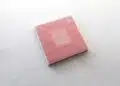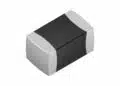


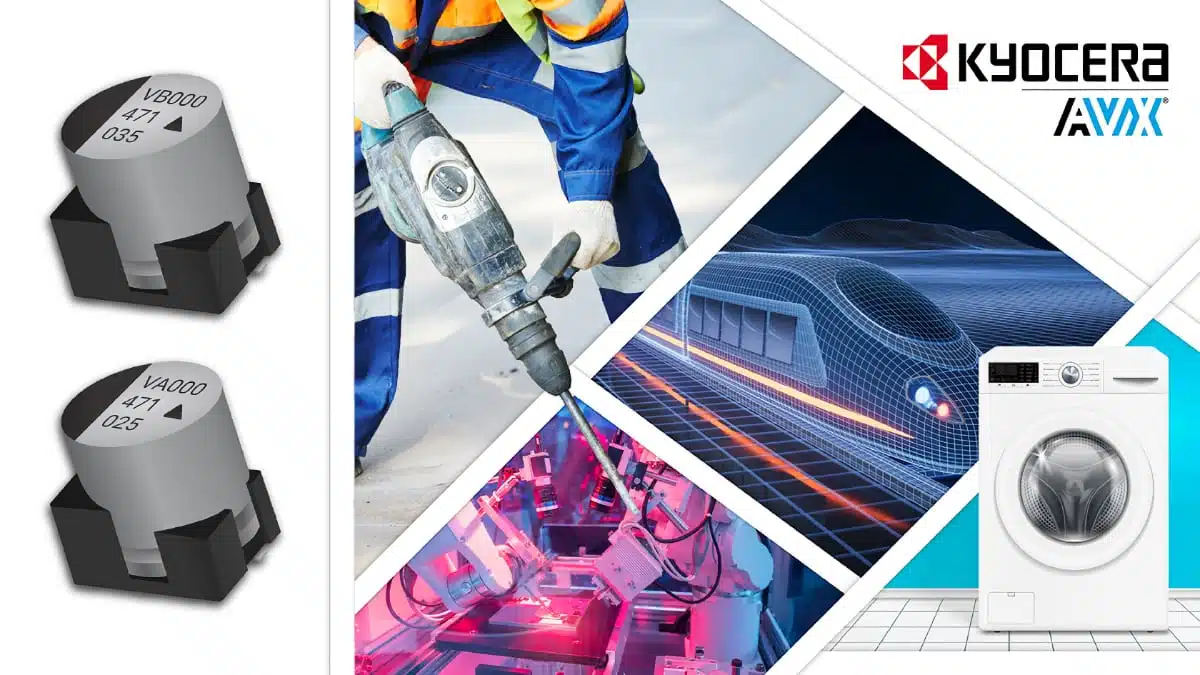
KYOCERA AVX has introduced the AEVA and AEVB Series of surface-mount aluminum electrolytic capacitors for industrial electronics exposed to vibration and elevated temperature.
The new KYOCERA AVX SMD aluminum electrolytic capacitors combine high capacitance in compact SMD cases with mechanical features intended to strengthen the capacitor-to-PCB connection under vibration loading.
Key features and benefits
- Vibration-resistant board mounting: Plastic supports and specially shaped terminations increase the soldered area and board-mounting strength. KYOCERA AVX specifies resistance to peak acceleration of up to 30G.
- Compact high-capacitance SMD option: The liquid-electrolyte construction delivers a high capacitance-voltage product in packages intended to be smaller than comparable can-type aluminum electrolytics.
- High-temperature capability: Both families are rated to +125°C, supporting electronics located near motors, power semiconductors, or enclosed industrial control assemblies.
- Low-temperature selection: AEVA extends down to -55°C, while AEVB is rated from -40°C; the correct series should therefore be selected according to the required environmental operating range.
- Automated assembly compatibility: Parts are supplied on 15-inch reels and are compatible with reflow soldering.
- Compliance: The series are halogen-free, RoHS compliant, and compatible with lead-free assembly processes.
Technical highlights
| Parameter | AEVA Series | AEVB Series |
|---|---|---|
| Rated voltage range | 6.3–100VDC | 16–50VDC |
| Capacitance range | 10–4,700µF | 47–2,200µF |
| Capacitance tolerance | ±20% | ±20% |
| Operating temperature | -55°C to +125°C | -40°C to +125°C |
| Endurance at rated voltage and +125°C | 1,500–4,000 hours | 2,000–5,000 hours |
| Case sizes | 0810, 1010, 1213, 1616, 1821 | 0810, 1010, 1213, 1616 |
| Peak acceleration | Up to 30G | Up to 30G |
Both series are liquid-electrolyte aluminum capacitors with low ESR and low leakage. The manufacturer specifies leakage current of no more than 0.01CV or 3µA, whichever is greater.
The endurance ratings are specified at rated voltage and +125°C. In practical design work, this makes the actual capacitor operating temperature, applied voltage, ripple-current heating, PCB copper area, and nearby heat sources essential inputs to lifetime assessment.
Typical applications
KYOCERA AVX identifies the series for industrial electronics exposed to temperature and vibration, including:
- Robotics and automated manufacturing equipment
- Embedded motor-control units
- Photovoltaic inverters
- Power tools
- DC/DC converters
- Uninterruptible power supplies
The product range is particularly relevant where a conventional radial or snap-in capacitor would create an assembly-height, placement-automation, or mechanical-retention constraint. Its SMD format can support compact control-board layouts, while the reinforcement features address a well-known weakness of board-mounted aluminum electrolytics in mechanically demanding equipment.
Application fit
| Circuit location | Potential role | Key selection check |
|---|---|---|
| DC/DC converter input or output | Bulk energy storage and ripple filtering | Confirm ripple-current capability, impedance and lifetime at the actual hot-spot temperature |
| Motor-control PCB | Local DC-bus buffering and transient-load support | Assess vibration direction, PCB stiffness, solder-joint loading and thermal proximity to power devices |
| PV inverter control electronics | Low-voltage rail filtering and hold-up energy | Check required minimum temperature, voltage transients and expected service life |
| UPS control and auxiliary supplies | Bulk filtering and ride-through support | Verify available capacitance at operating conditions and ripple-current stress |
| Robotics and power tools | Compact energy buffering on high-vibration boards | Validate the complete assembly, including PCB, mounting points and enclosure dynamics |
Design-in notes for engineers
- Treat 30G as a component qualification parameter, not a complete system guarantee. Final robustness depends on PCB thickness, copper pattern, solder profile, board support, component orientation, vibration spectrum, enclosure mounting, and the location of the capacitor relative to structural resonances.
- Select from the temperature range first. AEVA is the suitable family where -55°C operation is required; AEVB begins at -40°C. The specified maximum temperature is +125°C for both series.
- Verify voltage margin under real operating conditions. Evaluate nominal rail voltage, switching overshoot, start-up conditions, abnormal operating states, and tolerance of the power source rather than selecting solely on nominal DC voltage.
- Check ripple-current heating and ESR. Capacitor self-heating from ripple current can materially shorten service life; see Ripple Current and its Effects on the Performance of Capacitors for the underlying selection considerations.
- Review reflow and land-pattern requirements. The enlarged termination concept makes the manufacturer-recommended footprint, stencil design and reflow profile particularly important for achieving the intended solder-joint area and mechanical strength.
- Use the datasheet for final selection. Capacitance, endurance, ESR, permissible ripple current, dimensions and test conditions vary by individual part number and should be confirmed for the exact ordering code.
Further reading
- Ripple Current and its Effects on the Performance of Capacitors
- KYOCERA AVX Releases New Snap-In Aluminum Electrolytic Capacitors
- KYOCERA AVX Releases Radial-Leaded Aluminum Electrolytic Capacitors
- Buck Converter Design and Calculation
Source
This article is based on the KYOCERA AVX manufacturer press release and official product information for the AEVA and AEVB Series. Engineers should consult the current manufacturer datasheet and associated documentation for final component qualification and design release.