






Modelithics has released version 26.4 of its COMPLETE Library for Keysight ADS, adding new nonlinear diode and GaN HEMT models alongside 20 new Microwave Global Models for capacitor and resistor families.
For RF, microwave and millimetre-wave designers, the update broadens access to measurement-based component models intended to improve the correlation between circuit simulation and assembled hardware.
The Modelithics release supports Keysight ADS 2024 through ADS 2027 on 64-bit Windows and Linux platforms, while retaining backward compatibility with prior Modelithics library releases.
Key features and benefits
- Twenty new passive-component family models cover capacitors and resistors from Kyocera-AVX, YAGEO – Cornell Dubilier, Murata, Knowles-Syfer, Tecdia, IMS, TTM Technologies and Vishay.
- Scalable Microwave Global Models are validated at frequencies as high as 150 GHz, according to Modelithics, targeting RF front ends, aerospace, defence and high-speed communications designs.
- Substrate- and pad-aware modelling enables the designer to account for PCB material and mounting-pad conditions rather than treating the mounted passive as an ideal lumped element.
- Improved representation of ESR and resonance helps capture losses and higher-order behaviour that can become decisive as operating frequency rises.
- Three new TTM Technologies coupler models extend the System Component Library content for RF signal-distribution simulations.
- New nonlinear semiconductor content includes 25 Microchip Technology diode models and six GaN HEMT models sponsored by Guerilla RF, allowing passive networks to be evaluated with active-device nonlinearity in the same ADS workflow.
Technical highlights
| Library addition | Manufacturer-stated scope | Engineering relevance |
|---|---|---|
| Microwave Global Models | 20 new capacitor and resistor family models; validation to as high as 150 GHz | Supports selection and optimisation of real passive parts where mounting parasitics and resonances affect circuit response |
| Nonlinear diode models | 25 new Microchip Technology models, including PIN diode and varactor families | Useful for bias-dependent RF switching, tuning, matching and detection circuits |
| Updated varactor model | MV3903 update with improved high-frequency response | Can improve simulation confidence for tuned and voltage-controlled networks |
| GaN HEMT models | Six nonlinear Guerilla RF models based on DC-IV, S-parameter and load-pull data | Supports power-amplifier design work where matching networks and device nonlinearity interact |
| Coupler models | Three new TTM Technologies system-component models | Helps model RF signal-routing architectures and distributed signal paths |
The new diode content is based on DC-IV, capacitance and S-parameter measurements, and Modelithics states that the models represent temperature, frequency and RF-power-dependent nonlinear behaviour. Several of the new diode models support frequencies up to 110 GHz.
For passive-component users, the central addition is the expanded set of Microwave Global Models. Unlike a fixed-value ideal capacitor or resistor model, this approach is intended to represent a component family across defined values, physical configurations and mounting conditions. At microwave frequencies, the component body, solder pads and PCB substrate can materially change impedance, loss and self-resonant behaviour; this is why capacitor behaviour in RF and microwave circuits must be evaluated beyond nominal capacitance alone.
Application fit
| Design area | How the v26.4 content can help |
|---|---|
| RF matching networks | Assess the frequency-dependent behaviour of capacitor and resistor selections, including parasitic effects and resonances |
| Bias-tunable circuits | Simulate PIN-diode and varactor behaviour over bias, frequency, temperature and RF-power conditions |
| RF power amplifiers | Combine GaN HEMT nonlinear models with realistic matching, decoupling and stabilisation networks |
| mmWave front ends | Evaluate passives and nonlinear devices at frequencies where package, pad and substrate effects cannot be ignored |
| Couplers and signal routing | Model coupler-based signal-distribution paths as system-level RF building blocks |
| High-speed electronics | Include non-ideal passive behaviour in signal-conditioning, termination and interconnect-related circuit studies |
Design-in notes for engineers
- Check the model’s validated range. A model valid to a high frequency is not automatically appropriate for every component value, land pattern or substrate combination; verify the supported range and parameter limits for the selected part.
- Align the ADS model with the intended PCB stack-up. Dielectric constant, substrate thickness, copper geometry and pad shape influence RF behaviour, particularly where component pads become part of the matching network.
- Do not substitute nominal value for RF performance. A capacitor with the same nominal capacitance can exhibit substantially different impedance and resonance depending on dielectric, package size, electrode structure and mounting arrangement.
- Treat ESR and higher-order resonances as circuit parameters. These effects can alter insertion loss, return loss, notch depth, harmonic termination and amplifier stability.
- Use nonlinear models at realistic operating conditions. For diode and GaN simulations, apply the expected bias, temperature and RF drive level; small-signal results alone may not predict large-signal behaviour.
- Correlate with hardware early. Simulation models can reduce the number of layout and tuning iterations, but final release should still include PCB-level validation with the intended component lot, assembly process and operating conditions.
- Confirm model availability for the exact part family. The press release names participating suppliers but does not list individual part numbers or series; engineers should check the current library documentation and manufacturer component data before committing a design.
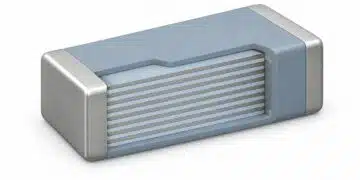
The availability of family-level passive models is especially relevant for engineers selecting microwave ceramic capacitors, where frequency-dependent impedance and mounting geometry often determine the practical result. The Modelithics approach to microwave single-layer capacitor modelling illustrates why a measured, scalable model can be more informative than an ideal component representation in high-frequency optimisation.
Further reading
- Modelithics Library for MATLAB: Measurement-Based Models for Microwave and RF Passive Components
- Capacitor in RF and Microwave
- Modelithics Microwave Single-Layer Capacitors Modeling
- Stackpole RNCQ Thin Film RF Chip Resistors up to 50 GHz
Source
This article is based on the Modelithics press release announcing Modelithics COMPLETE Library v26.4 for Keysight ADS. Engineers should consult the current Modelithics library documentation, individual manufacturer datasheets and qualification information before final component selection and design release.