



The voltage coefficient of resistance (VCR) is a key non‑linearity parameter of high‑value resistors that can quietly dominate error budgets in precision and high‑voltage circuits. While often ignored in low‑ohmic designs, VCR becomes critical once resistance values move into the tens of megaohms and beyond or when linearity over a wide voltage swing is required.
Key Takeaways
- The Voltage Coefficient of Resistance (VCR) characterizes resistance change relative to applied voltage, becoming critical in high-value resistors.
- VCR significantly affects precision in high-voltage circuits, especially beyond 10 MΩ due to non-linear behavior.
- Manufacturers often use MIL‑STD‑202 for standardized VCR testing, yet practical measurement can face challenges like environmental noise.
- Designers should incorporate VCR into their error budgets, particularly for applications involving high-impedance circuits and large voltage swings.
- Measuring VCR accurately requires careful setup to mitigate issues like self-heating, instrument accuracy, and environmental conditions.
This article explains what VCR is, how different resistor technologies behave, how to measure and specify it correctly, and how to design circuits that remain linear despite VCR.
1. Definition and Basic Theory
The voltage coefficient of resistance (VCR) describes the voltage-dependent change in a resistor’s measured resistance. It is particularly relevant in high-value thick-film and high-voltage resistors, and in any circuit requiring linear gain or scale factor over a substantial voltage swing.
For two measurements taken at voltages U1 and U2, with corresponding resistance values R1 and R2, the average VCR over that voltage interval is:
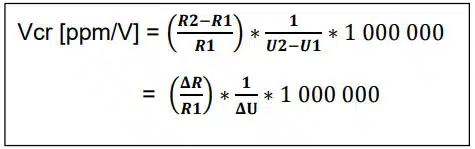
R1 = resistance value at voltage U1
R2 = resistance value at voltage U2
- The sign indicates direction: a negative VCR means that resistance decreases as applied voltage increases.
Important: a published VCR is a two-point, finite-difference result over a defined voltage interval. It is an average normalized slope, not proof that resistance changes linearly at every voltage between those two points. A VCR specified from 10 V to 100 V may not predict behaviour from 1 V to 10 V.
Strictly speaking, a resistor with measurable VCR has a DC current-voltage characteristic that departs slightly from ideal proportionality over the relevant range. Therefore, resistance should be understood as R(U), not necessarily as a single voltage-independent number.
VCR is often expressed in ppm/V or %/V. High-value ruthenium-oxide thick-film systems commonly show negative VCR, but the sign, magnitude, and curvature of the resistance-versus-voltage characteristic depend on the specific resistor technology, resistance value, geometry, production process, voltage range, polarity, and environment.

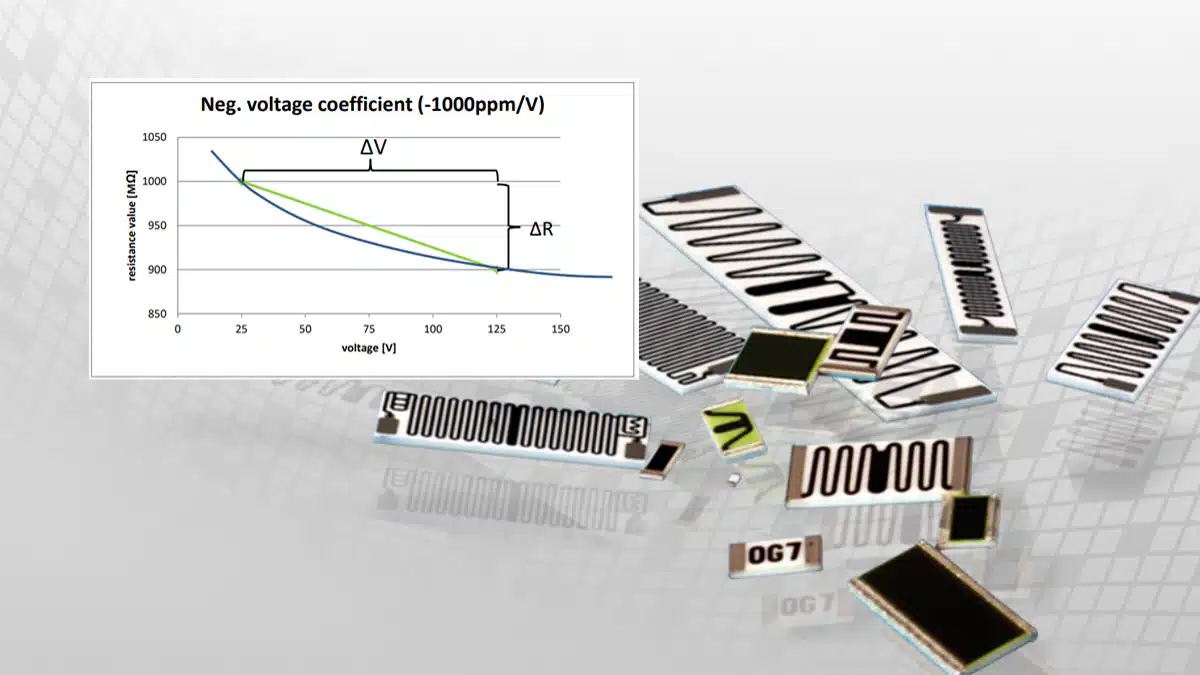
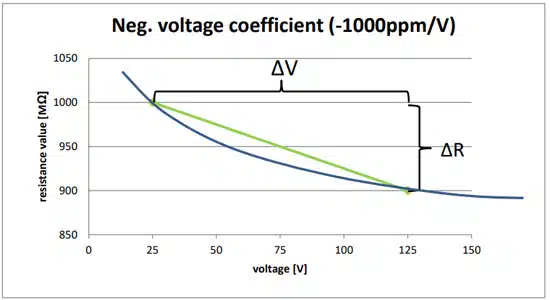
For example, if a 1 GΩ resistor has an average VCR of −1000 ppm/V between 25 V and 125 V, the estimated resistance change over that 100 V span is:
ΔR/R ≈ −1000 ppm/V · 100 V = −100,000 ppm = −10%
Its resistance would therefore change from approximately 1 GΩ at the reference voltage to approximately 0.9 GΩ at the higher voltage, assuming the quoted VCR is representative of that particular interval.
Key points:
- VCR is usually expressed in ppm/V or %/V.
- Thick‑film resistors with ruthenium‑oxide conducting phase typically exhibit negative VCR (resistance decreases with increasing voltage).
- The calculation is an average finite-difference slope between two measurement points; the true R(U) curve may be non-linear.
Example: A 1 GΩ resistor with VCR = −1000 ppm/V will change from 1 GΩ at 25 V to about 0.9 GΩ at 125 V (−10%) for a 100 V increase.
2. Standardized VCR Specification
VCR data can only be compared when the test conditions are known. A VCR figure should identify the voltage interval, reference voltage, polarity, temperature, timing or settling criterion, connection method, and whether the stated value is typical or maximum.
MIL-STD-202, Method 309, Voltage Coefficient of Resistance Determination Procedure defines a common method based on resistance measured at 10% of the specified maximum working voltage and resistance measured at the maximum specified working voltage. The method is dated 18 April 2015; cite the method and date rather than relying only on a historical revision letter for the base standard.
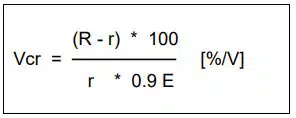
- R = resistance at maximum specified working voltage E
- E = maximum specified working voltage
- r = resistance at 10% of the maximum specified working voltage E
- R is the resistance measured at the specified maximum working voltage, E.
- r is the resistance measured at 10% of the maximum working voltage, 0.1E.
- The voltage interval is therefore 0.9E, and the ratio of the two applied voltages is 10:1.
Design caution: compliance-style test voltages are useful for comparing parts, but they may be poorly matched to the voltage swing in a low-voltage TIA, electrometer input stage, or other precision circuit. Evaluate VCR in the application’s actual resistor-voltage range whenever linearity is critical.
- Many resistors are rated up to 10 kV–100 kV or more, which demands specialized high‑voltage sources and fixtures.
- To avoid self‑heating of small SMD components, the standard calls for pulsed measurement, which increases complexity and is sensitive to RC time constants at very high resistances.
For these reasons, some manufacturers may use application-specific or production-test methods with different voltage ranges and timing. Such results should be compared only when the test conditions are stated.
3. VCR by Resistor Technology and Resistance Range
Although detailed numeric ranges are often proprietary or scattered across datasheets, some qualitative trends are well established. The table below summarizes typical behaviour:
Typical VCR Behaviour by Technology
| Resistor technology | Where VCR commonly becomes relevant | Indicative behaviour | Selection and verification notes |
|---|---|---|---|
| General-purpose thick-film chip | Usually high-value ranges; often increasingly important above 10 MΩ | Often negative; can range from modest to very high depending on resistance value, package, paste, geometry, and voltage span | Do not assume acceptable linearity from tolerance and TCR alone. Check datasheet conditions or measure representative parts. |
| High-voltage thick-film chip or axial resistor | High-voltage dividers, HV bias networks, and values from megohms to gigaohms | Usually engineered for lower VCR than general-purpose high-value thick film, but specifications remain strongly part-specific | Check VCR test voltage, continuous working voltage, limiting element voltage, power derating, pulse rating, creepage, and clearance. |
| Precision thin-film / metal-film | Low to several megohm ranges, including precision gain networks | Generally very low; specialised products may specify VCR explicitly | Do not equate “thin film” with zero VCR. Use part-level VCR data where the application error budget is tight. |
| Bulk metal foil | Ultra-precision, generally low- to mid-resistance applications | Extremely low VCR and excellent DC linearity are available in specialised products | Often selected where linearity, low TCR, low noise, and long-term stability justify the cost and available resistance range. |
| Wirewound | Usually low- to medium-value precision and power applications | VCR is normally low; inductance, capacitance, frequency response, and power coefficient may be more important | Assess AC and pulse behaviour separately from DC VCR. |
| Carbon composition and legacy high-value technologies | Medium to high values, especially older equipment or replacement designs | Voltage dependence and long-term stability can be comparatively poor | Characterize actual parts before using them in linear precision or HV metrology applications. |
As examples of the available range, specialised precision thin-film resistors can specify VCR values around 0.1 ppm/V, bulk metal foil products can specify below 0.1 ppm/V, and high-voltage thick-film products may specify values in the tens of ppm/V or higher depending on the series and test conditions. Such values must not be transferred from one part family or voltage interval to another without verification.
For thick‑film high‑ohmic parts, the paste formulation, sintering temperature, and layout geometry dominate VCR behaviour.
4. Absolute VCR, Differential VCR, and Divider Ratio VCR
The term VCR is sometimes used for several related but distinct quantities. Separating them avoids incorrect conclusions when selecting individual resistors or complete high-voltage divider networks.
| Quantity | Meaning | Why it matters |
|---|---|---|
| Two-point VCR | Average normalized resistance change between two stated voltages | This is the most common datasheet quantity. It is only meaningful with its test range and conditions. |
| Differential VCR | Local normalized slope of the resistance-voltage curve, approximately (1/R) · dR/dU | Useful conceptually when R(U) is nonlinear and the application operates over a narrow region of the curve. |
| Ratio voltage coefficient | Voltage-dependent change of a resistor-divider ratio rather than an individual resistor value | Often the decisive parameter in precision HV dividers, probes, and attenuators. |
A divider can have low absolute resistance drift yet still show unacceptable ratio error if the upper and lower arms do not track, if voltage distribution among series elements is unequal, or if self-heating and leakage change with applied voltage. For this reason, purpose-designed divider networks may specify a low ratio voltage coefficient in addition to the VCR of individual elements.
5. Influence of Paste, Sintering, and Geometry
For thick‑film resistors, both the conductive phase and the microstructure formed during firing determine the electric field distribution in the resistor. For thick-film high-ohmic resistors, the following manufacturing variables can influence VCR:
- VCR strongly depends on the resistive paste material.
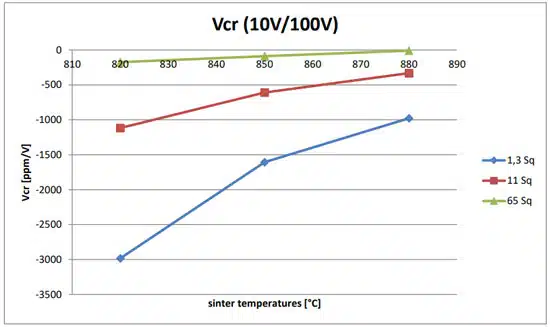
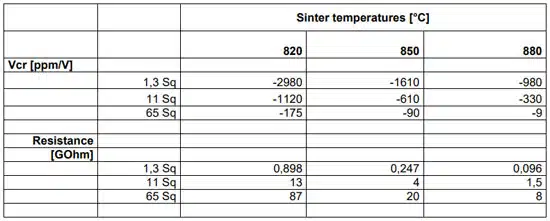
- Sintering temperature can shift VCR dramatically; there is often an optimum firing window that minimizes VCR without compromising stability.
- Increasing the effective length‑to‑width ratio (L/B, “number of squares”) by using meander patterns usually improves VCR.
Manufacturers internal incoming inspection as an illustrative example: several component sizes with different L/B ratios are fired at different temperatures; VCR is then measured between 10 V and 100 V to identify the optimal process window. Figure 2 shows exactly such VCR vs. sintering temperature behaviour for a single paste.
6. Measurement of Low VCR – Practical Challenges
Measuring VCR at high resistance values is considerably more demanding than measuring TCR. Several pitfalls must be addressed to obtain meaningful data.
6.1 Key Measurement Issues
- Number of steady digits
At very high resistances (e.g., 100 GΩ), currents are in the picoampere range, and digit hopping makes it difficult to secure enough valid digits. To resolve differences such as 10 ppm/V vs. 20 ppm/V, you may need four or five stable digits, which is challenging in industrial environments at low voltages. - Measurement environment
Air humidity, airflows (HVAC, doors), and mechanical vibrations all introduce noise and drift in the setup, limiting the reliability of the last significant digit. Shielding, guarding, and environmental control are essential. - Measurement range changes
When measuring between 1 V and 10 V, the current changes by nearly a factor of ten. DMMs or electrometers often change measurement range, and each range has different accuracy, linearity, and offset, which can distort the calculated VCR. - Self‑heating and TCR interaction
At small packages, high voltage, and low VCR, self‑heating can cause resistance changes via TCR that are misinterpreted as VCR. External temperature changes also affect readings. - Instrument accuracy and limits
Above about 1 GΩ, current measurement accuracy of electrometers at 10 pA–100 pA may be limited by instrument range, offset, burden voltage, leakage, and environmental stability. Establish the uncertainty from the selected instrument and measurement range rather than applying a universal percentage. One percent corresponds to 10,000 ppm; even across 100 V, this leaves ~100 ppm uncertainty in each measurement point. Statements like “1 ppm/V at hundreds of megaohms” should therefore be treated critically. - Measurement time and RC time constant
Large high‑value resistors have significant intrinsic capacitance ; cables and fixtures contribute external capacitance . The time constant is , and you should wait at least 5· to reach the final value, which can take many minutes.
6.2 Practical Measurement Recommendations
- Use a guarded measurement system: use triax or guarded cabling and a fixture compatible with the instrument’s driven guard. A cable shield alone is not necessarily an effective guard.
Control insulation leakage: use clean, high-insulation fixture materials such as PTFE, PEEK, or suitable clean ceramics. Avoid flux residues, fingerprints, moisture films, and contaminated standoffs.
Measure the fixture baseline: perform an open-circuit or leakage check using the same fixture, voltage, timing, and environmental conditions as the DUT measurement.
Fix source and measurement ranges where possible: auto-ranging may introduce range-dependent offset, linearity, and settling errors that appear as false VCR.
Use time-trend data: 5RC is a useful initial lower bound, but dielectric absorption, charge soakage, surface leakage, and instrument settling can require substantially longer stabilization. Define a practical stability criterion rather than relying only on a fixed wait time.
Repeat the sequence: measure U1, U2, and U1 again to reveal drift and hysteresis. Where permitted by the application and fixture, repeat with reversed polarity.
Control self-heating: calculate applied power at every voltage point and distinguish a temperature-driven resistance change from a true voltage coefficient.
Document test conditions: record voltage interval, polarity, ambient temperature, humidity, settling time, source mode, instrument ranges, connection method, fixture type, and repeatability.
Reporting rule: a VCR result without its voltage range and test conditions is incomplete. For example, report “−35 ppm/V, 10 V to 100 V, +25 °C, positive polarity, 60 s settling, guarded fixture” rather than simply “−35 ppm/V.”
6.3 Voltage Ratings and Series Resistor Strings
VCR must be assessed together with the resistor’s electrical ratings. A resistor may satisfy its nominal power limit but still exceed its maximum working voltage or limiting element voltage. As a first screening condition:
Uapplied ≤ min(Uworking, √(Prated · R))
This expression is only a starting point. Actual design validation must also consider voltage and power derating versus ambient temperature, pulse or surge duty, altitude, creepage and clearance, surface contamination, coating quality, and possible corona or partial discharge.
Using several resistors in series can reduce the voltage stress across each element, but it does not automatically guarantee low total VCR or low divider-ratio error. The outcome depends on the VCR and tolerance of each element, voltage sharing, thermal gradients, parasitic capacitance, PCB leakage, and long-term matching.
- Use resistors from the same qualified family and preferably the same production lot when matching matters.
- Provide sufficient creepage, clearance, and clean surface insulation between series elements.
- Consider capacitive voltage sharing and transient stress, not only DC resistance division.
- Measure divider scale factor over the complete operating voltage range after assembly.
6.4 Measurement Uncertainty and Credibility of Low VCR Claims
At high resistance values, a small error in measured current can become much larger than the resistance change being investigated. The quality of a VCR result therefore depends on the full uncertainty budget, not only on the displayed resolution of a DMM, SMU, electrometer, or picoammeter.
- Voltage-source accuracy, stability, and output leakage
- Current-measurement offset, burden voltage, linearity, noise, and range-dependent error
- Fixture, cable, PCB, and surface leakage
- Temperature change and self-heating coupled through TCR
- Settling time, dielectric absorption, and charge history
- Repeatability, polarity dependence, and operator or handling effects
As a practical rule, the expected VCR-induced resistance difference between the two voltage points should be comfortably larger than the combined repeatability and systematic uncertainty of the setup. If not, describe the result as a measurement limit or estimate rather than as a precise part characteristic.
7. Circuit‑Level Impact and Error Budgeting
VCR directly translates into voltage‑dependent gain or scale error in circuits where the resistor carries a significant voltage. The most obvious examples are:
- Transimpedance amplifiers (TIA) with high feedback resistors.
- High‑voltage dividers and probes.
- Electrometers, picoammeters, and leakage measurement setups.
- High‑impedance bias networks for photodiodes, PMTs, or x‑ray detectors.
7.1 Example: TIA Feedback Resistor
In a TIA, the output voltage is . If the feedback resistor has VCR, its effective value changes with the output voltage, and the conversion gain is no longer constant.
Consider a 1 GΩ feedback resistor with VCR = −1000 ppm/V, and a TIA operating from 1 V to 10 V output:
- ΔU = 9 V
- ΔR/R ≈ VCR · ΔU = −1000 ppm/V · 9 V = −9000 ppm ≈ −0.9%
So the effective gain changes by nearly 1% over the range, even if TCR and tolerance are ideal. For a TIA where the resistor’s maximum working voltage is 400 V (e.g., a 1206 size), measuring VCR between 40 V and 400 V per a datasheet‑like condition is not representative, because the real application only sees 1–10 V.
Design implication: for low‑voltage TIA, either:
- Measure VCR in the actual voltage range and use a correction table/curve in the system, or
- Choose a technology or value where VCR is negligible over the operating span.
7.2 Example: High-Voltage Divider
For a simple divider with upper resistor and lower resistor , the transfer ratio is:If the high-voltage arm changes resistance with applied voltage, the scale factor changes as well. The error is not determined by the VCR of the upper resistor alone: it depends on the voltage-related behaviour of both arms and on their tracking.
Consider a 1000:1 divider in which the upper arm is 999 MΩ and the lower arm is 1 MΩ. If the upper arm falls by 0.5% over the operating voltage range while the lower arm remains effectively constant, the divider scale factor changes by approximately 0.5%. In a 10 kV measurement, this corresponds to an error of approximately 50 V referred to the 10 kV input, assuming the lower arm remains constant and loading is negligible.
A practical high-voltage divider design should therefore:
- Use resistor technologies with VCR data relevant to the intended voltage range.
- Check ratio voltage coefficient where the divider scale factor, rather than absolute resistance, is the critical parameter.
- Distribute voltage and power conservatively, while accounting for DC and transient voltage sharing.
- Validate scale factor at multiple points across the full input-voltage range and at relevant temperatures.
- Use guarding, clean insulation surfaces, adequate creepage, and appropriate enclosure design to prevent external leakage from becoming the dominant error source.
7.3 Combining VCR with TCR, Tolerance, and Drift
In a real error budget, you combine:
- Tolerance (e.g., ±1%)
- TCR (over temperature excursion)
- VCR (over voltage excursion)
- Long‑term drift
Conceptually, you can treat each as a percentage and combine worst‑case linearly or statistically (RSS) depending on system requirements. VCR often appears as a “hidden” term when voltage span is large; explicitly including it in spreadsheets or models prevents surprises in system‑level linearity tests.
8. Design Guidelines and Best Practices
8.1 When to Care About VCR
- Resistance values of roughly 10 MΩ and above are a useful screening point, but VCR can also matter at lower values in demanding precision or high-voltage designs.
- Circuits with large voltage swings across a high‑value resistor.
- Precision measurement systems (electrometers, picoammeters, TIA front‑ends).
- High‑voltage dividers requiring linearity across their full range.
Rule‑of‑thumb: once ΔR/R from VCR over your operating voltage range approaches or exceeds your allowed gain/scale‑error budget, treat VCR as a primary design parameter.
8.2 Technology Selection Guidelines
| Design scenario | Recommended technology focus | VCR considerations |
|---|---|---|
| Ultra‑low noise, low value (<100 kΩ) | Bulk metal foil, thin‑film | VCR typically negligible. |
| Precision DC gain up to a few MΩ | Thin‑film, precision metal film | VCR rarely specified, but usually small. |
| High‑value TIA feedback (10 MΩ–1 GΩ) | Specialized high‑ohmic thick‑film, HV chips | Look for low VCR at actual operating voltage and good TCR. |
| HV dividers (kV range, 10 MΩ–GΩ) | HV thick‑film chips or axial, designed for VCR | Check vendor’s HV/VCR application data and derating. |
| Cost‑sensitive high‑value biasing | General‑purpose thick‑film | Verify whether VCR is acceptable via measurement or prototyping. |
9. Layout, PCB, and System‑Level Effects
At very high resistances, parasitics and leakage can dominate over true resistor behaviour.
- Leakage paths: Contamination, flux residues, and moisture on the PCB surface can add parallel leakage, effectively reducing apparent resistance and masking or distorting VCR behaviour.
- Creepage and clearance: High voltage plus contamination can cause corona or partial discharge, adding non‑linear leakage paths.
- Guarding: Guard rings driven at similar potential as high‑impedance nodes help suppress leakage currents into sensitive measurement points.
For meaningful VCR characterization in‑circuit, ensure that PCB layout, materials, and cleaning procedures are designed to support gigaohm‑level impedances.
10. Reliability, Aging, and Environmental Influences
VCR can also evolve over life. Qualitative considerations:
- Humidity: Increased humidity can change surface conduction and in some cases alter the effective field distribution within the resistive film.
- Mechanical and thermal stress: Microcracks or damaged terminations can locally concentrate electric fields and increase effective VCR.
- Long‑term load and surges: High‑voltage stress, especially near maximum rating, may cause gradual changes in microstructure that shift VCR over time.
Because the same microstructural features that affect VCR also influence stability, regular requalification (e.g., during supplier changes or process changes) is advisable for tight‑linearity applications.
11. Practical VCR Measurement Setup (Conceptual)
A typical DC measurement arrangement for VCR on a high‑value resistor includes:
- Stable DC voltage source capable of generating both and .
- Electrometer or picoammeter to measure current, from which resistance is derived.
- Guarded test fixture reducing leakage and capacitance.
- Shielded cables and an environmentally controlled bench.
Measurement sequence example:
- Connect resistor in guarded fixture; short input to discharge any residual charge.
- Apply , use 5τ only as an initial lower bound; verify settling with resistance-versus-time data and a defined stability criterion.
- measure current and compute .
- Apply , again wait ≥5·, measure and compute .
- Compute VCR from the formula above.
- Repeat to check repeatability; if necessary, reverse voltage polarity to evaluate symmetry.
12. Application‑Specific Recommendations
12.1 TIA Design
- Use resistor values only as high as necessary to achieve required gain; avoid unnecessary gigaohm values.
- Prefer resistor series with explicit VCR characterization or from vendors with strong HV/thick‑film expertise.
- If error budgets are tight, measure VCR at the real TIA output voltage range and store correction factors in firmware.
12.2 High‑Voltage Dividers
- Distribute voltage across multiple series resistors to limit per‑resistor electric field and VCR contribution.
- Validate linearity across the full voltage scale using calibrated equipment, not just at a single point.
- Consider temperature‑compensated design if TCR and VCR interact significantly.
13. Conclusion
VCR is a voltage-dependent resistance change that can become a major source of non-linearity in high-value resistors, high-voltage networks, electrometer front ends, and transimpedance amplifiers. It is most relevant when the resistance value is high, the voltage span is large, or the allowed gain or scale-factor error is small.
A VCR number is only useful when its test conditions are known. Always relate the data-sheet voltage range to the actual voltage across the resistor, distinguish individual-resistor VCR from divider ratio VCR, and consider voltage ratings, self-heating, leakage, temperature, and long-term stability together.
For demanding applications, validate the complete circuit over its real operating range. A carefully selected resistor technology, a clean and guarded layout, and application-relevant measurement conditions are the practical route to predictable linearity.
FAQs: Voltage Coefficient of Resistance (VCR)
The voltage coefficient of resistance (VCR) describes the change in a resistor’s measured resistance as the voltage across it changes. It is normally expressed in ppm/V or %/V over a stated voltage interval and becomes important when the resulting resistance change affects circuit gain, linearity, or divider scale factor.
VCR is often a primary design parameter for high-value resistors, particularly from roughly 10 MΩ upward, high-voltage resistor networks, and precision circuits with a substantial voltage swing across a resistor. It should also be checked at lower values when the permitted linearity error is very small.
For resistance values R1 and R2 measured at voltages U1 and U2, respectively:
VCR [ppm/V] = ((R2 − R1) / (R1 · (U2 − U1))) · 106
This is an average normalized slope over the stated voltage span. It should not be assumed to describe the local behaviour at every voltage point if the resistance-voltage curve is non-linear.
A negative VCR means that the measured resistance decreases as applied voltage increases. This behaviour is common in high-value ruthenium-oxide thick-film resistors, but the sign and magnitude depend on the resistor technology, construction, resistance value, and test range.
VCR describes resistance change with applied voltage, while TCR describes resistance change with temperature. They are separate mechanisms, although resistor self-heating can cause a TCR-related change that may be mistaken for VCR during a poorly controlled measurement.real R(T) or R(U) behavior is non-linear.
Precision thin-film and bulk metal foil resistors can offer very low VCR where their resistance and voltage ranges fit the application. Specialised high-voltage thick-film resistors are often the practical choice for high resistance or high voltage, but their VCR must be verified from the part-level data sheet or by measurement.
Ratio voltage coefficient describes the voltage-dependent change of a divider’s transfer ratio. It can be more important than the VCR of either individual resistor because divider accuracy depends on tracking between the high and low arms, voltage distribution, leakage, and temperature effects.
MIL-STD-202 Method 309 measures resistance at 10% of the rated continuous working voltage and again at the rated continuous working voltage. The standard applies the measurement intermittently to minimise self-heating and defines the result from the resistance difference across this 10:1 voltage ratio.
High resistance produces very small currents, making fixture leakage, humidity, contamination, cable effects, instrument offsets, auto-ranging, self-heating, and long settling times significant. Guarded fixtures, stable environmental conditions, repeated readings, and documented test conditions are essential for credible results.
A data-sheet VCR may be measured from tens to hundreds of volts, whereas a TIA feedback resistor may operate only from 1 V to 10 V. Since resistance versus voltage can be non-linear, use VCR data measured over the real operating range or characterize the assembled circuit directly.
Series resistors reduce the voltage stress across each element and can improve the design margin, but they do not automatically eliminate VCR or divider-ratio error. Use suitable parts, maintain clean insulation spacing, consider transient voltage sharing, and validate the assembled string over the full voltage range.
How to Evaluate and Minimize VCR in High-Value Resistor Designs
- Step 1 – Identify when VCR is relevant
Start by checking if your design uses resistor values above about 10 MΩ or if any resistor experiences a large voltage swing. If the expected resistance change from VCR over the operating voltage range is comparable to your allowed gain or scale error, you must include VCR in the design analysis.
- Step 2 – Choose suitable resistor technology
Select a resistor technology that matches your application’s value range and linearity requirements. Use thin-film or bulk metal foil for low- to mid-ohmic precision, specialized high-ohmic or high-voltage thick-film parts for 10 MΩ to GΩ ranges, and verify that the datasheet or vendor application notes provide realistic VCR behaviour for your use case.
- Step 3 – Understand and normalize VCR specifications
Review how the manufacturer specifies VCR: note the test voltages, whether the method follows MIL-STD-202 Method 309 or a modified approach, and if the value is typical or maximum. Normalize or interpret these numbers over your actual operating voltage range rather than only at the maximum working voltage, especially in low-voltage TIA applications.
- Step 4 – Set up a robust VCR measurement
If you need higher confidence than the datasheet provides, build a simple measurement setup with a stable DC source, electrometer or picoammeter, and guarded fixture. Measure resistance at two well-separated voltages, allow several RC time constants for settling, avoid auto-ranging in the instrument, and repeat measurements to confirm repeatability and rule out environmental artefacts.
- Step 5 – Incorporate VCR into the error budget
Calculate the expected resistance change ΔR/R from VCR across your operating voltage span and combine it with tolerance, TCR, and long-term drift. Use worst-case or root-sum-square combinations according to system requirements. If VCR dominates, consider reducing the resistor value, changing technology, or narrowing the operating voltage range.
- Step 6 – Optimize layout and environment
Design the PCB and test environment to support gigaohm-level impedances. Use clean board surfaces, adequate creepage and clearance, and guard rings around high-impedance nodes. Minimize leakage paths and environmental influences such as humidity and airflow, so that measured behaviour truly reflects the resistor’s VCR and not parasitic effects.
- Step 7 – Validate circuit-level behaviour
Finally, verify the complete circuit under realistic operating voltages and temperatures. For transimpedance amplifiers, measure gain versus output voltage; for high-voltage dividers, measure scale factor across the input range. Confirm that non-linearity stays within specification and, if necessary, apply calibration or digital correction based on measured VCR data.
Further Reading on Passive Components Blog
Explore these related Passive Components Blog articles for additional guidance on selecting high-voltage resistors, designing precision divider networks, and comparing resistor technologies.
- High Voltage Resistor Selection Guide — selection of resistance value, working voltage, power rating, TCR, VCR, insulation spacing, and environmental margins.
- Designing with High Voltage Resistors: 10 Top Tips for Success — practical design recommendations for high-voltage resistor circuits, including divider-ratio drift caused by TCR and VCR.
- Design of High-Precision Integrated Resistive Voltage Dividers — a detailed look at integrated divider structures, voltage-coefficient tracking, and low ratio error.
- Precision Voltage Divider Resistors in Space Applications — accuracy, stability, environmental stress, and dynamic performance considerations for precision divider applications.
- Resistor Technology Selection and Benchmark Guidelines — systematic comparison of thick-film, thin-film, metal foil, wirewound, carbon, and metal-element resistor technologies.
- Carbon, Metal Element, Metal Oxide, Metal Foil Resistors — overview of additional resistor technologies, their key performance characteristics, and application trade-offs.
- Resistor Design Considerations for Medical Applications — high-voltage resistor requirements in medical equipment, including linearity, VCR, TCR, and long-term voltage stability.
References
The following standards, technical resources, and related articles provide additional background on voltage coefficient of resistance, high-voltage resistor selection, precision divider design, and practical VCR measurement.
- MIL-STD-202 Method 309 – Voltage Coefficient of Resistance Determination Procedure — official DLA reference for the standardized VCR test method, including the 18 April 2015 Method 309 document.
- Designing with High Voltage Resistors: 10 Top Tips for Success — practical guidance on voltage, power, pulse stress, creepage, clearance, TCR, VCR, and environmental design constraints.
- Design of High-Precision Integrated Resistive Voltage Dividers — discusses precision HV divider design and demonstrates why ratio voltage coefficient can be more important than absolute resistor VCR.
- Stackpole Introduces High-Voltage Low-VCR Chip Resistors — example of low-VCR high-voltage chip-resistor specifications and design considerations for HV dividers and sensing circuits.
- Vishay – High Voltage SMD Resistors for Voltage Sensing Circuits — overview of high-voltage SMD resistor technologies, voltage handling, and representative low-VCR thin-film capability.
- Vishay / Mouser – High Voltage SMD Resistors: Did You Know? — short technical overview of VCR and high-voltage thin-film resistor options.
- Vishay – High-Voltage Thick-Film Chip Resistors — background on thick-film HV chip-resistor construction and continuous-voltage capability.
- Caddock – Voltage Dividers: Discrete Resistor Sets — reference for matched high-voltage divider designs and ratio-oriented performance requirements.
- Exxelia – High Voltage Resistor Selection Checklist — practical selection guide covering VCR, VCR tracking, power, voltage rating, and environmental considerations.
- VPG Foil Resistors – Qualified High-Precision Resistors for Aerospace and Defense