







Passive Components Blog
No Result
View All Result
  • Home
  • NewsFilter
    • All
    • Aerospace & Defence
    • Antenna
    • Applications
    • Automotive
    • Capacitors
    • Circuit Protection Devices
    • electro-mechanical news
    • Filters
    • Fuses
    • Inductors
    • Industrial
    • Integrated Passives
    • inter-connect news
    • Market & Supply Chain
    • Market Insights
    • Medical
    • Modelling and Simulation
    • New Materials & Supply
    • New Technologies
    • Non-linear Passives
    • Oscillators
    • Passive Sensors News
    • Resistors
    • RF & Microwave
    • Telecommunication
    • Weekly Digest

    Samsung Introduced Low ESL 3-Terminal Reverse-Geometry MLCCs for High-Performance ADAS

    Würth Elektronik Presents New Bidirectional Digital Isolators

    Using Stress–Strain Curves to Diagnose Tantalum Powders for Capacitors

    Coilcraft Introduces SMT Current Sense Transformers for High‑Performance Power Electronics

    Samsung Launches Ultra-Compact 008004 High Q MLCC for Next-Generation RF Applications

    Nichicon Extends Rechargeable Batteries Temperature to Rival Supercapacitors

    Two‑capacitor paradox explained for engineers

    YAGEO Releases Compact RJ45 Connector for Multi‑Gigabit Ethernet

    Circuit Protection Technology Annual Dossier

    Trending Tags

    • Ripple Current
    • RF
    • Leakage Current
    • Tantalum vs Ceramic
    • Snubber
    • Low ESR
    • Feedthrough
    • Derating
    • Dielectric Constant
    • New Products
    • Market Reports
  • VideoFilter
    • All
    • Antenna videos
    • Capacitor videos
    • Circuit Protection Video
    • Filter videos
    • Fuse videos
    • Inductor videos
    • Inter-Connect Video
    • Non-linear passives videos
    • Oscillator videos
    • Passive sensors videos
    • Resistor videos

    Two‑capacitor paradox explained for engineers

    Capacitances of Nonlinear MLCCs: What Datasheets Don’t Tell You

    Tapped Inductor Buck Converter Fundamentals

    Planar vs Conventional Transformer: When it Make Sense

    Modeling Fringing Field Losses in Inductors & Transformers

    Why Power Inductors Use a Ferrite Core With an Air Gap

    Transformer-Based Power-Line Harvester Magnetic Design

    Thermal Modeling of Magnetics

    Standard vs Planar LLC transformers Comparison for Battery Chargers

    Trending Tags

    • Capacitors explained
    • Inductors explained
    • Resistors explained
    • Filters explained
    • Application Video Guidelines
    • EMC
    • New Products
    • Ripple Current
    • Simulation
    • Tantalum vs Ceramic
  • Knowledge Blog
  • DossiersNew
  • Suppliers
    • Who is Who
  • PCNS
    • PCNS 2025
    • PCNS 2023
    • PCNS 2021
    • PCNS 2019
    • PCNS 2017
  • Events
  • Home
  • NewsFilter
    • All
    • Aerospace & Defence
    • Antenna
    • Applications
    • Automotive
    • Capacitors
    • Circuit Protection Devices
    • electro-mechanical news
    • Filters
    • Fuses
    • Inductors
    • Industrial
    • Integrated Passives
    • inter-connect news
    • Market & Supply Chain
    • Market Insights
    • Medical
    • Modelling and Simulation
    • New Materials & Supply
    • New Technologies
    • Non-linear Passives
    • Oscillators
    • Passive Sensors News
    • Resistors
    • RF & Microwave
    • Telecommunication
    • Weekly Digest

    Samsung Introduced Low ESL 3-Terminal Reverse-Geometry MLCCs for High-Performance ADAS

    Würth Elektronik Presents New Bidirectional Digital Isolators

    Using Stress–Strain Curves to Diagnose Tantalum Powders for Capacitors

    Coilcraft Introduces SMT Current Sense Transformers for High‑Performance Power Electronics

    Samsung Launches Ultra-Compact 008004 High Q MLCC for Next-Generation RF Applications

    Nichicon Extends Rechargeable Batteries Temperature to Rival Supercapacitors

    Two‑capacitor paradox explained for engineers

    YAGEO Releases Compact RJ45 Connector for Multi‑Gigabit Ethernet

    Circuit Protection Technology Annual Dossier

    Trending Tags

    • Ripple Current
    • RF
    • Leakage Current
    • Tantalum vs Ceramic
    • Snubber
    • Low ESR
    • Feedthrough
    • Derating
    • Dielectric Constant
    • New Products
    • Market Reports
  • VideoFilter
    • All
    • Antenna videos
    • Capacitor videos
    • Circuit Protection Video
    • Filter videos
    • Fuse videos
    • Inductor videos
    • Inter-Connect Video
    • Non-linear passives videos
    • Oscillator videos
    • Passive sensors videos
    • Resistor videos

    Two‑capacitor paradox explained for engineers

    Capacitances of Nonlinear MLCCs: What Datasheets Don’t Tell You

    Tapped Inductor Buck Converter Fundamentals

    Planar vs Conventional Transformer: When it Make Sense

    Modeling Fringing Field Losses in Inductors & Transformers

    Why Power Inductors Use a Ferrite Core With an Air Gap

    Transformer-Based Power-Line Harvester Magnetic Design

    Thermal Modeling of Magnetics

    Standard vs Planar LLC transformers Comparison for Battery Chargers

    Trending Tags

    • Capacitors explained
    • Inductors explained
    • Resistors explained
    • Filters explained
    • Application Video Guidelines
    • EMC
    • New Products
    • Ripple Current
    • Simulation
    • Tantalum vs Ceramic
  • Knowledge Blog
  • DossiersNew
  • Suppliers
    • Who is Who
  • PCNS
    • PCNS 2025
    • PCNS 2023
    • PCNS 2021
    • PCNS 2019
    • PCNS 2017
  • Events
No Result
View All Result
Passive Components Blog
No Result
View All Result

5G Handset and Automotive Electronics Demand Raises Passive Component Revenues

9.11.2020
Reading Time: 6 mins read
A A
source: Paumanok

source: Paumanok

Dennis Zogbi, Paumanok Inc. discusses passive components market and supply chain in his article published by TTI Market Eye.

The global value of passive electronic component shipments increased by more than 10 percent in the September 2020 quarter due to strong sales for multilayered ceramic chip capacitors (MLCC) consumed in 5G handsets and a revival in automobile production.

RelatedPosts

Samsung Introduced Low ESL 3-Terminal Reverse-Geometry MLCCs for High-Performance ADAS

Würth Elektronik Presents New Bidirectional Digital Isolators

Using Stress–Strain Curves to Diagnose Tantalum Powders for Capacitors

A combination of revised guidance from major passive component manufacturers, coupled with some early financial reporting by major MLCC manufacturers, has revealed a surge in component demand impacting the global supply chain on a quarter-to-quarter basis.

During the month of October, both Murata Manufacturing Company (the world’s largest capacitor manufacturer) and Vishay Intertechnology (the world’s largest resistor manufacturer) both made public announcements that increased their forecasts considerably compared to prior public statements. The updated guidance also shows how uncertain vendors were on how long the impact of the global pandemic would last.

Updated Reporting and Additional Guidance

Early reporting by key vendors and updated guidance suggests double-digit growth of at least 10.3 percent in the global passive components markets for the September 2020 quarter (on a quarter-to-quarter basis), led by MLCCs for applications in 5G handsets and a revival in the global auto industry. Many new vehicles are now 100 percent electric and, as a result, passive component intensive.

Samsung-EMCO reported a 16.9 percent increase in MLCC revenues on a quarter-to-quarter basis, citing strong MLCC sales for high-capacitance designs in 5G handsets and the revival of the automotive supply chain. Vishay raised guidance for their upcoming reporting to $640 million – a 10 percent increase quarter-to-quarter. Murata raised guidance, saying their revenues will now come in at a rate that is 10.3 percent higher than expected for the 2021 fiscal year.

New Forecasts for Consumption

Paumanok Publications, Inc. has revised its estimates upward for the September 2020 quarter by 10.3 percent in value on a quarter-to-quarter basis. This is based on revised guidance and actual sales data showing a sharp increase in sales for MLCCs consumed in 5G handsets and automobiles – especially for high-capacitance and high -voltage MLCCs, automotive-grade thick film chip resistors and tantalum chip capacitors for edge storage and some 5G handsets.

Sales of capacitors for renewable energy systems, especially wind and geothermal, are also up, as are capacitors for line voltage equipment, IoT, 5G infrastructure, personal computers and game consoles.
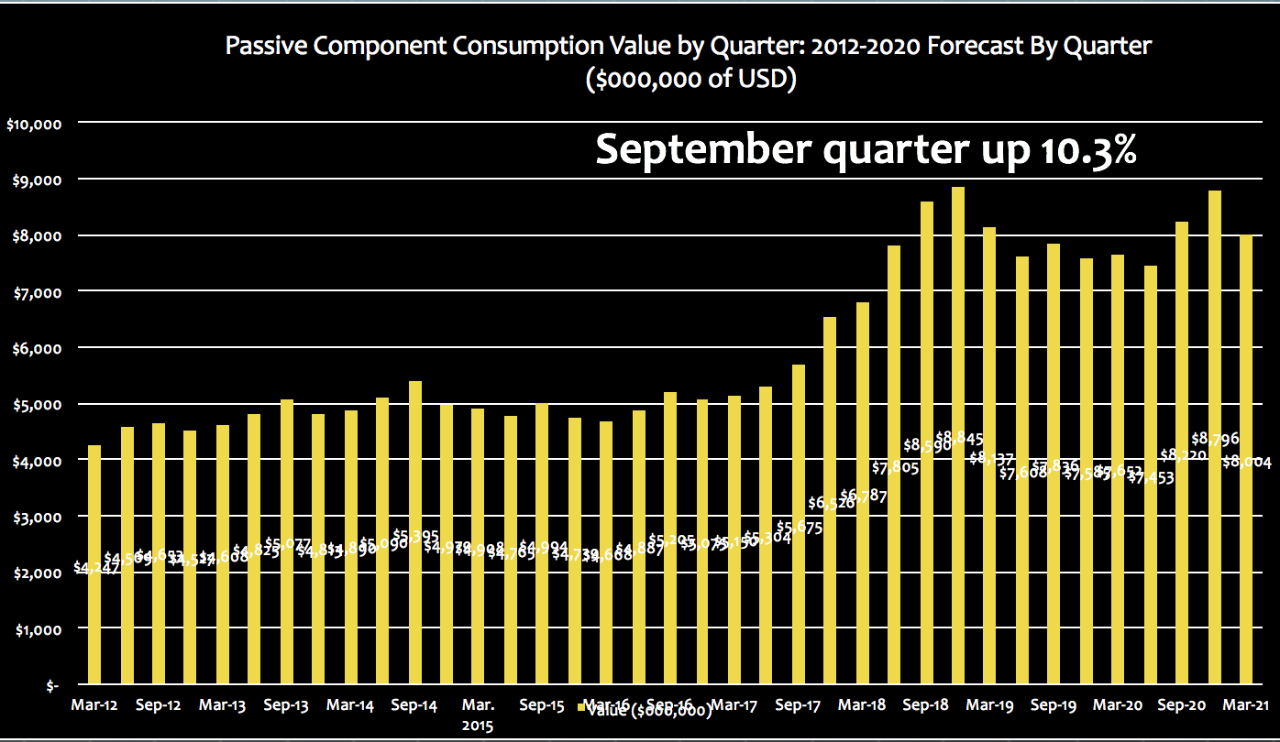
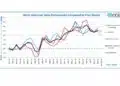
Figure 1: Global Passive Electronic Component Consumption Value by Quarter With September 2020 and December 2020 Quarters Up Sharply; Source: Paumanok

High Capacitance MLCC Drives Demand for Passives in The September 2020 Quarter

The MLCC markets have displayed significant volatility, which included shortages and higher prices for parts between 2017 and 2019. Capacity expansion and the pandemic caused the market to relax in 2020, as illustrated in Figure 2 below, but is now showing a revival driven by demand for 5G handsets in China and Korea, and a global revival in automotive production.
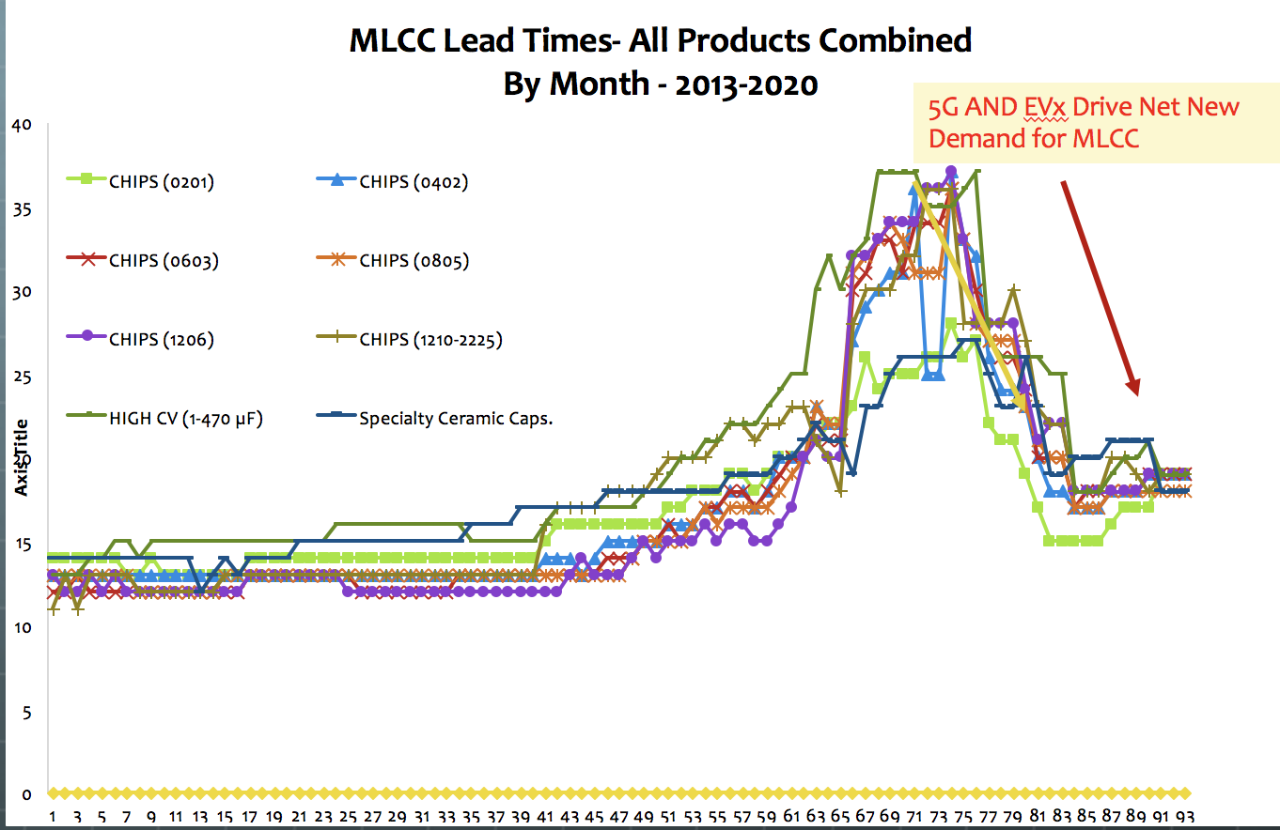
Figure 2: MLCC Lead Times- All Products Combined (Picofarad and Microfarad) By Month: 2013-2020; Source: Paumanok

Tantalum Supply Chain Impacted by New 225 Directive

Tantalum capacitor lead times extended significantly during the month of September 2020, then relaxed slightly in October, especially for smaller case size chips. But the supply chain for tantalum is so sensitive that we estimate the new United States department of Defense 225.225-7052 Authorization Act is having an impact due to the re-evaluation of suppliers for capacitor-grade tantalum powder and flake.

Section 849 adds tantalum to the definition of covered materials in 10 U.S.C. 2533c. This regulation prohibits the acquisition of any covered material smelted or produced in any covered country (North Korea, China, Russia or Iran).  Today, about 35 percent of the world’s supply of capacitor-grade tantalum metal powder comes from three companies in China.

The reader should note that tantalum is an exceptionally sensitive supply chain and tends to react in a dramatic way when confronted with the delicate nature of its supply chain.
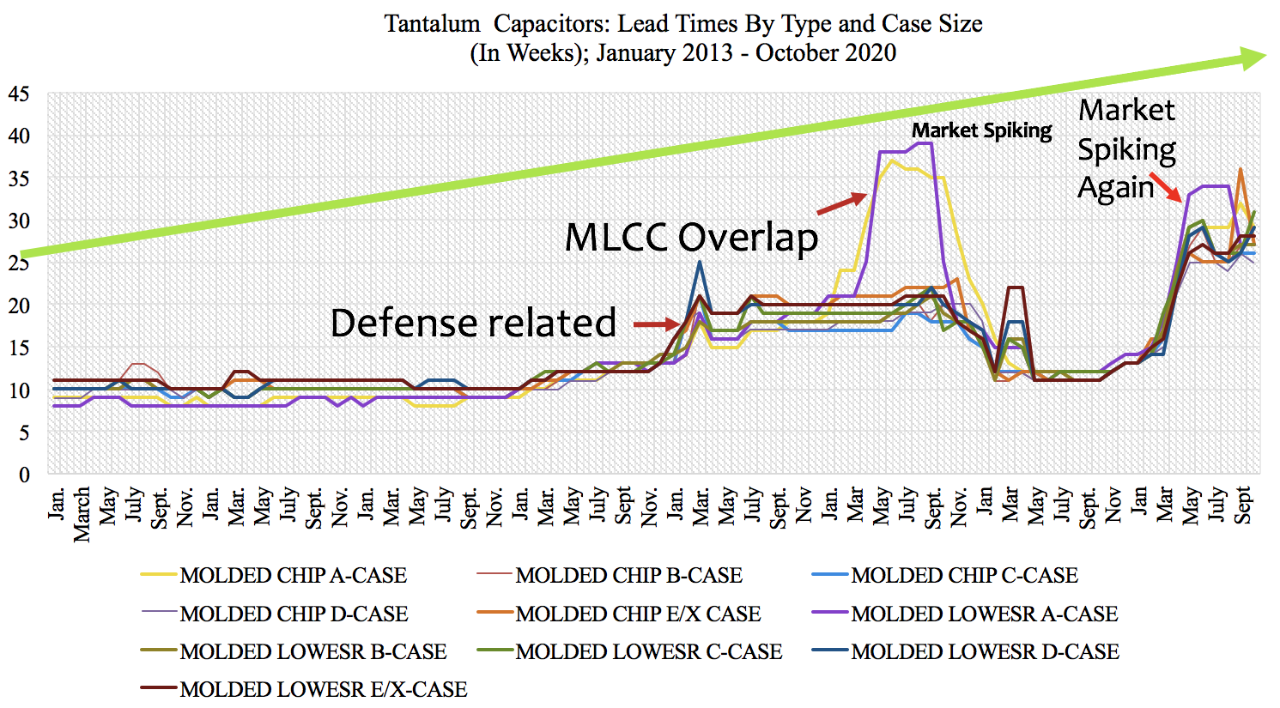
Figure 3: Tantalum Capacitor Lead Times- By Type (Polymer Versus Manganese); and Case Size. Source: Paumanok Monthly Market Research Report On Passive Components for October 2020

Thick Film Chip Resistors Also Impacted

Paumanok also noted in its October report that demand for thick film chip resistors is also increasing and lead times are extending. Chip resistors are also finding net new demand in 5G handset markets in China and Korea, while demand from the automotive sector is also increasing (see Figure 4 below). Thick film chip lead times are also responding to higher ruthenium prices, which are a key element in thick film production.
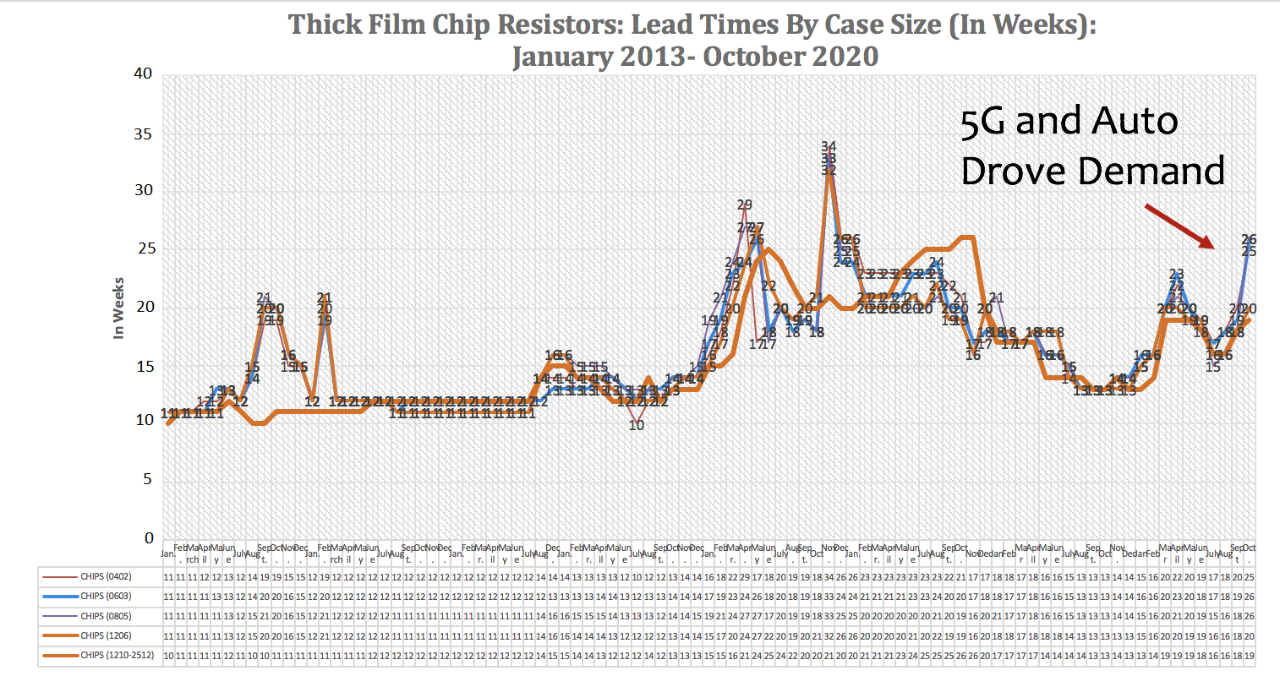
Figure 4: Thick Film Chip Resistor Lead Times – By Case Size. Source: Paumanok Monthly Market Research Report On Passive Components for October 2020

Summary and Conclusions

The passive electronic component markets experienced a double-digit growth spurt in the September 2020 quarter (on a quarter-to-quarter basis) that developed because of demand from the 5G handset markets and a revival in the automotive electronics sector. 

Demand was most pronounced for high capacitance MLCCs, especially the high voltage versions consumed in electric vehicles. Other markets showing increased activity included tantalum, due to a new challenge in its materials supply chain.  The market for chip resistors was also impacted, seeing a spike in demand for the September quarter, also influenced by demand from 5G handsets and automobiles. 

Chip resistors also face unprecedented increases in raw material prices due to its reliance on ruthenium for its thick film design. Ruthenium, which is a by-product of platinum mining in South Africa, has experienced a substantial increase in price due to striking mine workers in the platinum mines of South Africa. 

Materials like tantalum, ruthenium and palladium have demonstrated volatility in supply and demand over the past 40 years; they continue to do so in Q4 of 2020, and will do so for the foreseeable future.

Paumanok Releases Capacitors 2020-2025 Market Report
Paumanok Releases Resistor World Market Report, Technologies & Opportunities: 2020-2025
Paumanok Releases Passive Electronic Components: World Market Outlook: 2020-2025

Related

Source: TTI Market Eye, Paumanok

Recent Posts

Samsung Introduced Low ESL 3-Terminal Reverse-Geometry MLCCs for High-Performance ADAS

20.5.2026
12

Using Stress–Strain Curves to Diagnose Tantalum Powders for Capacitors

20.5.2026
15

Samsung Launches Ultra-Compact 008004 High Q MLCC for Next-Generation RF Applications

20.5.2026
8

Nichicon Extends Rechargeable Batteries Temperature to Rival Supercapacitors

19.5.2026
24

Two‑capacitor paradox explained for engineers

18.5.2026
49

Circuit Protection Technology Annual Dossier

15.5.2026
36

ESA SPCD 26 Registration Open

15.5.2026
25

Capacitances of Nonlinear MLCCs: What Datasheets Don’t Tell You

14.5.2026
88

Stackpole Releases Automotive Wide‑Termination Resistors

14.5.2026
28

Upcoming Events

Jun 2
16:00 - 17:00 CEST

Calculation, Simulation and Measurement of 800V EMC Filters

Jun 16
16:00 - 17:00 CEST

EMC with EMC – EMC‑compliant design with electromechanical connectors

View Calendar

Popular Posts

  • Buck Converter Design and Calculation

    0 shares
    Share 0 Tweet 0
  • Boost Converter Design and Calculation

    0 shares
    Share 0 Tweet 0
  • Flyback Converter Design and Calculation

    0 shares
    Share 0 Tweet 0
  • LLC Resonant Converter Design and Calculation

    0 shares
    Share 0 Tweet 0
  • MLCC and Ceramic Capacitors

    0 shares
    Share 0 Tweet 0
  • Capacitor Charging and Discharging

    0 shares
    Share 0 Tweet 0
  • What Electronics Engineer Needs to Know About Passive Low Pass Filters

    0 shares
    Share 0 Tweet 0
  • Dual Active Bridge (DAB) Topology

    0 shares
    Share 0 Tweet 0
  • Ripple Current and its Effects on the Performance of Capacitors

    3 shares
    Share 3 Tweet 0
  • Samsung Electro-Mechanics Releases High-Capacitance MLCCs for AI Server Applications

    0 shares
    Share 0 Tweet 0

Newsletter Subscription


Passive Components Blog

© EPCI - Leading Passive Components Educational and Information Site

  • Home
  • Privacy Policy
  • EPCI Membership & Advertisement
  • About

No Result
View All Result
  • Home
  • Knowledge Blog
  • PCNS

© EPCI - Leading Passive Components Educational and Information Site

This website uses cookies. By continuing to use this website you are giving consent to cookies being used. Visit our Privacy and Cookie Policy.
Go to mobile version