





Edgewater Research’s most recent IP&E update indicates that AI & broader market is stronger again; Nvidia Rubin Ultra is targeting 2x backplane density.
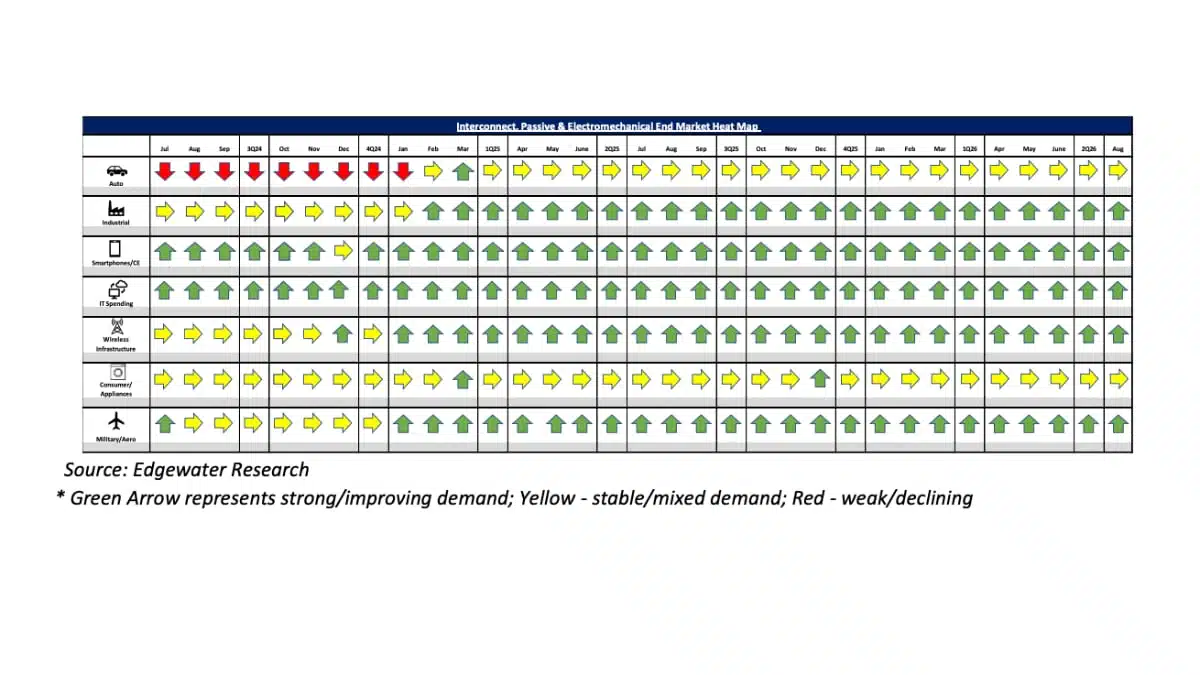
This August 2026 collection of news summaries, survey results, and channel market insights, covers Interconnect, Passives, and Electromechanical Components from Edgewater Research.
What’s Changed / What’s New?
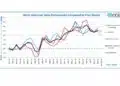
- Broader IP&E demand strengthened again: July bookings were among the strongest year-to-date, book-to-bill ratios remain above 1x, and channel inventories are still lean despite accelerating POS. Industrial, Mil/Aero, AI/data center and selected automotive markets are supporting the recovery.
- Passive-component tightness is emerging, especially in MLCCs: Orders for MLCCs and resistors reportedly accelerated sharply from June, led by Greater China; high MLCC utilization and an unfavorable capacity mix toward larger AI-related case sizes limit near-term supply relief.
- Nvidia Rubin Ultra architecture is becoming far more connector- and cable-intensive: The current plan calls for a modular NVL72 platform that can scale to NVL576, roughly doubling cabled-backplane density to about 10,368 cables and potentially raising backplane content by 60–70% versus current VR/GB NVL72 systems. This remains an important execution and signal-integrity risk.
- AWS Trainium upside increased: Second-half 2026 Trn3 connector/cable orders rose 15–20% since July, while the Trn3 Max ramp has moved forward into Q3 and its 2026 rack forecast increased to roughly 5–10K units from about 5K.
- Optics supply constraints are worsening: Laser availability, PCB and DSP constraints, tighter passive-fiber availability, and delays to planned U.S. manufacturing expansion are creating renewed risk of optical-module shortages into 2027.
Top 3 Channel Comments
- NVL72 is intended as Nvidia’s modular building block. Both standalone and scalable configurations retain the same cable backplane and 18 NVSwitch trays; the scalable version adds optical interfaces to link eight NVL72 racks into an NVL576 domain.
- Nvidia’s cableless direction is not representative of the whole market. AMD, AWS and Microsoft are still designing modular compute trays with substantial internal copper content, supporting a multi-year opportunity for flyover and internal PCIe cables.
- Distribution and industrial demand are catching up rapidly. One channel source called July its strongest bookings month in 12 months, reported August demand improving further, B2B above 1.3x, lean distributor stocks and accelerating sell-through.
Other Key Takeaways
- Nvidia demand remains robust: 2026 NVL connector demand is tracking toward the high end of the prior 60–80K rack outlook, while suppliers are reportedly being asked to prepare for more than 100K NVL72 racks in 2027.
- AEC demand is expanding: xAI’s 800G AEC demand is estimated at around 120K units per month through year-end 2026, largely linked to incremental GB300 deployments; Credo is estimated to hold about 80% share.
- 1.6T AEC adoption is broadening ahead of 2027: Hyperscalers, neoclouds and network OEMs are increasing activity, while AMD is reportedly qualifying AECs for MI4xx systems in response to customer demand, likely Meta.
- Internal copper may be a more durable growth area than the market assumes: PCIe Gen5/6 flyovers, higher CPU attachment in inference systems, modular AI-rack architectures and EDSFF storage transitions all favor increasing cable use; active/retimed copper becomes more relevant with PCIe Gen7 from late 2027 onward.
- NPO is moving from evaluation toward deployment: Volume NPO deployments are projected to begin in 2H 2027, particularly for rack-to-rack scaling. It may add connector and passive-fiber content while delaying broad CPO adoption, which still faces unresolved cost, yield, serviceability and multi-sourcing challenges.
- Auto remains stable, while industrial is constructive: Automotive customers are extending order visibility and may be pulling demand forward ahead of expected 2027 pricing resets; industrial strength is concentrated in energy storage, HVAC, infrastructure, semiconductor equipment and grid-related power applications.
Conclusion
The report’s central message is decisively constructive for IP&E through the rest of 2026 and into 2027: demand is improving faster than inventories can normalize, AI/data-center infrastructure is adding a structural growth driver, and supply conditions are progressively tightening.
For passive-component and interconnect suppliers, the most consequential changes are the prospective MLCC tightening cycle, much higher connectivity content in next-generation AI racks, sustained internal-copper relevance, and the transition from optical technology trials toward NPO deployments. The principal caveat is execution: Rubin Ultra’s density target, optical-component availability and AI-platform supply constraints could shift product architectures, shipment timing and content allocation.tals through the balance of 2026 and into 2027, supported by improving demand, continued inventory normalization, and a gradually tightening supply environment.
Full report available from: Dennis Reed, Sr. Research Analyst, Edgewater Research