


A University of Nebraska–Lincoln-led team has reported intrinsic antiferroelectric behavior in compressively strained, La-doped hafnia thin films, published in Science on September 24, 2026.
The peer-reviewed study, led by Xin Li with collaborators including Xiaoshan Xu, Alexei Gruverman, Evgeny Y. Tsymbal and Rohan Mishra, examines epitaxial single-crystal films rather than conventional polycrystalline capacitor dielectrics.
Key takeaways
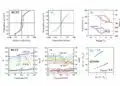
- Single-crystalline, (111)-oriented La-doped HfO₂ films on yttria-stabilized zirconia (YSZ) showed antiparallel dipole order, field-induced polar switching and double polarization–electric-field hysteresis—the three experimental characteristics used to establish antiferroelectricity.
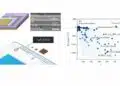
- The antiferroelectric phase was stabilized by compressive epitaxial strain and became more stable as the film thickness was reduced, persisting to approximately 0.6 nm, near the two-dimensional limit.
- The reported ordering temperature reached 850 °C in the ultrathin-film limit, a thermal-stability result that is important for the underlying crystal order but is not equivalent to a capacitor operating rating.
- Hafnia is lead-free and already familiar to semiconductor processing, but this demonstration uses a highly controlled La-doped epitaxial film on a crystalline YSZ substrate—not an MLCC-compatible multilayer ceramic process.
- The immediate significance is more fundamental than commercial: it strengthens the physical case that the observed response arises from intrinsic antiferroelectric order rather than charge trapping or redistribution.
Background
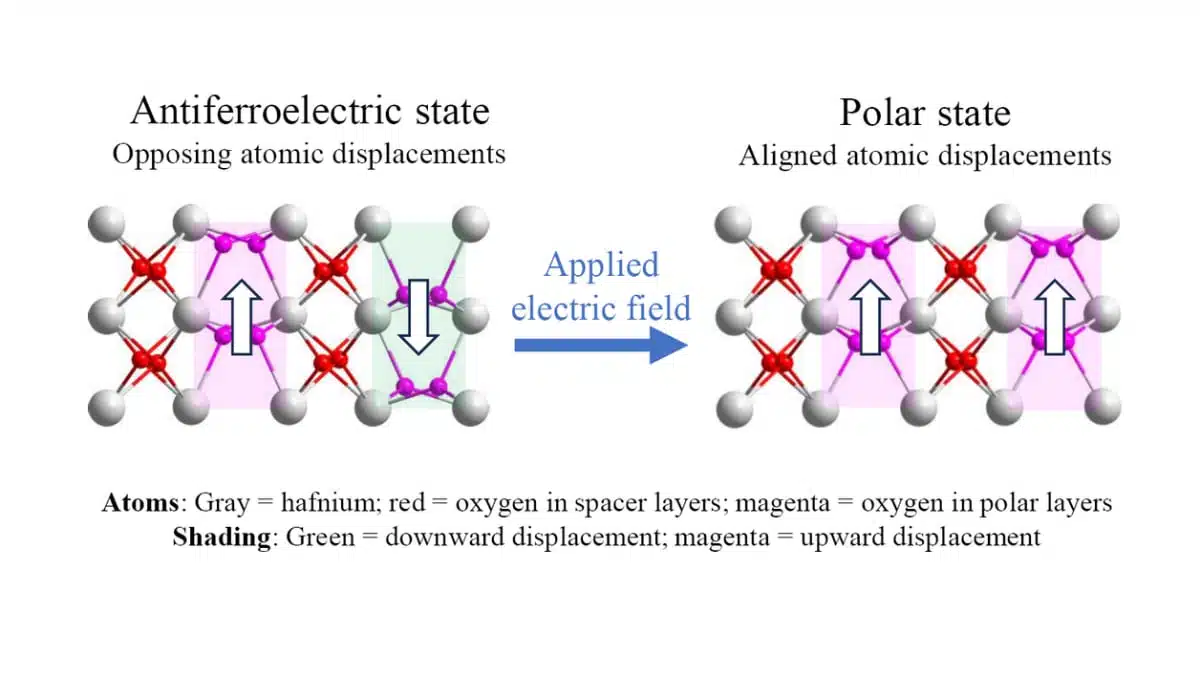
Antiferroelectrics contain local electric dipoles arranged in opposing directions, producing little or no net remanent polarization at zero applied field. Under a sufficiently high electric field, the antipolar structure can transform into a polar state. On removal of the field, it can revert to the antipolar state.
For capacitor engineers, the practical attraction is the characteristic double hysteresis loop. In principle, a narrow loop with a large reversible polarization change can support high recoverable energy density and useful charge–discharge behavior. The penalty is that useful switching normally requires a high transition field, while losses, cycle life, temperature stability, dielectric breakdown and electrode interfaces ultimately decide whether a material is viable in a component.
Hafnia is unusual in this context. HfO₂ is already used widely as a high-k gate dielectric and is a major ferroelectric-memory material platform because it can be made compatible with CMOS thermal budgets and scaling. Yet its ferroic behavior is notoriously sensitive to phase fraction, strain, dopants, film thickness, defects, oxygen vacancies, electrodes and thermal history. The central question addressed by this work is whether hafnia can be intrinsically antiferroelectric under defined structural conditions, rather than merely producing antiferroelectric-like electrical loops through extrinsic effects.
What the researchers found
The study used La-doped hafnia grown as a single-crystalline, (111)-oriented epitaxial thin film on YSZ. The substrate imposed compressive strain that stabilized an orthorhombic antipolar phase. This is materially different from the polycrystalline HfO₂- or HfZrO₂-based layers commonly investigated in integrated ferroelectric capacitors and FeFETs.
The authors combined structural, electrical and microscopy evidence. Their reported case for intrinsic antiferroelectricity rests on three linked observations:
- Antiparallel sublattice polarization in the crystal structure.
- Stable double-hysteresis switching under applied field.
- Interphase boundaries separating polarization states during the electrically driven transition.
The structural interpretation is described as consistent with the Kittel model of antiferroelectricity: polar layers with oppositely directed displacements are separated by nonpolar spacer layers. Applied field aligns the otherwise opposing displacements into a polar state.
| Property or observation | Reported result | Material and condition | Engineering relevance |
|---|---|---|---|
| Material form | La-doped, single-crystalline HfO₂ | (111)-oriented epitaxial film on YSZ | Not representative of deposited polycrystalline capacitor dielectrics |
| Ferroic state | Antiferroelectric | Compressive-strain condition | Provides a defined route to antipolar ordering |
| Electrical signature | Stable double hysteresis | Integral electrical measurements | Required evidence for reversible field-induced antipolar-to-polar switching |
| Thickness limit | Approximately 0.6 nm | Ultrathin film / 2D limit | Indicates the reported ordering did not collapse at extreme scaling |
| Ordering temperature | Up to 850 °C | Two-dimensional-limit film | Indicates robust crystal order, not a component-temperature rating |
The paper’s most counterintuitive result is the thickness trend. In many conventional ferroelectric thin films, reduced thickness intensifies depolarization fields and suppresses stable polarization. Here, the antipolar phase has no macroscopic polarization at zero field, so it avoids the same depolarization-field penalty. The authors connect this behavior to stronger orthorhombic antiferroelectric order in thinner, coherently strained films.
Why it matters for passive components
For passive-component engineering, this paper matters chiefly as a materials-physics result that may widen the design space for thin-film capacitors and integrated energy-storage structures.
An antiferroelectric hafnia platform could eventually matter in several areas:
- Integrated thin-film capacitors: A field-driven antipolar-to-polar transition may enable high charge storage per footprint in monolithic or on-chip capacitors, provided the transition field, dielectric loss and breakdown statistics become favorable.
- Energy-storage capacitors: Recoverable energy depends on the usable polarization change and the area enclosed by the hysteresis loop. The present paper establishes antiferroelectric behavior, but it does not yet provide a qualified energy-storage capacitor design with the device-level efficiency, lifetime and breakdown distribution needed for component comparison.
- Voltage-dependent capacitance: A sharp field-induced structural transition can produce highly nonlinear capacitance. That can be attractive for tunable electronics or adaptive circuits but problematic in precision decoupling, timing and filtering applications.
- Electrocaloric concepts: Reversible field-driven phase transitions can be relevant to solid-state cooling. However, cooling performance requires direct electrocaloric measurements, field cycling data and thermal integration evidence; these are not established by the reported structural result alone.
- Hafnia-based integrated devices: The stronger near-term connection is likely to CMOS-integrated capacitors, memory-adjacent structures and multifunctional thin-film devices rather than to discrete MLCCs.
The result should not be read as evidence that standard X7R, C0G/NP0 or high-voltage MLCC formulations can simply replace BaTiO₃-based dielectrics with hafnia. MLCC manufacturing depends on powder synthesis, tape casting, sub-micrometre dielectric layers, multilayer co-firing, electrode compatibility, grain-boundary control and high-volume reliability screening. None of those production requirements is demonstrated in an epitaxial La:HfO₂/YSZ film.
From lab to component
This is a fundamental-materials demonstration, with an editorial maturity estimate of TRL 2–3: the relevant physical principle has been formulated and experimentally demonstrated in a laboratory thin-film structure, but not yet in a component-relevant capacitor stack or production process.
The work removes uncertainty around the nature of the observed electrical response under the specific strain-stabilized conditions. It does not yet resolve the engineering questions that determine a capacitive product.
| Development question | Status in this study | Production implication |
|---|---|---|
| Intrinsic antipolar order | Demonstrated in strained single-crystal La:HfO₂ | Strong scientific foundation |
| Sub-nanometre structural stability | Demonstrated to about 0.6 nm | Supports scaling research |
| Energy density and efficiency | Not established as a component-level benchmark | Needed for energy-storage comparisons |
| Cycling endurance | Not reported as qualification data | Must address fatigue, imprint and wake-up behavior |
| Breakdown distribution | Not reported as a capacitor-reliability metric | Essential for practical energy storage |
| Base-metal-electrode compatibility | Not demonstrated | Critical for cost-effective multilayer capacitors |
| Multilayer ceramic processing | Not demonstrated | Major barrier for MLCC applicability |
The epitaxial route itself is a limitation. Pulsed-laser deposition and lattice-matched single-crystal substrates are powerful research tools, but they do not directly translate to high-throughput, low-cost multilayer capacitor fabrication. The role of La concentration, oxygen vacancy content, electrode work function, interface chemistry, grain structure and residual stress will also need systematic mapping.
Hafnium is not restricted by the lead hazard associated with many classic antiferroelectrics, but its supply chain and cost are less favorable than abundant dielectric feedstocks used in mainstream MLCC ceramics. That does not rule out niche integrated applications, where material volume is very small, but it matters for large-volume discrete capacitors.
What engineers should watch
- Demonstrations of antiferroelectric switching in sputtered, ALD-grown or MOCVD-grown polycrystalline hafnia films on silicon-compatible substrates.
- Full polarization–electric-field data including field amplitude, frequency, temperature, electrode geometry, leakage-current separation and sample-to-sample variation.
- Recoverable energy density, charge–discharge efficiency and pulse-power performance measured alongside breakdown statistics.
- Endurance, retention, imprint, wake-up and fatigue data across realistic electric-field cycling conditions.
- The stability of the antipolar phase after annealing, encapsulation, electrode deposition and thermal excursions representative of backend semiconductor processing.
- Evidence for manufacturable multilayer structures, including compatibility with TiN, W, Ru or other integrated electrodes—and, for discrete capacitors, the far more difficult question of compatibility with low-cost Ni/Cu electrode and ceramic co-firing systems.
Summary
The Nebraska-led Science paper establishes that compressively strained, single-crystal La-doped hafnia can exhibit the structural and electrical signatures of intrinsic antiferroelectricity. The order persists at an approximately 0.6 nm thickness and is reported to remain stable to an ordering temperature of 850 °C.
For passive-component engineers, the main takeaway is not an imminent hafnia MLCC or commercial energy-storage capacitor. It is that hafnia now has a stronger experimental basis as an antiferroelectric thin-film platform, potentially relevant to highly scaled integrated capacitors and field-switching devices once energy density, losses, reliability and manufacturability are demonstrated.
Source
This article is based on the peer-reviewed paper published in Science and the accompanying University of Nebraska–Lincoln press release. The paper has an openly available arXiv version; the precise publisher open-access license could not be verified from the accessible journal record. These are laboratory thin-film research results, not qualified commercial capacitors; engineers should wait for manufacturer data, reliability evidence and relevant standard qualification before making a design decision.
References
- Xin Li, Guodong Ren, Haidong Lu, Kartik Samanta, Amit Kumar Shah, Kai Huang, Pravan Omprakash, Yu Yun, Pratyush Buragohain, Huibo Cao, Yan Wu, Jordan A. Hachtel, Andrew R. Lupini, Miaofang Chi, Juan Carlos Idrobo, Evgeny Y. Tsymbal, Alexei Gruverman, Rohan Mishra and Xiaoshan Xu, “Antiferroelectric hafnia down to the 2D limit,” Science, 2026, https://doi.org/10.1126/science.ady5526. Publisher license not confirmed from the accessible record.[science]
- Xin Li et al., “Antiferroelectric Hafnia Down to the 2D Limit,” arXiv:2408.01830, revised August 2, 2025, https://doi.org/10.48550/arXiv.2408.01830.[arxiv]
- University of Nebraska–Lincoln, “Husker researchers make discovery in material that powers modern electronics,” September 24, 2026, https://news.unl.edu/article/husker-researchers-make-discovery-in-material-that-powers-modern-electronics.[news.unl]
- University of Nebraska–Lincoln via EurekAlert!, “Xiaoshan Xu, Susan J. Rosowski Professor of physics and astronomy,” image release, September 25, 2026.[eurekalert]