





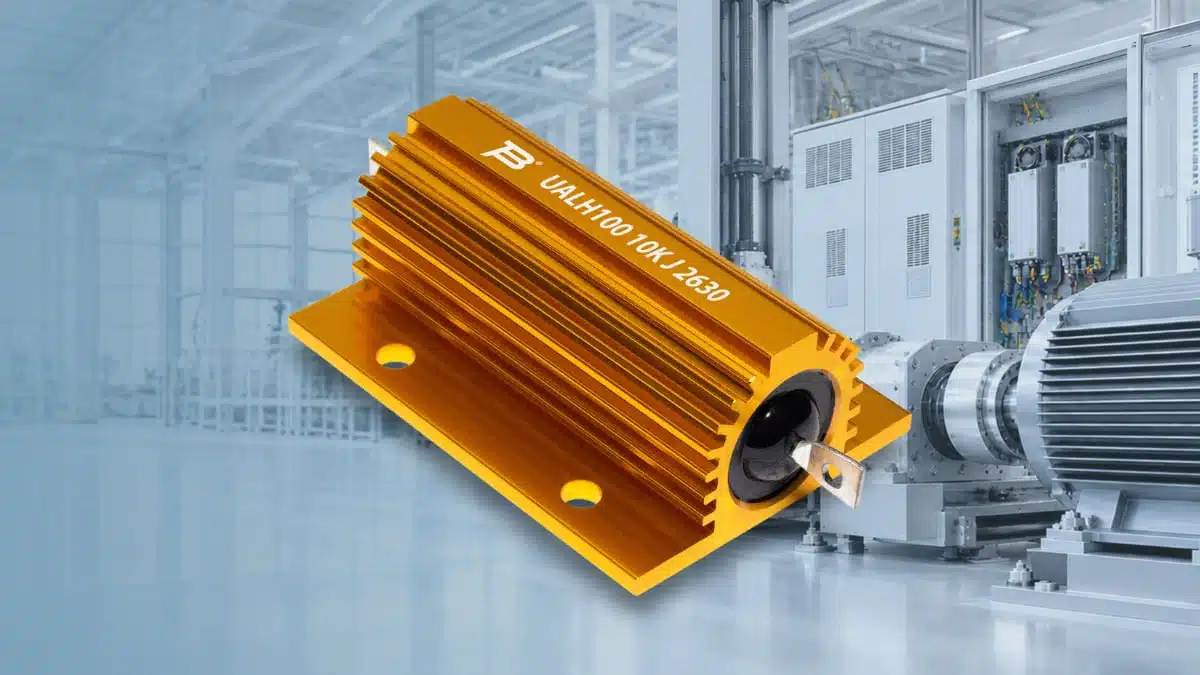
Bourns has introduced the UALH Series, an aluminum-housed wirewound resistor family for industrial equipment operating under high electrical and thermal stress.
The single-series release adds a 100 W heatsink-mounted resistor option with operation specified to +275 °C, addressing applications where continuous dissipation, working voltage and mounting thermal resistance must be assessed together.
Key features and benefits
- Aluminum-housed wirewound construction with silicone molding compound.
- 100 W power rating at 25 °C when mounted to a heatsink.
- 30 W power rating at 25 °C without a heatsink.
- Resistance range from 0.5 Ω to 22 kΩ.
- ±5% resistance tolerance and ±350 ppm/°C temperature coefficient of resistance.
- Operating-temperature range from −55 °C to +275 °C.
- Maximum working voltage of 1483 V and dielectric-withstanding voltage of 4500 V.
- Maximum rated current of 14.14 A.
- Moisture sensitivity level 1, plus RoHS-compliant and halogen-free status.
The release identifies only the UALH Series; it does not publish individual orderable part numbers, sub-families or multiple case-size designations. Publicly located documentation also did not provide separate outline drawings, land patterns, qualification reports, SPICE models, impedance curves, product-change notices or lifecycle notices for this series.
Technical highlights
| Parameter | UALH Series | Selection relevance |
|---|---|---|
| Resistor technology | Wirewound, aluminum housed | High-power fixed resistor |
| Power with heatsink | 100 W at 25 °C | Requires thermal interface |
| Power without heatsink | 30 W at 25 °C | Lower standalone limit |
| Resistance range | 0.5 Ω to 22 kΩ | Covers low- and high-value roles |
| Resistance tolerance | ±5% | General power-control accuracy |
| TCR | ±350 ppm/°C | Resistance shifts with temperature |
| Maximum working voltage | 1483 V | Check continuous circuit voltage |
| Dielectric withstand | 4500 V | Insulation test parameter |
| Maximum rated current | 14.14 A | Verify against \sqrt{P/R} |
| Operating temperature | −55 °C to +275 °C | Ambient and resistor-body limits |
The 100 W rating is explicitly conditional on heatsink mounting at 25 °C. It should not be treated as a free-air dissipation rating or transferred directly to a final assembly without evaluating the heatsink, mounting flatness, interface material, enclosure airflow and local ambient temperature.
The 14.14 A maximum rated current also constrains low-resistance selections. The rated current is calculated as \sqrt{P/R}, but must not exceed the stated maximum working current. For a low-ohmic resistor, both the power limit and current limit therefore need to be checked.
The ±350 ppm/°C TCR is material in current-sense, timing or calibration-sensitive circuits. Across a large resistor-temperature excursion, resistance change can be significant even when the component remains within its specified operating-temperature range. The UALH is consequently more appropriate where power handling and thermal robustness govern selection than where close resistance stability is the primary requirement.
Typical applications
Bourns identifies the UALH Series for industrial motor controls, industrial power supplies and high-power machinery. The published 100 W heatsink-mounted power rating, 1483 V maximum working voltage, 14.14 A maximum rated current and −55 °C to +275 °C operating range support its use where a fixed resistor must dissipate substantial continuous power under controlled mounting conditions.
| Application | Published ratings supporting fit | Checks before use |
|---|---|---|
| Industrial motor controls | 100 W with heatsink, 14.14 A maximum current | Braking duty, pulse energy, thermal path |
| Industrial power supplies | 1483 V working voltage, 30 W or 100 W rating | Continuous dissipation, fault voltage |
| High-power machinery | −55 °C to +275 °C operation | Ambient, enclosure temperature, vibration |
In motor-control equipment, the series may be considered for fixed resistance functions where dissipation is sustained and a heatsink can be incorporated into the mechanical design. The public documents do not state a pulse-energy rating, braking-resistor energy rating, inductance value or non-inductive winding option. Those characteristics should not be assumed for snubber, fast-switching, repetitive-pulse or regenerative-braking duties.
For industrial power supplies, the working-voltage rating and heatsink-mounted dissipation capability are relevant to bleed, discharge, load, damping or other power-resistance functions. Final suitability depends on the actual waveform and fault conditions. A dielectric-withstanding-voltage figure is an insulation-test specification, not a substitute for verifying steady-state, surge and transient voltage margins in the circuit.
Design-in notes for engineers
- Calculate worst-case resistor dissipation from the actual operating profile, including normal operation, overload, standby, fault and discharge intervals.
- Treat 100 W as a heatsink-system rating. Verify the resistor-to-heatsink interface, mounting torque, mating-surface flatness, thermal compound or pad selection, heatsink temperature and enclosure airflow.
- Use the 30 W rating rather than the heatsink-mounted value if the final assembly does not provide the specified heatsink condition.
- Check the 1483 V maximum working voltage against continuous voltage, transient voltage, fault voltage and any series-resistor voltage sharing.
- Check current independently of power. The specified maximum rated current is 14.14 A.
- Allow for resistance drift with temperature using the ±350 ppm/°C TCR, especially in current-setting or monitoring paths.
- Confirm whether the circuit imposes repetitive pulse, surge, overload, switching-frequency or inductive-energy stress. No public pulse-load curve, energy rating or inductance specification was located for the UALH Series.
- Assess creepage, clearance, protective earthing and accessible-surface temperature at the equipment level. The 4500 V dielectric-withstanding rating alone does not establish system insulation coordination.
- Validate the final mounted assembly under its highest ambient temperature and realistic cooling conditions before schematic, layout and production release.
The component’s high specified operating-temperature limit does not eliminate the need to control nearby temperature-sensitive parts, PCB materials, wiring insulation, connectors and heatsink interfaces. This should be verified under final operating conditions.
Further reading
- Wirewound Resistors
- Performance of AEC-Q200 Rated Power Resistors for Automotive Use
- Bourns Releases AEC-Q200 Wirewound Power Resistors
Source
This article is based on the Bourns UALH Series press release and official product documentation. Engineers should consult the current manufacturer datasheet and associated documentation for final qualification, thermal design and production-release decisions.