

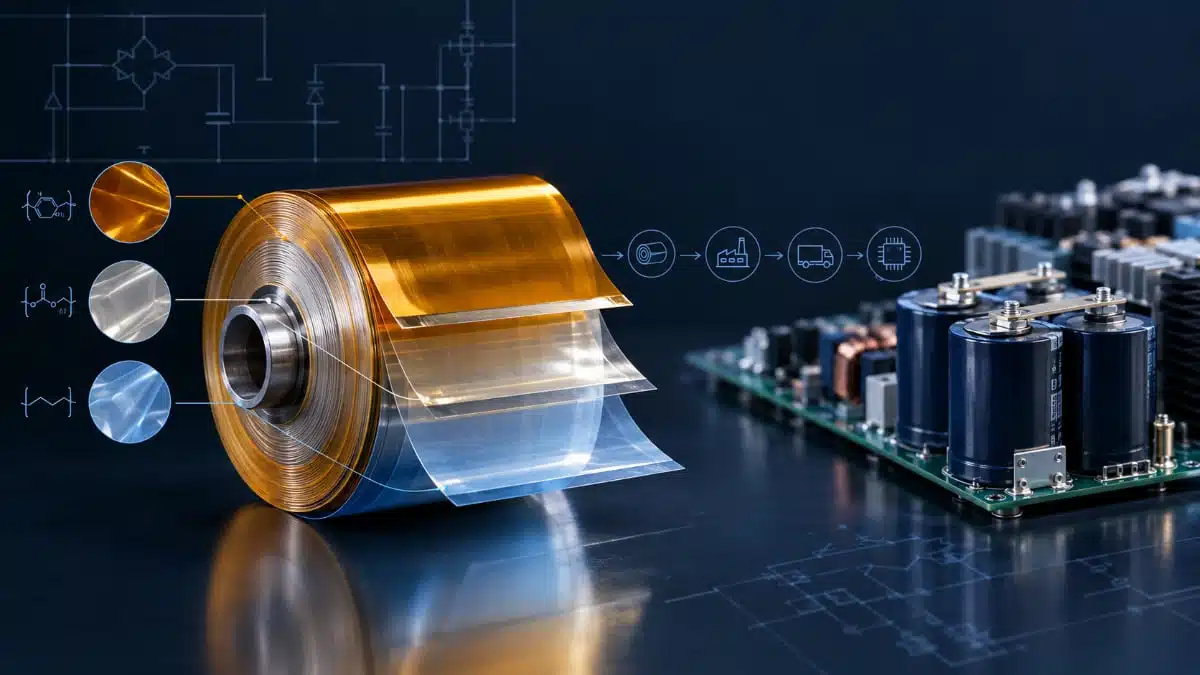
Changes in capacitor-grade polyethylene naphthalate (PEN) film availability are creating discontinuity risk for selected film-capacitor product families.
The most effective response is not a generic dielectric substitution, but a structured assessment of the affected capacitor function, electrical stresses, thermal conditions, compliance requirements and available qualified replacement paths.
PEN is used where a film capacitor benefits from a balance of compact construction, temperature capability, mechanical stability and dielectric performance. When a qualified PEN film source changes or is withdrawn, its impact can extend through film conversion, metallization, capacitor manufacturing, OEM qualification, production continuity and field-service support.
PEN Supply-Chain Challenge
The capacitor supply chain begins with polymer resin and specialist film production, then continues through film orientation, surface finishing, metallization, slitting, capacitor assembly, testing and qualification. The loss of an upstream film production route can affect multiple downstream capacitor series, particularly where a manufacturer has approved a specific film grade, thickness and metallization system for a long-running product family.
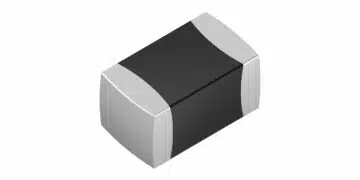
Panasonic discontinued its ECW-U stacked metallized film chip-capacitor series following a PEN-film supply discontinuation. Its published notification included a last-time-buy date of 26 December 2025 and final shipment date of 30 June 2026.
Yageo/KEMET also identified the shutdown of Mylar Specialty Films Luxembourg Line 5, a PET/PEN film production line, as affecting several capacitor families. The products listed in its notification included A50, C44A, C4AS/C4BS, C4C, F161 and F5A/F5B/F5D series.
These developments do not mean that PEN as a polymer has disappeared. They demonstrate that individual capacitor-qualified film supply paths can become unavailable, creating a need for component replacement, film-source requalification or redesign.
Why Film Replacement Requires Care
A film capacitor is defined by more than its nominal capacitance and rated voltage. Its behaviour depends on the dielectric film, film thickness, orientation, electrode metallization, segmentation pattern, winding or stacked-film geometry, terminals, encapsulation and manufacturing controls.
A film substitution can affect:
- Capacitance tolerance and temperature behaviour
- Dissipation factor, ESR and internal self-heating
- Insulation resistance and leakage current
- Continuous voltage, pulse voltage and repetitive surge capability
- Self-healing behaviour in metallized-film constructions
- Humidity performance and endurance under electrical bias
- Mechanical reliability, including vibration and soldering stress
- Safety approvals, customer qualification and documentation status
- Expected operational lifetime
The practical starting point is to define the capacitor’s electrical mission. A component used for DC-link energy storage, snubbing, resonant conversion, AC filtering, EMI suppression, local decoupling or timing may require very different replacement criteria.
PEN, PET and Alternative Films
PEN is a high-performance polyester film that can provide useful temperature and mechanical capability in compact film-capacitor constructions. PET is the more broadly established polyester dielectric and remains relevant for many general-purpose capacitor applications. Polypropylene remains a central material for low-loss power-film capacitors, while PPS, polyimide and PTFE address more specialised operating conditions.
| Dielectric film | Key strengths | Main trade-offs | Typical replacement relevance |
|---|---|---|---|
| PEN | Compact film-capacitor construction, useful temperature capability, good dimensional stability | Supply qualification may depend on specific film grades and sources; not every PEN grade is interchangeable | Preferred where an alternative capacitor-qualified PEN source is available |
| PET | Broad availability, established processing, cost-effective film-capacitor construction | Higher dielectric loss than PP; may be unsuitable for some high-temperature, high-frequency or high-ripple conditions | Suitable for general-purpose, coupling, timing and selected EMI applications after validation |
| PP / BOPP | Very low dissipation factor, strong fit for high ripple current, resonant circuits, DC links and AC filters | Lower temperature capability than some specialist films; may require larger physical volume | Strong candidate for power conversion, snubber, resonant and filter applications |
| PPS | Good thermal stability and dimensional behaviour | Higher cost and more specialised availability than PET or PP | Candidate for elevated-temperature and stability-sensitive applications |
| Polyimide | High-temperature capability and robustness for demanding environments | Higher cost, different electrical and processing trade-offs | Consider for aerospace, defence, high-temperature or severe-environment requirements |
| PTFE | Very low loss and excellent high-frequency and environmental properties | High cost, difficult processing and potentially limited component options | Consider where high-frequency performance or environmental resistance justifies the cost |
| Advanced multilayer polymer films | Potential combination of higher dielectric constant, high breakdown strength or low loss | Commercial maturity, long-term data, manufacturability and qualified availability vary by supplier | Evaluate for compact energy storage, pulse power or advanced power-electronic designs |
PEN remains commercially visible through TEONEX-related channels, but availability must be checked at the exact film-grade level. A film sold for flexible electronics, labels or insulation is not automatically qualified for capacitor manufacture. Thickness, surface condition, metallization compatibility, electrical defect distribution and long-term supply commitment are all relevant.
PET as a Replacement Option
PET can be a practical replacement route where the application does not rely on the specific thermal, loss or voltage-endurance characteristics of the original PEN-based capacitor. It is broadly used in film capacitors and offers a familiar manufacturing base, good mechanical properties and attractive cost.
However, PET should not be treated as an automatic drop-in replacement. Higher dielectric loss can increase internal heating in high-frequency or high-ripple-current operation. The replacement assessment should also consider insulation resistance, humidity response, capacitance stability, film thickness and the effect of any package-size change on creepage, clearance and PCB layout.
PET is generally more relevant when the capacitor serves a general-purpose function, such as coupling, timing, signal filtering or selected suppression duties. It may be less attractive in applications where low dissipation factor, high RMS current capability or elevated temperature are primary design constraints.
Polypropylene for Low-Loss Power Applications
Polypropylene, commonly called PP or BOPP in capacitor-film contexts, is a leading dielectric for power film capacitors. Its low dissipation factor supports efficient operation in DC-link capacitors, inverter output filters, resonant converters, snubbers and AC-filter applications.
The principal benefit of PP is lower dielectric loss, which can reduce self-heating under high ripple current and switching-frequency stress. This makes it particularly relevant when thermal margin and service life are key concerns.
The trade-off is that a direct conversion from PEN to PP may require a physically larger capacitor, a different winding design or a revised capacitor bank. The engineer should therefore evaluate the full electrical function rather than seek a matching dielectric label. In compact equipment, the available volume, cooling path and mounting arrangement may determine whether PP is viable.
PPS, Polyimide and PTFE
PPS, polyimide and PTFE provide alternative pathways for applications with demanding thermal, electrical or environmental requirements.
PPS can be useful where temperature stability and dimensional control are important. Polyimide supports high-temperature operation and demanding environments, but often at a significantly higher material and component cost. PTFE is relevant where very low loss, high-frequency operation or environmental resistance justify a specialised solution.
These films are generally not low-effort substitutions. They are most suitable when the application’s reliability or operating environment justifies redesign, dedicated testing and potentially higher component cost.
Advanced HDC and Low-Loss Films
Advanced multilayer polymer films are being developed to improve volumetric capacitance, dielectric strength, loss behaviour or temperature capability. They can be relevant to applications limited by mass, volume, pulse energy or thermal dissipation.
High dielectric constant and low dissipation factor optimise different performance priorities:
| Film optimisation direction | Main objective | Potentially suitable applications | Qualification focus |
|---|---|---|---|
| High dielectric constant | Increase capacitance or energy storage within a constrained volume | Compact pulse capacitors, energy storage, high-density converter designs | Breakdown distribution, field ageing, energy efficiency, manufacturability |
| Low dissipation factor | Reduce dielectric heating and improve high-frequency efficiency | DC links, resonant converters, snubbers, AC filters, high-ripple circuits | Loss versus frequency, RMS-current capability, hot-spot temperature, endurance |
| High-temperature capability | Maintain performance at elevated operating temperature | Automotive, traction, aerospace, under-hood and industrial power electronics | Temperature endurance, insulation resistance, thermal cycling, long-term ageing |
HDC and LDF terminology should be read carefully. These terms are used by Peak Nano for its NanoPlex product families and describe supplier-specific film concepts rather than universal replacement categories. They may be technically relevant options, but a material should be selected on measured capacitor-level performance, supply continuity and qualification evidence.
Research into nanodielectric and multilayer polymer films demonstrates the potential for higher dielectric constant while retaining high breakdown performance. Published laboratory-scale results should nevertheless be separated from commercially qualified capacitor performance, particularly for high-volume production, metallization compatibility, self-healing performance and multi-year endurance.
Component-Level Replacement Strategies
A component-level replacement is often more practical than changing dielectric film inside an existing capacitor design. Depending on the circuit and qualification constraints, users may consider:
- A replacement film capacitor with equivalent capacitance, voltage class, package, loss characteristics and approvals
- A qualified stacked-film SMD capacitor intended to replace an obsolete PEN-based component
- A PP power-film capacitor with an adjusted footprint, capacitance or parallel configuration
- A capacitor bank redesigned to distribute ripple current, voltage stress or self-heating across multiple components
- A multilayer ceramic capacitor solution where DC-bias behaviour, acoustic noise, flex cracking and failure mode have been assessed
- An aluminium electrolytic, hybrid-polymer or alternative bulk-energy-storage solution where ESR, lifetime and transient response are acceptable
- A circuit-level change that reduces capacitor stress through altered switching frequency, modulation strategy, snubber topology or thermal design
The best replacement is usually the one that preserves the system function with the lowest combined risk in electrical performance, reliability, approval status and supply continuity.
Qualification Plan
A structured replacement programme should be proportional to application criticality, but the following sequence is useful for most designs.
- Identify affected part numbers
Review bills of materials, approved vendor lists, PCNs and purchasing records. Record annual usage, end application, manufacturing site, service-life requirement and supply deadline. - Secure documented change information
Obtain the original manufacturer PCN or PDN. Record the reason for change, affected date codes, last-time-buy date, final shipment date and recommended replacement path. - Define the operating duty
Document DC and AC voltage, transient and surge conditions, waveform, frequency, ripple current, ambient temperature, hot-spot temperature, humidity exposure, cooling conditions and required lifetime. - Screen candidate parts
Compare capacitance, voltage rating, tolerance, dissipation factor, ESR, package size, lead or termination system, insulation resistance, approvals, operating-temperature range and supply status. - Validate circuit operation
Measure temperature rise, ripple current, switching overshoot, resonant frequency, EMI performance, control-loop behaviour and any effect on protection functions. - Run endurance and environmental tests
Select high-temperature endurance, humidity bias, temperature cycling, soldering, vibration and electrical-life testing relevant to the final application. - Release with traceability
Update drawings, BOMs, AVL records, change-control documentation, safety files, customer approval records and field-service information before production deployment.
For critical power-electronic designs, qualification should include samples from normal production rather than only engineering prototypes. Production samples are more representative of the variability in metallization, winding, termination, impregnation and encapsulation processes.
Procurement and Supply Actions
Engineering and procurement should work jointly from the earliest indication of a material or component change. Unit price is only one part of the decision; continuity, traceability and qualification timing are equally important.
- Obtain written confirmation of product status, material change, manufacturing location and final order dates.
- Separate confirmed factory allocation from distributor stock and uncommitted market availability.
- Calculate inventory coverage through the whole transition period, including qualification samples, production ramp, yield loss, service requirements and contingency stock.
- Clarify whether the proposed replacement retains the original dielectric, changes film source, changes capacitor construction or moves to another technology.
- Establish at least one technically credible alternative before the original product reaches its last-time-buy deadline.
- Maintain lot and date-code traceability for both legacy and replacement capacitors.
Conclusion
PEN-film supply changes are best understood as a supply-chain and qualification challenge rather than a simple end-of-life event for one polymer. The immediate exposure is concentrated in capacitor families that depend on specific qualified film grades and upstream production routes, but the resulting design impact can be significant for equipment manufacturers.
Alternative PEN sources may offer the least disruptive path where equivalent capacitor-grade film remains available. PET can be a practical solution for less demanding general-purpose applications, while polypropylene is often the stronger option for low-loss power conversion and high-ripple-current duty. PPS, polyimide and PTFE offer specialised routes when elevated temperature, frequency or environmental requirements dominate. Advanced high-dielectric-constant and low-loss multilayer films may expand future design options, but they should be assessed on commercial maturity, component-level evidence and assured availability.
The most robust strategy is to start with the capacitor’s function in the circuit, identify the actual electrical and environmental stresses, and qualify alternatives against those conditions. This avoids a narrow material-for-material substitution and supports a replacement decision that protects both production continuity and long-term reliability.
Further reading
- Film Capacitors: Construction, Dielectrics and Applications
- Capacitor Selection for Power Electronics Applications
- Understanding Capacitor ESR, Dissipation Factor and Ripple Current
- DC-Link Capacitors in Power Electronics
Source
This article is based on manufacturer product-change and product-obsolescence documentation, together with official film-material and capacitor-film product information. Engineers should consult the current manufacturer datasheet, PCN/PDN documentation, qualification evidence and application guidance before final component selection, qualification or design release.
References
- Panasonic Product Obsolescence Notice: ECW-U Series
- Panasonic ECW-U Series Product Discontinuation Notice
- Yageo/KEMET Product Change Notification: PET/PEN Film Supply Change
- TEONEX Polyethylene Naphthalate Film Product Information
- Peak Nano NanoPlex High Dielectric Constant Capacitor Film
- Peak Nano NanoPlex Low Dissipation Factor Capacitor Film