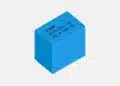


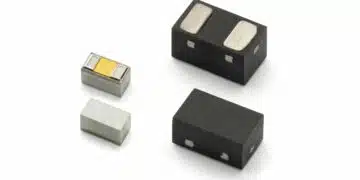



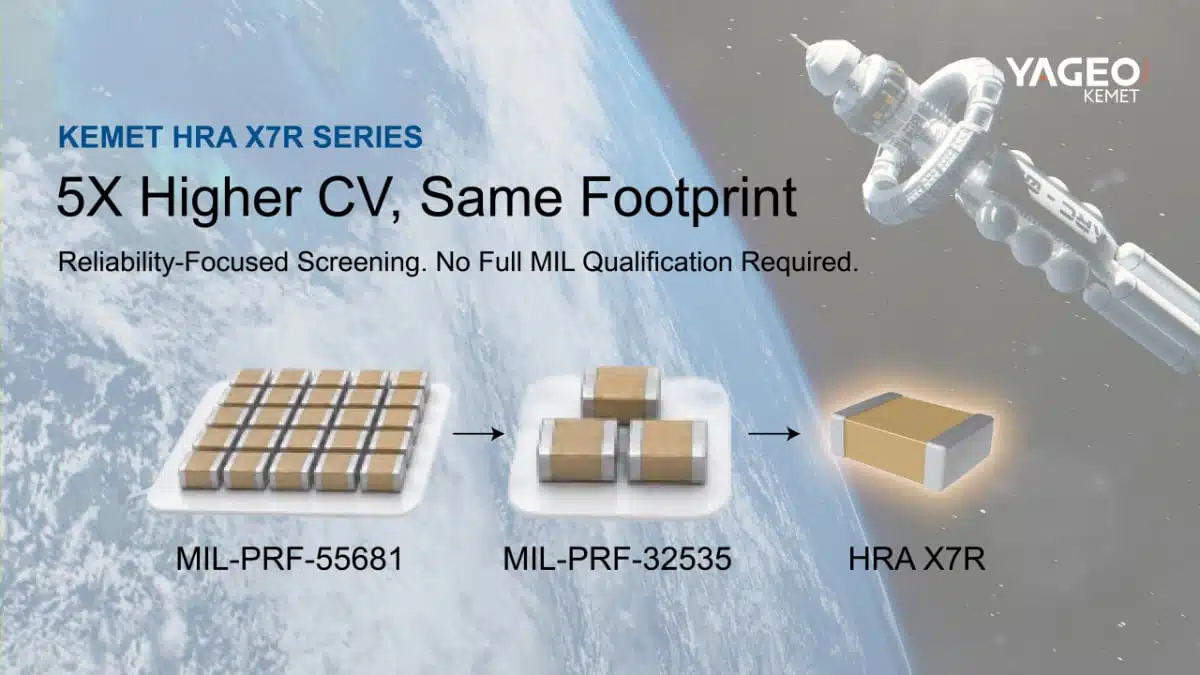
KEMET, YAGEO Group has introduced its HRA X7R series as a high-reliability alternative for defense, aerospace, and limited-mission space electronics that need more capacitance in compact MLCC footprints.
The KEMET YAGEO HRA X7R series is intended to bridge the gap between standard commercial MLCCs and fully qualified MIL-SPEC components where controlled manufacturing, screening, and lot traceability are important, but a MIL-qualified part is not mandatory.
Key features and benefits
- High capacitance-voltage capability: The HRA X7R range offers capacitance values up to 22 µF, with voltage ratings from 4 V to 100 V.
- Potential board-space reduction: According to KEMET, HRA parts can provide up to five times the capacitance of comparable MIL-PRF-32535-qualified devices. This may reduce the number of capacitors required in parallel for a given bulk-decoupling or filtering target.
- Wide package selection: Available EIA case sizes extend from 0402 to 2220, enabling use from dense control electronics to higher-capacitance power-rail bypassing.
- Reliability-oriented processing: KEMET states that the series uses patented base-metal-electrode technology and the same materials and process flow used for its MIL-PRF-32535 products.
- Screening and traceability options: The series includes X-Level and Z-Level options, lot-release testing, lot traceability, and availability of a single lot date code.
- Termination choices: Standard and flexible terminations are offered, with 100% matte tin, tin-lead, and gold finishes available for selected configurations.
The HRA family is a multilayer ceramic capacitor (MLCC) range using an X7R Class II dielectric. X7R parts offer a useful balance of capacitance density and temperature capability, although effective capacitance must still be assessed under the intended DC bias, AC ripple, temperature, and ageing conditions.
Technical highlights
| Parameter | KEMET HRA X7R series |
|---|---|
| Dielectric characteristic | X7R |
| Rated-voltage range | 4 V to 100 V |
| Maximum stated capacitance | Up to 22 µF |
| EIA case sizes | 0402 to 2220 |
| Operating-temperature range | -55°C to +125°C |
| Reliability options | X-Level and Z-Level |
| Termination styles | Standard and flexible termination |
| Finish options | Matte tin, tin-lead, or gold for selected configurations |
| Quality provisions | Voltage conditioning, biased-humidity testing, cross-section evaluation, lot-release testing, and lot traceability |
KEMET specifies voltage conditioning and post-electrical testing aligned with its MIL-PRF-32535 process approach, including a 5% percent-defective-allowable criterion. The manufacturer also cites biased-humidity testing at 85°C and 85% relative humidity in accordance with MIL-STD-202 requirements.
The HRA series should not be interpreted as a direct replacement for a fully MIL-qualified device where a program specification explicitly requires MIL-PRF-32535 qualification, QPL status, or a defined military screening flow. Instead, it provides an intermediate option for programs with high-reliability expectations but a different qualification basis.
Typical applications
KEMET identifies the HRA X7R MLCC family for high-reliability functions including:
- Local supply-rail decoupling near processors, FPGAs, memory, sensors, and RF subsystems
- Bulk bypassing on low- and medium-voltage power rails
- Input and output filtering in point-of-load DC/DC converters
- Switching-noise suppression in compact power-electronic assemblies
- Filtering and transient-voltage-suppression support circuits
- Autonomous-control, avionics, communications, and mission-electronics modules
- Limited-mission and NewSpace electronics where controlled quality and traceability are required without a fully MIL-qualified component mandate
For power converters using wide-bandgap switches, high-frequency current loops require particularly careful capacitor placement and interconnect design. A high nominal capacitance value alone does not ensure effective high-frequency decoupling: package inductance, PCB mounting geometry, DC-bias capacitance reduction, and parallel capacitor selection remain decisive.
Application fit
| Design requirement | HRA X7R relevance |
|---|---|
| Higher capacitance in a restricted PCB area | Higher CV capability can reduce the number of parallel MLCCs |
| Controlled manufacturing and traceability | Lot traceability, lot-release testing, and single lot date-code availability support controlled procurement |
| Mechanical-stress mitigation | Flexible termination options may help improve solder-joint robustness in mechanically demanding assemblies |
| High-reliability electronics without mandatory MIL qualification | Intended as an alternative between commercial MLCCs and fully MIL-qualified product families |
| Operation to +125°C | Supports elevated-temperature electronics, subject to full electrical derating and datasheet limits |
| Finish compatibility | Tin-lead and gold termination options may support specific assembly or interconnect requirements |
Design-in notes for engineers
- Verify the qualification requirement first: Select HRA only where the program’s parts-control plan permits a high-reliability alternative rather than a fully qualified MIL-SPEC component.
- Check effective capacitance: X7R MLCC capacitance varies with applied DC bias, temperature, ageing, and AC excitation. Confirm the usable capacitance at the actual operating point rather than selecting solely from the nominal value.
- Apply voltage margin: The rated voltage is not automatically the recommended continuous working voltage. Establish derating according to the end-equipment environment, mission profile, failure analysis, and manufacturer guidance.
- Evaluate termination type: Use flexible termination where board flexure, thermal cycling, vibration, connector loading, or assembly stress can impose bending stress on MLCC solder joints.
- Confirm screening configuration: Screening level, test requirements, termination finish, capacitance, voltage rating, and package size may not be available in every ordering-code combination.
- Review humidity exposure: Biased-humidity performance supports confidence in humid operating environments, but conformal coating, enclosure sealing, contamination control, and PCB cleanliness should remain part of the system-level reliability plan.
- Control procurement data: For aerospace and defense builds, retain manufacturer lot documentation, date-code requirements, change-control procedures, and incoming-inspection criteria within the component-approval process.
- Validate the assembled circuit: Evaluate inrush, surge, ripple current, resonant behavior, acoustic effects, and mounting stresses on the production PCB. For converter applications, buck converter design and calculation provides additional context on capacitor placement and power-stage design.
Further reading
- MLCC and Ceramic Capacitors
- MIL-PRF-32535 QPL SMD BME MLCCs by Kemet explained
- MLCC Capacitors Lifetime Prediction
- BME Stacked Ceramic Capacitors for Defense Applications
Source
This article is based on the KEMET manufacturer press release covering the HRA X7R high-reliability MLCC series. Engineers should consult the current manufacturer datasheet, ordering documentation, qualification records, and applicable program requirements before final component approval and design release.