






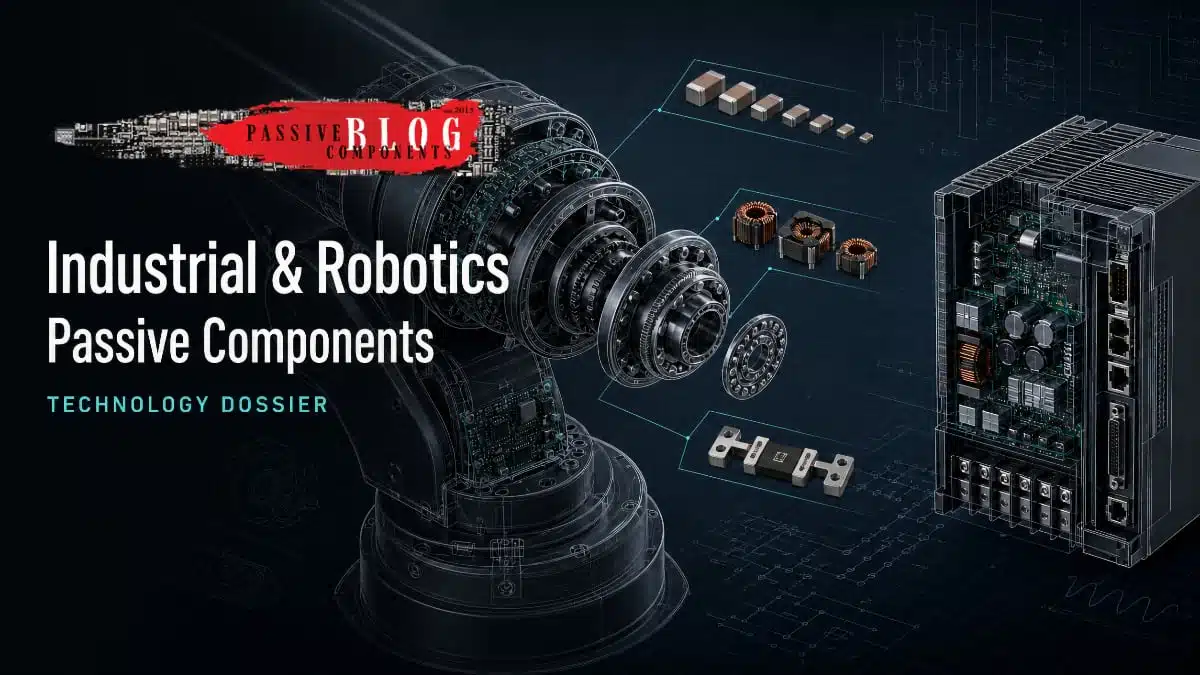
Passive Components Blog has published its Industrial and Robotics Passive Components Dossier 08/26 technical dossier report.
It is a compact, high-information, architecture-focused study of how industrial automation and robotics designs consume, constrain and increasingly bottleneck passive electronic components — and what the shift toward distributed conversion, wide-bandgap switching and in-robot Ethernet means for choosing them.
In practical terms, this dossier is for teams who need to turn factory-automation and humanoid-robot roadmaps into hard decisions on DC-link film capacitors, high-temperature MLCCs, common-mode chokes, current-sense shunt resistors, supercapacitor buffers, Single Pair Ethernet magnetics and industrial qualification evidence.
From 542,076 industrial robot installations in 2024 and an operational stock of 4.66 million units, through servo drives and variable-frequency drives, autonomous mobile robots and AGVs, collaborative arms and the emerging humanoid platforms, it distils these architectures into clear maps of where capacitors, magnetics, resistors, supercapacitors, protection devices and interconnect have moved from “background parts” to first-order limits on torque control, efficiency, EMC compliance, service life and supply risk.
The result is a shared, application-aware reference that lets design engineers, component engineers and sourcing leads work from common stress-point and architecture views, instead of scattered datasheets and generic automation market reports.
What the dossier covers
The Industrial and Robotics Passive Components Dossier 08/26 is a comprehensive report focused on the passive components that set performance and availability limits across factory automation, motion control and robotics. It combines architecture mapping, component-technology deep dives, application chapters, qualification guidance and market and supply-chain analysis into one reference you can use through the 2026–2027 design cycle. Structured into sixteen chapters plus an abbreviations appendix, and built on 69 pages, 23 tables, 9 original figures and 170 referenced sources, the dossier covers:
Seven structural trends reshaping industrial and robotics passives
How the migration from 24 V toward 48 V and 800 V DC distribution, the move from cabinet-level to joint-level power conversion, SiC and GaN switching approaching 1 MHz, the arrival of Single Pair Ethernet as an in-robot network, AEC-Q200 convergence in industrial qualification practice, supercapacitor energy recovery and structural MLCC tightness are redefining passive-component roles and bottlenecks in industrial and robotic equipment.
Industrial and robotics architectures and the role of passive components
An architecture-led view that maps the 24 V control base, 24–60 V robot battery and joint-drive systems, 400–800 V industrial DC links and emerging 800 V DC infrastructure to their key passive technologies and critical parameters. The dossier explains how decentralised power-management units, regenerative braking and mobile safety sensing change decoupling hierarchies, magnetics requirements and current-sensing architecture.
Key passive technologies for industrial and robotics
Application-driven chapters for:
- Capacitors: high-temperature and high-voltage MLCCs for motor drives, industrial power and robot joints; film and DC-link capacitors for inverters, VFDs, servo drives and active front ends; aluminium electrolytic, tantalum and polymer capacitors for bulk storage and harsh-environment duty.
- Inductors and magnetics: power inductors for servo drives and wide-bandgap converters, common-mode chokes and EMI filters, current-sense transformers, and the ferrite-versus-nanocrystalline core-material transition with core-loss reduction above 60% at 1 MHz.
- Resistors and current sensing: shunt resistors for motor control and torque sensing, precision resistors for sensors and encoders, and high-power braking resistors — with TCR, pulse energy and thermal-gradient behaviour treated as control-loop parameters, not catalogue footnotes.
- Supercapacitors and energy storage: ride-through and peak-power buffering, regenerative braking energy recovery, and battery-supercapacitor hybrids for AMR and AGV platforms, including a full supplier landscape from high-power cells to board-level backup modules.
- EMI/EMC and circuit protection: surge and overvoltage protection, ESD and transient suppression, and EMI suppression strategies for drives and robotics.
Each family is covered in terms of its role in industrial and robotic systems, stress mechanisms, technology options, derating rules and the 2025–2026 shifts in design practice.
Single Pair Ethernet and the in-robot network
A dedicated chapter treats SPE as an architecture decision rather than a cable substitution. It covers 10BASE-T1L at 10 Mb/s over up to 1,000 m, 100BASE-T1 and 1000BASE-T1 in-robot links, why humanoids need a different network topology from a fixed cell, and how Power over Data Line changes the required passive set from a data-only common-mode choke toward additional differential-mode inductance, coupling capacitors and revised EMC budgets. A design checklist translates this into a per-link passive stack.
Reliability, qualification and standards
Industrial versus automotive-grade qualification, AEC-Q200 Rev E convergence in industrial practice, IEC 60068 environmental testing, IEC 61508 and ISO 13849 functional-safety context, and IEC 61800-3:2022 EMC requirements for adjustable-speed drives with radiated immunity extended to 6 GHz — plus what component lifetime actually looks like in humid, vibrating, thermally cycled industrial environments.
Market, supplier landscape and supply-chain view
Industrial end use accounts for roughly 12% of global passive-component consumption value, against an equipment environment that MarketsandMarkets sizes at USD 274.99 billion in 2025 rising to USD 435.24 billion in 2030. The dossier maps supplier leadership segment by segment — MLCC, film and DC-link, aluminium electrolytic, tantalum and polymer, magnetics and EMC, resistors and shunts, supercapacitors, circuit protection, and connectors and high-flex robot cable — because the ceramic share table does not describe who leads a drive or robot BOM. It also documents 2026 lead-time ranges of 20–36 weeks for automotive-grade MLCCs and DC-link film capacitors, 30–52-plus weeks for large-can electrolytics, and the 2026 price actions across MLCC, chip resistor and tantalum ranges.
Humanoid, mobile and collaborative robotics deep dive
A full chapter on the passive-component bill of materials of humanoid platforms, AMR and AGV power and sensing architecture, and collaborative arms — with comparative component-count estimates by platform, analyst BOM cost structures, and the honest uncertainty band between roughly 16,000 installed humanoids in 2025 and forecasts above 250,000 shipments in 2030. Mobile robots are already material at just under USD 5 billion of 2024 revenue heading toward USD 14 billion in 2030, and cobots at nearly 58,000 shipments in 2025.
Application examples and next-generation technologies
Worked passive-component profiles for a servo drive, a humanoid SPE network and an AMR power architecture, followed by a forward chapter on miniaturisation and integrated passive devices, wide-bandgap impact on passive specifications, and embedded passives, busbar capacitors and module-level integration — closing with engineering and procurement implications and a long-term outlook to 2031.
CONTENT
- Structural Trends Shaping Industrial and Robotics Passives in 2026
- Market and Supply-Chain Environment for Industrial and Robotics Passives
- Industrial and Robotics Architectures and the Role of Passive Components
- Capacitors for Industrial and Robotics Applications
- Inductors and Magnetics for Industrial and Robotics Applications
- Resistors and Current Sensing for Industrial and Robotics Applications
- Supercapacitors and Energy Storage for Industrial and Robotics Applications
- Single Pair Ethernet and Industrial Networking for Robots
- EMI/EMC and Circuit Protection for Industrial and Robotics Applications
- Reliability, Qualification and Standards
- Humanoid and Mobile Robotics: A Passive Components Deep Dive
- Application Examples
- Next-Generation Passive Component Technologies
- Design and Business Implications
- Key Takeaways
- About the Dossier — plus Appendix A: Abbreviations and Acronyms
Key questions the dossier answers
- • How does the migration from 24 V control rails toward 48 V robot buses and 800 V DC industrial distribution change passive-component requirements, voltage classes and decoupling architecture?
- • Where do MLCCs, film and DC-link capacitors, aluminium electrolytics, tantalum polymer and supercapacitors each make the most sense in an industrial drive or robot power path — and which stress mechanism decides?
- • What actually changes in the passive BOM when power conversion moves from the cabinet into the joint, the limb and the mobile chassis?
- • How do SiC and GaN switching frequencies redistribute constraints into magnetics, core materials, common-mode suppression and layout-sensitive passives, and when does nanocrystalline replace ferrite?
- • Which passive set does Single Pair Ethernet require per link, and how does Power over Data Line change the common-mode choke, differential inductance and EMC budget for an in-robot network?
- • How should industrial teams read AEC-Q200 evidence, IEC 60068 environmental data and IEC 61800-3 EMC limits against their real mission profile, rather than treating qualification as a pass mark?
- • Who are the genuine global leaders in each passive segment relevant to industrial and robotics — not just in MLCC volume — and where is alternate-source depth real versus notional?
- • What are the current lead-time, pricing and allocation realities for high-temperature, high-voltage, high-capacitance and large-can passives, and how should they be built into design decisions?
- • How much passive content does a humanoid actually carry compared with an industrial arm or an AMR, and how much of the humanoid forecast can be treated as plannable demand?
Who needs this on their desk
- Power electronics and motion-control engineers designing servo drives, VFDs and robot joints who are tired of translating generic catalogue specs into actual system margin.
- Robotics hardware architects building cobots, AMRs, AGVs and humanoids who need power, network and EMC design connected in one framework.
- Component and qualification engineers building approved-part lists who need a defensible logic for derating, alternates and lifecycle risk.
- Procurement and supply-chain leads who need to know which categories are genuinely constrained in 2026 — and which ones just look that way.
- Platform and product leaders making multi-year architecture bets who need to see the passive-component consequences before they’re locked into silicon and mechanical design.
Availability
The Industrial & Robotics Passive Components Technology Dossier is available now at 699 EUR exclusively from passive-components.eu as a paid download.
Learn more at:
Check also other available dossiers, visit the Technology Dossiers page on the passive-components.eu blog.