








Passive Components Blog
No Result
View All Result
  • Home
  • NewsFilter
    • All
    • Aerospace & Defence
    • Antenna
    • Applications
    • Automotive
    • Capacitors
    • Circuit Protection Devices
    • electro-mechanical news
    • Filters
    • Fuses
    • Inductors
    • Industrial
    • Integrated Passives
    • inter-connect news
    • Market & Supply Chain
    • Market Insights
    • Medical
    • Modelling and Simulation
    • New Materials & Supply
    • New Technologies
    • Non-linear Passives
    • Oscillators
    • Passive Sensors News
    • Resistors
    • RF & Microwave
    • Telecommunication
    • Weekly Digest

    Researchers Demonstrated 32nm Aluminum Vacuum Gap Capacitor

    Conductive Polymer Capacitor Market and Design‑In Guide to 2035

    TDK Releases High Performance 105C DC Link Film Capacitors

    YAGEO Offers Automotive MOVs for EV and AI power

    YAGEO Acquires 100% of Shares of Shibaura Electronics

    Wk 3 Electronics Supply Chain Digest

    Vishay Extends Aluminum Capacitors Rating Up to 600 V for DC Links

    Würth Elektronik Introduces Product Navigator for Passive Components

    Panasonic Passive Components for Reliable Robotic Arms

    Trending Tags

    • Ripple Current
    • RF
    • Leakage Current
    • Tantalum vs Ceramic
    • Snubber
    • Low ESR
    • Feedthrough
    • Derating
    • Dielectric Constant
    • New Products
    • Market Reports
  • VideoFilter
    • All
    • Antenna videos
    • Capacitor videos
    • Circuit Protection Video
    • Filter videos
    • Fuse videos
    • Inductor videos
    • Inter-Connect Video
    • Non-linear passives videos
    • Oscillator videos
    • Passive sensors videos
    • Resistor videos

    One‑Pulse Characterization of Nonlinear Power Inductors

    Thermistor Linearization Challenges

    Coaxial Connectors and How to Connect with PCB

    PCB Manufacturing, Test Methods, Quality and Reliability

    Transformer Behavior – Current Transfer and Hidden Feedback

    Choosing the Right Capacitor: The Importance of Accurate Measurements

    RF Inductors: Selection and Design Challenges for High-Frequency Circuits

    Transformer Safety IEC 61558 Standard

    3-Phase EMI Filter Design, Simulation, Calculation and Test

    Trending Tags

    • Capacitors explained
    • Inductors explained
    • Resistors explained
    • Filters explained
    • Application Video Guidelines
    • EMC
    • New Products
    • Ripple Current
    • Simulation
    • Tantalum vs Ceramic
  • Knowledge Blog
  • Suppliers
    • Who is Who
  • PCNS
    • PCNS 2025
    • PCNS 2023
    • PCNS 2021
    • PCNS 2019
    • PCNS 2017
  • Events
  • Home
  • NewsFilter
    • All
    • Aerospace & Defence
    • Antenna
    • Applications
    • Automotive
    • Capacitors
    • Circuit Protection Devices
    • electro-mechanical news
    • Filters
    • Fuses
    • Inductors
    • Industrial
    • Integrated Passives
    • inter-connect news
    • Market & Supply Chain
    • Market Insights
    • Medical
    • Modelling and Simulation
    • New Materials & Supply
    • New Technologies
    • Non-linear Passives
    • Oscillators
    • Passive Sensors News
    • Resistors
    • RF & Microwave
    • Telecommunication
    • Weekly Digest

    Researchers Demonstrated 32nm Aluminum Vacuum Gap Capacitor

    Conductive Polymer Capacitor Market and Design‑In Guide to 2035

    TDK Releases High Performance 105C DC Link Film Capacitors

    YAGEO Offers Automotive MOVs for EV and AI power

    YAGEO Acquires 100% of Shares of Shibaura Electronics

    Wk 3 Electronics Supply Chain Digest

    Vishay Extends Aluminum Capacitors Rating Up to 600 V for DC Links

    Würth Elektronik Introduces Product Navigator for Passive Components

    Panasonic Passive Components for Reliable Robotic Arms

    Trending Tags

    • Ripple Current
    • RF
    • Leakage Current
    • Tantalum vs Ceramic
    • Snubber
    • Low ESR
    • Feedthrough
    • Derating
    • Dielectric Constant
    • New Products
    • Market Reports
  • VideoFilter
    • All
    • Antenna videos
    • Capacitor videos
    • Circuit Protection Video
    • Filter videos
    • Fuse videos
    • Inductor videos
    • Inter-Connect Video
    • Non-linear passives videos
    • Oscillator videos
    • Passive sensors videos
    • Resistor videos

    One‑Pulse Characterization of Nonlinear Power Inductors

    Thermistor Linearization Challenges

    Coaxial Connectors and How to Connect with PCB

    PCB Manufacturing, Test Methods, Quality and Reliability

    Transformer Behavior – Current Transfer and Hidden Feedback

    Choosing the Right Capacitor: The Importance of Accurate Measurements

    RF Inductors: Selection and Design Challenges for High-Frequency Circuits

    Transformer Safety IEC 61558 Standard

    3-Phase EMI Filter Design, Simulation, Calculation and Test

    Trending Tags

    • Capacitors explained
    • Inductors explained
    • Resistors explained
    • Filters explained
    • Application Video Guidelines
    • EMC
    • New Products
    • Ripple Current
    • Simulation
    • Tantalum vs Ceramic
  • Knowledge Blog
  • Suppliers
    • Who is Who
  • PCNS
    • PCNS 2025
    • PCNS 2023
    • PCNS 2021
    • PCNS 2019
    • PCNS 2017
  • Events
No Result
View All Result
Passive Components Blog
No Result
View All Result

AVX Launches New Best-In-Class Prizmacap™ Supercapacitors

2.7.2021
Reading Time: 3 mins read
A A

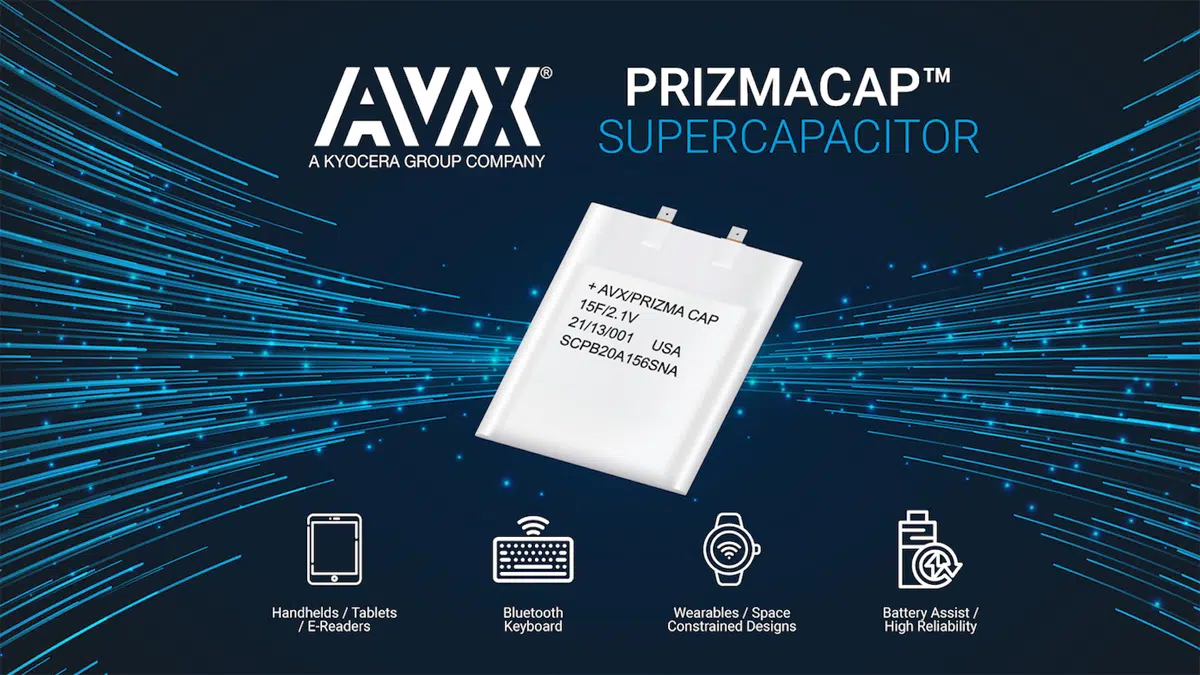
Ideal for an array of SWaP-optimized, battery-powered products, the new SCP Series PrizmaCap supercapacitors have the widest operating temperature range of any available supercapacitor technology, the highest capacitance and energy density of any SFF, prismatic, EDLC >1F, and an extremely lightweight and ultralow-profile package.

AVX Corporation, a leading manufacturer and supplier of advanced electronic components and interconnect, sensor, control, and antenna solutions, has launched a superlative new series of standard and custom supercapacitors engineered to provide peak performance in an array of SWaP-optimized, battery-powered products.

RelatedPosts

Conductive Polymer Capacitor Market and Design‑In Guide to 2035

Kyocera Releases Ultra-Compact Low Voltage Clock Oscillators

KYOCERA AVX Releases Antenna for Iridium Satellite IoT Applications

The new SCP Series PrizmaCap™ supercapacitors features

  • the widest operating temperature range of any supercapacitor technology currently available on the market (-55°C to +90°C)
  • the highest capacitance (3.5–15F) and energy density (1.14–2.43Wh/kg) of any small form factor (SFF)
  • prismatic, electric double-layer capacitor (EDLC) rated for more than 1F currently available on the market
  • extremely lightweight (<2g)
  • low-profile form factor (0.8–2mm)
  • based on propylene carbonate electrolyte technology, which has been proven safe and effective in energy storage applications including lithium-ion batteries.

AVX’s new SCP Series PrizmaCap supercapacitors can be used alone or in conjunction with primary or secondary batteries to extend backup time, improve battery life, and provide instantaneous power pulses in energy storage, energy and power holdup, pulse power handling, and battery assist applications within a range of consumer, commercial, and industrial electronics that prioritize size, weight, and power (SWaP) optimization.

The series is especially well suited for use in end products including wearable and handheld devices, industrial equipment, wireless keyboards, power peripherals, tablets, and e-readers. SCP Series PrizmaCap supercapacitors are currently available in three standard form factors with a 48x45mm footprint, one of three ultralow height profiles: 0.8mm, 1.3mm, or 2.0mm, and two fixed-position, surface-mount terminals compatible with hand soldering or — for more reliable connections — AVX Interconnect’s economical and ultralow-profile 70-9159 Series STRIPT™ two-piece, single contacts.

These three standard solutions (SCPB08A355SNA, SCPB13A855SNA, and SCPB20A156SNA) are rated for up to 15F capacitance, 2.1V electrical potential from -55°C to +65°C, 8.63A peak current, and 2.43Wh/kg energy density, and have the widest operating temperature range of any supercapacitor technology currently available on the market, -55°C to +90°C, with appropriate derating to 1.1V. They are also rated for maximum DCL as low as 50μA after 72 hours of operation, maximum ESR as low as 30mΩ at 1kHz and 55mΩ at DC, and up to 2,582W/kg power density and 0.0092Wh maximum energy. Additional off-the-shelf solutions with standard footprints and capacitance values will be released as they are qualified, and custom SCP Series PrizmaCap supercapacitors are available with customer-specified footprints and capacitance values spanning 1–500F.

“Our new SCP Series PrizmaCap supercapacitors have a revolutionary new design in terms of form, fit, and function compared to other AVX supercapacitors, and they leverage this innovative design to deliver the highest capacitance and energy density of any currently available, small form factor, prismatic, EDLC supercapacitor rated for more than one Farad, as well as the widest range of rated operating temperatures — including both the highest and lowest extremes — of any supercapacitor technology currently available on the market,” said Eric DeRose, global product manager – Supercapacitors, AVX.

“The new PrizmaCaps also have an extremely lightweight and ultralow-profile package that’s compatible with both solder and interconnect termination processes for added design flexibility and ideal for use in compact consumer, commercial, and industrial electronics with densely populated PCBs and stringent SWaP demands.”

AVX’s new SCP Series PrizmaCap supercapacitors are RoHS- and REACH-compliant, lead-free compatible, and currently made in the USA. They are also fully tested for life cycle, high-temperature load life, temperature characteristics, vibration resistance, and humidity characteristics prior to being packaged and shipped in trays to ensure optimal performance. Standard lead-time for the series is currently 16 weeks.

Related

Source: AVX

Recent Posts

Researchers Demonstrated 32nm Aluminum Vacuum Gap Capacitor

20.1.2026
17

Conductive Polymer Capacitor Market and Design‑In Guide to 2035

20.1.2026
44

TDK Releases High Performance 105C DC Link Film Capacitors

19.1.2026
35

YAGEO Offers Automotive MOVs for EV and AI power

19.1.2026
22

Vishay Extends Aluminum Capacitors Rating Up to 600 V for DC Links

15.1.2026
32

Würth Elektronik Introduces Product Navigator for Passive Components

14.1.2026
68

Panasonic Passive Components for Reliable Robotic Arms

14.1.2026
78

Littelfuse Unveils Ultra-Low-Power TMR Magnetic Switches

13.1.2026
31

Rubycon PMLCAP DC‑Link Film Capacitors in Mass Production

9.1.2026
83

Upcoming Events

Jan 21
18:00 - 18:45 CET

To Rogowski or not to Rogowski

Jan 27
16:00 - 17:00 CET

Simplifying Vehicle Development with Automotive Ethernet and Zonal Smart Switch Technologies

Feb 24
16:00 - 17:00 CET

Designing Qi2 Wireless Power Systems: Practical Development and EMC Optimization

View Calendar

Popular Posts

  • Buck Converter Design and Calculation

    0 shares
    Share 0 Tweet 0
  • Boost Converter Design and Calculation

    0 shares
    Share 0 Tweet 0
  • LLC Resonant Converter Design and Calculation

    0 shares
    Share 0 Tweet 0
  • Flyback Converter Design and Calculation

    0 shares
    Share 0 Tweet 0
  • Ripple Current and its Effects on the Performance of Capacitors

    3 shares
    Share 3 Tweet 0
  • How Metal Prices Are Driving Passive Component Price Hikes

    0 shares
    Share 0 Tweet 0
  • MLCC and Ceramic Capacitors

    0 shares
    Share 0 Tweet 0
  • Dual Active Bridge (DAB) Topology

    0 shares
    Share 0 Tweet 0
  • What is a Dielectric Constant and DF of Plastic Materials?

    4 shares
    Share 4 Tweet 0
  • Degradation of Capacitors and its Failure Mechanisms

    0 shares
    Share 0 Tweet 0

Newsletter Subscription


Passive Components Blog

© EPCI - Leading Passive Components Educational and Information Site

  • Home
  • Privacy Policy
  • EPCI Membership & Advertisement
  • About

No Result
View All Result
  • Home
  • Knowledge Blog
  • PCNS

© EPCI - Leading Passive Components Educational and Information Site

This website uses cookies. By continuing to use this website you are giving consent to cookies being used. Visit our Privacy and Cookie Policy.
Go to mobile version