













Passive Components Blog
No Result
View All Result
  • Home
  • NewsFilter
    • All
    • Aerospace & Defence
    • Antenna
    • Applications
    • Automotive
    • Capacitors
    • Circuit Protection Devices
    • electro-mechanical news
    • Filters
    • Fuses
    • Inductors
    • Industrial
    • Integrated Passives
    • inter-connect news
    • Market & Supply Chain
    • Market Insights
    • Medical
    • Modelling and Simulation
    • New Materials & Supply
    • New Technologies
    • Non-linear Passives
    • Oscillators
    • Passive Sensors News
    • Resistors
    • RF & Microwave
    • Telecommunication
    • Weekly Digest

    Designing a 2 kW LLC Transformer with Integrated Resonant Inductor

    Middle East Conflict: The Potential Impact to Passive Components

    Inductor Technology Dossier

    Coilcraft Releases TLVR Inductors for High Density VRMs and PoL Converters

    Rutheniums Critical Role in Passive Component Supply Chains

    Bourns Expands its Modular Contacts for Power-Dense Systems

    Murata to Decouple China Rare Earth Supply in 3 Years

    Samtec AcceleRate Slim ARC6 Cable Assemblies with New Signaling Options

    Hirose Electric to Establish Automotive Connector Plant in India

    Trending Tags

    • Ripple Current
    • RF
    • Leakage Current
    • Tantalum vs Ceramic
    • Snubber
    • Low ESR
    • Feedthrough
    • Derating
    • Dielectric Constant
    • New Products
    • Market Reports
  • VideoFilter
    • All
    • Antenna videos
    • Capacitor videos
    • Circuit Protection Video
    • Filter videos
    • Fuse videos
    • Inductor videos
    • Inter-Connect Video
    • Non-linear passives videos
    • Oscillator videos
    • Passive sensors videos
    • Resistor videos

    Thermal Modeling of Magnetics

    Standard vs Planar LLC transformers Comparison for Battery Chargers

    How Modern Tools Model Magnetic Components for Power Electronics

    Advanced Loss Modeling for Planar Magnetics in the Frenetic Planar Tool

    2026 Power Magnetics Design Trends: Flyback, DAB and Planar

    Enabling Software‑Defined Vehicle Architectures: Automotive Ethernet and Zonal Smart Power

    Calculating Resistance Value of a Flyback RC Snubber 

    One‑Pulse Characterization of Nonlinear Power Inductors

    Thermistor Linearization Challenges

    Trending Tags

    • Capacitors explained
    • Inductors explained
    • Resistors explained
    • Filters explained
    • Application Video Guidelines
    • EMC
    • New Products
    • Ripple Current
    • Simulation
    • Tantalum vs Ceramic
  • Knowledge Blog
  • DossiersNew
  • Suppliers
    • Who is Who
  • PCNS
    • PCNS 2025
    • PCNS 2023
    • PCNS 2021
    • PCNS 2019
    • PCNS 2017
  • Events
  • Home
  • NewsFilter
    • All
    • Aerospace & Defence
    • Antenna
    • Applications
    • Automotive
    • Capacitors
    • Circuit Protection Devices
    • electro-mechanical news
    • Filters
    • Fuses
    • Inductors
    • Industrial
    • Integrated Passives
    • inter-connect news
    • Market & Supply Chain
    • Market Insights
    • Medical
    • Modelling and Simulation
    • New Materials & Supply
    • New Technologies
    • Non-linear Passives
    • Oscillators
    • Passive Sensors News
    • Resistors
    • RF & Microwave
    • Telecommunication
    • Weekly Digest

    Designing a 2 kW LLC Transformer with Integrated Resonant Inductor

    Middle East Conflict: The Potential Impact to Passive Components

    Inductor Technology Dossier

    Coilcraft Releases TLVR Inductors for High Density VRMs and PoL Converters

    Rutheniums Critical Role in Passive Component Supply Chains

    Bourns Expands its Modular Contacts for Power-Dense Systems

    Murata to Decouple China Rare Earth Supply in 3 Years

    Samtec AcceleRate Slim ARC6 Cable Assemblies with New Signaling Options

    Hirose Electric to Establish Automotive Connector Plant in India

    Trending Tags

    • Ripple Current
    • RF
    • Leakage Current
    • Tantalum vs Ceramic
    • Snubber
    • Low ESR
    • Feedthrough
    • Derating
    • Dielectric Constant
    • New Products
    • Market Reports
  • VideoFilter
    • All
    • Antenna videos
    • Capacitor videos
    • Circuit Protection Video
    • Filter videos
    • Fuse videos
    • Inductor videos
    • Inter-Connect Video
    • Non-linear passives videos
    • Oscillator videos
    • Passive sensors videos
    • Resistor videos

    Thermal Modeling of Magnetics

    Standard vs Planar LLC transformers Comparison for Battery Chargers

    How Modern Tools Model Magnetic Components for Power Electronics

    Advanced Loss Modeling for Planar Magnetics in the Frenetic Planar Tool

    2026 Power Magnetics Design Trends: Flyback, DAB and Planar

    Enabling Software‑Defined Vehicle Architectures: Automotive Ethernet and Zonal Smart Power

    Calculating Resistance Value of a Flyback RC Snubber 

    One‑Pulse Characterization of Nonlinear Power Inductors

    Thermistor Linearization Challenges

    Trending Tags

    • Capacitors explained
    • Inductors explained
    • Resistors explained
    • Filters explained
    • Application Video Guidelines
    • EMC
    • New Products
    • Ripple Current
    • Simulation
    • Tantalum vs Ceramic
  • Knowledge Blog
  • DossiersNew
  • Suppliers
    • Who is Who
  • PCNS
    • PCNS 2025
    • PCNS 2023
    • PCNS 2021
    • PCNS 2019
    • PCNS 2017
  • Events
No Result
View All Result
Passive Components Blog
No Result
View All Result

Bourns Releases Compact Automotive Isolation Power Transformer

2.3.2026
Reading Time: 4 mins read
A A

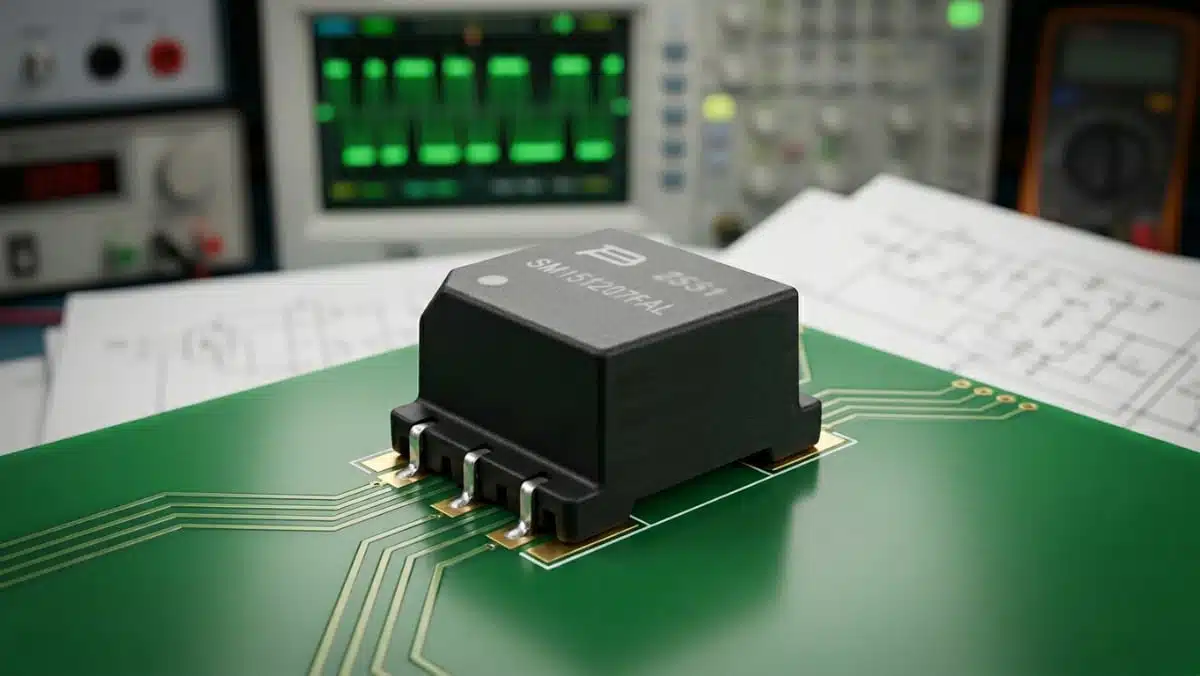
Bourns has released the Model HCTSM151207FAL, an AEC-Q200 compliant automotive-grade isolation power transformer designed for high-voltage isolation needs.

This compact component provides reinforced insulation with over 15 mm clearance and creepage distances, making it suitable for safety-critical applications involving hazardous voltages. Design engineers will appreciate its compatibility with flyback converters like those using Texas Instruments SN6501 and SN6505B drivers.

RelatedPosts

Bourns Expands its Modular Contacts for Power-Dense Systems

Bourns Expanded Semi-Shielded Low Profile Automotive Power Inductor

Bourns Extends PPTC Resettable High‑Power, High‑Voltage Protection Fuses

Key Features and Benefits

The HCTSM151207FAL transformer uses a ferrite toroid core for high coupling efficiency and low transformer losses, supporting a 24 V input to deliver up to 12 V at 100 mA output. It features a primary inductance of 400 µH minimum and withstands 7.64 kV AC for 2 seconds at 1 mA, ensuring robust isolation in overvoltage category II environments up to pollution degree 2 and 2 km altitude.

  • Working voltage up to 1500 VDC, ideal for separating low-voltage interfaces from high-voltage batteries in energy storage systems.
  • Reinforced insulation compliant with IEC 60664-1:2007, IEC/UL 62368-1:2018, and UL 62368-1:2021 standards.
  • AEC-Q200 Grade 1 qualified for automotive reliability, with operation from -40 °C to +125 °C.
  • RoHS compliant, measuring 15.0 x 21.3 x 9.6 mm for space-constrained PCB layouts.

These specs translate to enhanced safety in circuits where arc flash or partial discharge risks must be minimized, particularly in high-altitude or dusty industrial settings.

Typical Applications

This transformer targets isolated interface power supplies for communication protocols in harsh environments.

  • Energy storage systems (ESS) up to 1500 V, protecting control circuits from battery stacks.
  • High-voltage DC meters for accurate readings without ground loops.
  • CAN, RS-485, RS-422, RS-232, SPI, I2C, and low-power LAN interfaces in Industry 4.0 equipment.
  • Digital input modules and automotive ECUs requiring galvanic isolation.

In practice, it fits PFC stages or DC-DC converters in EV chargers, industrial drives, and solar inverters, where the 15 mm creepage exceeds basic requirements for reinforced isolation.

Technical Highlights

The model’s dimensions allow surface-mount assembly, with the toroid core minimizing EMI radiation compared to bobbin-wound alternatives. Its hi-pot rating supports functional insulation testing during production, while the wide temperature range ensures performance in under-hood or outdoor enclosures.

Key parameters include:

  • Clearance/creepage: 15 mm minimum, reducing field stress and enabling compliance without potting.
  • Turns ratio configurable for custom needs, though standard is optimized for TI drivers.
  • Pollution degree 2 rating suits non-condensing environments typical in sealed enclosures.

Engineers should verify exact turns ratio and leakage inductance from the datasheet for resonant flyback designs.

Design-in Notes for Engineers

Select this transformer for applications needing >7 kV isolation without increasing board area; pair with SN6501 for <100 mA supplies to achieve >80% efficiency. Simulate thermal rise under full load, as toroid cores distribute heat evenly but require adequate copper traces. For ESS integration, confirm system-level creepage paths exceed 15 mm including PCB material. Prototype testing should include partial discharge checks at 1500 VDC.

Source

This article is based on the manufacturer’s featured product bulletin for the HCTSM151207FAL, providing key specifications and application details as announced.

References

  1. Bourns Featured Product Bulletin IC26012

Related

Recent Posts

Designing a 2 kW LLC Transformer with Integrated Resonant Inductor

20.3.2026
9

Middle East Conflict: The Potential Impact to Passive Components

20.3.2026
20

Inductor Technology Dossier

19.3.2026
30

Coilcraft Releases TLVR Inductors for High Density VRMs and PoL Converters

19.3.2026
23

Bourns Expands its Modular Contacts for Power-Dense Systems

19.3.2026
6

Samtec AcceleRate Slim ARC6 Cable Assemblies with New Signaling Options

19.3.2026
7

Samsung Outlines Growth Roadmap at its 52nd General Shareholders Meeting

19.3.2026
16

Vishay Introduced Space-Grade SMT Common Mode Choke

19.3.2026
11

Exxelia to Exhibit at APEC 2026 in San Antonio, Texas

17.3.2026
33

Upcoming Events

Mar 24
9:00 - 10:00 CET

Power protection in the digital age – eFuse and hot-swap strategies for modern data center design

Apr 21
16:00 - 17:00 CEST

Heatsink Solutions: Thermal Management in electronic devices

May 5
16:00 - 17:00 CEST

Understanding and Selecting Capacitors – Fundamentals, Technologies and Latest Trends

View Calendar

Popular Posts

  • Buck Converter Design and Calculation

    0 shares
    Share 0 Tweet 0
  • Boost Converter Design and Calculation

    0 shares
    Share 0 Tweet 0
  • Flyback Converter Design and Calculation

    0 shares
    Share 0 Tweet 0
  • LLC Resonant Converter Design and Calculation

    0 shares
    Share 0 Tweet 0
  • MLCC Manufacturers Consider Price Increase as AI Demand Outpaces Supply

    0 shares
    Share 0 Tweet 0
  • MLCC and Ceramic Capacitors

    0 shares
    Share 0 Tweet 0
  • Dual Active Bridge (DAB) Topology

    0 shares
    Share 0 Tweet 0
  • Ripple Current and its Effects on the Performance of Capacitors

    3 shares
    Share 3 Tweet 0
  • MLCC Case Sizes Standards Explained

    0 shares
    Share 0 Tweet 0
  • What is a Dielectric Constant and DF of Plastic Materials?

    4 shares
    Share 4 Tweet 0

Newsletter Subscription


Passive Components Blog

© EPCI - Leading Passive Components Educational and Information Site

  • Home
  • Privacy Policy
  • EPCI Membership & Advertisement
  • About

No Result
View All Result
  • Home
  • Knowledge Blog
  • PCNS

© EPCI - Leading Passive Components Educational and Information Site

This website uses cookies. By continuing to use this website you are giving consent to cookies being used. Visit our Privacy and Cookie Policy.
Go to mobile version