



Passive Components Blog
No Result
View All Result
  • Home
  • News
    • All
    • Aerospace & Defence
    • Antenna
    • Applications
    • Automotive
    • Capacitors
    • Circuit Protection Devices
    • electro-mechanical news
    • Filters
    • Fuses
    • Inductors
    • Industrial
    • Integrated Passives
    • inter-connect news
    • Market & Supply Chain
    • Market Insights
    • Medical
    • Modelling and Simulation
    • New Materials & Supply
    • New Technologies
    • Non-linear Passives
    • Optoelectronics and Isolation
    • Oscillators
    • Passive Sensors News
    • Resistors
    • RF & Microwave
    • Telecommunication
    • Weekly Digest

    Elektra Awards 2026: Passive Components and Interconnect Finalists Showcase Advances in Power Integrity, Precision and Reliability

    Mathematical state-space illustration of a series-connected memcapacitor oscillator with two constrained memory coordinates

    Memcapacitor chaos in a six-state series-connected model

    Exxelia capacitor and magnetics innovations for Electronica 2026, including CM-HVLP and CF-PP140 capacitors

    Exxelia Brings High-Temperature Passives to Electronica 2026

    IP&E Market Outlook: AI Demand Tightens Supply and Supports Higher Pricing into 2027

    Samsung Electro-Mechanics CL05Z106MS66PN automotive MLCC illustration with a rectangular ceramic body and metal end terminations

    Samsung Adds 0402 10 µF X7T MLCC for ADAS Power Rails

    Bourns PTVS03-450E-H power TVS diode in a surface-mount DFN package

    Bourns Releases 450 V Power TVS for DC Bus Clamping

    MLCC construction image

    Samsung Electro-Mechanics Patent Targets to Reduce Moisture and Cracks in High-Capacity MLCCs

    Samsung Electro-Mechanics MFC molded frame ceramic capacitor with epoxy encapsulation and external metal frame

    Samsung 100V Molded Frame MLCC Targets 48V AI Server PSUs

    SCHURTER EKO square-body DC fuse variants with ceramic bodies and different metal terminal arrangements

    SCHURTER EKO DC Fuses Extend to 1500 V and 2000 A

    Trending Tags

    • Ripple Current
    • RF
    • Leakage Current
    • Tantalum vs Ceramic
    • Snubber
    • Low ESR
    • Feedthrough
    • Derating
    • Dielectric Constant
    • New Products
    • Market Reports
  • Knowledge Blog
  • Dossiers
    • Aerospace and Defense Passive Components Dossier
    • AI Hardware Dossier
    • Automotive Dossier
    • Industrial Robotics Dossier
    • Power Converter Dossier
    • Capacitor Dossier
    • Circuit Protection Dossier
    • Inductor Dossier
    • Resistor Dossier
    • Silicon Capacitors and Integrated Passives Dossier
  • Suppliers
    • Who is Who
  • PCNS
    • PCNS 2025
    • PCNS 2023
    • PCNS 2021
    • PCNS 2019
    • PCNS 2017
  • Events
No Result
View All Result
Passive Components Blog
No Result
View All Result

Connector Housings Overview

13.9.2021
Reading Time: 3 mins read
A A

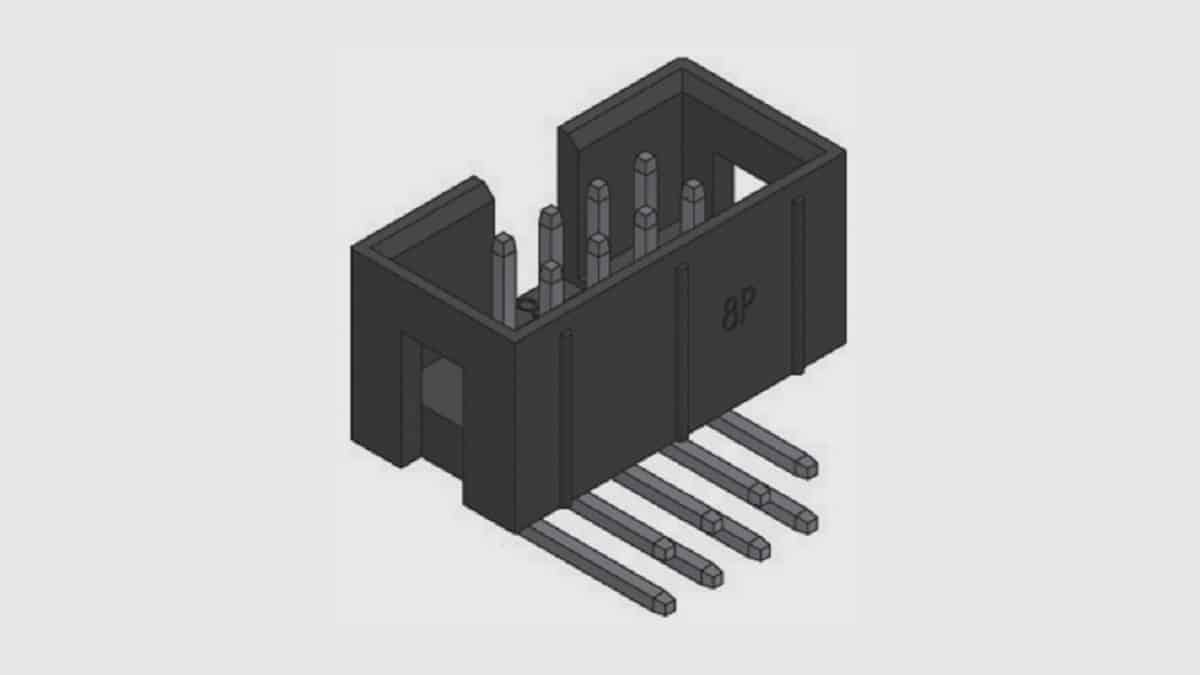
In Chapter I/1.2.1 Connector Housing, the four major functions of a connector housing were identified as:

Electrical insulation: All of the individual contacts within the connector housing must be electrically insulated from one another in order to perform their designated function. Connector pin counts of more than 1000 have been realized. In some cases, power distribution for example, multiple contacts may be interconnected, usually on the power and/or ground plane of a PCB. As noted in Chapter I/1.4.3 Polymer Materials and Processing the polymer materials used for connector housings have very high volume and surface resistivities. Volume resistivity is an intrinsic property and typical engineering polymer values are in the range of 1016 W-cm. Surface resistivities are dependent on surface contamination and degradation. Two other electrical parameters related to these resistivities merit mention, the dielectric strength and Dielectric Withstanding Voltage (DWV). The dielectric strength quantifies the ability of a polymer to withstand an applied voltage without electrical breakdown through the thickness of the polymer, in volts/cm and correlates with volume resistivity. DWV specifies the voltage that can be applied across the surface of the polymer without creating surface conduction paths over the polymer and is a measure of surface degradation. The stability of these resistances with respect to time, temperature and environmental degradation must be considered during material selection. The electrical insulation characteristics of a connector housing are dependent on both the design and material of the housing as will be discussed.

RelatedPosts

Polymer Materials and Processing

What is RF Connector

Connector Materials and Processes

Dimensional stability: The two halves of the housing must mate together and, therefore, their mating features must be of corresponding shapes and on the same centerlines. The dimensional control required, obviously, depends on the size and the centerline spacing, of the housing. Centerline spacings can vary from 2.54 mm (0.100 in) to 0.4 mm (0.016 in.) with corresponding decreases in dimensional tolerance requirements. Connector housings greater than 30 cm, (12 inches) have been molded successfully. The ability to realize these levels of dimensional control, both during molding of the housings and in field applications is an important consideration in housing design and material selection.

Mechanical support: In many connector designs the contacts are “latched” into the housing for mechanical support as well as dimensional control. Because spring deflections are responsible for creating the contact force, the mechanical stability of the support provided by the connector housing can have a significant impact on the spring characteristics of such connectors. For example, polymer creep at a retention groove in a housing may result in a change in the contact spring deflection, with an accompanying decrease in the contact normal force. Once again, this requirement impacts on the design and materials choices for the housing.

Environmental shielding: The effectiveness of the environmental shielding provided by a connector depends entirely on the design of the housing. The basic guideline is to keep the openings in the housing to a minimum to restrict the access of the environment to the separable connection, in all cases, and to the permanent connections depending on the design. There is one exception to this general guideline. In the case of power connectors, air flow channels through the housing may be beneficial in reducing the temperature rise of the connector due to Joule, I2 R, heating.

Consider now how these requirements influence material selection and housing design decisions.
Related

Source: Wurth elektronik

Recent Posts

Circular Connectors Coding

26.11.2025
308

Connector PCB Design Challenges

3.10.2025
149

Non-Magnetic Interconnects

23.4.2025
76

10 Tips for Ensuring Reliability of Discrete Wire Assemblies

20.2.2025
101

Polymer Materials and Processing

11.8.2025
296

Basic PCB Technology Overview

1.7.2025
81

What is RF Connector

17.12.2024
108

Creepage and Clearance of Connector

25.7.2025
138

RF Connector Types: How To Choose the Right One

24.4.2026
1.6k

Upcoming Events

Nov 24
16:00 - 17:00 CET

Select the Correct Components for Your DC/DC Converter

Dec 1
16:00 - 17:00 CET

Developing low-noise mixed-signal systems

Dec 8
16:00 - 17:00 CET

WE-CCMF: Design Principles, Layout Guidelines and Measurement Results for High-Speed EMI Filtering

View Calendar

Popular Posts

  • Buck Converter Design and Calculation

    0 shares
    Share 0 Tweet 0
  • Boost Converter Design and Calculation

    0 shares
    Share 0 Tweet 0
  • LLC Resonant Converter Design and Calculation

    0 shares
    Share 0 Tweet 0
  • September 2026 Interconnect, Passives and Electromechanical Components Market Insights

    0 shares
    Share 0 Tweet 0
  • Capacitor Charging and Discharging

    0 shares
    Share 0 Tweet 0
  • Flyback Converter Design and Calculation

    0 shares
    Share 0 Tweet 0
  • MLCC and Ceramic Capacitors

    0 shares
    Share 0 Tweet 0
  • RF Connector Types: How To Choose the Right One

    0 shares
    Share 0 Tweet 0
  • Passive Low Pass Filters: Fundamentals and EMI Design

    0 shares
    Share 0 Tweet 0
  • Audio Capacitors: Choosing Capacitors for Crossover Circuits

    0 shares
    Share 0 Tweet 0

Newsletter Subscription


Passive Components Blog

© 2015–2026
All rights reserved

  • Home
  • Privacy Policy
  • EPCI Membership & Advertisement
  • About

No Result
View All Result
  • Home
  • Knowledge Blog
  • Dossiers
  • PCNS

© 2015–2026
All rights reserved