




The Electronic Components Industry Association’s October 2026 Industry Pulse survey signals a sharp weakening in near-term sales confidence, with passive components recording the largest deterioration.
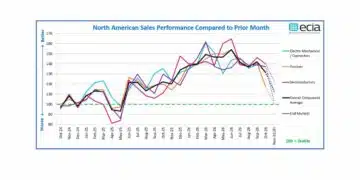
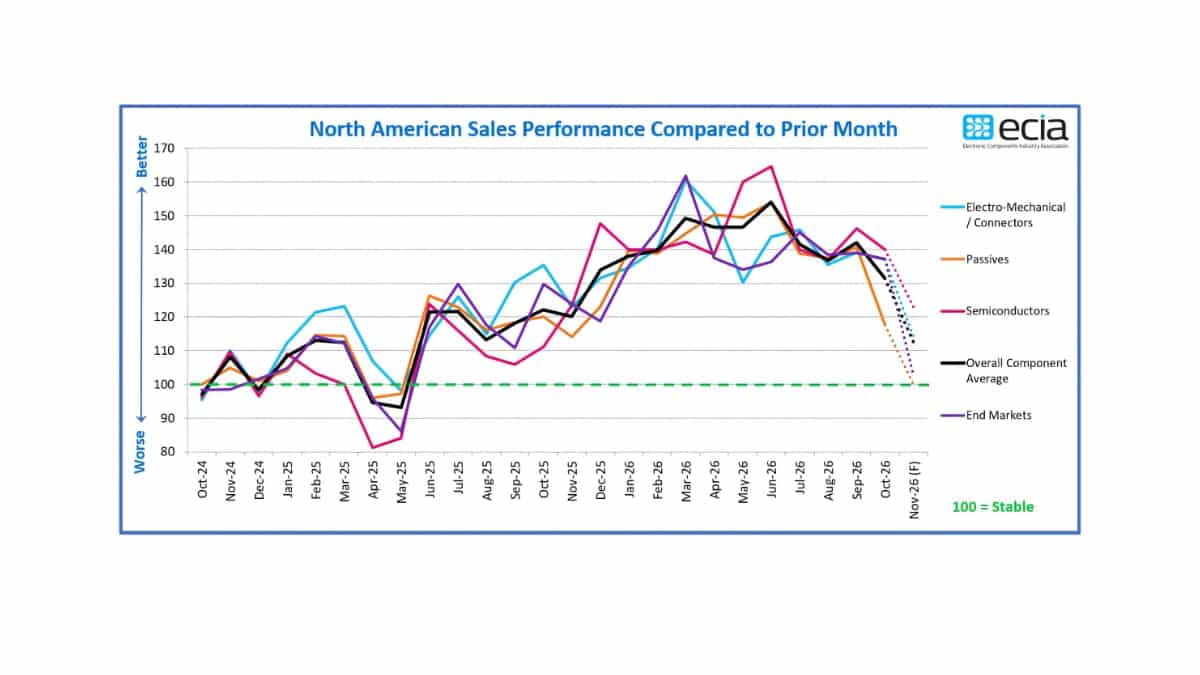
The November outlook for passives falls to 100, the survey’s stability threshold, after declining by more than 40 index points from September.
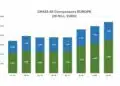
Across all component categories, the November outlook drops 19.2 points from October to 112.4. ECIA describes this as the steepest month-to-month decline in the overall index since June 2022. However, the overall reading remains above the stability threshold, and the November figures represent expectations rather than confirmed sales results.
Key Findings
- Passive components: November sales sentiment reaches 100, indicating expectations of broadly unchanged sales rather than growth.
- Overall component market: The November outlook falls 19.2 points, following a 10.4-point decline in October’s reported results.
- Electro-mechanical components: The November forecast is 25.0 points below September’s reading.
- Semiconductors: The November forecast is 23.1 points below September’s reading.
- End markets: Half of the surveyed end-market outlook scores fall below 100.
- Lead times: September-to-October reports show little overall change, with memory ICs remaining under the greatest pressure.
Passive Components Move from Growth Expectations to Stability
The passive-component outlook marks a substantial change in confidence after the stronger sentiment recorded earlier in the year. Nevertheless, a reading of 100 should not be interpreted as a forecast of falling sales: it indicates a neutral outlook at the boundary between expected growth and contraction.
The distinction between index points and sales percentages is equally important. The decline of more than 40 points from September to the November outlook is a change in survey sentiment, not a forecast that passive-component revenue will fall by more than 40%.
For suppliers and distributors, the result signals greater caution in near-term planning. It does not, by itself, establish a comparable deterioration in shipments, order intake or demand for individual capacitor, resistor and inductor technologies.
End-Market Weakness Extends Beyond Passives
The deterioration is not limited to passive components. Electro-mechanical and semiconductor sentiment also weakens substantially between September and the November forecast.
Across the surveyed end markets, declines in the November outlook range from 14.6 points for computers to 32.1 points for avionics, military and space. Half of the end-market scores fall below the 100-point stability threshold, indicating expectations of lower sales in those markets.
This creates an important distinction: the overall component outlook remains positive, but the underlying end-market picture is more uneven. An aggregate reading above 100 therefore should not be taken to mean that every application segment is still expected to grow.
Softer Sales Sentiment Does Not Mean Broad Supply Relief
Lead-time responses changed little between September and October. ECIA reports only a slight increase in the share of respondents seeing shorter lead times for passive and electro-mechanical components.
Semiconductors remain the most constrained group. Every semiconductor subcategory shows greater lead-time pressure than any passive or electro-mechanical subcategory, with memory ICs experiencing the greatest stress.
The practical implication is that demand confidence and component availability need to be assessed separately. A weaker sales outlook does not automatically translate into shorter delivery times, and the survey does not establish broad-based supply relief for passive components.
Seasonality and Data-Center Concerns Are Possible Factors
ECIA Chief Analyst Dale Ford identifies typical expectations of softer year-end market conditions as one possible explanation for the November decline. He also suggests that growing concerns about resistance to data-center construction may be weighing on confidence.
These are possible explanations, not demonstrated causes. The executive summary does not quantify their respective contributions or identify which passive-component technologies would be most affected.
For readers following AI hardware demand for passive components, the distinction matters: this survey captures near-term market confidence, rather than providing a technology-specific assessment of longer-term AI infrastructure demand.
What the Results Mean for Component Planning
The October survey supports a more cautious near-term planning stance, but not a blanket conclusion that the component market has entered contraction.
Three distinctions are particularly useful when interpreting the results:
- Forecast versus outcome: November readings reflect respondents’ expectations collected in the October survey, not verified November sales performance.
- Sentiment versus revenue: Index changes describe the direction of confidence, not percentage changes in market value.
- Market averages versus individual parts: Broad component-group readings cannot determine the availability or demand outlook for a specific technology, qualification grade or supplier.
For purchasing and supply-chain teams, the appropriate takeaway is to compare the weaker outlook with actual orders, inventory requirements and supplier delivery commitments before changing procurement plans. For manufacturers and distributors, subsequent results will help establish whether November’s caution reflects a temporary year-end pause or a more persistent slowdown.
About the ECIA Industry Pulse Survey
ECIA’s monthly and quarterly Industry Pulse reports track current sales sentiment, sales outlook, product cancellations, decommits and lead times. Detailed reporting covers six major electronic-component categories, six semiconductor subcategories and eight end markets, with responses also segmented among manufacturers, distributors and manufacturer representatives.
The complete report is available to ECIA members and survey participants. Despite the weaker near-term outlook, the association retains a positive long-term view based on innovation and the adoption of next-generation electronic products.
Further reading
- Passive Components in 2026: From Invisible Commodity to Design Parameter
- ECIA September 2026 Pulse: Growth Holds, Supply Pressure Persists
- AI and Passive Components: Structural Growth Beyond Data Centers
Source
This article is based on the Electronic Components Industry Association’s October 2026 Industry Pulse: Electronic Component Trends and Sentiment executive summary, authored by Chief Analyst Dale Ford. The source is an industry-association survey summary rather than a manufacturer product announcement. The planning implications presented here are editorial interpretation, not additional ECIA survey findings.
References
- ECIA October 2026 Industry Pulse executive summary — Original survey findings and commentary.
- AI Hardware Demand for Passive Components Dossier — Technical and supply-chain background.
- Passive Components in 2026: From Invisible Commodity to Design Parameter — Component-specific market and sourcing context.
- ECIA September 2026 Pulse: Growth Holds, Supply Pressure Persists — Previous survey context.
- AI and Passive Components: Structural Growth Beyond Data Centers — Longer-term demand and supply-chain discussion.