





Passive Components Blog
No Result
View All Result
  • Home
  • NewsFilter
    • All
    • Aerospace & Defence
    • Antenna
    • Applications
    • Automotive
    • Capacitors
    • Circuit Protection Devices
    • electro-mechanical news
    • Filters
    • Fuses
    • Inductors
    • Industrial
    • Integrated Passives
    • inter-connect news
    • Market & Supply Chain
    • Market Insights
    • Medical
    • Modelling and Simulation
    • New Materials & Supply
    • New Technologies
    • Non-linear Passives
    • Oscillators
    • Passive Sensors News
    • Resistors
    • RF & Microwave
    • Telecommunication
    • Weekly Digest

    Wk 28 Electronics Supply Chain Digest

    Bourns Introduces Automotive BMS Signal Transformer with Integrated Common Mode Chokes

    Itelcond Introduces High‑Voltage Aluminium Capacitors for Modern IGBT DC‑links

    Bourns Introduces Automotive Shielded Power Inductors for Compact DC‑DC Converters

    EMC Design Fundamentals: Safe Use of Varistors and Common Mode Chokes in Mains and Data-Line Filters

    Murata Unveils Lead Disc Ceramic Capacitors for Automotive Safety and EMI Suppression

    SCHURTER Releases Intelligent Three‑Terminal Fuses for Safer Li‑ion Battery Systems

    Can Copper Conductive Inks Displace Silver in Hybrid Electronics?

    Square-Wave Harmonics and RMS Currents in Power Converters

    Trending Tags

    • Ripple Current
    • RF
    • Leakage Current
    • Tantalum vs Ceramic
    • Snubber
    • Low ESR
    • Feedthrough
    • Derating
    • Dielectric Constant
    • New Products
    • Market Reports
  • VideoFilter
    • All
    • Antenna videos
    • Capacitor videos
    • Circuit Protection Video
    • Filter videos
    • Fuse videos
    • Inductor videos
    • Inter-Connect Video
    • Non-linear passives videos
    • Oscillator videos
    • Passive sensors videos
    • Resistor videos

    EMC Design Fundamentals: Safe Use of Varistors and Common Mode Chokes in Mains and Data-Line Filters

    Ferrite versus Nanocrystalline Power Inductor Cores: Turns, Gap and Size

    KYOCERA AVX Presents Antenna Integrator Studio Tutorial for Antenna Placement and RF Design

    Power Design Simulation Tools for Faster Inductor Selection and Loss Optimization

    EMC‑Compliant PCB and Connector Design Guidelines

    Why Isolated DC/DC Power Supplies Fail Late, Würth Elektronik Podcast

    Designing 800 V DC EMC Filters: Calculation, Simulation and Measurement

    Current Sense Transformer Datasheet and Design‑in Guide

    Designing a USB Type‑C Flyback Planar Transformer with Frenetic’s Planar Tool

    Trending Tags

    • Capacitors explained
    • Inductors explained
    • Resistors explained
    • Filters explained
    • Application Video Guidelines
    • EMC
    • New Products
    • Ripple Current
    • Simulation
    • Tantalum vs Ceramic
  • Knowledge Blog
  • Dossiers
    • AI Hardware Dossier
    • Power Converter Dossier
    • Automotive Dossier
    • Capacitor Dossier
    • Resistor Dossier
    • Inductor Dossier
    • Circuit Protection Dossier
  • Suppliers
    • Who is Who
  • PCNS
    • PCNS 2025
    • PCNS 2023
    • PCNS 2021
    • PCNS 2019
    • PCNS 2017
  • Events
  • Home
  • NewsFilter
    • All
    • Aerospace & Defence
    • Antenna
    • Applications
    • Automotive
    • Capacitors
    • Circuit Protection Devices
    • electro-mechanical news
    • Filters
    • Fuses
    • Inductors
    • Industrial
    • Integrated Passives
    • inter-connect news
    • Market & Supply Chain
    • Market Insights
    • Medical
    • Modelling and Simulation
    • New Materials & Supply
    • New Technologies
    • Non-linear Passives
    • Oscillators
    • Passive Sensors News
    • Resistors
    • RF & Microwave
    • Telecommunication
    • Weekly Digest

    Wk 28 Electronics Supply Chain Digest

    Bourns Introduces Automotive BMS Signal Transformer with Integrated Common Mode Chokes

    Itelcond Introduces High‑Voltage Aluminium Capacitors for Modern IGBT DC‑links

    Bourns Introduces Automotive Shielded Power Inductors for Compact DC‑DC Converters

    EMC Design Fundamentals: Safe Use of Varistors and Common Mode Chokes in Mains and Data-Line Filters

    Murata Unveils Lead Disc Ceramic Capacitors for Automotive Safety and EMI Suppression

    SCHURTER Releases Intelligent Three‑Terminal Fuses for Safer Li‑ion Battery Systems

    Can Copper Conductive Inks Displace Silver in Hybrid Electronics?

    Square-Wave Harmonics and RMS Currents in Power Converters

    Trending Tags

    • Ripple Current
    • RF
    • Leakage Current
    • Tantalum vs Ceramic
    • Snubber
    • Low ESR
    • Feedthrough
    • Derating
    • Dielectric Constant
    • New Products
    • Market Reports
  • VideoFilter
    • All
    • Antenna videos
    • Capacitor videos
    • Circuit Protection Video
    • Filter videos
    • Fuse videos
    • Inductor videos
    • Inter-Connect Video
    • Non-linear passives videos
    • Oscillator videos
    • Passive sensors videos
    • Resistor videos

    EMC Design Fundamentals: Safe Use of Varistors and Common Mode Chokes in Mains and Data-Line Filters

    Ferrite versus Nanocrystalline Power Inductor Cores: Turns, Gap and Size

    KYOCERA AVX Presents Antenna Integrator Studio Tutorial for Antenna Placement and RF Design

    Power Design Simulation Tools for Faster Inductor Selection and Loss Optimization

    EMC‑Compliant PCB and Connector Design Guidelines

    Why Isolated DC/DC Power Supplies Fail Late, Würth Elektronik Podcast

    Designing 800 V DC EMC Filters: Calculation, Simulation and Measurement

    Current Sense Transformer Datasheet and Design‑in Guide

    Designing a USB Type‑C Flyback Planar Transformer with Frenetic’s Planar Tool

    Trending Tags

    • Capacitors explained
    • Inductors explained
    • Resistors explained
    • Filters explained
    • Application Video Guidelines
    • EMC
    • New Products
    • Ripple Current
    • Simulation
    • Tantalum vs Ceramic
  • Knowledge Blog
  • Dossiers
    • AI Hardware Dossier
    • Power Converter Dossier
    • Automotive Dossier
    • Capacitor Dossier
    • Resistor Dossier
    • Inductor Dossier
    • Circuit Protection Dossier
  • Suppliers
    • Who is Who
  • PCNS
    • PCNS 2025
    • PCNS 2023
    • PCNS 2021
    • PCNS 2019
    • PCNS 2017
  • Events
No Result
View All Result
Passive Components Blog
No Result
View All Result

10 Tips for Ensuring Reliability of Discrete Wire Assemblies

20.2.2025
Reading Time: 4 mins read
A A

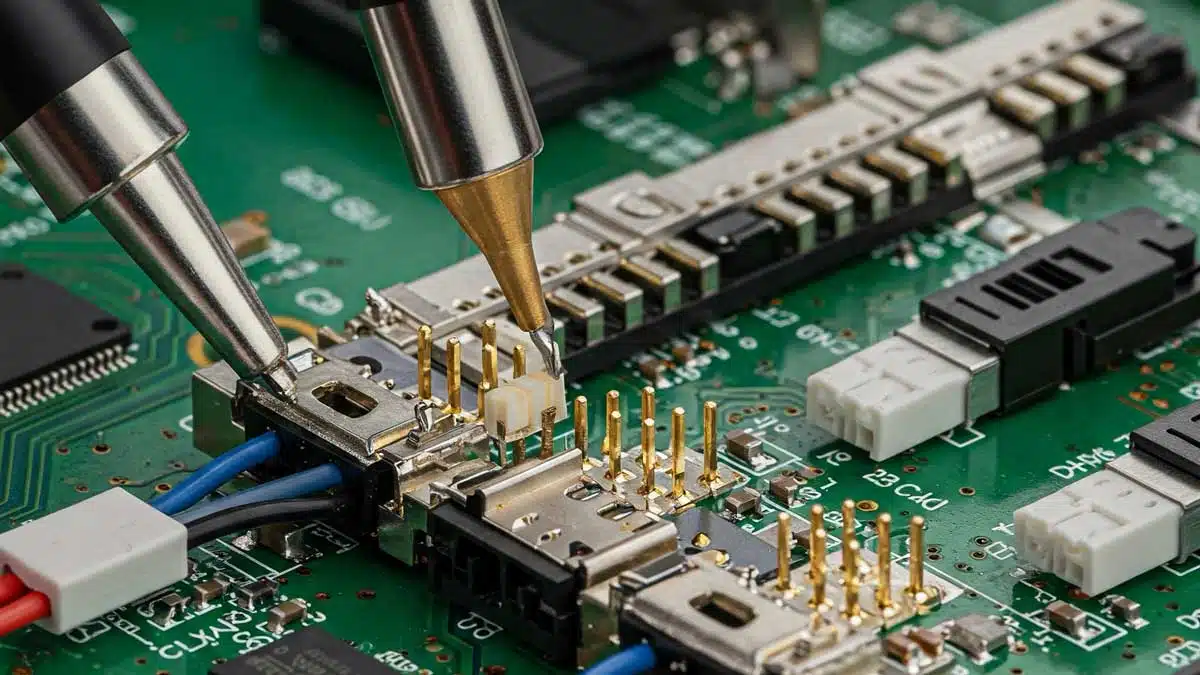
Samtec in its blog compiled ten essential tips for discrete wire assemblies. These guidelines will improve the durability and performance of discrete wire assemblies while minimizing rework and troubleshooting.

When working on reliable discrete wire assemblies, precision and attention to detail are critical to ensuring performance and longevity.

RelatedPosts

Samtec AcceleRate Slim ARC6 Cable Assemblies with New Signaling Options

Samtec ANSI/VITA 90 Connectors: Rugged Small Form Factor Standard

Key Interconnect Technologies for 2025

Even small mistakes—such as improper cable routing or excessive force during assembly—can lead to performance issues, mechanical failures, or long-term reliability concerns. Following industry standards like IPC/WHMA-A-620 and using the right techniques can help ensure a successful, high-quality assembly.

1. Optimize Cable Length and Management

Optimize Cable Length and Management: Ensure adequate cable length for routing and movement to prevent undue strain. Avoid aggressive zip ties or routing cables around sharp edges, which can degrade insulation and impact performance.

2. Respect Minimum Bend Radius
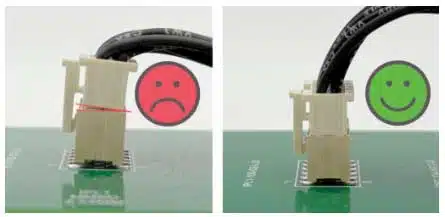
Respect Minimum Bend Radius: Follow manufacturers’ recommendations for minimum bend radius and maintain a safe distance from connectors before starting a bend. Tight bends near terminations can create mechanical stress, leading to electrical or mechanical failures.

3. Proper Handling During Modifications

Proper Handling During Modifications: Many customers purchase single-ended cables and terminate the other end themselves. However, excessive force during modifications can damage the genuine terminated end. Handle cables carefully to preserve the integrity of the factory-crimped connection.

4. Handle Retention Features with Care

Handle Retention Features with Care: Crimped contacts and terminals have small yet essential retention features that keep them secured in housings. Mishandling can damage these features, leading to poor retention and electrical failures. Always use proper techniques to insert and remove contacts without bending or breaking these retention features.

5. Use Proper Demating Techniques

Use Proper Demating Techniques: Pulling on wires to unmate connectors can damage both the wire and the contact system. Instead, use ejector shrouds or demating tools to evenly release connectors without placing stress on individual wires. If a demating tool or feature is not part of the design, then grip the plastic or metal housing while disengaging the latch.

6. Maintain System Compatibility

For optimal results, always use reliable manufacturer components and approved tooling from the same manufacturer. Mixing different brands can introduce inconsistencies in fit, performance, and long-term reliability. Just because a contact system from supplier A appears compatible with a body from supplier B doesn’t guarantee that its features will function as expected.

7. Use the Right Tools for Contact Removal

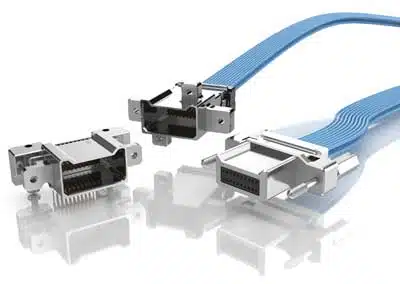
Improperly removing crimped cables from plastic housings can cause damage, leading to poor retention and future mating issues. Samtec offers specialized tools to safely remove contacts without damaging connectors. Refer to the manufacturing tooling guides, for the recommended equipment.
8. Understand Latch Strength Limitations

Plastic and metal latches are designed to secure mated connectors under normal conditions but are not intended to withstand excessive pull forces. Avoid relying solely on latches to hold connectors in high-stress applications unless otherwise specified.

9. Investigate Issues Thoroughly

If a defect occurs, manufacturers employ various root cause analysis, regression testing, continuous monitoring, and inspection techniques to identify the underlying issues. Consider factors such as tooling calibration, wire specifications, crimp measurement, lubrication, and any modifications made to the tool. Detailed documentation and images can expedite the resolution process.

10. Regularly Maintain and Inspect Tools

Crimp tools require periodic maintenance to function optimally. Ensure that tools are lubricated, calibrated, and inspected regularly to prevent inconsistencies in crimp quality. A well-maintained tool extends the lifespan of your assembly process and minimizes defects.

By adhering to these best practices, you can enhance the quality and durability of your reliable discrete wire assemblies. 

Source: Samtec

Recent Posts

Molex Unveils Automotive Ethernet Connectors for Next‑Gen SDV Architectures

2.7.2026
48

binder Prints Electronics on 3D Components Connector Surface

1.7.2026
21

EMC‑Compliant PCB and Connector Design Guidelines

22.6.2026
115

Hirose Releases Ultra‑low Profile FPC‑to‑board Connector

17.6.2026
50

Molex Expanded AirBorn SInergy Hybrid Connectors with 25 A Power Modules

16.6.2026
59

Hirose Releases 0.5 mm Floating Board-to-Board Connector for EV Powertrain Designs

15.6.2026
30

Hirose Expands Compact High‑Voltage EV connectors

21.5.2026
61

YAGEO Releases Compact RJ45 Connector for Multi‑Gigabit Ethernet

18.5.2026
59

Binder Hybrid Connector Simplifies One Cable Automation

13.5.2026
50

Upcoming Events

Jul 28
8:00 - 11:00 CEST

Post Procurement Testing of EEE Components for LEO Space Applications

Jul 29
17:30 - 18:30 CEST

To Ferrite or to Nanocrystalline in Transformer Design

Sep 29
16:00 - 17:00 CEST

Cybersecurity 2026

View Calendar

Popular Posts

  • Boost Converter Design and Calculation

    0 shares
    Share 0 Tweet 0
  • Buck Converter Design and Calculation

    0 shares
    Share 0 Tweet 0
  • YAGEO Announces July 2026 Capacitor Price Increase

    0 shares
    Share 0 Tweet 0
  • Flyback Converter Design and Calculation

    0 shares
    Share 0 Tweet 0
  • LLC Resonant Converter Design and Calculation

    0 shares
    Share 0 Tweet 0
  • MLCC and Ceramic Capacitors

    0 shares
    Share 0 Tweet 0
  • MLCCs in the Age of AI: Q2 2026 Market Tightness

    0 shares
    Share 0 Tweet 0
  • Earthing Systems and IEC Classification Explained

    0 shares
    Share 0 Tweet 0
  • Nvidia Vera Rubin: Why One AI Rack Needs So Many More MLCC Capacitors

    0 shares
    Share 0 Tweet 0
  • Dual Active Bridge (DAB) Topology

    0 shares
    Share 0 Tweet 0

Newsletter Subscription


Passive Components Blog

© EPCI - Leading Passive Components Educational and Information Site

  • Home
  • Privacy Policy
  • EPCI Membership & Advertisement
  • About

No Result
View All Result
  • Home
  • Knowledge Blog
  • Dossiers
  • PCNS

© EPCI - Leading Passive Components Educational and Information Site

This website uses cookies. By continuing to use this website you are giving consent to cookies being used. Visit our Privacy and Cookie Policy.