






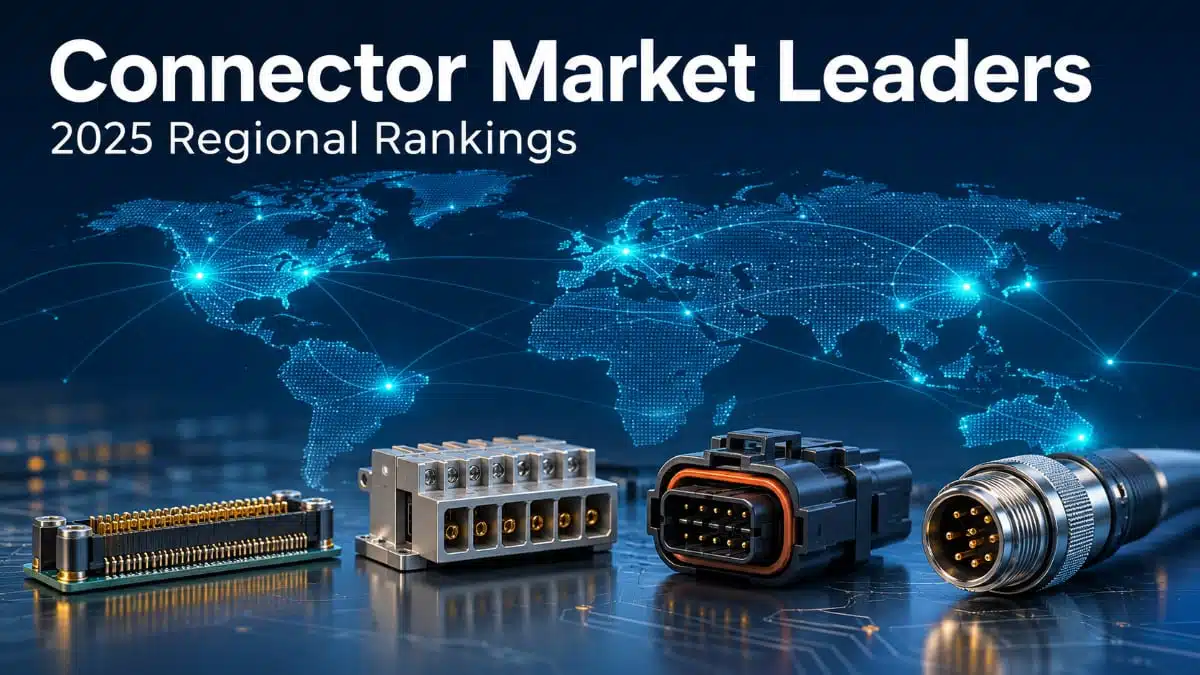
TE Connectivity led connector sales in four of the six geographic regions tracked by Bishop & Associates in 2025, while Amphenol ranked first in North America and Asia Pacific.
Together, the regional top-10 lists identify 23 manufacturers—showing why a worldwide sales ranking alone can overlook relevant sourcing candidates.
Following our earlier report on the Top 10 Connector Manufacturers 2025: Amphenol Takes the Lead, this follow-up examines the regional picture. The latest analysis, published by TTI MarketEYE on November 23, 2026, adds a geographic perspective to supplier evaluation, highlighting both globally established groups and companies with a more concentrated regional presence.
Global Leadership and Regional Leadership Are Different
Amphenol took first place in the worldwide connector sales ranking for 2025, but TE Connectivity retained the leading position in Europe, Japan, China and the rest-of-world category.
Both companies appeared in the top 10 across all six regions. TE Connectivity ranked either first or second everywhere, while Amphenol placed first or second in five regions and seventh in Japan.
The distinction matters for purchasing teams: worldwide scale and regional sales position describe different aspects of a supplier’s business. Neither establishes whether a particular connector family meets an application’s electrical, mechanical or supply requirements.
Top 10 Connector Manufacturers by Geographic Region
The following table shows the 2025 regional sales rankings published by TTI MarketEYE, based on Bishop & Associates research. China, Japan and Asia Pacific are presented as separate reporting categories. ROW means rest of world.
| 2025 rank | North America | Europe | Japan | China | Asia Pacific | ROW |
|---|---|---|---|---|---|---|
| 1 | Amphenol | TE Connectivity | TE Connectivity | TE Connectivity | Amphenol | TE Connectivity |
| 2 | TE Connectivity | Amphenol | Yazaki | Amphenol | TE Connectivity | Amphenol |
| 3 | Molex | Aptiv | JAE | Luxshare | Molex | BizLink |
| 4 | Aptiv | Molex | J.S.T. | Foxconn (FIT) | Foxconn (FIT) | Rosenberger |
| 5 | BizLink | Rosenberger | Sumitomo | Aptiv | Luxshare | Yazaki |
| 6 | CommScope | HARTING | Hirose | Molex | Aptiv | Sumitomo |
| 7 | Samtec | BizLink | Amphenol | Jonhon | Yazaki | Aptiv |
| 8 | Yazaki | Phoenix Contact | Molex | LOTES | Hirose | Foxconn (FIT) |
| 9 | Glenair | Yazaki | Rosenberger | JAE | LOTES | KET |
| 10 | Rosenberger | Weidmüller | IRISO | Hirose | BizLink | Luxshare |
Regional ranking data: Bishop & Associates, as published by TTI MarketEYE.
These are rankings by connector sales within each geographic market—not rankings of supplier headquarters, manufacturing locations, product quality or customer satisfaction. The published table provides positions rather than regional sales values or market shares, so the numerical distance between suppliers cannot be determined from it.
Regional Rankings Add 13 Suppliers to the Global Shortlist
Looking beyond the worldwide top 10 brings another 13 manufacturers into consideration:
- JAE
- Sumitomo
- Jonhon
- LOTES
- Phoenix Contact
- Samtec
- J.S.T.
- HARTING
- CommScope
- Korea Electric Terminal, or KET
- Glenair
- IRISO
- Weidmüller
This expands the combined worldwide and regional shortlist to 23 companies. Several additional suppliers appear in more than one regional list: JAE ranks in Japan and China, LOTES in China and Asia Pacific, and Sumitomo in Japan and ROW.
The practical value is a broader starting point for supplier research. A manufacturer outside the global top 10 may still have a substantial position in the market where a customer develops, manufactures or sells equipment.
Europe: A Broader Supplier Landscape Behind the Leaders
TE Connectivity and Amphenol occupy the first two positions in Europe, followed by Aptiv, Molex and Rosenberger.
The European list also includes HARTING in sixth place, Phoenix Contact in eighth and Weidmüller in tenth. None of these three appears in the worldwide top 10, illustrating how a global-only shortlist can exclude regionally significant suppliers.
For European equipment manufacturers, these results support a wider sourcing review rather than an automatic preference for the largest worldwide groups. The next step remains checking the exact product portfolio, qualification evidence, engineering support and delivery arrangements required for the project.
Japan, China and Asia Pacific Show Distinct Supplier Positions
Japan has a particularly different ranking from the worldwide list. TE Connectivity leads, followed by Yazaki, JAE, J.S.T. and Sumitomo. Hirose places sixth, while IRISO completes the regional top 10.
China’s ranking places TE Connectivity and Amphenol first and second, followed by Luxshare and Foxconn Interconnect Technology. Jonhon and LOTES also appear, in seventh and eighth place respectively.
In the separately reported Asia Pacific category, Amphenol leads TE Connectivity and Molex, with Foxconn, Luxshare and Aptiv occupying fourth through sixth.
These differences reinforce the need to treat the regions separately. A strong position in one Asian market does not automatically imply the same position across Japan, China and the wider Asia Pacific reporting category.
How Widely Do the Leading Suppliers Appear?
The number of regional top-10 appearances provides another view of supplier reach:
- Six regions: Amphenol and TE Connectivity.
- Five regions: Molex, Aptiv and Yazaki.
- Four regions: BizLink and Rosenberger.
- Three regions: Foxconn Interconnect Technology, Luxshare and Hirose.
- Two regions: JAE, LOTES and Sumitomo.
- One region: the remaining 10 manufacturers.
Molex appears in every regional top 10 except ROW, while Yazaki appears in every region except China. Aptiv increased its coverage from four regions in 2024 to five in 2025.
These counts describe the breadth of a company’s top-10 sales presence. They do not measure the completeness of its connector portfolio or the availability of local production and technical support.
Turning Market Rankings into a Connector Sourcing Decision
Regional rankings are most useful as a screening tool. They help identify manufacturers worth investigating, but the sourcing decision should move quickly from company-level scale to the exact interconnect.
A practical evaluation should address five areas:
- Application fit. Confirm the interface, contact arrangement, pitch, mounting method, current and voltage requirements, and operating environment.
- Technical evidence. Review drawings, specifications, samples, qualification results and access to application engineering.
- Supply capability. Verify delivery commitments, production capacity and arrangements for supporting future demand.
- Quality requirements. Check the certifications and qualification evidence relevant to the intended equipment and market.
- Long-term support. Assess whether the supplier can support development, production, maintenance and eventual product changes.
At component level, connector contact considerations provide a more direct basis for assessing design and assembly suitability than sales position alone.
For high-speed interfaces, matching connectors to protocol requirements adds another qualification layer: protocol-specific test data, signal-integrity models and mechanical constraints must support the intended implementation.
A top-ranked supplier is therefore a candidate for evaluation—not a substitute for it.
Further reading
- Six Essential Tips To Select The Right Connector
- RF Connector Types: How To Choose the Right One
- Material Selection
Source
This article is based on Ronald E. Bishop’s “Selecting a Connector Vendor – Part 2: A Look at Regional Leaders,” published by TTI MarketEYE on November 23, 2026, drawing on Bishop & Associates’ 2026 connector-industry research. The original publication is a market-research commentary rather than a manufacturer press release. The information has been edited and extended with sourcing guidance, comparison limits and continuity with our previously published worldwide ranking.