





Passive Components Blog
No Result
View All Result
  • Home
  • NewsFilter
    • All
    • Aerospace & Defence
    • Antenna
    • Applications
    • Automotive
    • Capacitors
    • Circuit Protection Devices
    • electro-mechanical news
    • Filters
    • Fuses
    • Inductors
    • Industrial
    • Integrated Passives
    • inter-connect news
    • Market & Supply Chain
    • Market Insights
    • Medical
    • Modelling and Simulation
    • New Materials & Supply
    • New Technologies
    • Non-linear Passives
    • Oscillators
    • Passive Sensors News
    • Resistors
    • RF & Microwave
    • Telecommunication
    • Weekly Digest

    Binder Hybrid Connector Simplifies One Cable Automation

    Tapped Inductor Buck Converter Fundamentals

    TAIYO YUDEN Releases Mini Metal Power Inductors

    Molecular Memristor Shows Record 145 kH Emergent Inductance

    Planar vs Conventional Transformer: When it Make Sense

    Researchers Propose Next‑Gen Compact Memory Using Ultra-thin Ferroelectric Capacitors

    Nichicon ADN Automotive Hybrid Aluminum Capacitors Now Available in EMEA

    Wk 19 Electronics Supply Chain Digest

    Electrocaloric Multilayer Capacitors: Towards Quiet, Solid‑State Cooling Around Room Temperature

    Trending Tags

    • Ripple Current
    • RF
    • Leakage Current
    • Tantalum vs Ceramic
    • Snubber
    • Low ESR
    • Feedthrough
    • Derating
    • Dielectric Constant
    • New Products
    • Market Reports
  • VideoFilter
    • All
    • Antenna videos
    • Capacitor videos
    • Circuit Protection Video
    • Filter videos
    • Fuse videos
    • Inductor videos
    • Inter-Connect Video
    • Non-linear passives videos
    • Oscillator videos
    • Passive sensors videos
    • Resistor videos

    Tapped Inductor Buck Converter Fundamentals

    Planar vs Conventional Transformer: When it Make Sense

    Modeling Fringing Field Losses in Inductors & Transformers

    Why Power Inductors Use a Ferrite Core With an Air Gap

    Transformer-Based Power-Line Harvester Magnetic Design

    Thermal Modeling of Magnetics

    Standard vs Planar LLC transformers Comparison for Battery Chargers

    How Modern Tools Model Magnetic Components for Power Electronics

    Advanced Loss Modeling for Planar Magnetics in the Frenetic Planar Tool

    Trending Tags

    • Capacitors explained
    • Inductors explained
    • Resistors explained
    • Filters explained
    • Application Video Guidelines
    • EMC
    • New Products
    • Ripple Current
    • Simulation
    • Tantalum vs Ceramic
  • Knowledge Blog
  • DossiersNew
  • Suppliers
    • Who is Who
  • PCNS
    • PCNS 2025
    • PCNS 2023
    • PCNS 2021
    • PCNS 2019
    • PCNS 2017
  • Events
  • Home
  • NewsFilter
    • All
    • Aerospace & Defence
    • Antenna
    • Applications
    • Automotive
    • Capacitors
    • Circuit Protection Devices
    • electro-mechanical news
    • Filters
    • Fuses
    • Inductors
    • Industrial
    • Integrated Passives
    • inter-connect news
    • Market & Supply Chain
    • Market Insights
    • Medical
    • Modelling and Simulation
    • New Materials & Supply
    • New Technologies
    • Non-linear Passives
    • Oscillators
    • Passive Sensors News
    • Resistors
    • RF & Microwave
    • Telecommunication
    • Weekly Digest

    Binder Hybrid Connector Simplifies One Cable Automation

    Tapped Inductor Buck Converter Fundamentals

    TAIYO YUDEN Releases Mini Metal Power Inductors

    Molecular Memristor Shows Record 145 kH Emergent Inductance

    Planar vs Conventional Transformer: When it Make Sense

    Researchers Propose Next‑Gen Compact Memory Using Ultra-thin Ferroelectric Capacitors

    Nichicon ADN Automotive Hybrid Aluminum Capacitors Now Available in EMEA

    Wk 19 Electronics Supply Chain Digest

    Electrocaloric Multilayer Capacitors: Towards Quiet, Solid‑State Cooling Around Room Temperature

    Trending Tags

    • Ripple Current
    • RF
    • Leakage Current
    • Tantalum vs Ceramic
    • Snubber
    • Low ESR
    • Feedthrough
    • Derating
    • Dielectric Constant
    • New Products
    • Market Reports
  • VideoFilter
    • All
    • Antenna videos
    • Capacitor videos
    • Circuit Protection Video
    • Filter videos
    • Fuse videos
    • Inductor videos
    • Inter-Connect Video
    • Non-linear passives videos
    • Oscillator videos
    • Passive sensors videos
    • Resistor videos

    Tapped Inductor Buck Converter Fundamentals

    Planar vs Conventional Transformer: When it Make Sense

    Modeling Fringing Field Losses in Inductors & Transformers

    Why Power Inductors Use a Ferrite Core With an Air Gap

    Transformer-Based Power-Line Harvester Magnetic Design

    Thermal Modeling of Magnetics

    Standard vs Planar LLC transformers Comparison for Battery Chargers

    How Modern Tools Model Magnetic Components for Power Electronics

    Advanced Loss Modeling for Planar Magnetics in the Frenetic Planar Tool

    Trending Tags

    • Capacitors explained
    • Inductors explained
    • Resistors explained
    • Filters explained
    • Application Video Guidelines
    • EMC
    • New Products
    • Ripple Current
    • Simulation
    • Tantalum vs Ceramic
  • Knowledge Blog
  • DossiersNew
  • Suppliers
    • Who is Who
  • PCNS
    • PCNS 2025
    • PCNS 2023
    • PCNS 2021
    • PCNS 2019
    • PCNS 2017
  • Events
No Result
View All Result
Passive Components Blog
No Result
View All Result

Discrete Components Selection Optimization with Modelithics and Keysight ADS

22.9.2025
Reading Time: 5 mins read
A A

This article based on Modelithics blog article “taking advantage of discrete optimization” explains hot to optimize discrete components in RF circuit design using Keysight ADS and Modelithics Microwave Global Models that automatically selects real-world component values during simulation.

This bridges the gap between idealized designs and manufacturable circuits, improving accuracy and streamlining the design process.

RelatedPosts

Modelithics Releases COMPLETE v26.1 for Keysight ADS

Modelithics Expands COMPLETE+3D Library for Ansys HFSS

Modelithics Library for MATLAB: Measurement-Based Models for Microwave and RF Passive Components

Introduction: The Hidden Gap in RF Circuit Optimization

In the world of RF and microwave circuit design, optimization is not just a luxury—it’s a necessity. Whether you’re crafting a high-performance filter or fine-tuning an amplifier, the ability to adjust component values to meet stringent performance goals is central to success. Yet, a persistent challenge lurks beneath the surface of traditional optimization workflows: the disconnect between idealized component values and the real-world parts available from manufacturers.

Imagine designing a lowpass filter using surface-mount RLC components. You run a simulation, perform an optimization, and arrive at values that look perfect on paper. But when you go to source those components, you realize that the values—say, 5.569 nH for an inductor or 2.076 pF for a capacitor—don’t exist in any catalog. The result? A frustrating and time-consuming process of manually mapping ideal values to the closest available parts, often compromising performance in the process.

This is where discrete optimization enters the picture—not as a workaround, but as a transformative solution.

Discrete Optimization: Bridging Simulation and Reality

Discrete optimization is a feature available in Keysight’s Advanced Design System (ADS) when paired with Modelithics Microwave Global Models™. Unlike traditional optimization, which treats component values as continuous variables, discrete optimization constrains those values to actual, manufacturer-specified part numbers. This means that the output of your simulation isn’t just theoretically optimal—it’s physically realizable.

Modelithics offers comprehensive model libraries for RLC components from leading vendors such as Coilcraft and KYOCERA AVX. Each Microwave Global Model spans an entire part series, enabling designers to simulate, tune, and optimize across a wide range of real-world values. These models include parameters like L_Discrete, C_Discrete, and R_Discrete, which allow you to select specific part values or activate discrete optimization mode directly within ADS.

A Practical Example: Designing a Lowpass Filter

To illustrate the power of discrete optimization, consider a simple lowpass filter designed to pass signals up to 2 GHz. Using a synthesis tool, the initial design specifies ideal component values: inductors L1 and L3 at 5.569 nH, L2 at 8.825 nH, and capacitors C1 and C2 at 2.076 pF. These values serve as a theoretical starting point. See Figure 1. schematic and its frequency response.
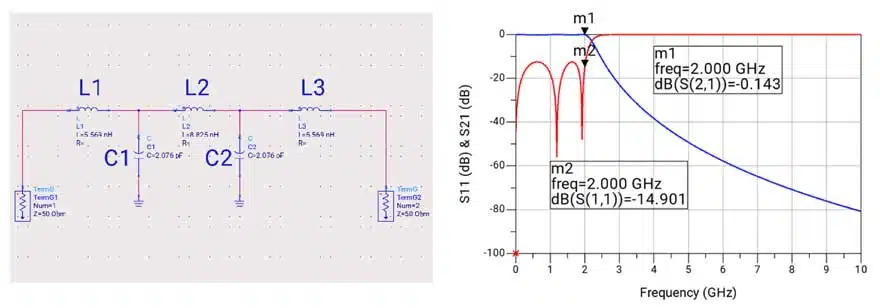
Figure 1. Schematic of the initial filter with ideal component models (left) along with the frequency response (right)

When these ideal models are replaced with real components—specifically, Coilcraft’s 0402CS series inductors and KYOCERA AVX’s 600L series capacitors—the frequency response shifts downward by approximately 630 MHz. This deviation underscores the impact of parasitics and layout effects, which are captured by the Modelithics models but absent in ideal simulations.

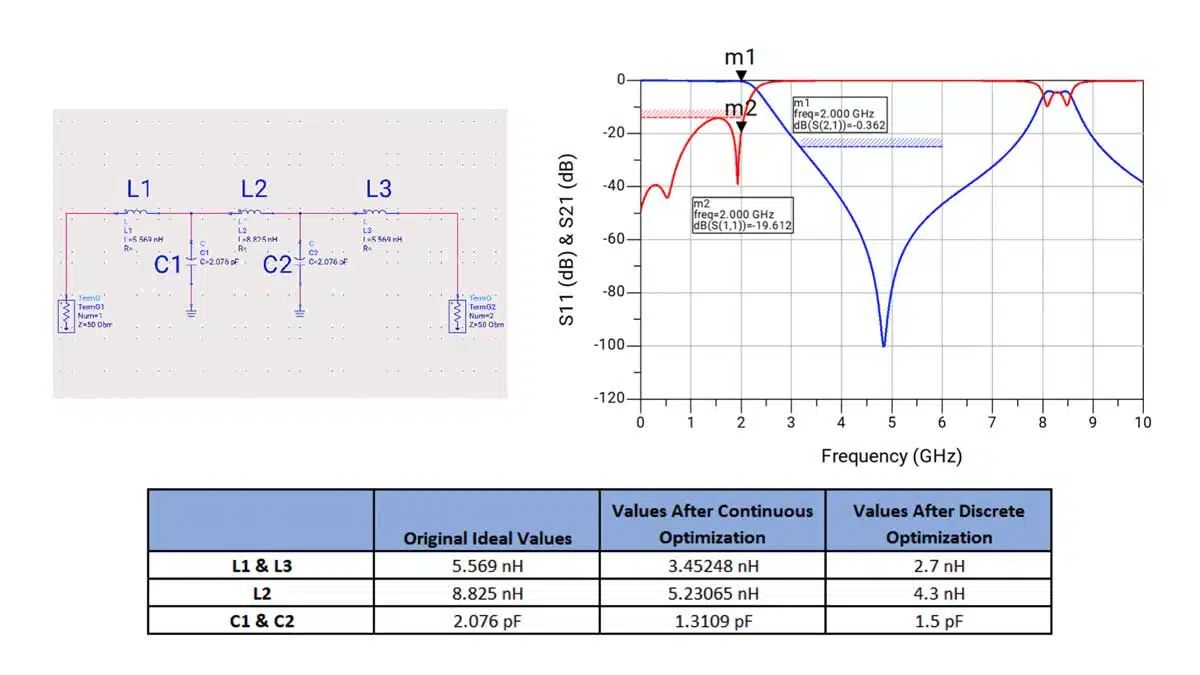
To correct this, the design undergoes a two-step optimization process. First, a continuous optimization is performed to identify the general range of values that meet the desired performance goals: S11 below −14 dB from DC to 2 GHz, and S21 below −25 dB from 3.2 to 6 GHz. This yields new component values—L1 and L3 at 3.45248 nH, L2 at 5.23065 nH, and C1 and C2 at 1.3109 pF—but again, these are not real parts.

Armed with this insight, the designer then performs a discrete optimization. By setting nominal, minimum, and maximum values based on the results of the continuous optimization, the tool automatically selects the best available components. The final design uses L1 and L3 at 2.7 nH, L2 at 4.3 nH, and C1 and C2 at 1.5 pF—values that exist in manufacturer catalogs and deliver the desired frequency response. See Table 2. of the parameters optimization and frequency response of real parts in the Figure 2.

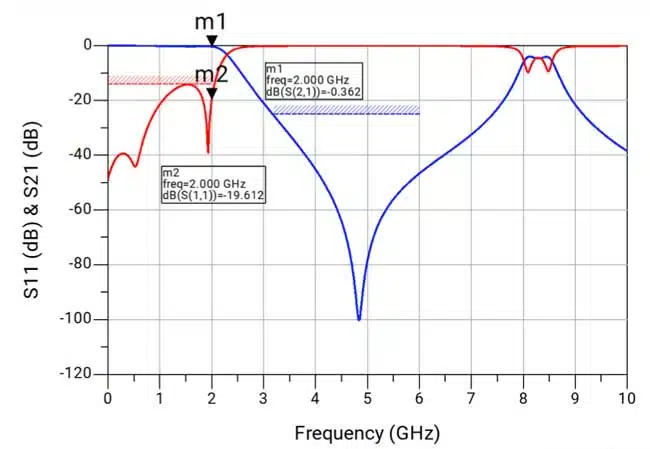
Figure 2. Simulated frequency response of the filter with the final real-life part values. The limit lines represent the optimization goals.

Strategic Impact: Why Discrete Optimization Matters

The implications of this approach extend far beyond a single filter design. Discrete optimization streamlines the entire design workflow, eliminating the guesswork and manual adjustments that often plague RF projects. It ensures that simulation results translate directly into manufacturable designs, reducing time-to-market and improving reliability.

Moreover, by leveraging vendor-validated models, designers gain a deeper understanding of how components behave in real-world conditions. This leads to more accurate simulations, better performance, and fewer surprises during prototyping and testing.

Conclusion: A Smarter Way to Design

Discrete optimization is more than a feature—it’s a philosophy. It represents a shift toward realism, precision, and efficiency in RF design. By integrating Modelithics Microwave Global Models with Keysight ADS, engineers can move confidently from concept to implementation, knowing that their designs are grounded in the realities of component availability and performance.

If you’re ready to elevate your design process, discrete optimization is the tool you’ve been waiting for.


Related

Source: Modelithics

Recent Posts

Tapped Inductor Buck Converter Fundamentals

13.5.2026
11

TAIYO YUDEN Releases Mini Metal Power Inductors

13.5.2026
9

Molecular Memristor Shows Record 145 kH Emergent Inductance

12.5.2026
11

Planar vs Conventional Transformer: When it Make Sense

11.5.2026
35

Researchers Propose Next‑Gen Compact Memory Using Ultra-thin Ferroelectric Capacitors

11.5.2026
28

Nichicon ADN Automotive Hybrid Aluminum Capacitors Now Available in EMEA

11.5.2026
23

Electrocaloric Multilayer Capacitors: Towards Quiet, Solid‑State Cooling Around Room Temperature

7.5.2026
186

High-Crystallinity Nanocrystalline Composites for MHz Chip Inductors

7.5.2026
63

Stackpole Expanded its AlN Thick Film Chip Resistors

6.5.2026
23

Upcoming Events

May 19
16:00 - 17:00 CEST

Designing Qi2 Wireless Power Systems: Practical Development and EMC Optimization

Jun 2
16:00 - 17:00 CEST

Calculation, Simulation and Measurement of 800V EMC Filters

Jun 16
16:00 - 17:00 CEST

EMC with EMC – EMC‑compliant design with electromechanical connectors

View Calendar

Popular Posts

  • Buck Converter Design and Calculation

    0 shares
    Share 0 Tweet 0
  • Boost Converter Design and Calculation

    0 shares
    Share 0 Tweet 0
  • Flyback Converter Design and Calculation

    0 shares
    Share 0 Tweet 0
  • LLC Resonant Converter Design and Calculation

    0 shares
    Share 0 Tweet 0
  • MLCC and Ceramic Capacitors

    0 shares
    Share 0 Tweet 0
  • Dual Active Bridge (DAB) Topology

    0 shares
    Share 0 Tweet 0
  • Capacitor Charging and Discharging

    0 shares
    Share 0 Tweet 0
  • What Electronics Engineer Needs to Know About Passive Low Pass Filters

    0 shares
    Share 0 Tweet 0
  • Ripple Current and its Effects on the Performance of Capacitors

    3 shares
    Share 3 Tweet 0
  • MLCC Case Sizes Standards Explained

    0 shares
    Share 0 Tweet 0

Newsletter Subscription


Passive Components Blog

© EPCI - Leading Passive Components Educational and Information Site

  • Home
  • Privacy Policy
  • EPCI Membership & Advertisement
  • About

No Result
View All Result
  • Home
  • Knowledge Blog
  • PCNS

© EPCI - Leading Passive Components Educational and Information Site

This website uses cookies. By continuing to use this website you are giving consent to cookies being used. Visit our Privacy and Cookie Policy.
Go to mobile version