














Passive Components Blog
No Result
View All Result
  • Home
  • NewsFilter
    • All
    • Aerospace & Defence
    • Antenna
    • Applications
    • Automotive
    • Capacitors
    • Circuit Protection Devices
    • electro-mechanical news
    • Filters
    • Fuses
    • Inductors
    • Industrial
    • Integrated Passives
    • inter-connect news
    • Market & Supply Chain
    • Market Insights
    • Medical
    • Modelling and Simulation
    • New Materials & Supply
    • New Technologies
    • Non-linear Passives
    • Oscillators
    • Passive Sensors News
    • Resistors
    • RF & Microwave
    • Telecommunication
    • Weekly Digest

    YAGEO Introduces 310VAC SMD Y2 Safety MP Capacitors for Compact EMI Filtering

    DMASS: European Components Distribution Returns To Growth In Q1 2026

    German Component Distribution Market Rebounds in Q1 2026 According to FBDi

    Nippon Chemi-Con Announces New Capacitor series for AI, Automotive and Immersion Cooling

    Ultrahigh Energy Storage in Lead‑Free BiFeO₃‑Based Ceramic Capacitors via Local Polar Structure Design

    Molex Expanded AirBorn SInergy Hybrid Connectors with 25 A Power Modules

    Murata Expands Ansys Simulation Models for RF inductors, MLCCs, and Power Inductors

    Sumida Introduces SMD Metal Inductors for High‑Current Automotive DC/DC Converters

    Hirose Releases 0.5 mm Floating Board-to-Board Connector for EV Powertrain Designs

    Trending Tags

    • Ripple Current
    • RF
    • Leakage Current
    • Tantalum vs Ceramic
    • Snubber
    • Low ESR
    • Feedthrough
    • Derating
    • Dielectric Constant
    • New Products
    • Market Reports
  • VideoFilter
    • All
    • Antenna videos
    • Capacitor videos
    • Circuit Protection Video
    • Filter videos
    • Fuse videos
    • Inductor videos
    • Inter-Connect Video
    • Non-linear passives videos
    • Oscillator videos
    • Passive sensors videos
    • Resistor videos

    Why Isolated DC/DC Power Supplies Fail Late, Würth Elektronik Podcast

    Designing 800 V DC EMC Filters: Calculation, Simulation and Measurement

    Current Sense Transformer Datasheet and Design‑in Guide

    Designing a USB Type‑C Flyback Planar Transformer with Frenetic’s Planar Tool

    Magnetics Design in High‑Frequency GaN Converters

    Qi2 Wireless Charging: Inductors, Capacitors and EMC Filters

    Two‑capacitor paradox explained for engineers

    Capacitances of Nonlinear MLCCs: What Datasheets Don’t Tell You

    Tapped Inductor Buck Converter Fundamentals

    Trending Tags

    • Capacitors explained
    • Inductors explained
    • Resistors explained
    • Filters explained
    • Application Video Guidelines
    • EMC
    • New Products
    • Ripple Current
    • Simulation
    • Tantalum vs Ceramic
  • Knowledge Blog
  • DossiersNew
  • Suppliers
    • Who is Who
  • PCNS
    • PCNS 2025
    • PCNS 2023
    • PCNS 2021
    • PCNS 2019
    • PCNS 2017
  • Events
  • Home
  • NewsFilter
    • All
    • Aerospace & Defence
    • Antenna
    • Applications
    • Automotive
    • Capacitors
    • Circuit Protection Devices
    • electro-mechanical news
    • Filters
    • Fuses
    • Inductors
    • Industrial
    • Integrated Passives
    • inter-connect news
    • Market & Supply Chain
    • Market Insights
    • Medical
    • Modelling and Simulation
    • New Materials & Supply
    • New Technologies
    • Non-linear Passives
    • Oscillators
    • Passive Sensors News
    • Resistors
    • RF & Microwave
    • Telecommunication
    • Weekly Digest

    YAGEO Introduces 310VAC SMD Y2 Safety MP Capacitors for Compact EMI Filtering

    DMASS: European Components Distribution Returns To Growth In Q1 2026

    German Component Distribution Market Rebounds in Q1 2026 According to FBDi

    Nippon Chemi-Con Announces New Capacitor series for AI, Automotive and Immersion Cooling

    Ultrahigh Energy Storage in Lead‑Free BiFeO₃‑Based Ceramic Capacitors via Local Polar Structure Design

    Molex Expanded AirBorn SInergy Hybrid Connectors with 25 A Power Modules

    Murata Expands Ansys Simulation Models for RF inductors, MLCCs, and Power Inductors

    Sumida Introduces SMD Metal Inductors for High‑Current Automotive DC/DC Converters

    Hirose Releases 0.5 mm Floating Board-to-Board Connector for EV Powertrain Designs

    Trending Tags

    • Ripple Current
    • RF
    • Leakage Current
    • Tantalum vs Ceramic
    • Snubber
    • Low ESR
    • Feedthrough
    • Derating
    • Dielectric Constant
    • New Products
    • Market Reports
  • VideoFilter
    • All
    • Antenna videos
    • Capacitor videos
    • Circuit Protection Video
    • Filter videos
    • Fuse videos
    • Inductor videos
    • Inter-Connect Video
    • Non-linear passives videos
    • Oscillator videos
    • Passive sensors videos
    • Resistor videos

    Why Isolated DC/DC Power Supplies Fail Late, Würth Elektronik Podcast

    Designing 800 V DC EMC Filters: Calculation, Simulation and Measurement

    Current Sense Transformer Datasheet and Design‑in Guide

    Designing a USB Type‑C Flyback Planar Transformer with Frenetic’s Planar Tool

    Magnetics Design in High‑Frequency GaN Converters

    Qi2 Wireless Charging: Inductors, Capacitors and EMC Filters

    Two‑capacitor paradox explained for engineers

    Capacitances of Nonlinear MLCCs: What Datasheets Don’t Tell You

    Tapped Inductor Buck Converter Fundamentals

    Trending Tags

    • Capacitors explained
    • Inductors explained
    • Resistors explained
    • Filters explained
    • Application Video Guidelines
    • EMC
    • New Products
    • Ripple Current
    • Simulation
    • Tantalum vs Ceramic
  • Knowledge Blog
  • DossiersNew
  • Suppliers
    • Who is Who
  • PCNS
    • PCNS 2025
    • PCNS 2023
    • PCNS 2021
    • PCNS 2019
    • PCNS 2017
  • Events
No Result
View All Result
Passive Components Blog
No Result
View All Result

Disposable Resistors, Supercapacitors or Transistors on Sheet of Paper

7.10.2022
Reading Time: 3 mins read
A A
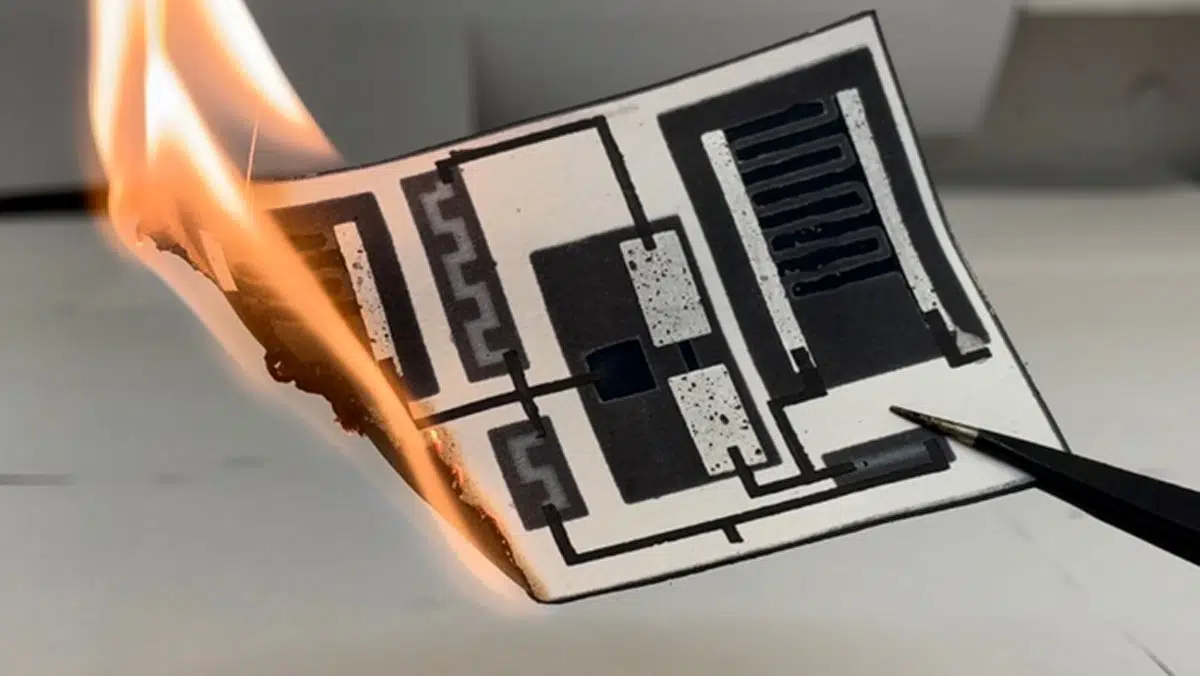
An electronic circuit printed on paper could be a more flexible and disposable option for single-use electronics.
Credit: Adapted from ACS Applied Materials & Interfaces 2022, DOI: 10.1021/acsami.2c13503

An electronic circuit printed on paper could be a more flexible and disposable option for single-use electronics. Credit: Adapted from ACS Applied Materials & Interfaces 2022, DOI: 10.1021/acsami.2c13503

Researchers from State University of New York at Binghamton reporting in ACS Applied Materials & Interfaces a prototype circuit board with fully integrated electrical components such as disposable resistors, supercapacitors or transistors on sheet of paper that can be burned or left to degrade.

Discarded electronic devices, such as cell phones, are a fast-growing source of waste. One way to mitigate the problem could be to use components that are made with renewable resources and that are easy to dispose of responsibly.

RelatedPosts

YAGEO Introduces 310VAC SMD Y2 Safety MP Capacitors for Compact EMI Filtering

DMASS: European Components Distribution Returns To Growth In Q1 2026

German Component Distribution Market Rebounds in Q1 2026 According to FBDi

Most small electronic devices contain circuit boards that are made from glass fibers, resins and metal wiring. These boards are not easy to recycle and are relatively bulky, making them undesirable for use in point-of-care medical devices, environmental monitors or personal wearable devices.

One alternative is to use paper-based circuit boards, which should be easier to dispose of, less expensive and more flexible. However, current options require specialized paper, or they simply have traditional metal circuitry components mounted onto a sheet of paper. Instead, Choi and colleagues wanted to develop circuitry that would be simple to manufacture and that had all the electronic components fully integrated into the sheet.  

The team designed a paper-based amplifier-type circuit that incorporated resistors, capacitors and a transistor. They first used wax to print channels onto a sheet of paper in a simple pattern. After melting the wax so that it soaked into the paper, the team printed semi-conductive and conductive inks, which soaked into the areas not blocked by wax. Then, the researchers screen-printed additional conductive metal components and casted a gel-based electrolyte onto the sheet.

Tests confirmed that the resistor, capacitor and transistor designs performed properly. The final circuit was very flexible and thin, just like paper, even after adding the components. To demonstrate the degradability of the circuit, the team showed that the entire unit quickly burned to ash after being lit on fire. The researchers say this represents a step toward producing completely disposable electronic devices.

Abstract

Humanity’s excessive production of material waste poses a critical environmental threat, and the problem is only escalating, especially in the past few decades with the rapid development of powerful electronic tools and persistent consumer desire to upgrade to the newest available technology. The poor disposability of electronics is especially an issue for the newly arising field of single-use devices and sensors, which are often used to evaluate human health and monitor environmental conditions, and for other novel applications. Though impressive in terms of function and convenience, usage of conventional electronic components in these applications would inflict an immense surge in waste and result in higher costs.

This work’s primary objective is to develop a cost-effective, eco-friendly, all-paper, device for single-use applications that can be easily and safely disposed of through incineration or biodegradation. All electronic components are paper-based and integrated on paper-based printed circuit boards (PCBs), innovatively providing a realistic and practical solution for green electronic platforms. In particular, a methodology is discussed for simultaneously achieving very tunable resistors (20 Ω to 285 kΩ), supercapacitors (∼3.29 mF), and electrolyte-gated field-effect transistors on and within the thickness of a single sheet of paper. Each electronic component is completely integrated into functionalized paper regions and exhibits favorable electrical activity, adjustability, flexibility, and disposability. A simple amplifier circuit is successfully demonstrated within a small area and within the thickness of a single sheet of paper, displaying component versatility and the capability for their fabrication processes to be performed in parallel for efficient and rapid development.

JOURNAL: ACS Applied Materials & Interfaces

DOI: 10.1021/acsami.2c13503 

ARTICLE TITLE: Integrated Papertronic Techniques: Highly Customizable Resistor, Supercapacitor, and Transistor Circuitry on a Single Sheet of Paper


Related

Source: American Chemical Society

Recent Posts

YAGEO Introduces 310VAC SMD Y2 Safety MP Capacitors for Compact EMI Filtering

16.6.2026
2

DMASS: European Components Distribution Returns To Growth In Q1 2026

16.6.2026
7

German Component Distribution Market Rebounds in Q1 2026 According to FBDi

16.6.2026
7

Nippon Chemi-Con Announces New Capacitor series for AI, Automotive and Immersion Cooling

16.6.2026
10

Ultrahigh Energy Storage in Lead‑Free BiFeO₃‑Based Ceramic Capacitors via Local Polar Structure Design

16.6.2026
12

Murata Expands Ansys Simulation Models for RF inductors, MLCCs, and Power Inductors

16.6.2026
9

Imec Presents High-density MIMCAP RF interposer for III-V chiplets

15.6.2026
22

Knowles Releases 3825 X1/Y2 Safety MLCCs for High‑Voltage Applications

11.6.2026
35

TAIYO YUDEN Releases 220uF 1210 Automotive MLCC

11.6.2026
49

Upcoming Events

Jul 14
16:00 - 17:00 CEST

EMC Design Essentials: Mastering Varistors and Common Mode Chokes

Jul 21
16:00 - 17:00 CEST

Safety by design: X and Y Interference suppression capacitors for power line filters

View Calendar

Popular Posts

  • Buck Converter Design and Calculation

    0 shares
    Share 0 Tweet 0
  • Boost Converter Design and Calculation

    0 shares
    Share 0 Tweet 0
  • LLC Resonant Converter Design and Calculation

    0 shares
    Share 0 Tweet 0
  • MLCC and Ceramic Capacitors

    0 shares
    Share 0 Tweet 0
  • Flyback Converter Design and Calculation

    0 shares
    Share 0 Tweet 0
  • Earthing Systems and IEC Classification Explained

    0 shares
    Share 0 Tweet 0
  • SEPIC Converter Design and Calculation

    0 shares
    Share 0 Tweet 0
  • Dual Active Bridge (DAB) Topology

    0 shares
    Share 0 Tweet 0
  • What Electronics Engineer Needs to Know About Passive Low Pass Filters

    0 shares
    Share 0 Tweet 0
  • MLCC Case Sizes Standards Explained

    0 shares
    Share 0 Tweet 0

Newsletter Subscription


Passive Components Blog

© EPCI - Leading Passive Components Educational and Information Site

  • Home
  • Privacy Policy
  • EPCI Membership & Advertisement
  • About

No Result
View All Result
  • Home
  • Knowledge Blog
  • Dossiers
  • PCNS

© EPCI - Leading Passive Components Educational and Information Site

This website uses cookies. By continuing to use this website you are giving consent to cookies being used. Visit our Privacy and Cookie Policy.
Go to mobile version