












Passive Components Blog
No Result
View All Result
  • Home
  • NewsFilter
    • All
    • Aerospace & Defence
    • Antenna
    • Applications
    • Automotive
    • Capacitors
    • Circuit Protection Devices
    • electro-mechanical news
    • Filters
    • Fuses
    • Inductors
    • Industrial
    • Integrated Passives
    • inter-connect news
    • Market & Supply Chain
    • Market Insights
    • Medical
    • Modelling and Simulation
    • New Materials & Supply
    • New Technologies
    • Non-linear Passives
    • Oscillators
    • Passive Sensors News
    • Resistors
    • RF & Microwave
    • Telecommunication
    • Weekly Digest

    Murata and Xona Partner on LEO Satellite Navigation for Industrial Applications

    Bourns Offers Custom Magnetics for 3‑Phase Flying Capacitor Inverters

    YAGEO Releases Cost Efficient Pt‑RTD Sensors with Ni wires

    Nvidia Vera Rubin: Why One AI Rack Needs So Many More MLCC Capacitors

    Stackpole Introduces 1400A Busbar Shunt Resistors

    Tecate Unveils High‑temp 105C Supercapacitors for Harsh‑Environment Designs

    Bourns Expands 1000V High‑Power Fuses for Semiconductor and Battery Protection

    Passive Components in 2026: From Invisible Commodity to Design Parameter

    Bourns Introduces High Current Chip Ferrite Beads for Dense Power Rails

    Trending Tags

    • Ripple Current
    • RF
    • Leakage Current
    • Tantalum vs Ceramic
    • Snubber
    • Low ESR
    • Feedthrough
    • Derating
    • Dielectric Constant
    • New Products
    • Market Reports
  • VideoFilter
    • All
    • Antenna videos
    • Capacitor videos
    • Circuit Protection Video
    • Filter videos
    • Fuse videos
    • Inductor videos
    • Inter-Connect Video
    • Non-linear passives videos
    • Oscillator videos
    • Passive sensors videos
    • Resistor videos

    Current Sense Transformer Datasheet and Design‑in Guide

    Designing a USB Type‑C Flyback Planar Transformer with Frenetic’s Planar Tool

    Magnetics Design in High‑Frequency GaN Converters

    Qi2 Wireless Charging: Inductors, Capacitors and EMC Filters

    Two‑capacitor paradox explained for engineers

    Capacitances of Nonlinear MLCCs: What Datasheets Don’t Tell You

    Tapped Inductor Buck Converter Fundamentals

    Planar vs Conventional Transformer: When it Make Sense

    Modeling Fringing Field Losses in Inductors & Transformers

    Trending Tags

    • Capacitors explained
    • Inductors explained
    • Resistors explained
    • Filters explained
    • Application Video Guidelines
    • EMC
    • New Products
    • Ripple Current
    • Simulation
    • Tantalum vs Ceramic
  • Knowledge Blog
  • DossiersNew
  • Suppliers
    • Who is Who
  • PCNS
    • PCNS 2025
    • PCNS 2023
    • PCNS 2021
    • PCNS 2019
    • PCNS 2017
  • Events
  • Home
  • NewsFilter
    • All
    • Aerospace & Defence
    • Antenna
    • Applications
    • Automotive
    • Capacitors
    • Circuit Protection Devices
    • electro-mechanical news
    • Filters
    • Fuses
    • Inductors
    • Industrial
    • Integrated Passives
    • inter-connect news
    • Market & Supply Chain
    • Market Insights
    • Medical
    • Modelling and Simulation
    • New Materials & Supply
    • New Technologies
    • Non-linear Passives
    • Oscillators
    • Passive Sensors News
    • Resistors
    • RF & Microwave
    • Telecommunication
    • Weekly Digest

    Murata and Xona Partner on LEO Satellite Navigation for Industrial Applications

    Bourns Offers Custom Magnetics for 3‑Phase Flying Capacitor Inverters

    YAGEO Releases Cost Efficient Pt‑RTD Sensors with Ni wires

    Nvidia Vera Rubin: Why One AI Rack Needs So Many More MLCC Capacitors

    Stackpole Introduces 1400A Busbar Shunt Resistors

    Tecate Unveils High‑temp 105C Supercapacitors for Harsh‑Environment Designs

    Bourns Expands 1000V High‑Power Fuses for Semiconductor and Battery Protection

    Passive Components in 2026: From Invisible Commodity to Design Parameter

    Bourns Introduces High Current Chip Ferrite Beads for Dense Power Rails

    Trending Tags

    • Ripple Current
    • RF
    • Leakage Current
    • Tantalum vs Ceramic
    • Snubber
    • Low ESR
    • Feedthrough
    • Derating
    • Dielectric Constant
    • New Products
    • Market Reports
  • VideoFilter
    • All
    • Antenna videos
    • Capacitor videos
    • Circuit Protection Video
    • Filter videos
    • Fuse videos
    • Inductor videos
    • Inter-Connect Video
    • Non-linear passives videos
    • Oscillator videos
    • Passive sensors videos
    • Resistor videos

    Current Sense Transformer Datasheet and Design‑in Guide

    Designing a USB Type‑C Flyback Planar Transformer with Frenetic’s Planar Tool

    Magnetics Design in High‑Frequency GaN Converters

    Qi2 Wireless Charging: Inductors, Capacitors and EMC Filters

    Two‑capacitor paradox explained for engineers

    Capacitances of Nonlinear MLCCs: What Datasheets Don’t Tell You

    Tapped Inductor Buck Converter Fundamentals

    Planar vs Conventional Transformer: When it Make Sense

    Modeling Fringing Field Losses in Inductors & Transformers

    Trending Tags

    • Capacitors explained
    • Inductors explained
    • Resistors explained
    • Filters explained
    • Application Video Guidelines
    • EMC
    • New Products
    • Ripple Current
    • Simulation
    • Tantalum vs Ceramic
  • Knowledge Blog
  • DossiersNew
  • Suppliers
    • Who is Who
  • PCNS
    • PCNS 2025
    • PCNS 2023
    • PCNS 2021
    • PCNS 2019
    • PCNS 2017
  • Events
No Result
View All Result
Passive Components Blog
No Result
View All Result

Electric Vehicle Technology Trends

18.4.2024
Reading Time: 5 mins read
A A

This article based on Knowles Precision Devices blog looks at three key trends impacting EV development that we are currently monitoring around shifting semiconductor development, in-vehicle system integration as a way to control costs, and the evolution of the EV charging ecosystem.

The market demands and technology trends that impact all aspects of electric vehicle (EV) development are constantly evolving. As trends change, so do the requirements for EV power systems, which impacts the demands placed on the components we supply.

RelatedPosts

Knowles Doubles Capacitance of its Class I Ceramic C0G Capacitors

Knowles Releases High Q Non-Magnetic X7R MLCCs for Medical Imaging

Knowles Unveils High-Performance Safety-Certified MLCC Capacitors

Trend 1: Shifting to Wide Band Gap Semiconductors

Consumer demands for longer range per charge and faster charging times are leading to EV power systems that must operate at higher voltages and temperatures. But as this shift happens, power system efficiency can’t suffer. In fact, battery systems must actually become more efficient. To increase efficiency of these high-voltage systems, we are starting to see a shift from using conventional silicon-based (Si) semiconductors to using wide-bandgap (WBG) semiconductors built with silicon carbide (SiC) or gallium nitride (GaN).

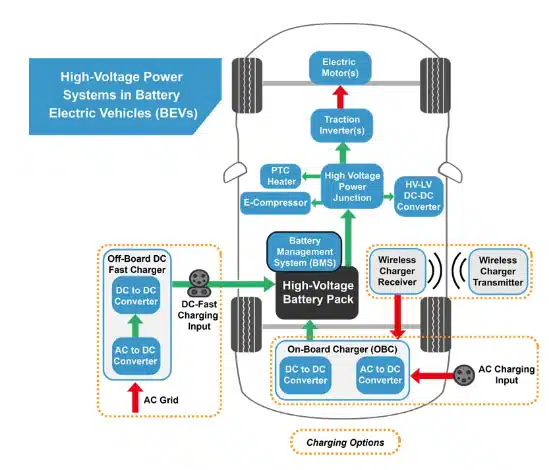
Currently, SiC-based WBG semiconductors are being used in applications such as inverters in 800V systems since these components enable higher switching frequencies and can help reduce the size and weight of the system. We are also seeing GaN-based semiconductors start to emerge as an option for lower-power systems such as the DC-DC converters that manage the auxiliary systems in the vehicle. If you look at this from the functional block diagram level (Figure 1), the table below shows how we see the device technology to WBG trend shaping up:

Functional Block FromTo
OBCIGBTSiC MOSFET, GaN HEMT
InverterIGBTSiC MOSFET
DC-DCIGBTSiC MOSFET, GaN HEMT
Figure 1. EV functional block diagram

While this shift is happening, researchers are of course already trying to further push limits as they work on developing ultra-WBG semiconductors. These semiconductors are poised to operate at even higher voltages and temperatures while being built using innovative materials that make them even smaller and lighter. It will be exciting to keep an eye on these developments and what will be possible in the near future with these components!

Trend 2: Integrating In-Vehicle Systems

Like most industries, EV manufacturers feel the pressure to reduce costs, even as they push the limits of what vehicles are capable of. Integration, or the combining of individual subsystems (functions from the EV block diagram in Figure 1) together into multi-function modules, is now a growing trend to help curb costs. Below are three in-vehicle systems where integration is starting to (or will likely start to) play a key role:

  • Configuring bidirectional charging, which enables vehicle-to-home (V2H) and vehicle-to-grid (V2G) charging (discussed more below)
  • Combining the onboard charger (OBC) and the DC-DC converter into a single unit that is smaller and lighter while offering increased power density
  • Incorporating all-in-one power systems such as an 8-in-1 power system that combines many key components of the electric drive train into a single module

Looking back at the first trend we discussed around WBG semiconductors, you can see how we feel these two trends tie together in the table below:

ThemeFromTo
Device TechnologyIGBTSiC MOSFET, GaN HEMT
Voltage Level650 (for 400V Systems)1200V (for 800V systems)
IntegrationIndividual SubsystemsHighly Integrated Systems

Trend 3: Boosting the EV Charging Ecosystem

As we all know, charging is a key part of the EV ecosystem – without sufficient charging, EVs simply don’t work. But charging is no longer as simple as having a means to plug in the vehicle and get it juiced up. There are a lot of market and societal demands EV engineers must also consider that range from rapid charging, especially when people are on the go, to the desire to use the energy generated from charging more efficiently. As a result, we are seeing several in-vehicle changes starting with the big shift from 400V to 800V systems, which is necessary for rapid charging to become a reality.

Looking at ways to use the energy generated from vehicle charging more efficiently, especially excess energy, there are a few key parts of this trend. As mentioned above, V2H and V2G are bidirectional charging methods that can further proliferate the sustainability benefits of EVs beyond the vehicle. In a V2H application, the EV battery acts as a mobile power bank that can supply a person’s home with electricity during peak hours. A V2G scenario is similar except the energy can be fed back to the grid to help balance energy fluctuations and promote grid sustainability. And similarly, there is also a demand from consumers around the concept of “green mobility,” where the EV, the EV charger, and renewable energy sources are all integrated on the grid to avoid using electricity generated from coal to charge vehicles. 

Related

Source: Knowles Precision Devices

Recent Posts

Murata and Xona Partner on LEO Satellite Navigation for Industrial Applications

3.6.2026
13

Nvidia Vera Rubin: Why One AI Rack Needs So Many More MLCC Capacitors

2.6.2026
52

Passive Components in 2026: From Invisible Commodity to Design Parameter

2.6.2026
21

May 2026 Interconnect, Passives and Electromechanical Components Market Insights

29.5.2026
94

ECIA Industry Pulse April 2026: Sentiment Cools but Stays Strong

21.5.2026
71

Industrial Passive Components Markets and Technologies 2026

21.5.2026
154

Automotive Passive Components Technology Dossier

21.5.2026
85

Samsung Electro-Mechanics Signs 1.5T KRW Silicon Capacitor AI Contract

21.5.2026
125

Murata Expands Thermistor Production Capacity at Yokaichi Plant

21.5.2026
49

Upcoming Events

Jun 16
16:00 - 17:00 CEST

EMC with EMC – EMC‑compliant design with electromechanical connectors

View Calendar

Popular Posts

  • Buck Converter Design and Calculation

    0 shares
    Share 0 Tweet 0
  • Boost Converter Design and Calculation

    0 shares
    Share 0 Tweet 0
  • Flyback Converter Design and Calculation

    0 shares
    Share 0 Tweet 0
  • MLCC and Ceramic Capacitors

    0 shares
    Share 0 Tweet 0
  • LLC Resonant Converter Design and Calculation

    0 shares
    Share 0 Tweet 0
  • Capacitor Charging and Discharging

    0 shares
    Share 0 Tweet 0
  • What Electronics Engineer Needs to Know About Passive Low Pass Filters

    0 shares
    Share 0 Tweet 0
  • Dual Active Bridge (DAB) Topology

    0 shares
    Share 0 Tweet 0
  • Ripple Current and its Effects on the Performance of Capacitors

    3 shares
    Share 3 Tweet 0
  • SEPIC Converter Design and Calculation

    0 shares
    Share 0 Tweet 0

Newsletter Subscription


Passive Components Blog

© EPCI - Leading Passive Components Educational and Information Site

  • Home
  • Privacy Policy
  • EPCI Membership & Advertisement
  • About

No Result
View All Result
  • Home
  • Knowledge Blog
  • Dossiers
  • PCNS

© EPCI - Leading Passive Components Educational and Information Site

This website uses cookies. By continuing to use this website you are giving consent to cookies being used. Visit our Privacy and Cookie Policy.
Go to mobile version