






Passive Components Blog
No Result
View All Result
  • Home
  • NewsFilter
    • All
    • Aerospace & Defence
    • Antenna
    • Applications
    • Automotive
    • Capacitors
    • Circuit Protection Devices
    • electro-mechanical news
    • Filters
    • Fuses
    • Inductors
    • Industrial
    • Integrated Passives
    • inter-connect news
    • Market & Supply Chain
    • Market Insights
    • Medical
    • Modelling and Simulation
    • New Materials & Supply
    • New Technologies
    • Non-linear Passives
    • Oscillators
    • Passive Sensors News
    • Resistors
    • RF & Microwave
    • Telecommunication
    • Weekly Digest

    Murata Publishes Power Delivery Guide for AI Servers

    Selecting Current Sense Transformers with Würth Elektronik REDEXPERT

    Mechanical Drift Indicator of Tantalum Capacitor Anodes Degradation under Reverse Bias

    Enabling Software‑Defined Vehicle Architectures: Automotive Ethernet and Zonal Smart Power

    Calculating Resistance Value of a Flyback RC Snubber 

    Wk 5 Electronics Supply Chain Digest

    Top 10 Connector Vendors by Product Type

    Bourns Releases High‑Q Air Coil Inductors for RF Aplications

    CMSE 2026 Announces Call for Presentations on High-Reliability Military and Space Electronics

    Trending Tags

    • Ripple Current
    • RF
    • Leakage Current
    • Tantalum vs Ceramic
    • Snubber
    • Low ESR
    • Feedthrough
    • Derating
    • Dielectric Constant
    • New Products
    • Market Reports
  • VideoFilter
    • All
    • Antenna videos
    • Capacitor videos
    • Circuit Protection Video
    • Filter videos
    • Fuse videos
    • Inductor videos
    • Inter-Connect Video
    • Non-linear passives videos
    • Oscillator videos
    • Passive sensors videos
    • Resistor videos

    Enabling Software‑Defined Vehicle Architectures: Automotive Ethernet and Zonal Smart Power

    Calculating Resistance Value of a Flyback RC Snubber 

    One‑Pulse Characterization of Nonlinear Power Inductors

    Thermistor Linearization Challenges

    Coaxial Connectors and How to Connect with PCB

    PCB Manufacturing, Test Methods, Quality and Reliability

    Transformer Behavior – Current Transfer and Hidden Feedback

    Choosing the Right Capacitor: The Importance of Accurate Measurements

    RF Inductors: Selection and Design Challenges for High-Frequency Circuits

    Trending Tags

    • Capacitors explained
    • Inductors explained
    • Resistors explained
    • Filters explained
    • Application Video Guidelines
    • EMC
    • New Products
    • Ripple Current
    • Simulation
    • Tantalum vs Ceramic
  • Knowledge Blog
  • DossiersNew
  • Suppliers
    • Who is Who
  • PCNS
    • PCNS 2025
    • PCNS 2023
    • PCNS 2021
    • PCNS 2019
    • PCNS 2017
  • Events
  • Home
  • NewsFilter
    • All
    • Aerospace & Defence
    • Antenna
    • Applications
    • Automotive
    • Capacitors
    • Circuit Protection Devices
    • electro-mechanical news
    • Filters
    • Fuses
    • Inductors
    • Industrial
    • Integrated Passives
    • inter-connect news
    • Market & Supply Chain
    • Market Insights
    • Medical
    • Modelling and Simulation
    • New Materials & Supply
    • New Technologies
    • Non-linear Passives
    • Oscillators
    • Passive Sensors News
    • Resistors
    • RF & Microwave
    • Telecommunication
    • Weekly Digest

    Murata Publishes Power Delivery Guide for AI Servers

    Selecting Current Sense Transformers with Würth Elektronik REDEXPERT

    Mechanical Drift Indicator of Tantalum Capacitor Anodes Degradation under Reverse Bias

    Enabling Software‑Defined Vehicle Architectures: Automotive Ethernet and Zonal Smart Power

    Calculating Resistance Value of a Flyback RC Snubber 

    Wk 5 Electronics Supply Chain Digest

    Top 10 Connector Vendors by Product Type

    Bourns Releases High‑Q Air Coil Inductors for RF Aplications

    CMSE 2026 Announces Call for Presentations on High-Reliability Military and Space Electronics

    Trending Tags

    • Ripple Current
    • RF
    • Leakage Current
    • Tantalum vs Ceramic
    • Snubber
    • Low ESR
    • Feedthrough
    • Derating
    • Dielectric Constant
    • New Products
    • Market Reports
  • VideoFilter
    • All
    • Antenna videos
    • Capacitor videos
    • Circuit Protection Video
    • Filter videos
    • Fuse videos
    • Inductor videos
    • Inter-Connect Video
    • Non-linear passives videos
    • Oscillator videos
    • Passive sensors videos
    • Resistor videos

    Enabling Software‑Defined Vehicle Architectures: Automotive Ethernet and Zonal Smart Power

    Calculating Resistance Value of a Flyback RC Snubber 

    One‑Pulse Characterization of Nonlinear Power Inductors

    Thermistor Linearization Challenges

    Coaxial Connectors and How to Connect with PCB

    PCB Manufacturing, Test Methods, Quality and Reliability

    Transformer Behavior – Current Transfer and Hidden Feedback

    Choosing the Right Capacitor: The Importance of Accurate Measurements

    RF Inductors: Selection and Design Challenges for High-Frequency Circuits

    Trending Tags

    • Capacitors explained
    • Inductors explained
    • Resistors explained
    • Filters explained
    • Application Video Guidelines
    • EMC
    • New Products
    • Ripple Current
    • Simulation
    • Tantalum vs Ceramic
  • Knowledge Blog
  • DossiersNew
  • Suppliers
    • Who is Who
  • PCNS
    • PCNS 2025
    • PCNS 2023
    • PCNS 2021
    • PCNS 2019
    • PCNS 2017
  • Events
No Result
View All Result
Passive Components Blog
No Result
View All Result

Empower Announces E-CAP™: The Highest Performance, Smallest Size, and Most Configurable Capacitor Technology Platform

13.7.2022
Reading Time: 3 mins read
A A

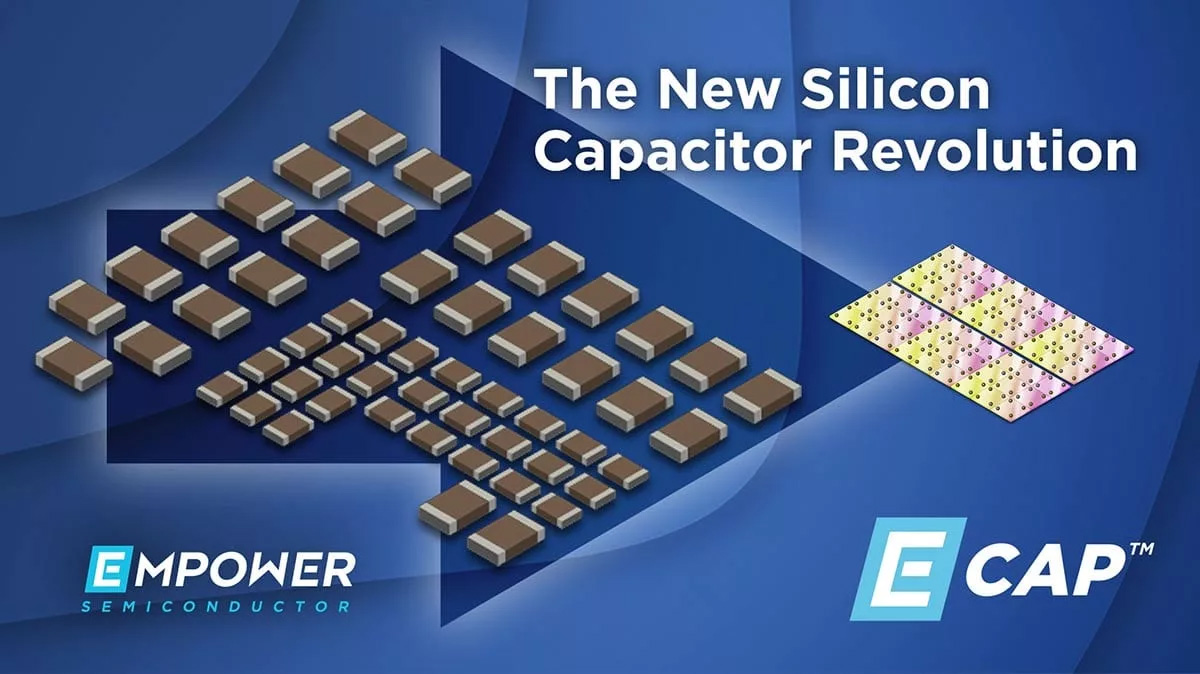
Empower Semiconductor, the world leader in Integrated Voltage Regulators (IVR), today announced a breakthrough with the highest performance, most configurable, and smallest commercially available range of capacitors. E-CAP™ is a vastly superior performing capacitor, far exceeding the semiconductor industry’s previously leading Multi-Layer Ceramic Capacitors (MLCC).

The capacitor is one of the most basic and fundamental components in electronics needed for energy storage and supply voltage filtering.  The capacitor industry has not progressed nearly at the rate that all other electronic technologies have or as the semiconductor world needs.  Currently the leading technology is in MLCCs, but they are space limiting, inefficient, unreliable, and low performing.  Empower Semiconductor is changing all of that with the introduction of E-CAP™. It is the most exciting advancement for capacitors in decades as it enables new possibilities for today’s applications due to the incredible size reduction, performance increase, and improved reliability.

RelatedPosts

Empower’s Low ESL 1pH Silicon Capacitor Meets Tight AI Chip Requirements

Empower E-CAP Silicon Capacitors vs MLCC

Empower Boost Silicon Capacitor Performance 

“We like to achieve power management innovation at Empower and our team always targets knocking down technology barriers to enable the next generation of applications.  We have had tremendous customer demand and interest in the game-changing technology of the Empower IVR™ power ICs and now, once again, with our breakthrough of re-imagining the capacitor” said Steve Shultis, Senior Vice President WW Sales and Marketing at Empower Semiconductor.  “During the development of our EP70XX IVR, we determined that off-the-shelf capacitor technology was not good enough for demanding applications. As a result, we re-designed it with the performance we required in size and flexibility.  We are excited to make this technology available to our partners.”

With game-changing capacitor density and flexibility, E-CAP™ technology allows for groups of varying capacitor values and sizes to be integrated onto a single die. Space critical applications that cannot afford to have a sea of capacitors spaced out can be realized with E-CAP™.  Height limited applications are also addressed with the capability of much less than 100µm in thickness.  This tiny die format allows for footprints that are 80% smaller than equivalent MLCC based solutions.

E-CAP™ technology features superior stability with no DC or AC bias de-rating, no temperature de-rating, and no significant effects of aging. Combined with the ultra-low ESL (15pH), E-CAP™ provides a highly simplified and reliable solution to the system designer.  This highly differentiated high-performance technology is available in configurations up to 8.4µF.

Empower’s EP70XX IVR family, which is known for its superior performance and unmatched power density, was the first application for E-CAP™. Empower has mastered the expertise of leveraging the superior characteristics of the technology to provide its size benefits to a variety of implementations such as die, package, and PCB substrates. The performance benefits allow higher power efficiency to be achieved due to the superior voltage filtering for better SoC/CPU voltage accuracy during load transients

E-CAP™ opens up demanding new applications in IoT, wearables, mobile, and processors where size, performance, and flexibility are essential.  
Related

Source: Empower

Recent Posts

Murata Publishes Power Delivery Guide for AI Servers

4.2.2026
8

Mechanical Drift Indicator of Tantalum Capacitor Anodes Degradation under Reverse Bias

3.2.2026
15

Enabling Software‑Defined Vehicle Architectures: Automotive Ethernet and Zonal Smart Power

2.2.2026
18

CMSE 2026 Announces Call for Presentations on High-Reliability Military and Space Electronics

28.1.2026
46

ESA Call for Papers 6th Space Passive Component Days – SPCD 2026

28.1.2026
42

Exxelia Publishes Micropen White Papers for Printed Electronics

26.1.2026
33

Samsung Q4 2025 Results: MLCC focus for AI, Server and Automotive

26.1.2026
99

Capacitor Technology Dossier

26.1.2026
140

Passive Components in Quantum Computing

22.1.2026
152

Upcoming Events

Feb 24
16:00 - 17:00 CET

Designing Qi2 Wireless Power Systems: Practical Development and EMC Optimization

Mar 3
16:00 - 17:00 CET

Cybersecurity at the Eleventh Hour – from RED to CRA – Information and Discussion

Mar 21
All day

PSMA Capacitor Workshop 2026

View Calendar

Popular Posts

  • Buck Converter Design and Calculation

    0 shares
    Share 0 Tweet 0
  • Boost Converter Design and Calculation

    0 shares
    Share 0 Tweet 0
  • LLC Resonant Converter Design and Calculation

    0 shares
    Share 0 Tweet 0
  • Flyback Converter Design and Calculation

    0 shares
    Share 0 Tweet 0
  • Ripple Current and its Effects on the Performance of Capacitors

    3 shares
    Share 3 Tweet 0
  • How Metal Prices Are Driving Passive Component Price Hikes

    0 shares
    Share 0 Tweet 0
  • MLCC and Ceramic Capacitors

    0 shares
    Share 0 Tweet 0
  • Dual Active Bridge (DAB) Topology

    0 shares
    Share 0 Tweet 0
  • What is a Dielectric Constant and DF of Plastic Materials?

    4 shares
    Share 4 Tweet 0
  • Degradation of Capacitors and its Failure Mechanisms

    0 shares
    Share 0 Tweet 0

Newsletter Subscription


Passive Components Blog

© EPCI - Leading Passive Components Educational and Information Site

  • Home
  • Privacy Policy
  • EPCI Membership & Advertisement
  • About

No Result
View All Result
  • Home
  • Knowledge Blog
  • PCNS

© EPCI - Leading Passive Components Educational and Information Site

This website uses cookies. By continuing to use this website you are giving consent to cookies being used. Visit our Privacy and Cookie Policy.
Go to mobile version