












Passive Components Blog
No Result
View All Result
  • Home
  • NewsFilter
    • All
    • Aerospace & Defence
    • Antenna
    • Applications
    • Automotive
    • Capacitors
    • Circuit Protection Devices
    • electro-mechanical news
    • Filters
    • Fuses
    • Inductors
    • Industrial
    • Integrated Passives
    • inter-connect news
    • Market & Supply Chain
    • Market Insights
    • Medical
    • Modelling and Simulation
    • New Materials & Supply
    • New Technologies
    • Non-linear Passives
    • Oscillators
    • Passive Sensors News
    • Resistors
    • RF & Microwave
    • Telecommunication
    • Weekly Digest

    CMSE 2026 Announces Call for Presentations on High-Reliability Military and Space Electronics

    ESA Call for Papers 6th Space Passive Component Days – SPCD 2026

    Würth Elektronik Offers Halogen‑Free EMC Gaskets for Displays and Housings

    Component Distribution Supply Chain January 2026

    Binder Unveils M8 Flange Solder Connectors for Flexible Cabling

    Power Electronics Tools for Passives and Magnetic Designs

    Modelithics Releases Component Model Library for SIMULIA CST Studio Suite

    Exxelia Publishes Micropen White Papers for Printed Electronics

    Stackpole Releases AlN High‑Power Thick Film Chip Resistors

    Trending Tags

    • Ripple Current
    • RF
    • Leakage Current
    • Tantalum vs Ceramic
    • Snubber
    • Low ESR
    • Feedthrough
    • Derating
    • Dielectric Constant
    • New Products
    • Market Reports
  • VideoFilter
    • All
    • Antenna videos
    • Capacitor videos
    • Circuit Protection Video
    • Filter videos
    • Fuse videos
    • Inductor videos
    • Inter-Connect Video
    • Non-linear passives videos
    • Oscillator videos
    • Passive sensors videos
    • Resistor videos

    One‑Pulse Characterization of Nonlinear Power Inductors

    Thermistor Linearization Challenges

    Coaxial Connectors and How to Connect with PCB

    PCB Manufacturing, Test Methods, Quality and Reliability

    Transformer Behavior – Current Transfer and Hidden Feedback

    Choosing the Right Capacitor: The Importance of Accurate Measurements

    RF Inductors: Selection and Design Challenges for High-Frequency Circuits

    Transformer Safety IEC 61558 Standard

    3-Phase EMI Filter Design, Simulation, Calculation and Test

    Trending Tags

    • Capacitors explained
    • Inductors explained
    • Resistors explained
    • Filters explained
    • Application Video Guidelines
    • EMC
    • New Products
    • Ripple Current
    • Simulation
    • Tantalum vs Ceramic
  • Knowledge Blog
  • DossiersNew
  • Suppliers
    • Who is Who
  • PCNS
    • PCNS 2025
    • PCNS 2023
    • PCNS 2021
    • PCNS 2019
    • PCNS 2017
  • Events
  • Home
  • NewsFilter
    • All
    • Aerospace & Defence
    • Antenna
    • Applications
    • Automotive
    • Capacitors
    • Circuit Protection Devices
    • electro-mechanical news
    • Filters
    • Fuses
    • Inductors
    • Industrial
    • Integrated Passives
    • inter-connect news
    • Market & Supply Chain
    • Market Insights
    • Medical
    • Modelling and Simulation
    • New Materials & Supply
    • New Technologies
    • Non-linear Passives
    • Oscillators
    • Passive Sensors News
    • Resistors
    • RF & Microwave
    • Telecommunication
    • Weekly Digest

    CMSE 2026 Announces Call for Presentations on High-Reliability Military and Space Electronics

    ESA Call for Papers 6th Space Passive Component Days – SPCD 2026

    Würth Elektronik Offers Halogen‑Free EMC Gaskets for Displays and Housings

    Component Distribution Supply Chain January 2026

    Binder Unveils M8 Flange Solder Connectors for Flexible Cabling

    Power Electronics Tools for Passives and Magnetic Designs

    Modelithics Releases Component Model Library for SIMULIA CST Studio Suite

    Exxelia Publishes Micropen White Papers for Printed Electronics

    Stackpole Releases AlN High‑Power Thick Film Chip Resistors

    Trending Tags

    • Ripple Current
    • RF
    • Leakage Current
    • Tantalum vs Ceramic
    • Snubber
    • Low ESR
    • Feedthrough
    • Derating
    • Dielectric Constant
    • New Products
    • Market Reports
  • VideoFilter
    • All
    • Antenna videos
    • Capacitor videos
    • Circuit Protection Video
    • Filter videos
    • Fuse videos
    • Inductor videos
    • Inter-Connect Video
    • Non-linear passives videos
    • Oscillator videos
    • Passive sensors videos
    • Resistor videos

    One‑Pulse Characterization of Nonlinear Power Inductors

    Thermistor Linearization Challenges

    Coaxial Connectors and How to Connect with PCB

    PCB Manufacturing, Test Methods, Quality and Reliability

    Transformer Behavior – Current Transfer and Hidden Feedback

    Choosing the Right Capacitor: The Importance of Accurate Measurements

    RF Inductors: Selection and Design Challenges for High-Frequency Circuits

    Transformer Safety IEC 61558 Standard

    3-Phase EMI Filter Design, Simulation, Calculation and Test

    Trending Tags

    • Capacitors explained
    • Inductors explained
    • Resistors explained
    • Filters explained
    • Application Video Guidelines
    • EMC
    • New Products
    • Ripple Current
    • Simulation
    • Tantalum vs Ceramic
  • Knowledge Blog
  • DossiersNew
  • Suppliers
    • Who is Who
  • PCNS
    • PCNS 2025
    • PCNS 2023
    • PCNS 2021
    • PCNS 2019
    • PCNS 2017
  • Events
No Result
View All Result
Passive Components Blog
No Result
View All Result

Fuse Function of PP Capacitors Segmented Film Explained

6.1.2022
Reading Time: 4 mins read
A A

The article explains safe built-in fuse function technology of segmented metallized PP dielectric films utilized in Panasonic Industry’s box type film capacitors.

When speaking about a device’s overall reliability, we know that is first and foremost a question of the components it is consisting of. Next to the ability of withstanding rough operational conditions such as vibrations and shocks, it is high voltage stress that can pose a severe risk of damage to components such as capacitors in high power designs – as found in automotive applications, industrial power supplies, DC/DC, AC/DC converters, solar inverters and many more.

RelatedPosts

Conductive Polymer Capacitor Market and Design‑In Guide to 2035

Panasonic Passive Components for Reliable Robotic Arms

Panasonic Releases Compact Tactile Switch with 3N Operation Force and 500K Cycles Life

In those contexts, high voltage stress cannot be abolished – but there are to avoid overall and fatal product failure: The fuse function is an integral part of the Panasonic Industry Film Capacitor technology which is worth a closer look for everyone designing next-gen high voltage applications.

Film Caps – a brief clarification on the basic principle

Film capacitors, commonly also known as plastic film capacitors, or polymer film capacitors, are electrical capacitors utilizing an insulating plastic film as the dielectric. The dielectric film materials vary depending on required dielectric strength, primarily Polypropylene (PP), Polyester (PET), Polyphenylene sulfide (PPS) etc. The electrodes could be metallized aluminum, zinc or Al-Zn alloy applied directly to the surface of the plastic.
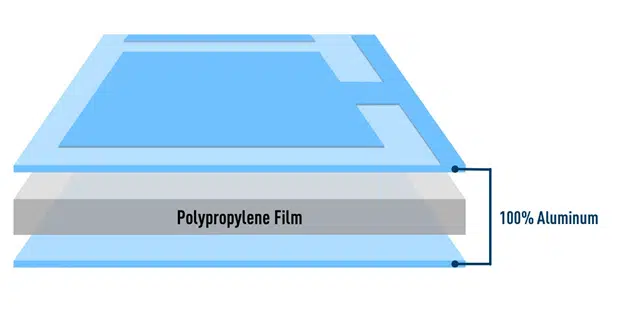
Figure 1. Basic principle of polypropylene film capacitor with segmented metallization; source: Panasonic Industry

Film Caps – and the benefits of self-healing

To a certain but remarkable extent, metallized film capacitors have the ability to “repair” themselves. This so called “self-healing” ability applies when a capacitor with metallized films has the foils exposed to each other due to dielectric breakdown under voltage stress. The combination of the foils’ thinness and the high energy density at the damaged area causes the foils to vaporize – and the capacitor stays in operation. However, when too many of such damaged areas fail in a very short period of time, metallized film capacitors short circuit upon failure. In pursuit of higher safety and higher reliability for most of the industries’ innovations, the market correspondingly shows an increased demand for film capacitors to also open upon failure.

Better safe – built-in fuse function with patterned metallization

Specific patterned metallization technology – better known as “fuse function” emerges from a segmented thin layer of vapor deposited aluminum.  

Those segments isolate the failure caused by overvoltage, therefore the damage is only encapsulated in a few areas of the capacitor. In case too many of those areas fail in a very short period of time, the capacitor will then open in a safe manner.
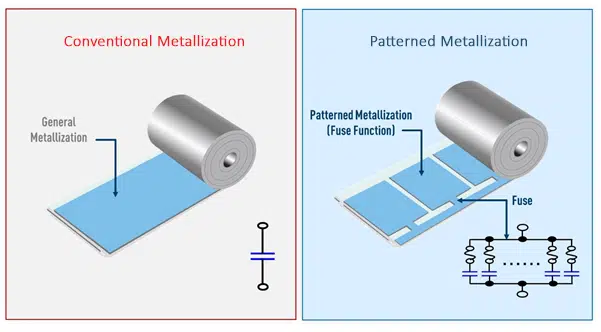
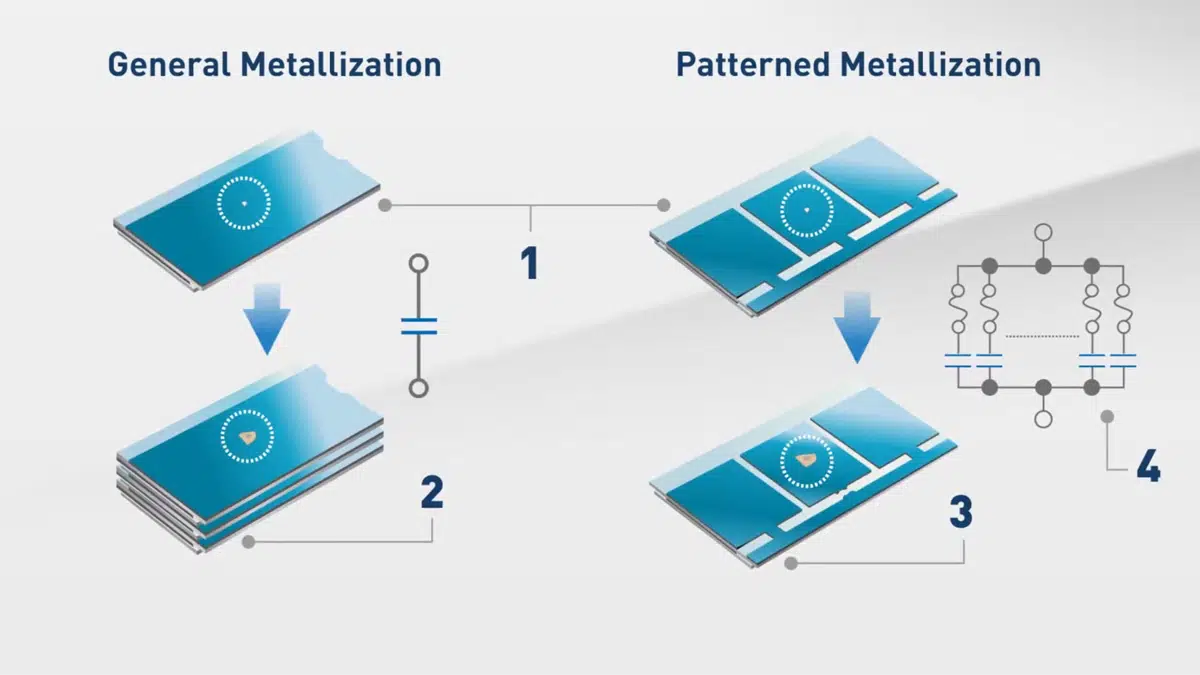
Figure 2. Comparison of conventional (left) and patterned metallization with fuse function (right); source: Panasonic Industry

A comparison

The difference is apparent: When “treating” dielectric material with high- or overvoltage, the un-patterned version reveals a far more severe damage than the patterned fuse function film cap concept.
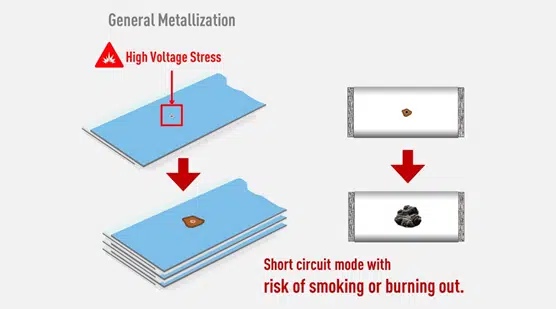
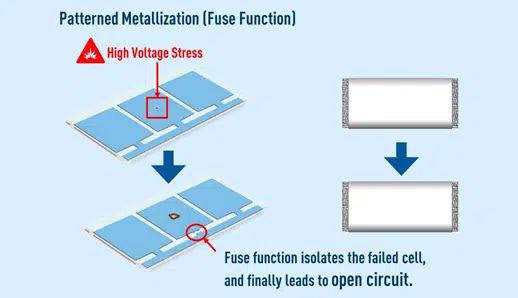
Figure 3. High voltage stress applied to dielectric material with conventional metallization; source: Panasonic Industry
Figure 4. High voltage stress applied to dielectric material with patterned fuse function ; source: Panasonic Industry

This patterned built-in fuse function should be a core criterion for everyone involved in high voltage application design and looking for the ideal type of capacitor. Or – shortly said: Better patterned than sorry!

To have a closer look, you can watch Panasonic Industry’s comparison in motion:

Related

Recent Posts

CMSE 2026 Announces Call for Presentations on High-Reliability Military and Space Electronics

28.1.2026
13

ESA Call for Papers 6th Space Passive Component Days – SPCD 2026

28.1.2026
14

Power Electronics Tools for Passives and Magnetic Designs

27.1.2026
28

Samsung Q4 2025 Results: MLCC focus for AI, Server and Automotive

26.1.2026
45

Capacitor Technology Dossier

26.1.2026
68

Passive Components in Quantum Computing

22.1.2026
118

Miniaturization of MLCCs and Electrolytics, KAVX Tech Chat

21.1.2026
66

Researchers Demonstrated 32nm Aluminum Vacuum Gap Capacitor

20.1.2026
38

Conductive Polymer Capacitor Market and Design‑In Guide to 2035

20.1.2026
135

Upcoming Events

Feb 24
16:00 - 17:00 CET

Designing Qi2 Wireless Power Systems: Practical Development and EMC Optimization

Mar 3
16:00 - 17:00 CET

Cybersecurity at the Eleventh Hour – from RED to CRA – Information and Discussion

Mar 21
All day

PSMA Capacitor Workshop 2026

View Calendar

Popular Posts

  • Buck Converter Design and Calculation

    0 shares
    Share 0 Tweet 0
  • Boost Converter Design and Calculation

    0 shares
    Share 0 Tweet 0
  • LLC Resonant Converter Design and Calculation

    0 shares
    Share 0 Tweet 0
  • Flyback Converter Design and Calculation

    0 shares
    Share 0 Tweet 0
  • Ripple Current and its Effects on the Performance of Capacitors

    3 shares
    Share 3 Tweet 0
  • How Metal Prices Are Driving Passive Component Price Hikes

    0 shares
    Share 0 Tweet 0
  • MLCC and Ceramic Capacitors

    0 shares
    Share 0 Tweet 0
  • Dual Active Bridge (DAB) Topology

    0 shares
    Share 0 Tweet 0
  • Degradation of Capacitors and its Failure Mechanisms

    0 shares
    Share 0 Tweet 0
  • What is a Dielectric Constant and DF of Plastic Materials?

    4 shares
    Share 4 Tweet 0

Newsletter Subscription


Passive Components Blog

© EPCI - Leading Passive Components Educational and Information Site

  • Home
  • Privacy Policy
  • EPCI Membership & Advertisement
  • About

No Result
View All Result
  • Home
  • Knowledge Blog
  • PCNS

© EPCI - Leading Passive Components Educational and Information Site

This website uses cookies. By continuing to use this website you are giving consent to cookies being used. Visit our Privacy and Cookie Policy.
Go to mobile version