



Passive Components Blog
No Result
View All Result
  • Home
  • NewsFilter
    • All
    • Aerospace & Defence
    • Antenna
    • Applications
    • Automotive
    • Capacitors
    • Circuit Protection Devices
    • electro-mechanical news
    • Filters
    • Fuses
    • Inductors
    • Industrial
    • Integrated Passives
    • inter-connect news
    • Market & Supply Chain
    • Market Insights
    • Medical
    • Modelling and Simulation
    • New Materials & Supply
    • New Technologies
    • Non-linear Passives
    • Oscillators
    • Passive Sensors News
    • Resistors
    • RF & Microwave
    • Telecommunication
    • Weekly Digest

    Magnetics Design in High‑Frequency GaN Converters

    ECIA Industry Pulse April 2026: Sentiment Cools but Stays Strong

    Industrial Passive Components Markets and Technologies 2026

    Automotive Passive Components Technology Dossier

    Samsung Electro-Mechanics Signs 1.5T KRW Silicon Capacitor AI Contract

    Murata Expands Thermistor Production Capacity at Yokaichi Plant

    Hirose Expands Compact High‑Voltage EV connectors

    Qi2 Wireless Charging: Inductors, Capacitors and EMC Filters

    Samsung Introduced Low ESL 3-Terminal Reverse-Geometry MLCCs for High-Performance ADAS

    Trending Tags

    • Ripple Current
    • RF
    • Leakage Current
    • Tantalum vs Ceramic
    • Snubber
    • Low ESR
    • Feedthrough
    • Derating
    • Dielectric Constant
    • New Products
    • Market Reports
  • VideoFilter
    • All
    • Antenna videos
    • Capacitor videos
    • Circuit Protection Video
    • Filter videos
    • Fuse videos
    • Inductor videos
    • Inter-Connect Video
    • Non-linear passives videos
    • Oscillator videos
    • Passive sensors videos
    • Resistor videos

    Magnetics Design in High‑Frequency GaN Converters

    Qi2 Wireless Charging: Inductors, Capacitors and EMC Filters

    Two‑capacitor paradox explained for engineers

    Capacitances of Nonlinear MLCCs: What Datasheets Don’t Tell You

    Tapped Inductor Buck Converter Fundamentals

    Planar vs Conventional Transformer: When it Make Sense

    Modeling Fringing Field Losses in Inductors & Transformers

    Why Power Inductors Use a Ferrite Core With an Air Gap

    Transformer-Based Power-Line Harvester Magnetic Design

    Trending Tags

    • Capacitors explained
    • Inductors explained
    • Resistors explained
    • Filters explained
    • Application Video Guidelines
    • EMC
    • New Products
    • Ripple Current
    • Simulation
    • Tantalum vs Ceramic
  • Knowledge Blog
  • DossiersNew
  • Suppliers
    • Who is Who
  • PCNS
    • PCNS 2025
    • PCNS 2023
    • PCNS 2021
    • PCNS 2019
    • PCNS 2017
  • Events
  • Home
  • NewsFilter
    • All
    • Aerospace & Defence
    • Antenna
    • Applications
    • Automotive
    • Capacitors
    • Circuit Protection Devices
    • electro-mechanical news
    • Filters
    • Fuses
    • Inductors
    • Industrial
    • Integrated Passives
    • inter-connect news
    • Market & Supply Chain
    • Market Insights
    • Medical
    • Modelling and Simulation
    • New Materials & Supply
    • New Technologies
    • Non-linear Passives
    • Oscillators
    • Passive Sensors News
    • Resistors
    • RF & Microwave
    • Telecommunication
    • Weekly Digest

    Magnetics Design in High‑Frequency GaN Converters

    ECIA Industry Pulse April 2026: Sentiment Cools but Stays Strong

    Industrial Passive Components Markets and Technologies 2026

    Automotive Passive Components Technology Dossier

    Samsung Electro-Mechanics Signs 1.5T KRW Silicon Capacitor AI Contract

    Murata Expands Thermistor Production Capacity at Yokaichi Plant

    Hirose Expands Compact High‑Voltage EV connectors

    Qi2 Wireless Charging: Inductors, Capacitors and EMC Filters

    Samsung Introduced Low ESL 3-Terminal Reverse-Geometry MLCCs for High-Performance ADAS

    Trending Tags

    • Ripple Current
    • RF
    • Leakage Current
    • Tantalum vs Ceramic
    • Snubber
    • Low ESR
    • Feedthrough
    • Derating
    • Dielectric Constant
    • New Products
    • Market Reports
  • VideoFilter
    • All
    • Antenna videos
    • Capacitor videos
    • Circuit Protection Video
    • Filter videos
    • Fuse videos
    • Inductor videos
    • Inter-Connect Video
    • Non-linear passives videos
    • Oscillator videos
    • Passive sensors videos
    • Resistor videos

    Magnetics Design in High‑Frequency GaN Converters

    Qi2 Wireless Charging: Inductors, Capacitors and EMC Filters

    Two‑capacitor paradox explained for engineers

    Capacitances of Nonlinear MLCCs: What Datasheets Don’t Tell You

    Tapped Inductor Buck Converter Fundamentals

    Planar vs Conventional Transformer: When it Make Sense

    Modeling Fringing Field Losses in Inductors & Transformers

    Why Power Inductors Use a Ferrite Core With an Air Gap

    Transformer-Based Power-Line Harvester Magnetic Design

    Trending Tags

    • Capacitors explained
    • Inductors explained
    • Resistors explained
    • Filters explained
    • Application Video Guidelines
    • EMC
    • New Products
    • Ripple Current
    • Simulation
    • Tantalum vs Ceramic
  • Knowledge Blog
  • DossiersNew
  • Suppliers
    • Who is Who
  • PCNS
    • PCNS 2025
    • PCNS 2023
    • PCNS 2021
    • PCNS 2019
    • PCNS 2017
  • Events
No Result
View All Result
Passive Components Blog
No Result
View All Result

KYOCERA Develops Some of World’s Smallest 008004 Multilayer Ceramic Capacitors for Mobile Devices

10.1.2018
Reading Time: 2 mins read
A A

Source: Kyocera news

December 7, 2017
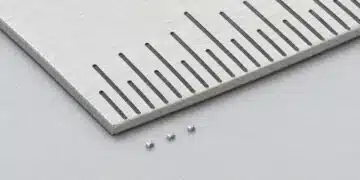
Kyocera Corporation (President: Hideo Tanimoto) today announced that it has developed new multilayer ceramic capacitors (MLCCs) for mobile device applications in a 008004 case size, among the world’s smallest*1. Measuring just 0.25 x 0.125 x 0.125mm, Kyocera’s new CM01 Series MLCCs reduce space requirements by 60% in surface area and 75% in total volume as compared to conventional products. The new MLCCs are now available worldwide.

RelatedPosts

Magnetics Design in High‑Frequency GaN Converters

ECIA Industry Pulse April 2026: Sentiment Cools but Stays Strong

Industrial Passive Components Markets and Technologies 2026

The trend toward smaller, more highly functional telecommunications equipment has increased component requirements within smartphones, wearables and related devices — creating particular demand for ultra-miniature MLCCs to facilitate greater circuit densities. In response to this demand, Kyocera’s new CM01 Series’ ultra-compact size will help circuit designers create more capable and functional products. The new MLCCs feature tight tolerances on key specifications, with an industry-leading*2 Q-value*3 which is 20% higher than conventional MLCCs*4 to meet the rising demand for highly efficient power amplifier modules. Kyocera will continue to develop innovative products that contribute to an expanding IoT (Internet of Things) society.

Product Overview

Product name CM01 Series MLCC
Size 0.25×0.125×0.125mm
Characteristics C0G (EIA)
Capacitance 0.2 to 22pF
Tolerance
0.2 to 9.9pF: B (±0.1pF)
C (±0.25pF)
10 to 22pF: J (±5%)
Rated voltage 25Vdc: 0.2 to 9.9pF
16Vdc: 10 to 22pF
Production facility Kagoshima Kokubu Plant

Main Features
1. Ultra compact size reduces space requirements
Continuous improvements in Kyocera’s proprietary electrode printing and forming technologies enable the company to reduce these components’ space requirement by 60% in mounting area and 75% in total volume, as compared to the 01005 case size. These ultra-compact MLCCs can thus contribute greatly to the goal of delivering equivalent performance from smaller devices; or, delivering greater performance and functionality without increasing the circuit (or device) size.

2. Tight tolerance with 20% increase in Q-value compared to conventional MLCCs
With demand for ever-greater telecommunication bandwidth and data transfer speeds, improved power efficiency has become crucial. Power amplifier modules require components with tight tolerances on key specifications, such as electrode dimensions, to optimize power use within matching circuits. Kyocera’s new MLCCs accomplish this while reducing energy consumption in ultra-high-speed and high-capacity devices.

*1: Among the world’s smallest for 008004 size MLCCs. Based on research by Kyocera (as of November 2017).
*2: Based on research by Kyocera (as of November 2017).
*3: Q-value: An index to show the degree of energy loss inside a capacitor. A higher value indicates lower energy loss.
*4: When compared to Kyocera’s conventional MLCCs in a 01005 case size.

featured image: Kyocera’s new 008004 MLCCs (scale shows 0.25mm increments), source: Kyocera
 

Related

Recent Posts

Industrial Passive Components Markets and Technologies 2026

21.5.2026
36

Automotive Passive Components Technology Dossier

21.5.2026
36

Samsung Electro-Mechanics Signs 1.5T KRW Silicon Capacitor AI Contract

21.5.2026
24

Qi2 Wireless Charging: Inductors, Capacitors and EMC Filters

21.5.2026
19

Samsung Introduced Low ESL 3-Terminal Reverse-Geometry MLCCs for High-Performance ADAS

20.5.2026
39

Using Stress–Strain Curves to Diagnose Tantalum Powders for Capacitors

20.5.2026
25

Samsung Launches Ultra-Compact 008004 High Q MLCC for Next-Generation RF Applications

20.5.2026
29

Nichicon Extends Rechargeable Batteries Temperature to Rival Supercapacitors

19.5.2026
31

Two‑capacitor paradox explained for engineers

18.5.2026
64

Upcoming Events

Jun 2
16:00 - 17:00 CEST

Calculation, Simulation and Measurement of 800V EMC Filters

Jun 16
16:00 - 17:00 CEST

EMC with EMC – EMC‑compliant design with electromechanical connectors

View Calendar

Popular Posts

  • Buck Converter Design and Calculation

    0 shares
    Share 0 Tweet 0
  • Boost Converter Design and Calculation

    0 shares
    Share 0 Tweet 0
  • Flyback Converter Design and Calculation

    0 shares
    Share 0 Tweet 0
  • LLC Resonant Converter Design and Calculation

    0 shares
    Share 0 Tweet 0
  • MLCC and Ceramic Capacitors

    0 shares
    Share 0 Tweet 0
  • Capacitor Charging and Discharging

    0 shares
    Share 0 Tweet 0
  • What Electronics Engineer Needs to Know About Passive Low Pass Filters

    0 shares
    Share 0 Tweet 0
  • Dual Active Bridge (DAB) Topology

    0 shares
    Share 0 Tweet 0
  • Ripple Current and its Effects on the Performance of Capacitors

    3 shares
    Share 3 Tweet 0
  • Samsung Electro-Mechanics Releases High-Capacitance MLCCs for AI Server Applications

    0 shares
    Share 0 Tweet 0

Newsletter Subscription


Passive Components Blog

© EPCI - Leading Passive Components Educational and Information Site

  • Home
  • Privacy Policy
  • EPCI Membership & Advertisement
  • About

No Result
View All Result
  • Home
  • Knowledge Blog
  • Dossiers
  • PCNS

© EPCI - Leading Passive Components Educational and Information Site

This website uses cookies. By continuing to use this website you are giving consent to cookies being used. Visit our Privacy and Cookie Policy.
Go to mobile version