












Passive Components Blog
No Result
View All Result
  • Home
  • NewsFilter
    • All
    • Aerospace & Defence
    • Antenna
    • Applications
    • Automotive
    • Capacitors
    • Circuit Protection Devices
    • electro-mechanical news
    • Filters
    • Fuses
    • Inductors
    • Industrial
    • Integrated Passives
    • inter-connect news
    • Market & Supply Chain
    • Market Insights
    • Medical
    • Modelling and Simulation
    • New Materials & Supply
    • New Technologies
    • Non-linear Passives
    • Oscillators
    • Passive Sensors News
    • Resistors
    • RF & Microwave
    • Telecommunication
    • Weekly Digest

    Binder Extends NCC Circular Connectors for Harsh Environments

    Standard vs Planar LLC transformers Comparison for Battery Chargers

    Würth Elektronik and Grinn Launch Edge AI Cooperation

    Bourns Expanded Semi-Shielded Low Profile Automotive Power Inductor

    Peak Nano to Develop Fusion Grade High Energy Film Capacitors

    Murata New Vibration Sensor Targets High‑Frequency Predictive Maintenance

    Kyocera Releases 30fs Jitter Differential Clock Oscillator

    Panasonic Expands Automotive PP Film Capacitors Voltage Range

    Panasonic Extends Automotive Power Inductor Line

    Trending Tags

    • Ripple Current
    • RF
    • Leakage Current
    • Tantalum vs Ceramic
    • Snubber
    • Low ESR
    • Feedthrough
    • Derating
    • Dielectric Constant
    • New Products
    • Market Reports
  • VideoFilter
    • All
    • Antenna videos
    • Capacitor videos
    • Circuit Protection Video
    • Filter videos
    • Fuse videos
    • Inductor videos
    • Inter-Connect Video
    • Non-linear passives videos
    • Oscillator videos
    • Passive sensors videos
    • Resistor videos

    Standard vs Planar LLC transformers Comparison for Battery Chargers

    How Modern Tools Model Magnetic Components for Power Electronics

    Advanced Loss Modeling for Planar Magnetics in the Frenetic Planar Tool

    2026 Power Magnetics Design Trends: Flyback, DAB and Planar

    Enabling Software‑Defined Vehicle Architectures: Automotive Ethernet and Zonal Smart Power

    Calculating Resistance Value of a Flyback RC Snubber 

    One‑Pulse Characterization of Nonlinear Power Inductors

    Thermistor Linearization Challenges

    Coaxial Connectors and How to Connect with PCB

    Trending Tags

    • Capacitors explained
    • Inductors explained
    • Resistors explained
    • Filters explained
    • Application Video Guidelines
    • EMC
    • New Products
    • Ripple Current
    • Simulation
    • Tantalum vs Ceramic
  • Knowledge Blog
  • DossiersNew
  • Suppliers
    • Who is Who
  • PCNS
    • PCNS 2025
    • PCNS 2023
    • PCNS 2021
    • PCNS 2019
    • PCNS 2017
  • Events
  • Home
  • NewsFilter
    • All
    • Aerospace & Defence
    • Antenna
    • Applications
    • Automotive
    • Capacitors
    • Circuit Protection Devices
    • electro-mechanical news
    • Filters
    • Fuses
    • Inductors
    • Industrial
    • Integrated Passives
    • inter-connect news
    • Market & Supply Chain
    • Market Insights
    • Medical
    • Modelling and Simulation
    • New Materials & Supply
    • New Technologies
    • Non-linear Passives
    • Oscillators
    • Passive Sensors News
    • Resistors
    • RF & Microwave
    • Telecommunication
    • Weekly Digest

    Binder Extends NCC Circular Connectors for Harsh Environments

    Standard vs Planar LLC transformers Comparison for Battery Chargers

    Würth Elektronik and Grinn Launch Edge AI Cooperation

    Bourns Expanded Semi-Shielded Low Profile Automotive Power Inductor

    Peak Nano to Develop Fusion Grade High Energy Film Capacitors

    Murata New Vibration Sensor Targets High‑Frequency Predictive Maintenance

    Kyocera Releases 30fs Jitter Differential Clock Oscillator

    Panasonic Expands Automotive PP Film Capacitors Voltage Range

    Panasonic Extends Automotive Power Inductor Line

    Trending Tags

    • Ripple Current
    • RF
    • Leakage Current
    • Tantalum vs Ceramic
    • Snubber
    • Low ESR
    • Feedthrough
    • Derating
    • Dielectric Constant
    • New Products
    • Market Reports
  • VideoFilter
    • All
    • Antenna videos
    • Capacitor videos
    • Circuit Protection Video
    • Filter videos
    • Fuse videos
    • Inductor videos
    • Inter-Connect Video
    • Non-linear passives videos
    • Oscillator videos
    • Passive sensors videos
    • Resistor videos

    Standard vs Planar LLC transformers Comparison for Battery Chargers

    How Modern Tools Model Magnetic Components for Power Electronics

    Advanced Loss Modeling for Planar Magnetics in the Frenetic Planar Tool

    2026 Power Magnetics Design Trends: Flyback, DAB and Planar

    Enabling Software‑Defined Vehicle Architectures: Automotive Ethernet and Zonal Smart Power

    Calculating Resistance Value of a Flyback RC Snubber 

    One‑Pulse Characterization of Nonlinear Power Inductors

    Thermistor Linearization Challenges

    Coaxial Connectors and How to Connect with PCB

    Trending Tags

    • Capacitors explained
    • Inductors explained
    • Resistors explained
    • Filters explained
    • Application Video Guidelines
    • EMC
    • New Products
    • Ripple Current
    • Simulation
    • Tantalum vs Ceramic
  • Knowledge Blog
  • DossiersNew
  • Suppliers
    • Who is Who
  • PCNS
    • PCNS 2025
    • PCNS 2023
    • PCNS 2021
    • PCNS 2019
    • PCNS 2017
  • Events
No Result
View All Result
Passive Components Blog
No Result
View All Result

Molecular Adsorption Concept for Increasing Energy Density of Hybrid Supercapacitors

6.9.2024
Reading Time: 3 mins read
A A

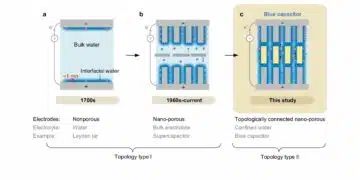
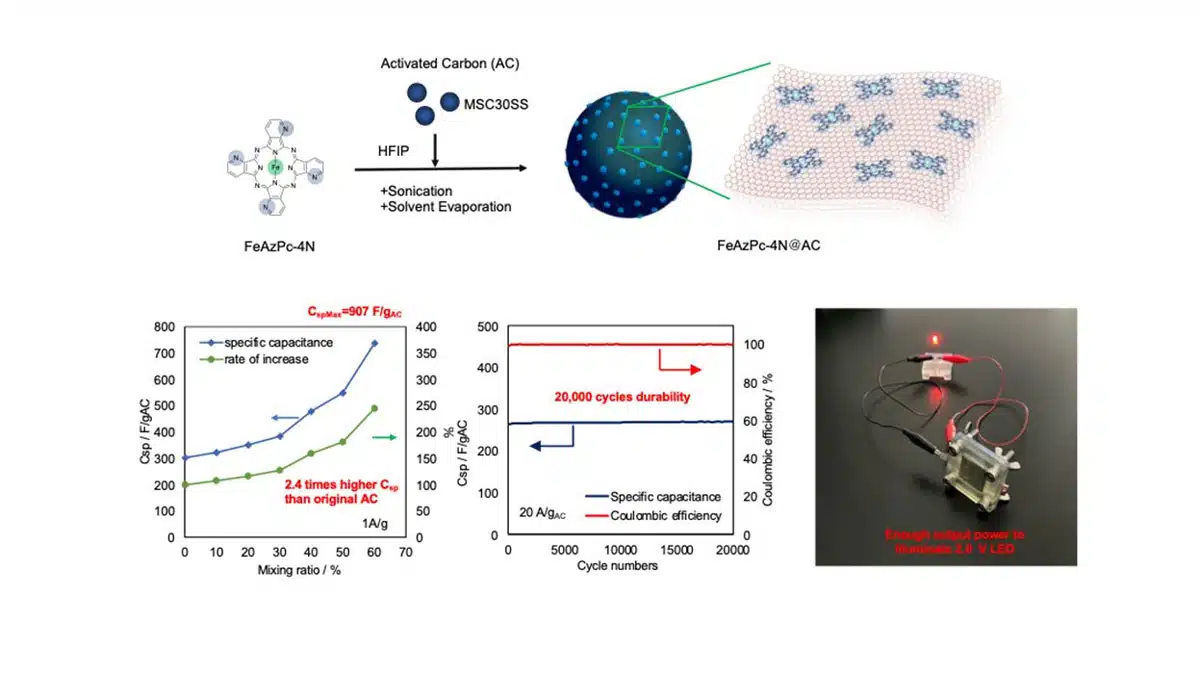
Researchers at Tohoku University demonstrated that high-capacity hybrid supercapacitors can be realized by utilizing iron azaphthalocyanine (FeAzPc-4N) adsorbed activated carbons (ACs) as an electrode due to the combination of the electric double layer of activated carbon surfaces and redox reactions of FeAzPc-4N molecules.

Researchers at Tohoku University have successfully increased the capacity, lifetime durability, and cost-effectiveness of a capacitor in their pursuit of a more power-efficient future. A capacitor is a device used as part of a circuit that can store and release energy, just like a battery. What makes a capacitor different from a battery is that it takes much less time to charge. For example, your cellphone battery will power your phone instantly, but charging that battery back up to 100% when it dies is far from instantaneous.

RelatedPosts

Binder Extends NCC Circular Connectors for Harsh Environments

Standard vs Planar LLC transformers Comparison for Battery Chargers

Würth Elektronik and Grinn Launch Edge AI Cooperation

While this makes capacitors sound like the superior choice, they have some big drawbacks that need to be overcome. Firstly, their capacity is much smaller than batteries, so they cannot store large amounts of energy at once. Secondly, they can be quite expensive. In recent years, supercapacitors (capacitors with increased capacity and performance) have been developed using nanocarbon materials, such as carbon nanotubes (CNTs), which increase the surface area and overall capacity. However, due to the expensive nature of nanocarbon materials, large-scale production using this technique is not cost-effective.

In order to tackle these specific concerns to improve the overall performance of capacitors, a research group consisting of Professor Hiroshi Yabu (Tohoku University), AZUL Energy Co., Ltd. (a venture company from Tohoku University), and the AZUL Energy x Tohoku University Bio-Inspired GX Co-Creation Center was formed. Their findings were published in ACS Applied Materials & Interfaces On June 20, 2024.

The team succeeded in increasing the capacitance of capacitors by 2.4 times (to 907 F/gAC) compared to carbon alone by “sprinkling” iron azaphthalocyanine (FeAzPc-4N), a type of blue pigment, onto activated carbon. This method allows the molecule to adsorb at the molecular level, utilizing its redox capabilities. Additionally, the study demonstrated that 20,000 charge-discharge cycles are possible even in high-load regions of 20 A/gAC, making it feasible to power LEDs.

“This increased lifespan compared to batteries may help reduce waste, as the same capacitor can be reused many more times,” comments Hiroshi Yabu, one of the researchers, “The components of capacitors are also significantly less toxic than batteries.”

The capacitor electrode developed in this research can increase capacity to the level of supercapacitors using CNTs while utilizing commonly available and inexpensive activated carbon, making it a potential option for next-generation energy devices. What’s the next step for the team after this? To make the supercapacitor even more super-powered.

Journal reference:

  1. Kosuke Ishibashi, Yutaro Hirai, Keisuke Oku, Koju Ito, and Hiroshi Yabu. A Molecular Adsorption Concept for Increasing Energy Density of Hybrid Supercapacitors. ACS Applied Materials & Interfaces, 2024; DOI: 10.1021/acsami.4c06084

Related

Source: Tohoku University

Recent Posts

Peak Nano to Develop Fusion Grade High Energy Film Capacitors

11.3.2026
24

Panasonic Expands Automotive PP Film Capacitors Voltage Range

9.3.2026
22

February 2026 Interconnect, Passives and Electromechanical Components Market Insights

9.3.2026
47

Empower Extends Embedded Silicon Capacitors for AI

6.3.2026
42

AI Servers Demand is Driving Tantalum Capacitor Price Hikes

5.3.2026
111

DMASS Reports Europe Components Up 9.8% in Q4 2025

3.3.2026
22

Mastering Galvanic Isolation in Power Electronics: Methods, Standards, and Implementation

2.3.2026
65

VINATech Targets AI Data Center Supercapacitor Boom

26.2.2026
70

TDK Introduces 350V Safety Film Capacitors for Compact EMI Suppression

26.2.2026
42

Upcoming Events

Mar 19
13:00 - 14:00 CDT

Smart Consideration of Inductor Thermal Performance

Mar 21
All day

PSMA Capacitor Workshop 2026

Apr 21
16:00 - 17:00 CEST

Heatsink Solutions: Thermal Management in electronic devices

View Calendar

Popular Posts

  • Buck Converter Design and Calculation

    0 shares
    Share 0 Tweet 0
  • Boost Converter Design and Calculation

    0 shares
    Share 0 Tweet 0
  • Flyback Converter Design and Calculation

    0 shares
    Share 0 Tweet 0
  • LLC Resonant Converter Design and Calculation

    0 shares
    Share 0 Tweet 0
  • MLCC Manufacturers Consider Price Increase as AI Demand Outpaces Supply

    0 shares
    Share 0 Tweet 0
  • Dual Active Bridge (DAB) Topology

    0 shares
    Share 0 Tweet 0
  • Ripple Current and its Effects on the Performance of Capacitors

    3 shares
    Share 3 Tweet 0
  • MLCC and Ceramic Capacitors

    0 shares
    Share 0 Tweet 0
  • MLCC Case Sizes Standards Explained

    0 shares
    Share 0 Tweet 0
  • 3-Phase EMI Filter Design, Simulation, Calculation and Test

    0 shares
    Share 0 Tweet 0

Newsletter Subscription


Passive Components Blog

© EPCI - Leading Passive Components Educational and Information Site

  • Home
  • Privacy Policy
  • EPCI Membership & Advertisement
  • About

No Result
View All Result
  • Home
  • Knowledge Blog
  • PCNS

© EPCI - Leading Passive Components Educational and Information Site

This website uses cookies. By continuing to use this website you are giving consent to cookies being used. Visit our Privacy and Cookie Policy.
Go to mobile version