




Passive Components Blog
No Result
View All Result
  • Home
  • News
    • All
    • Aerospace & Defence
    • Antenna
    • Applications
    • Automotive
    • Capacitors
    • Circuit Protection Devices
    • electro-mechanical news
    • Filters
    • Fuses
    • Inductors
    • Industrial
    • Integrated Passives
    • inter-connect news
    • Market & Supply Chain
    • Market Insights
    • Medical
    • Modelling and Simulation
    • New Materials & Supply
    • New Technologies
    • Non-linear Passives
    • Optoelectronics and Isolation
    • Oscillators
    • Passive Sensors News
    • Resistors
    • RF & Microwave
    • Telecommunication
    • Weekly Digest
    MLCC construction image

    Samsung Electro-Mechanics Patent Targets to Reduce Moisture and Cracks in High-Capacity MLCCs

    Samsung Electro-Mechanics MFC molded frame ceramic capacitor with epoxy encapsulation and external metal frame

    Samsung 100V Molded Frame MLCC Targets 48V AI Server PSUs

    SCHURTER EKO square-body DC fuse variants with ceramic bodies and different metal terminal arrangements

    SCHURTER EKO DC Fuses Extend to 1500 V and 2000 A

    illustration of packaged SMD power inductors on a four-wire cryogenic characterization board

    Cryogenic SMD Inductors at 4 K: Low DCR, Persistent AC Loss

    Wk 43 Electronics Supply Chain Digest

    TDK M704 and M705 NTC temperature sensors with a leaded plastic housing and metal-tag ring-lug assembly

    TDK M704 and M705 NTC Sensors for High-Voltage Power Systems

    Conceptual illustration for Modelithics COMPLETE 26.5 showing RF capacitors, inductors and resistors on a microwave PCB.

    Modelithics COMPLETE 26.5 Adds RF Passive Models for AWR

    TDK B3201 series Y1 film safety capacitors with rectangular cases and parallel wire leads

    TDK Introduces Y1 Film Safety Capacitors for 500 V AC EMI Filtering

    Littelfuse C&K SDE surface-mount DIP switches with gull-wing terminals and top-mounted actuators

    Littelfuse C&K SDE End-Stackable SMT DIP Switches

    Trending Tags

    • Ripple Current
    • RF
    • Leakage Current
    • Tantalum vs Ceramic
    • Snubber
    • Low ESR
    • Feedthrough
    • Derating
    • Dielectric Constant
    • New Products
    • Market Reports
  • Knowledge Blog
  • Dossiers
    • Aerospace and Defense Passive Components Dossier
    • AI Hardware Dossier
    • Automotive Dossier
    • Industrial Robotics Dossier
    • Power Converter Dossier
    • Capacitor Dossier
    • Circuit Protection Dossier
    • Inductor Dossier
    • Resistor Dossier
    • Silicon Capacitors and Integrated Passives Dossier
  • Suppliers
    • Who is Who
  • PCNS
    • PCNS 2025
    • PCNS 2023
    • PCNS 2021
    • PCNS 2019
    • PCNS 2017
  • Events
No Result
View All Result
Passive Components Blog
No Result
View All Result

Molecular Adsorption Concept for Increasing Energy Density of Hybrid Supercapacitors

6.9.2024
Reading Time: 3 mins read
A A

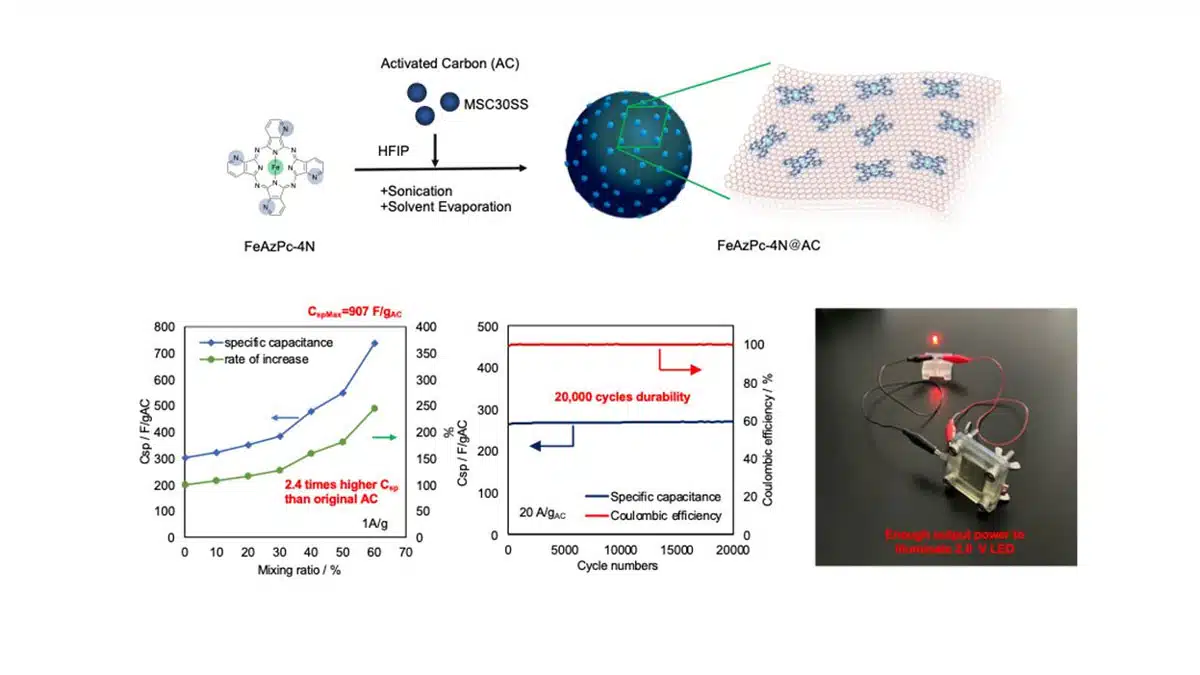
Researchers at Tohoku University demonstrated that high-capacity hybrid supercapacitors can be realized by utilizing iron azaphthalocyanine (FeAzPc-4N) adsorbed activated carbons (ACs) as an electrode due to the combination of the electric double layer of activated carbon surfaces and redox reactions of FeAzPc-4N molecules.

Researchers at Tohoku University have successfully increased the capacity, lifetime durability, and cost-effectiveness of a capacitor in their pursuit of a more power-efficient future. A capacitor is a device used as part of a circuit that can store and release energy, just like a battery. What makes a capacitor different from a battery is that it takes much less time to charge. For example, your cellphone battery will power your phone instantly, but charging that battery back up to 100% when it dies is far from instantaneous.

RelatedPosts

Samsung Electro-Mechanics Patent Targets to Reduce Moisture and Cracks in High-Capacity MLCCs

Samsung 100V Molded Frame MLCC Targets 48V AI Server PSUs

SCHURTER EKO DC Fuses Extend to 1500 V and 2000 A

While this makes capacitors sound like the superior choice, they have some big drawbacks that need to be overcome. Firstly, their capacity is much smaller than batteries, so they cannot store large amounts of energy at once. Secondly, they can be quite expensive. In recent years, supercapacitors (capacitors with increased capacity and performance) have been developed using nanocarbon materials, such as carbon nanotubes (CNTs), which increase the surface area and overall capacity. However, due to the expensive nature of nanocarbon materials, large-scale production using this technique is not cost-effective.

In order to tackle these specific concerns to improve the overall performance of capacitors, a research group consisting of Professor Hiroshi Yabu (Tohoku University), AZUL Energy Co., Ltd. (a venture company from Tohoku University), and the AZUL Energy x Tohoku University Bio-Inspired GX Co-Creation Center was formed. Their findings were published in ACS Applied Materials & Interfaces On June 20, 2024.

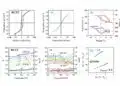
The team succeeded in increasing the capacitance of capacitors by 2.4 times (to 907 F/gAC) compared to carbon alone by “sprinkling” iron azaphthalocyanine (FeAzPc-4N), a type of blue pigment, onto activated carbon. This method allows the molecule to adsorb at the molecular level, utilizing its redox capabilities. Additionally, the study demonstrated that 20,000 charge-discharge cycles are possible even in high-load regions of 20 A/gAC, making it feasible to power LEDs.

“This increased lifespan compared to batteries may help reduce waste, as the same capacitor can be reused many more times,” comments Hiroshi Yabu, one of the researchers, “The components of capacitors are also significantly less toxic than batteries.”

The capacitor electrode developed in this research can increase capacity to the level of supercapacitors using CNTs while utilizing commonly available and inexpensive activated carbon, making it a potential option for next-generation energy devices. What’s the next step for the team after this? To make the supercapacitor even more super-powered.

Journal reference:

  1. Kosuke Ishibashi, Yutaro Hirai, Keisuke Oku, Koju Ito, and Hiroshi Yabu. A Molecular Adsorption Concept for Increasing Energy Density of Hybrid Supercapacitors. ACS Applied Materials & Interfaces, 2024; DOI: 10.1021/acsami.4c06084
Related

Source: Tohoku University

Recent Posts

MLCC construction image

Samsung Electro-Mechanics Patent Targets to Reduce Moisture and Cracks in High-Capacity MLCCs

26.10.2026
9
Samsung Electro-Mechanics MFC molded frame ceramic capacitor with epoxy encapsulation and external metal frame

Samsung 100V Molded Frame MLCC Targets 48V AI Server PSUs

26.10.2026
7
TDK B3201 series Y1 film safety capacitors with rectangular cases and parallel wire leads

TDK Introduces Y1 Film Safety Capacitors for 500 V AC EMI Filtering

21.10.2026
31
Modelithics COMPLETE+3D v26.4 library for RF passive-component and 3D electromagnetic simulation in Keysight ADS/RFPro

Modelithics COMPLETE+3D v26.4 Expands RF Models and 3D Workflows

19.10.2026
11
Siemens executives Markus Grabmeier and Barry Powell with Skeleton Technologies CEO Taavi Madiberk at the investment announcement

Siemens Backs Skeleton’s US AI Power Manufacturing Expansion

15.10.2026
63
Supercapacitor LSM production

LS Materials Wins $51.5M AI Data Center Supercapacitor Order

13.10.2026
94
Features of BCZT and strontium titanate dielectric layers in a thin-film superlattice

Relaxor superlattice capacitors approach 99% efficiency

12.10.2026
39
Conceptual Toray heat-resistant film capacitor beside an inverter cooling structure.

Toray Film Capacitor Enables 150°C Inverter Operation

9.10.2026
90
Silicon capacitors and integrated passives dossier cover

Silicon Capacitors and Integrated Passives Dossier Report 10/26

8.10.2026
73

Upcoming Events

Oct 27
15:00 - 16:00 CET

Heraeus Electronics Webinar: What materials perform when failure is not an option?

Oct 27
16:00 - 17:00 CET

Power Inductor technologies

Oct 28
13:00 - 14:00 CDT

Inductor Design in a Multi-Phase Buck Converter

View Calendar

Popular Posts

  • Buck Converter Design and Calculation

    0 shares
    Share 0 Tweet 0
  • Boost Converter Design and Calculation

    0 shares
    Share 0 Tweet 0
  • LLC Resonant Converter Design and Calculation

    0 shares
    Share 0 Tweet 0
  • Capacitor Charging and Discharging

    0 shares
    Share 0 Tweet 0
  • Flyback Converter Design and Calculation

    0 shares
    Share 0 Tweet 0
  • September 2026 Interconnect, Passives and Electromechanical Components Market Insights

    0 shares
    Share 0 Tweet 0
  • MLCC and Ceramic Capacitors

    0 shares
    Share 0 Tweet 0
  • RF Connector Types: How To Choose the Right One

    0 shares
    Share 0 Tweet 0
  • Passive Low Pass Filters: Fundamentals and EMI Design

    0 shares
    Share 0 Tweet 0
  • Audio Capacitors: Choosing Capacitors for Crossover Circuits

    0 shares
    Share 0 Tweet 0

Newsletter Subscription


Passive Components Blog

© 2015–2026
All rights reserved

  • Home
  • Privacy Policy
  • EPCI Membership & Advertisement
  • About

No Result
View All Result
  • Home
  • Knowledge Blog
  • Dossiers
  • PCNS

© 2015–2026
All rights reserved