





Passive Components Blog
No Result
View All Result
  • Home
  • NewsFilter
    • All
    • Aerospace & Defence
    • Antenna
    • Applications
    • Automotive
    • Capacitors
    • Circuit Protection Devices
    • electro-mechanical news
    • Filters
    • Fuses
    • Inductors
    • Industrial
    • Integrated Passives
    • inter-connect news
    • Market & Supply Chain
    • Market Insights
    • Medical
    • Modelling and Simulation
    • New Materials & Supply
    • New Technologies
    • Non-linear Passives
    • Oscillators
    • Passive Sensors News
    • Resistors
    • RF & Microwave
    • Telecommunication
    • Weekly Digest

    YAGEO Extends Automotive Tantalum Polymer Capacitors for AI and ADAS Controllers

    Knowles Introduces PP Film Capacitors for High‑Stress Power Electronics

    High‑Power Current Sensing with YAGEO PK Metal Current Sensors

    AI Data Centers Push Aluminium Capacitor Prices Higher

    Murata Releases 1210 Metal Terminal Common Mode Choke for 10Base‑T1S In‑Vehicle Ethernet

    DigiKey Ads 27,000 New In-Stock Parts and 104 Additional Suppliers in Q2 2026

    Würth Elektronik Coupled Inductors Harnessing Leakage Inductance in SEPIC, ZETA and Ćuk Converters

    Samsung Introduces Ultra‑compact, High‑Capacitance MLCCs for AI Edge and Wearable designs

    Knowles Presents Pulse Power Capacitors for Demanding MedTech, Industrial and Defense Applications

    Trending Tags

    • Ripple Current
    • RF
    • Leakage Current
    • Tantalum vs Ceramic
    • Snubber
    • Low ESR
    • Feedthrough
    • Derating
    • Dielectric Constant
    • New Products
    • Market Reports
  • VideoFilter
    • All
    • Antenna videos
    • Capacitor videos
    • Circuit Protection Video
    • Filter videos
    • Fuse videos
    • Inductor videos
    • Inter-Connect Video
    • Non-linear passives videos
    • Oscillator videos
    • Passive sensors videos
    • Resistor videos

    EMC Design Fundamentals: Safe Use of Varistors and Common Mode Chokes in Mains and Data-Line Filters

    Ferrite versus Nanocrystalline Power Inductor Cores: Turns, Gap and Size

    KYOCERA AVX Presents Antenna Integrator Studio Tutorial for Antenna Placement and RF Design

    Power Design Simulation Tools for Faster Inductor Selection and Loss Optimization

    EMC‑Compliant PCB and Connector Design Guidelines

    Why Isolated DC/DC Power Supplies Fail Late, Würth Elektronik Podcast

    Designing 800 V DC EMC Filters: Calculation, Simulation and Measurement

    Current Sense Transformer Datasheet and Design‑in Guide

    Designing a USB Type‑C Flyback Planar Transformer with Frenetic’s Planar Tool

    Trending Tags

    • Capacitors explained
    • Inductors explained
    • Resistors explained
    • Filters explained
    • Application Video Guidelines
    • EMC
    • New Products
    • Ripple Current
    • Simulation
    • Tantalum vs Ceramic
  • Knowledge Blog
  • Dossiers
    • AI Hardware Dossier
    • Power Converter Dossier
    • Automotive Dossier
    • Capacitor Dossier
    • Resistor Dossier
    • Inductor Dossier
    • Circuit Protection Dossier
  • Suppliers
    • Who is Who
  • PCNS
    • PCNS 2025
    • PCNS 2023
    • PCNS 2021
    • PCNS 2019
    • PCNS 2017
  • Events
  • Home
  • NewsFilter
    • All
    • Aerospace & Defence
    • Antenna
    • Applications
    • Automotive
    • Capacitors
    • Circuit Protection Devices
    • electro-mechanical news
    • Filters
    • Fuses
    • Inductors
    • Industrial
    • Integrated Passives
    • inter-connect news
    • Market & Supply Chain
    • Market Insights
    • Medical
    • Modelling and Simulation
    • New Materials & Supply
    • New Technologies
    • Non-linear Passives
    • Oscillators
    • Passive Sensors News
    • Resistors
    • RF & Microwave
    • Telecommunication
    • Weekly Digest

    YAGEO Extends Automotive Tantalum Polymer Capacitors for AI and ADAS Controllers

    Knowles Introduces PP Film Capacitors for High‑Stress Power Electronics

    High‑Power Current Sensing with YAGEO PK Metal Current Sensors

    AI Data Centers Push Aluminium Capacitor Prices Higher

    Murata Releases 1210 Metal Terminal Common Mode Choke for 10Base‑T1S In‑Vehicle Ethernet

    DigiKey Ads 27,000 New In-Stock Parts and 104 Additional Suppliers in Q2 2026

    Würth Elektronik Coupled Inductors Harnessing Leakage Inductance in SEPIC, ZETA and Ćuk Converters

    Samsung Introduces Ultra‑compact, High‑Capacitance MLCCs for AI Edge and Wearable designs

    Knowles Presents Pulse Power Capacitors for Demanding MedTech, Industrial and Defense Applications

    Trending Tags

    • Ripple Current
    • RF
    • Leakage Current
    • Tantalum vs Ceramic
    • Snubber
    • Low ESR
    • Feedthrough
    • Derating
    • Dielectric Constant
    • New Products
    • Market Reports
  • VideoFilter
    • All
    • Antenna videos
    • Capacitor videos
    • Circuit Protection Video
    • Filter videos
    • Fuse videos
    • Inductor videos
    • Inter-Connect Video
    • Non-linear passives videos
    • Oscillator videos
    • Passive sensors videos
    • Resistor videos

    EMC Design Fundamentals: Safe Use of Varistors and Common Mode Chokes in Mains and Data-Line Filters

    Ferrite versus Nanocrystalline Power Inductor Cores: Turns, Gap and Size

    KYOCERA AVX Presents Antenna Integrator Studio Tutorial for Antenna Placement and RF Design

    Power Design Simulation Tools for Faster Inductor Selection and Loss Optimization

    EMC‑Compliant PCB and Connector Design Guidelines

    Why Isolated DC/DC Power Supplies Fail Late, Würth Elektronik Podcast

    Designing 800 V DC EMC Filters: Calculation, Simulation and Measurement

    Current Sense Transformer Datasheet and Design‑in Guide

    Designing a USB Type‑C Flyback Planar Transformer with Frenetic’s Planar Tool

    Trending Tags

    • Capacitors explained
    • Inductors explained
    • Resistors explained
    • Filters explained
    • Application Video Guidelines
    • EMC
    • New Products
    • Ripple Current
    • Simulation
    • Tantalum vs Ceramic
  • Knowledge Blog
  • Dossiers
    • AI Hardware Dossier
    • Power Converter Dossier
    • Automotive Dossier
    • Capacitor Dossier
    • Resistor Dossier
    • Inductor Dossier
    • Circuit Protection Dossier
  • Suppliers
    • Who is Who
  • PCNS
    • PCNS 2025
    • PCNS 2023
    • PCNS 2021
    • PCNS 2019
    • PCNS 2017
  • Events
No Result
View All Result
Passive Components Blog
No Result
View All Result

Most Reliable, Most Efficient and Price Effective Solid Tantalum Capacitors

26.10.2020
Reading Time: 8 mins read
A A

by: EPCI e-Symposium PCNS paper

by Y. Freeman, P. Lessner, E. Jones; KEMET Electronics

RelatedPosts

AVX Releases High-Temperature 150°C Glass-Encapsulated Multilayer Varistors

COTS procurement for space missions

Niobium and Niobium Oxide Capacitors Overview

presented by Ed Jones at the 2nd PCNS 10-13th September 2019, Bucharest, Romania as paper 3.2.

Commercial space constellations are an example of the increasing share of the space applications looking for more affordable electronics [1.] According to [1] selecting traditional space parts under MIL SPEC not only increases cost, but also leads to older technologies and   larger packages. As an alternative, selecting parts that are not MIL SPEC, e.g., automotive parts, allows cost reduction as well as maximum flexibility including additional test requirements aligned with the program requirements. The internal evaluation by the end-user as well as usage of the application stress factors such as derating should insure reliability of the commercial parts in space application.

As it was shown in [2.], usage of the commercial (automotive) Tantalum capacitors with traditional 50% derating can be more expensive, less reliable, and less efficient solution, especially, at higher application voltages. Reference [2] cites very expensive failures related to the usage of the substandard parts in space applications.

The differences between the high reliability, special COTS, and commercial parts can be seen in the Table 1 for KEMET series of solid Tantalum capacitors.
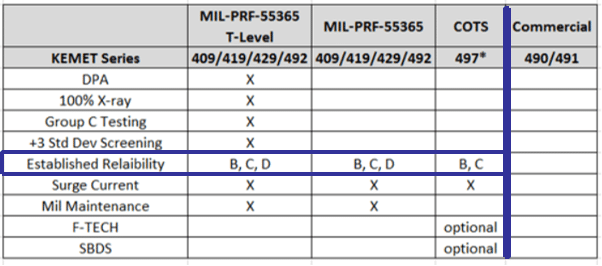
Table 1. Comparison of different series of KEMET solid Tantalum capacitors

According Table 1, the major difference between MIL and Special COTS series on the left and commercial series on the right is the established reliability tests performed on every production batch. Additionally, changing materials and processes in the Hi-Rel and Special COTS parts with established reliability requires re-qualification and notifying the customers while there is no requalification required for the commercial parts.

The materials and processes in commercial parts are constantly changing to reduce the manufacturing cost and only excessive yield losses limit these changes. In this situation testing of the commercial parts by the end-user becomes unproductive since the parts from the next manufacturing lot may be different from the ones just tested.

Besides that, 50% derating of Tantalum capacitors results in about 10x increase in volume (10x loss in charge efficiency CV/cc) due to the combination of the thicker dielectric and coarse tantalum powder with lower specific surface area required to form the thicker dielectric. Increasing the capacitor size also means increasing the manufacturing cost, which depends strongly on the amount of the tantalum powder in tantalum anodes.

A possibility to achieve the highest reliability and efficiency and potentially reduce the cost of Tantalum capacitors was demonstrated in [2] for Special COTS capacitors with established reliability, which were manufactured with advanced flawless technology (F-Tech) and unique simulated breakdown screening (SBDS) described in [3].

As it was shown in [2] based on KEMET-NGC mutual work, failure rate was about 5*107 times lower with F-Tech/SBDS vs. the conventional technology. Additionally, de-rating of the F-Tech/SBDS parts provides much steeper reduction in the failure rate vs. the conventional technology. As an example, 20% de-rating of the F-Tech/SBDS parts provides more reduction in the failure rate then 50% de-rating of the Industry Average parts with conventional technology. Lower de-rating increases charge efficiency (smaller packages) and helps reduce the manufacturing cost.

Flawless dielectric (Fig. 1) is critically important for manufacturing of reliable Tantalum capacitors
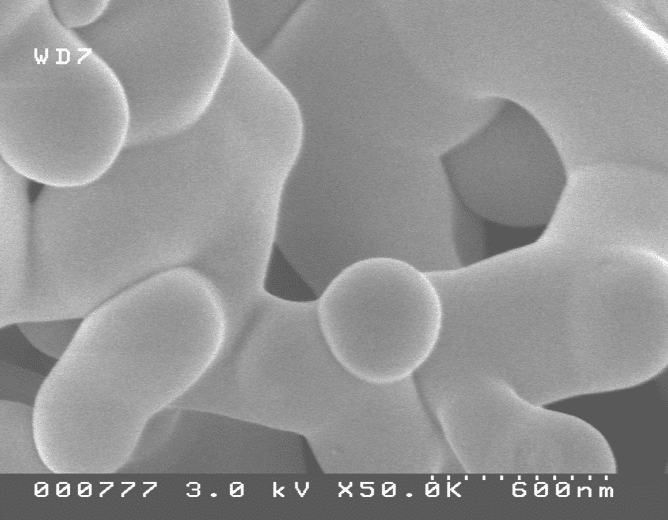
 

Fig. 1 SEM image of the flawless dielectric obtained with F-Tech.3

To form the flawless dielectric, tantalum anodes should have high chemical purity and mechanical robustness.3 This can be achieved by using the coarse tantalum powder pressed at high density and sintered at high temperature. At these conditions most of the impurities are evaporated from tantalum into the vacuum chamber providing high chemical purity to tantalum anodes and significant shrinkage makes the anodes mechanically strong.

The disadvantage of this old technology is low charge efficiency CV/cc, which is the major selling point of Tantalum capacitors. An alternative to the old technology is F-Tech that provides the highest chemical purity and mechanical robustness to tantalum anodes sintered with higher charge powder at much lower temperatures. In any case, it is critical to verify the quality of the dielectric by SEM analysis of the representative samples of formed anodes from every production lot. E

ven small changes to the chemical composition of the powder or process conditions can provoke initial defects in the dielectric that continue to grow during the capacitor manufacturing and testing causing failures during the field application.

The end-user processes can affect reliability of Tantalum capacitors. Several of these processes were investigated in the KEMET-NGC mutual work (Table 2).

 

Table 2. End-user processes investigated in KEMET-NGC mutual work on reliability of Tantalum capacitors

Fig. 2 demonstrates percent of failures during accelerated Life test with increasing bias voltage in D-case 15 uF – 35 V MnO2 Tantalum capacitors manufactured with F-Tech and SBDS and treated according to Table 2.
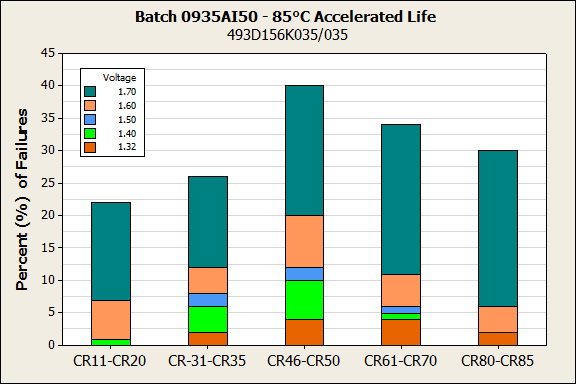
 

Fig. 2. Percent of failures in Tantalum capacitors with MnO2 cathode

According to Fig. 2 the lowest percent of failures was in the baseline (virgin parts). The percent of failures increased with all the end-user processes, especially, with uncontrolled use environment (CR46-CR50).

Fig. 3 demonstrates the results of the same accelerated testing of Polymer Tantalum capacitors with F-Tech, SBDS and either hybrid cathode technology: in-situ PEDOT internally and slurry PEDOT externally (a), or pure slurry PEDOT internally and externally (b).
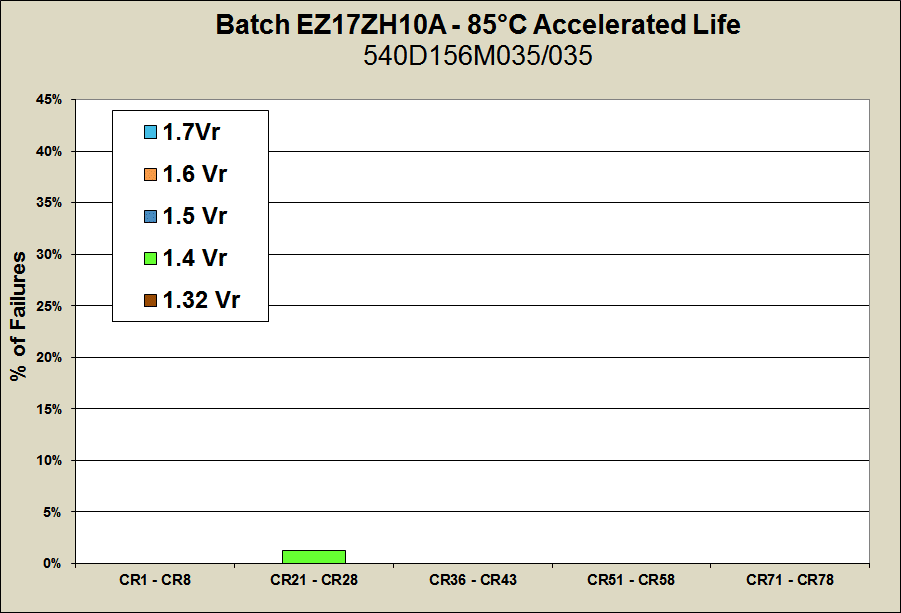
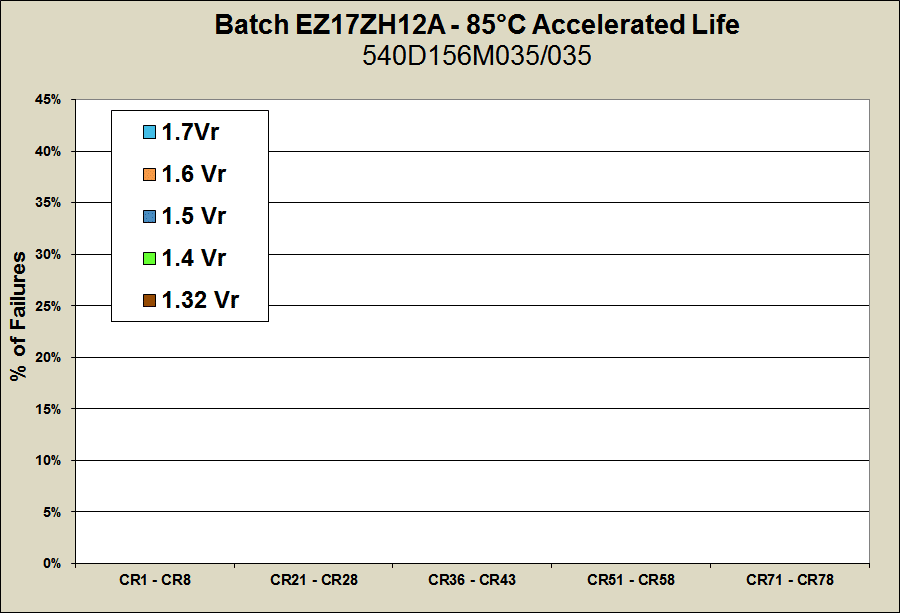
 

Fig. 3.a) Percent of failures in Polymer Tantalum capacitors with hybrid cathode


Fig. 3.b) Percent of failures in Polymer Tantalum capacitors with pure slurry cathode


According to Fig. 3, there were practically no failures in Polymer Tantalum capacitors with F-Tech and SBDS at the same test conditions that resulted in 20% to 40% failures in MnO2 Tantalum capacitors with F-Tech and SBDS. These results show that Polymer Tantalum capacitors manufactured with advanced technologies and screening technique are more reliable than MnO2 Tantalum capacitors manufactured with these technologies and screening technique. This difference can be related to the multiple high temperature stresses during the pyrolytic deposition of the MnO2 cathode while polymer cathode is deposited and cured at much lower temperatures.

Comparison of the Polymer Tantalum capacitors with different cathode technologies was performed using SBDS results. The simulated BDV values are proportional to the actual BDV values; however, SBDS doesn’t cause any damage to the population of the capacitors. The DCL in all the parts before and after SBDS remains below the limit, and the parts with low simulated BDV are removed from the population of the capacitors after the SBDS is completed.3 Fig. 4 demonstrates simulated BDV distributions in Polymer Tantalum capacitors with hybrid (a) and pure slurry (b) PEDOT cathodes.
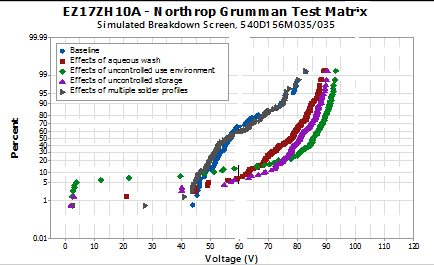
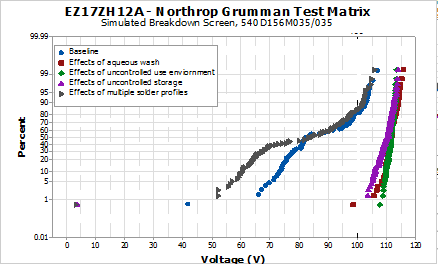
 

Fig. 4.a) Simulated BDV distributions in Polymer Tantalum capacitors with hybrid cathode


Fig. 4.b) Simulated BDV distributions in Polymer Tantalum capacitors with pure slurry PEDOT cathodes

As one can see in Fig. 4, simulated BDV values are higher in Polymer Tantalum capacitors with pure slurry polymer cathode in comparison to the capacitors with hybrid polymer cathode. Pure slurry parts also had lower DCL and higher ESR in comparison to the hybrid parts. Fig. 4 also shows that the end-user processes related to humidification cause increase in simulated BDV in comparison to the simulated BDV in baseline (virgin) parts. At the same time, multiple solder profiles cause BDV values decrease in some parts with pure slurry cathodes, which can be related to the drying at the reflow testing. The effects of moisture on dc and ac characteristics of Polymer Tantalum capacitors were discussed in [3].

Conclusions

Special COTS Polymer Tantalum capacitors with established reliability manufactured with F-Tech and SBDS and used with low/no derating provide the highest reliability, efficiency, and cost effectiveness among any solid Tantalum capacitors.

Special COTS Tantalum capacitors with established reliability allow usage of the most advanced technologies and screening techniques not included in MIL SPECs

Special COTS Tantalum capacitors with established reliability allow maximum flexibility to the end-users, including additional test requirements aligned with the program requirements.

The results of the internal testing of the Special COTS Tantalum capacitors by the end-users are applicable to all manufacturing lots and dates of manufacturing; any changes to the materials and processes in these capacitors require re-qualification and notifying customers.

Acknowledgements

The authors would like to acknowledge important contributions to the experimental part of the work and helpful discussions by NGC’s Bill Winkel, Ed Rich and Payam Motabar and KEMET’s Erin Atkinson, Kristin Tempel, Steve Hussey and Jonathan Paulsen.

References

  1. A. Casasnovas; The Path to Affordable Electronics for Commercial Space Constellations; Honeywell, SPWG, LA, April 2019
  2. Y. Freeman and P. Lessner. Tantalum Capacitors in Space Applications, ESA 2018, https://passive-components.eu/tantalum-capacitors-in-space-applications/
  3. Y. Freeman. Tantalum Capacitors: Science, Technology, and Application, Springer, 2017


more 2nd PCNS symposium technical papers can be viewed and downloaded in pdf from EPCI Academy e-Proceedings:

Related

Recent Posts

YAGEO Extends Automotive Tantalum Polymer Capacitors for AI and ADAS Controllers

31.7.2026
36

Knowles Introduces PP Film Capacitors for High‑Stress Power Electronics

30.7.2026
37

AI Data Centers Push Aluminium Capacitor Prices Higher

30.7.2026
93

Samsung Introduces Ultra‑compact, High‑Capacitance MLCCs for AI Edge and Wearable designs

29.7.2026
50

Knowles Presents Pulse Power Capacitors for Demanding MedTech, Industrial and Defense Applications

29.7.2026
24

YAGEO Extends its Supercapacitor Series Line-Up

28.7.2026
70

June 2026: AI Demand Pushes Japanese and Korean MLCC Makers to Five‑Year Shipment High

28.7.2026
125

Samsung Introduces 1000V C0G and X7 MLCCs for 800V DC Systems

27.7.2026
75

TT Electronics: How Qualification Underpins Reliable Selection of Thick‑Film Resistors

27.7.2026
92

Upcoming Events

Sep 29
16:00 - 17:00 CEST

Cybersecurity 2026

View Calendar

Popular Posts

  • Buck Converter Design and Calculation

    0 shares
    Share 0 Tweet 0
  • Boost Converter Design and Calculation

    0 shares
    Share 0 Tweet 0
  • YAGEO Announces July 2026 Capacitor Price Increase

    0 shares
    Share 0 Tweet 0
  • Flyback Converter Design and Calculation

    0 shares
    Share 0 Tweet 0
  • LLC Resonant Converter Design and Calculation

    0 shares
    Share 0 Tweet 0
  • MLCCs in the Age of AI: Q2 2026 Market Tightness

    0 shares
    Share 0 Tweet 0
  • MLCC and Ceramic Capacitors

    0 shares
    Share 0 Tweet 0
  • Earthing Systems and IEC Classification Explained

    0 shares
    Share 0 Tweet 0
  • Dual Active Bridge (DAB) Topology

    0 shares
    Share 0 Tweet 0
  • Core Materials, Permeability and Their Losses

    0 shares
    Share 0 Tweet 0

Newsletter Subscription


Passive Components Blog

© EPCI - Leading Passive Components Educational and Information Site

  • Home
  • Privacy Policy
  • EPCI Membership & Advertisement
  • About

No Result
View All Result
  • Home
  • Knowledge Blog
  • Dossiers
  • PCNS

© EPCI - Leading Passive Components Educational and Information Site