














Passive Components Blog
No Result
View All Result
  • Home
  • NewsFilter
    • All
    • Aerospace & Defence
    • Antenna
    • Applications
    • Automotive
    • Capacitors
    • Circuit Protection Devices
    • electro-mechanical news
    • Filters
    • Fuses
    • Inductors
    • Industrial
    • Integrated Passives
    • inter-connect news
    • Market & Supply Chain
    • Market Insights
    • Medical
    • Modelling and Simulation
    • New Materials & Supply
    • New Technologies
    • Non-linear Passives
    • Oscillators
    • Passive Sensors News
    • Resistors
    • RF & Microwave
    • Telecommunication
    • Weekly Digest

    Miniaturization of Tantalum Capacitors: Structural Limit Under Constant Rating

    Heatsink Design and Thermal Interface Materials for Reliable Electronics

    Murata New MLCC Bulk Case Packaging Cuts Packaging Material by 99%

    Wk 17 Electronics Supply Chain Digest

    Exxelia Introduces SMD High‑Voltage Mica Capacitors

    Modelithics Releases COMPLETE v26.1 for Keysight ADS

    April 2026 Interconnect, Passives and Electromechanical Components Market Insights

    SPICE Simulation of Non-Linear Resistors: Vishay’s Thermistor and PPTC Modelling Ecosystem

    KYOCERA AVX Introduces Traction‑Grade DC Link Film Capacitors

    Trending Tags

    • Ripple Current
    • RF
    • Leakage Current
    • Tantalum vs Ceramic
    • Snubber
    • Low ESR
    • Feedthrough
    • Derating
    • Dielectric Constant
    • New Products
    • Market Reports
  • VideoFilter
    • All
    • Antenna videos
    • Capacitor videos
    • Circuit Protection Video
    • Filter videos
    • Fuse videos
    • Inductor videos
    • Inter-Connect Video
    • Non-linear passives videos
    • Oscillator videos
    • Passive sensors videos
    • Resistor videos

    Why Power Inductors Use a Ferrite Core With an Air Gap

    Transformer-Based Power-Line Harvester Magnetic Design

    Thermal Modeling of Magnetics

    Standard vs Planar LLC transformers Comparison for Battery Chargers

    How Modern Tools Model Magnetic Components for Power Electronics

    Advanced Loss Modeling for Planar Magnetics in the Frenetic Planar Tool

    2026 Power Magnetics Design Trends: Flyback, DAB and Planar

    Enabling Software‑Defined Vehicle Architectures: Automotive Ethernet and Zonal Smart Power

    Calculating Resistance Value of a Flyback RC Snubber 

    Trending Tags

    • Capacitors explained
    • Inductors explained
    • Resistors explained
    • Filters explained
    • Application Video Guidelines
    • EMC
    • New Products
    • Ripple Current
    • Simulation
    • Tantalum vs Ceramic
  • Knowledge Blog
  • DossiersNew
  • Suppliers
    • Who is Who
  • PCNS
    • PCNS 2025
    • PCNS 2023
    • PCNS 2021
    • PCNS 2019
    • PCNS 2017
  • Events
  • Home
  • NewsFilter
    • All
    • Aerospace & Defence
    • Antenna
    • Applications
    • Automotive
    • Capacitors
    • Circuit Protection Devices
    • electro-mechanical news
    • Filters
    • Fuses
    • Inductors
    • Industrial
    • Integrated Passives
    • inter-connect news
    • Market & Supply Chain
    • Market Insights
    • Medical
    • Modelling and Simulation
    • New Materials & Supply
    • New Technologies
    • Non-linear Passives
    • Oscillators
    • Passive Sensors News
    • Resistors
    • RF & Microwave
    • Telecommunication
    • Weekly Digest

    Miniaturization of Tantalum Capacitors: Structural Limit Under Constant Rating

    Heatsink Design and Thermal Interface Materials for Reliable Electronics

    Murata New MLCC Bulk Case Packaging Cuts Packaging Material by 99%

    Wk 17 Electronics Supply Chain Digest

    Exxelia Introduces SMD High‑Voltage Mica Capacitors

    Modelithics Releases COMPLETE v26.1 for Keysight ADS

    April 2026 Interconnect, Passives and Electromechanical Components Market Insights

    SPICE Simulation of Non-Linear Resistors: Vishay’s Thermistor and PPTC Modelling Ecosystem

    KYOCERA AVX Introduces Traction‑Grade DC Link Film Capacitors

    Trending Tags

    • Ripple Current
    • RF
    • Leakage Current
    • Tantalum vs Ceramic
    • Snubber
    • Low ESR
    • Feedthrough
    • Derating
    • Dielectric Constant
    • New Products
    • Market Reports
  • VideoFilter
    • All
    • Antenna videos
    • Capacitor videos
    • Circuit Protection Video
    • Filter videos
    • Fuse videos
    • Inductor videos
    • Inter-Connect Video
    • Non-linear passives videos
    • Oscillator videos
    • Passive sensors videos
    • Resistor videos

    Why Power Inductors Use a Ferrite Core With an Air Gap

    Transformer-Based Power-Line Harvester Magnetic Design

    Thermal Modeling of Magnetics

    Standard vs Planar LLC transformers Comparison for Battery Chargers

    How Modern Tools Model Magnetic Components for Power Electronics

    Advanced Loss Modeling for Planar Magnetics in the Frenetic Planar Tool

    2026 Power Magnetics Design Trends: Flyback, DAB and Planar

    Enabling Software‑Defined Vehicle Architectures: Automotive Ethernet and Zonal Smart Power

    Calculating Resistance Value of a Flyback RC Snubber 

    Trending Tags

    • Capacitors explained
    • Inductors explained
    • Resistors explained
    • Filters explained
    • Application Video Guidelines
    • EMC
    • New Products
    • Ripple Current
    • Simulation
    • Tantalum vs Ceramic
  • Knowledge Blog
  • DossiersNew
  • Suppliers
    • Who is Who
  • PCNS
    • PCNS 2025
    • PCNS 2023
    • PCNS 2021
    • PCNS 2019
    • PCNS 2017
  • Events
No Result
View All Result
Passive Components Blog
No Result
View All Result

Panasonic Industry Releases Highest Capacitance 63V Conductive Polymer Tantalum Capacitors in 3mm Height

18.9.2025
Reading Time: 4 mins read
A A

Panasonic Industry commercializes conductive polymer tantalum solid capacitors (POSCAP) with the industry’s lowest profile to support high-output power delivery required for USB type-C connections.

Ultra-high withstand voltage and high capacitance, compliant with USB Power Delivery 3.1, contribute to the miniaturization and enhanced functionality of information and communication equipment.

RelatedPosts

Panasonic High Precision Chip Resistors Bridge Gap Between Thin and Thick Technology

Panasonic Releases Transparent EMI Shielding Film for Displays

Panasonic Expands Automotive PP Film Capacitors Voltage Range

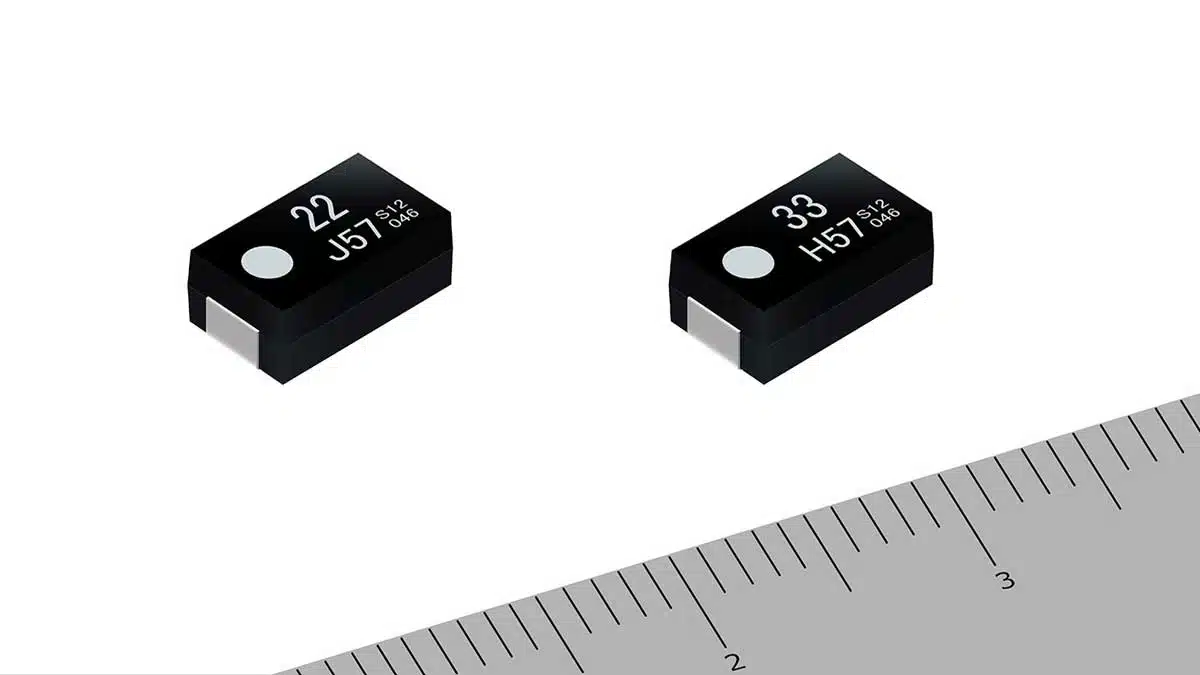
Panasonic Industry Co., Ltd., a Panasonic Group company, announced that it will begin commercial production of its two models of Conductive Polymer Tantalum Solid Capacitors (POSCAP), 50TQT33M and 63TQT22M. These capacitors are incorporated into power circuits used for information and communication equipment, including laptops and tablets. They offer an ultra-high withstand voltage and high capacitance in a body with the industry’s lowest profile of 3 mm, supporting high-output power delivery through USB Type-C connectors. Mass production for these models is planned to start in December 2025.

These capacitors are ideal for voltage stabilization and noise reduction in power supplies compliant with USB Power Delivery (USB-PD) 3.1. While previous USB-C connectors supplied up to 100 W (20 V/5 A), USB-PD 3.1 expands this to 240 W (48 V/5 A). This enables widespread use of USB-C connectors for high-speed data transfer and rapid charging, and is expected to further expand applications to larger equipment requiring high power output, such as displays.

On the other hand, information and communication equipment such as laptops are increasingly required to be thinner and more compact. Capacitors therefore must combine an ultra-high withstand voltage, high capacitance, and a low profile in order to fit into limited space. Panasonic Industry began mass production of Conductive Polymer Tantalum Solid Capacitors (POSCAP) in 1997 and, as an industry leader, has continuously delivered first-of-their-kind products. Leveraging proprietary powder molding technology and film formation technologies, the company has newly developed two models that achieve both an ultra-high withstand voltage and high capacitance in a package with the industry’s lowest profile of 3 mm.

Through these unique device technologies, Panasonic Industry will continue to contribute to enhancing the functionality of electronic equipment, including laptops, while also reducing the environmental impact through smaller, lighter devices and lower material usage.

Key features:

  1. Achieves both an ultra-high withstand voltage and high capacitance*2 to support high-output USB Type-C power delivery, in a 3 mm profile—the lowest in the industry*1—enabled by proprietary powder molding and film formation technologies
  2. Lineup of USB-PD 3.1-compliant models rated at 50 V and 63 V
  3. Contributes to reduced material usage lower environmental impact through low-profile design

1. Achieves both an ultra-high withstand voltage and high capacitance to support high-output USB Type-C power delivery, in a 3 mm profile—the lowest in the industry—enabled by proprietary powder molding and film formation technologies

To achieve capacitor performance required for USB-PD 3.1 power supplies in a low-profile body, both high capacitance and a high withstand voltage must be ensured, despite their trade-off relationship. High-capacitance tantalum powder is necessary for electrode materials, but its fine particle size makes molding difficult, creating challenges for stable production. Forming a uniform dielectric film on the surface of the electrodes is important for enhancing the withstand voltage. However, since electrodes made with high-capacitance tantalum powder contain extremely small internal pores, dielectric oxide films tend to develop imperfections.

Panasonic Industry overcame these challenges by establishing proprietary technology to mold high-capacitance tantalum powder with uniform density, and by optimizing the film deposition process to create flawless dielectric films. This enabled the development of two new models that combine an ultra-high withstand voltage and high capacitance, meeting the USB-C high-output power delivery requirements in a 3 mm low-profile package.

2. Lineup of USB-PD 3.1-compliant models rated at 50 V and 63 V 

Until now, Panasonic Industry’s POSCAP lineup extended only up to 35 V, with no models compatible with USB-PD 3.1, which extends the rated voltage specification to 36 V (180 W) and 48 V (240 W). The two new models, rated at 50 V and 63 V, each achieve a high capacitance of 22 μF or higher in a package with the industry’s lowest profile of 3 mm. The full lineup provides flexibility to meet diverse applications and equipment specifications.

3. Contributes to reduced material usage lower environmental impact through low-profile design

Compared to the industry standard size, the new models reduce volume by 25%, contributing to a lower environmental impact through reduced material usage.

Applications:

  • Voltage stabilization and noise reduction of USB-PD 3.1-compliant power supplies for laptops, displays, and peripheral equipment
  • Arc discharge[2] countermeasures for USB-PD 3.1-compliant connectors

Specifications:

  • Life: 2,000 hours at 105°C; guaranteed operating temperature range: -55°C to 105°C
  • Ripple current[3]: 100 kHz, 105°C
  • ESR[4]: 100 kHz, 20°C

50 V rated

63 V rated
Size*4
(mm)
Capacitance
(μF)
Ripple current
(mArms)
ESR
(mΩ)
Capacitance
(μF)
Ripple current
(mArms)
ESR
(mΩ)
L7.3 × W4.3 × H2.833120010022990150

Related

Source: Panasonic Industry

Recent Posts

Miniaturization of Tantalum Capacitors: Structural Limit Under Constant Rating

27.4.2026
21

Murata New MLCC Bulk Case Packaging Cuts Packaging Material by 99%

27.4.2026
28

Exxelia Introduces SMD High‑Voltage Mica Capacitors

28.4.2026
11

Modelithics Releases COMPLETE v26.1 for Keysight ADS

23.4.2026
11

April 2026 Interconnect, Passives and Electromechanical Components Market Insights

22.4.2026
58

KYOCERA AVX Introduces Traction‑Grade DC Link Film Capacitors

21.4.2026
41

When More Capacitance Hurts Reliability: The Role of the Metallic Skeleton in Tantalum Anodes

20.4.2026
43

YAGEO Introduces High‑Current Y2/X1 Film Capacitors for Wide-bandgap Power Systems

17.4.2026
34

Amphenol Explanded Liquid Cooling Connectors for AI, ESS and EV Systems

17.4.2026
20

Upcoming Events

Apr 29
10:00 - 11:00 CDT

SEPIC Design Done Right

Apr 30
10:00 - 11:00 CDT

Programming Embedded Systems

May 5
16:00 - 17:00 CEST

Understanding and Selecting Capacitors – Fundamentals, Technologies and Latest Trends

View Calendar

Popular Posts

  • Buck Converter Design and Calculation

    0 shares
    Share 0 Tweet 0
  • Boost Converter Design and Calculation

    0 shares
    Share 0 Tweet 0
  • Flyback Converter Design and Calculation

    0 shares
    Share 0 Tweet 0
  • LLC Resonant Converter Design and Calculation

    0 shares
    Share 0 Tweet 0
  • MLCC and Ceramic Capacitors

    0 shares
    Share 0 Tweet 0
  • Dual Active Bridge (DAB) Topology

    0 shares
    Share 0 Tweet 0
  • Capacitor Charging and Discharging

    0 shares
    Share 0 Tweet 0
  • What Electronics Engineer Needs to Know About Passive Low Pass Filters

    0 shares
    Share 0 Tweet 0
  • Ripple Current and its Effects on the Performance of Capacitors

    3 shares
    Share 3 Tweet 0
  • MLCC Case Sizes Standards Explained

    0 shares
    Share 0 Tweet 0

Newsletter Subscription


Passive Components Blog

© EPCI - Leading Passive Components Educational and Information Site

  • Home
  • Privacy Policy
  • EPCI Membership & Advertisement
  • About

No Result
View All Result
  • Home
  • Knowledge Blog
  • PCNS

© EPCI - Leading Passive Components Educational and Information Site

This website uses cookies. By continuing to use this website you are giving consent to cookies being used. Visit our Privacy and Cookie Policy.
Go to mobile version