

















Passive Components Blog
No Result
View All Result
  • Home
  • NewsFilter
    • All
    • Aerospace & Defence
    • Antenna
    • Applications
    • Automotive
    • Capacitors
    • Circuit Protection Devices
    • electro-mechanical news
    • Filters
    • Fuses
    • Inductors
    • Industrial
    • Integrated Passives
    • inter-connect news
    • Market & Supply Chain
    • Market Insights
    • Medical
    • Modelling and Simulation
    • New Materials & Supply
    • New Technologies
    • Non-linear Passives
    • Oscillators
    • Passive Sensors News
    • Resistors
    • RF & Microwave
    • Telecommunication
    • Weekly Digest

    Samsung Introduces Ultra-High-Voltage 1500 V MLCCs for xEV Powertrains

    YAGEO Q1 2026 Results: AI Servers and Pricing Power Behind a Moderate Q2 Outlook

    TDK Introduces High‑Voltage Common‑Mode Chokes for Compact 1250 V DC Converters

    Vishay Extends Power Inductors for DC/DC with 1212 Compact Case

    Modeling Planar Magnetics Temperature: Practical Guidelines for Power Electronics Engineers

    YAGEO Releases Ferrite Shielded Power Inductors for High‑Density Designs

    Samsung Presents MLCC Selection Guide for Humanoids and Robotic Applications

    AI-Assisted Structural Diagnostics and Physics-Based Reliability Interpretation of Tantalum Capacitor Anodes

    YAGEO Introduces EMI Suppression High‑Current 3‑phase Common Mode Chokes

    Trending Tags

    • Ripple Current
    • RF
    • Leakage Current
    • Tantalum vs Ceramic
    • Snubber
    • Low ESR
    • Feedthrough
    • Derating
    • Dielectric Constant
    • New Products
    • Market Reports
  • VideoFilter
    • All
    • Antenna videos
    • Capacitor videos
    • Circuit Protection Video
    • Filter videos
    • Fuse videos
    • Inductor videos
    • Inter-Connect Video
    • Non-linear passives videos
    • Oscillator videos
    • Passive sensors videos
    • Resistor videos

    Transformer-Based Power-Line Harvester Magnetic Design

    Thermal Modeling of Magnetics

    Standard vs Planar LLC transformers Comparison for Battery Chargers

    How Modern Tools Model Magnetic Components for Power Electronics

    Advanced Loss Modeling for Planar Magnetics in the Frenetic Planar Tool

    2026 Power Magnetics Design Trends: Flyback, DAB and Planar

    Enabling Software‑Defined Vehicle Architectures: Automotive Ethernet and Zonal Smart Power

    Calculating Resistance Value of a Flyback RC Snubber 

    One‑Pulse Characterization of Nonlinear Power Inductors

    Trending Tags

    • Capacitors explained
    • Inductors explained
    • Resistors explained
    • Filters explained
    • Application Video Guidelines
    • EMC
    • New Products
    • Ripple Current
    • Simulation
    • Tantalum vs Ceramic
  • Knowledge Blog
  • DossiersNew
  • Suppliers
    • Who is Who
  • PCNS
    • PCNS 2025
    • PCNS 2023
    • PCNS 2021
    • PCNS 2019
    • PCNS 2017
  • Events
  • Home
  • NewsFilter
    • All
    • Aerospace & Defence
    • Antenna
    • Applications
    • Automotive
    • Capacitors
    • Circuit Protection Devices
    • electro-mechanical news
    • Filters
    • Fuses
    • Inductors
    • Industrial
    • Integrated Passives
    • inter-connect news
    • Market & Supply Chain
    • Market Insights
    • Medical
    • Modelling and Simulation
    • New Materials & Supply
    • New Technologies
    • Non-linear Passives
    • Oscillators
    • Passive Sensors News
    • Resistors
    • RF & Microwave
    • Telecommunication
    • Weekly Digest

    Samsung Introduces Ultra-High-Voltage 1500 V MLCCs for xEV Powertrains

    YAGEO Q1 2026 Results: AI Servers and Pricing Power Behind a Moderate Q2 Outlook

    TDK Introduces High‑Voltage Common‑Mode Chokes for Compact 1250 V DC Converters

    Vishay Extends Power Inductors for DC/DC with 1212 Compact Case

    Modeling Planar Magnetics Temperature: Practical Guidelines for Power Electronics Engineers

    YAGEO Releases Ferrite Shielded Power Inductors for High‑Density Designs

    Samsung Presents MLCC Selection Guide for Humanoids and Robotic Applications

    AI-Assisted Structural Diagnostics and Physics-Based Reliability Interpretation of Tantalum Capacitor Anodes

    YAGEO Introduces EMI Suppression High‑Current 3‑phase Common Mode Chokes

    Trending Tags

    • Ripple Current
    • RF
    • Leakage Current
    • Tantalum vs Ceramic
    • Snubber
    • Low ESR
    • Feedthrough
    • Derating
    • Dielectric Constant
    • New Products
    • Market Reports
  • VideoFilter
    • All
    • Antenna videos
    • Capacitor videos
    • Circuit Protection Video
    • Filter videos
    • Fuse videos
    • Inductor videos
    • Inter-Connect Video
    • Non-linear passives videos
    • Oscillator videos
    • Passive sensors videos
    • Resistor videos

    Transformer-Based Power-Line Harvester Magnetic Design

    Thermal Modeling of Magnetics

    Standard vs Planar LLC transformers Comparison for Battery Chargers

    How Modern Tools Model Magnetic Components for Power Electronics

    Advanced Loss Modeling for Planar Magnetics in the Frenetic Planar Tool

    2026 Power Magnetics Design Trends: Flyback, DAB and Planar

    Enabling Software‑Defined Vehicle Architectures: Automotive Ethernet and Zonal Smart Power

    Calculating Resistance Value of a Flyback RC Snubber 

    One‑Pulse Characterization of Nonlinear Power Inductors

    Trending Tags

    • Capacitors explained
    • Inductors explained
    • Resistors explained
    • Filters explained
    • Application Video Guidelines
    • EMC
    • New Products
    • Ripple Current
    • Simulation
    • Tantalum vs Ceramic
  • Knowledge Blog
  • DossiersNew
  • Suppliers
    • Who is Who
  • PCNS
    • PCNS 2025
    • PCNS 2023
    • PCNS 2021
    • PCNS 2019
    • PCNS 2017
  • Events
No Result
View All Result
Passive Components Blog
No Result
View All Result

Researchers Improve Flexible Li-Ion Supercapacitors with ZnS/CuS Nanoparticles

18.1.2024
Reading Time: 3 mins read
A A

Researchers from Tsinghua University created zinc-sulfide nanoparticles that can be incorporated into multichannel carbon fibers (CFs) to improve performance of Li-Ion supercapacitors performance. The results were published in Energy Materials and Devices  journal.

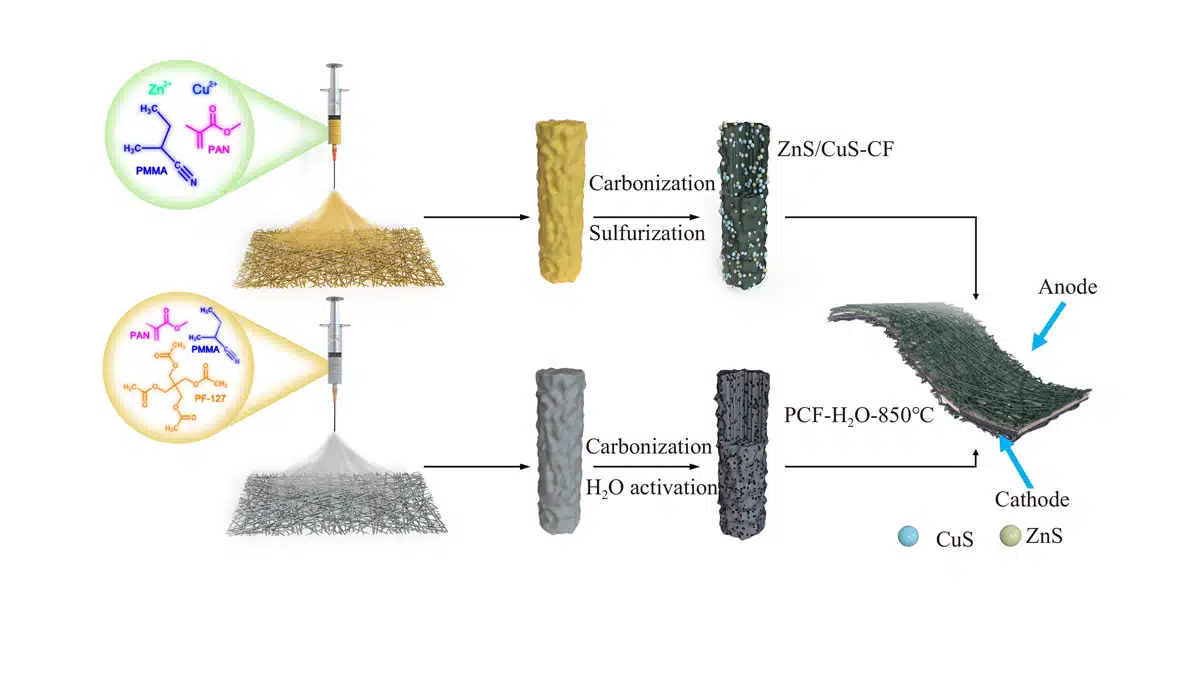
Transition metal sulfides (TMSs) are widely recognized for their potential as anode materials in the development of flexible lithium-ion capacitors (FLICs) owing to their high theoretical capacity. However, their practical application has been significantly limited by rapid capacity decay and sluggish kinetics associated with TMS volume variation. In response to these challenges, we have prepared ZnS/CuS nanoparticles embedded in continuous and multichannel carbon fibers (CFs).

RelatedPosts

Samsung Introduces Ultra-High-Voltage 1500 V MLCCs for xEV Powertrains

YAGEO Q1 2026 Results: AI Servers and Pricing Power Behind a Moderate Q2 Outlook

TDK Introduces High‑Voltage Common‑Mode Chokes for Compact 1250 V DC Converters

This was achieved through a process involving blow-spinning and subsequent sulfidation. Notably, the electrochemical performance of these materials was largely improved, owing to the synergistic effect of bimetallic sulfides. The ZnS/CuS-CF anode material demonstrated a high specific capacity of over 900 mAh g−1 at a current density of 0.2 A g−1. Furthermore, it exhibited superior rate capacity (300 mAh g−1 at 20 A g−1) and excellent cyclic stability, maintaining its performance over 1000 cycles at 10 A g−1. We also prepared lithium-ion capacitors (LICs) using the same method.

These LICs exhibited a maximum energy density of 136 Wh kg−1, a high power density of 43.5 kW kg−1, and an impressive cyclic stability over 4000 cycles. In addition, the FLICs, when configured in the form of a pouch cell, demonstrated significant potential for the development of smart, flexible electronic devices.

“An effective strategy to enhance the energy and power densities of CF-based anode materials involves coupling them with highly active materials.” said Bohan Li, Researcher and Author, Tsinghua University Press.

Multichannel carbon fibers with embedded ZnS/CuS nanoparticles are the end product. This material demonstrated enhanced high specific capacity and rate capacity, along with decreased resistance to charge transfer and ion diffusion. Improvements in energy and power densities were achieved by combining mixed metal sulfides with a FLIC.

Combining metals like zinc with sulfides and carbon fibers seems to be a successful way to create a high-capacity anode. The metals can react more quickly due to the high activity level, a major improvement over FLICs.

The carbon fiber network’s structure not only enhances the material’s performance but also lessens the possibility of nanoparticles bunching up, preserving stability and cycle consistency.

“Carbon fibers function as a conductive network and 3D matrix, accommodating volume expansion and maximizing the high-capacity feature of ZnS and CuS nanoparticles. This enhances the specific capacity and cycle stability of CF-based anode materials.” Add Bohan Li

The three-dimensional matrix of the carbon fibers also limits the expansion of ZnS and CuS. At best, an expansion of the battery’s internal components may result in a reduction in performance, and at worst, the battery may completely fail.

A pouch cell was used to test the technology’s usability under pressure (bending). Pouch cells, which are frequently found in laptops, cell phones, and cars, are essentially an enclosed anode and cathode with a separator and conducting material.

The outcomes demonstrate the technology’s versatility, as an LED was successfully lit up at all angles when bent at different angles. The technology not only resisted initial bending, but it also effortlessly assumed its original shape – a crucial feature of flexible technology.

The material intends to advance current technology to increase the range of intelligent, adaptable gadgets that are becoming more and more popular. Advances in these electronics may result in more environmentally friendly technology accessible to both businesses and consumers.

For ZnS/CuS nanoparticle production on a continuous carbon fiber network to be a technology that can be utilized in wearable and portable devices instead of the standard TMSs used in FLICs, it would need to be scaled up.

Reference link:

Li, B., et al. (2024) ZnS/CuS nanoparticles encapsulated in multichannel carbon fibers as high-performance anode materials for flexible Li-ion capacitors. 

SciOpen. doi.org/10.26599/EMD.2023.9370012

Related

Recent Posts

Samsung Introduces Ultra-High-Voltage 1500 V MLCCs for xEV Powertrains

16.4.2026
3

YAGEO Q1 2026 Results: AI Servers and Pricing Power Behind a Moderate Q2 Outlook

16.4.2026
3

Samsung Presents MLCC Selection Guide for Humanoids and Robotic Applications

15.4.2026
11

AI-Assisted Structural Diagnostics and Physics-Based Reliability Interpretation of Tantalum Capacitor Anodes

14.4.2026
14

KYOCERA AVX MIL-PRF-32535 BME NP0 MLCCs Approved to the DLA QPD

14.4.2026
19

ECIA March 2026 Industry Pulse Points to Best Sales Climate in Five Years

13.4.2026
27

Murata Automotive MLCCs Push Capacitance Limits for ADAS and Power Lines

8.4.2026
40

TDK and Nippon Chemical Launch Joint Venture for MLCC Materials

7.4.2026
43

March 2026 Interconnect, Passives and Electromechanical Components Market Insights

2.4.2026
96

Upcoming Events

Apr 21
16:00 - 17:00 CEST

Heatsink Solutions: Thermal Management in electronic devices

Apr 22
17:00 - 18:00 CEST

Derating Tantalum, Film, and Ceramic Capacitors

Apr 29
10:00 - 11:00 CDT

SEPIC Design Done Right

View Calendar

Popular Posts

  • Buck Converter Design and Calculation

    0 shares
    Share 0 Tweet 0
  • Boost Converter Design and Calculation

    0 shares
    Share 0 Tweet 0
  • Flyback Converter Design and Calculation

    0 shares
    Share 0 Tweet 0
  • LLC Resonant Converter Design and Calculation

    0 shares
    Share 0 Tweet 0
  • MLCC and Ceramic Capacitors

    0 shares
    Share 0 Tweet 0
  • Dual Active Bridge (DAB) Topology

    0 shares
    Share 0 Tweet 0
  • Capacitor Charging and Discharging

    0 shares
    Share 0 Tweet 0
  • Plastic Materials Dielectric Constant and DF

    4 shares
    Share 4 Tweet 0
  • MLCC Case Sizes Standards Explained

    0 shares
    Share 0 Tweet 0
  • Ripple Current and its Effects on the Performance of Capacitors

    3 shares
    Share 3 Tweet 0

Newsletter Subscription


Passive Components Blog

© EPCI - Leading Passive Components Educational and Information Site

  • Home
  • Privacy Policy
  • EPCI Membership & Advertisement
  • About

No Result
View All Result
  • Home
  • Knowledge Blog
  • PCNS

© EPCI - Leading Passive Components Educational and Information Site

This website uses cookies. By continuing to use this website you are giving consent to cookies being used. Visit our Privacy and Cookie Policy.
Go to mobile version