




Passive Components Blog
No Result
View All Result
  • Home
  • NewsFilter
    • All
    • Aerospace & Defence
    • Antenna
    • Applications
    • Automotive
    • Capacitors
    • Circuit Protection Devices
    • electro-mechanical news
    • Filters
    • Fuses
    • Inductors
    • Industrial
    • Integrated Passives
    • inter-connect news
    • Market & Supply Chain
    • Market Insights
    • Medical
    • Modelling and Simulation
    • New Materials & Supply
    • New Technologies
    • Non-linear Passives
    • Oscillators
    • Passive Sensors News
    • Resistors
    • RF & Microwave
    • Telecommunication
    • Weekly Digest

    April 2026 Interconnect, Passives and Electromechanical Components Market Insights

    SPICE Simulation of Non-Linear Resistors: Vishay’s Thermistor and PPTC Modelling Ecosystem

    KYOCERA AVX Introduces Traction‑Grade DC Link Film Capacitors

    When More Capacitance Hurts Reliability: The Role of the Metallic Skeleton in Tantalum Anodes

    Why Power Inductors Use a Ferrite Core With an Air Gap

    Wk 16 Electronics Supply Chain Digest

    YAGEO Introduces High‑Current Y2/X1 Film Capacitors for Wide-bandgap Power Systems

    Amphenol Explanded Liquid Cooling Connectors for AI, ESS and EV Systems

    Hirose Introduced BGA connector for PCIe Gen6 for AI and Edge Computing

    Trending Tags

    • Ripple Current
    • RF
    • Leakage Current
    • Tantalum vs Ceramic
    • Snubber
    • Low ESR
    • Feedthrough
    • Derating
    • Dielectric Constant
    • New Products
    • Market Reports
  • VideoFilter
    • All
    • Antenna videos
    • Capacitor videos
    • Circuit Protection Video
    • Filter videos
    • Fuse videos
    • Inductor videos
    • Inter-Connect Video
    • Non-linear passives videos
    • Oscillator videos
    • Passive sensors videos
    • Resistor videos

    Why Power Inductors Use a Ferrite Core With an Air Gap

    Transformer-Based Power-Line Harvester Magnetic Design

    Thermal Modeling of Magnetics

    Standard vs Planar LLC transformers Comparison for Battery Chargers

    How Modern Tools Model Magnetic Components for Power Electronics

    Advanced Loss Modeling for Planar Magnetics in the Frenetic Planar Tool

    2026 Power Magnetics Design Trends: Flyback, DAB and Planar

    Enabling Software‑Defined Vehicle Architectures: Automotive Ethernet and Zonal Smart Power

    Calculating Resistance Value of a Flyback RC Snubber 

    Trending Tags

    • Capacitors explained
    • Inductors explained
    • Resistors explained
    • Filters explained
    • Application Video Guidelines
    • EMC
    • New Products
    • Ripple Current
    • Simulation
    • Tantalum vs Ceramic
  • Knowledge Blog
  • DossiersNew
  • Suppliers
    • Who is Who
  • PCNS
    • PCNS 2025
    • PCNS 2023
    • PCNS 2021
    • PCNS 2019
    • PCNS 2017
  • Events
  • Home
  • NewsFilter
    • All
    • Aerospace & Defence
    • Antenna
    • Applications
    • Automotive
    • Capacitors
    • Circuit Protection Devices
    • electro-mechanical news
    • Filters
    • Fuses
    • Inductors
    • Industrial
    • Integrated Passives
    • inter-connect news
    • Market & Supply Chain
    • Market Insights
    • Medical
    • Modelling and Simulation
    • New Materials & Supply
    • New Technologies
    • Non-linear Passives
    • Oscillators
    • Passive Sensors News
    • Resistors
    • RF & Microwave
    • Telecommunication
    • Weekly Digest

    April 2026 Interconnect, Passives and Electromechanical Components Market Insights

    SPICE Simulation of Non-Linear Resistors: Vishay’s Thermistor and PPTC Modelling Ecosystem

    KYOCERA AVX Introduces Traction‑Grade DC Link Film Capacitors

    When More Capacitance Hurts Reliability: The Role of the Metallic Skeleton in Tantalum Anodes

    Why Power Inductors Use a Ferrite Core With an Air Gap

    Wk 16 Electronics Supply Chain Digest

    YAGEO Introduces High‑Current Y2/X1 Film Capacitors for Wide-bandgap Power Systems

    Amphenol Explanded Liquid Cooling Connectors for AI, ESS and EV Systems

    Hirose Introduced BGA connector for PCIe Gen6 for AI and Edge Computing

    Trending Tags

    • Ripple Current
    • RF
    • Leakage Current
    • Tantalum vs Ceramic
    • Snubber
    • Low ESR
    • Feedthrough
    • Derating
    • Dielectric Constant
    • New Products
    • Market Reports
  • VideoFilter
    • All
    • Antenna videos
    • Capacitor videos
    • Circuit Protection Video
    • Filter videos
    • Fuse videos
    • Inductor videos
    • Inter-Connect Video
    • Non-linear passives videos
    • Oscillator videos
    • Passive sensors videos
    • Resistor videos

    Why Power Inductors Use a Ferrite Core With an Air Gap

    Transformer-Based Power-Line Harvester Magnetic Design

    Thermal Modeling of Magnetics

    Standard vs Planar LLC transformers Comparison for Battery Chargers

    How Modern Tools Model Magnetic Components for Power Electronics

    Advanced Loss Modeling for Planar Magnetics in the Frenetic Planar Tool

    2026 Power Magnetics Design Trends: Flyback, DAB and Planar

    Enabling Software‑Defined Vehicle Architectures: Automotive Ethernet and Zonal Smart Power

    Calculating Resistance Value of a Flyback RC Snubber 

    Trending Tags

    • Capacitors explained
    • Inductors explained
    • Resistors explained
    • Filters explained
    • Application Video Guidelines
    • EMC
    • New Products
    • Ripple Current
    • Simulation
    • Tantalum vs Ceramic
  • Knowledge Blog
  • DossiersNew
  • Suppliers
    • Who is Who
  • PCNS
    • PCNS 2025
    • PCNS 2023
    • PCNS 2021
    • PCNS 2019
    • PCNS 2017
  • Events
No Result
View All Result
Passive Components Blog
No Result
View All Result

Rubycon PMLCAP DC‑Link Film Capacitors in Mass Production

9.1.2026
Reading Time: 5 mins read
A A

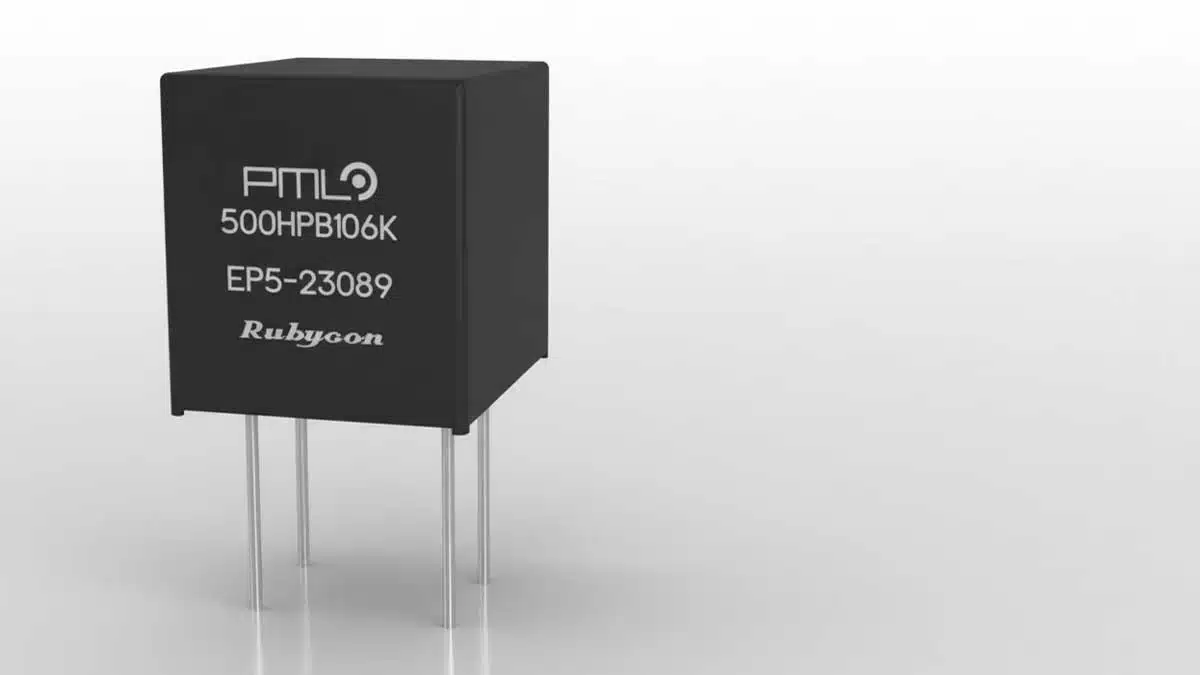
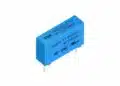
Rubycon’s HPB series based on PMLCAP technology is entering mass production in January 2026, bringing a compact, high‑power‑density alternative to traditional DC‑link film capacitors.

The series targets modern power electronics where higher switching frequencies, high ripple currents and elevated temperatures are becoming standard design constraints. For design engineers and purchasers, this marks the transition from early promotion to a fully specified, production‑ready platform with finalized datasheet values.

RelatedPosts

Rubycon Releases High Capacitance Radial Lead Aluminum Electrolytic Capacitors

Rubycon Extends Capacitance of Polymer Hybrid Aluminum Capacitors

Rubycon Extends Capacitance and Low Impedance Aluminum Electrolytic Capacitors

Key features and benefits

The Rubycon HPB series is a high‑voltage PMLCAP film capacitor family optimized as a DC‑link capacitor element in demanding power conversion stages. In many cases it enables replacement of bulky film capacitors with a significantly smaller footprint while maintaining or improving electrical performance.

Key characteristics include:

  • PMLCAP construction that supports high power density versus conventional film DC‑link capacitors.
  • Stable capacitance and electrical behavior up to 125°C, allowing placement closer to heat sources such as power semiconductors.
  • Finalized ripple current ratings in the updated datasheet that reflect the behavior of actual mass‑production parts.
  • Exclusive 10% capacitance tolerance across the series, simplifying stock management and worst‑case design calculations.
  • Targeted AEC‑Q200 qualification, with the marking temporarily removed and planned for reintroduction after extended qualification is completed.

In practical terms, the HPB series helps reduce DC‑link volume and board area, increases thermal headroom and provides designers with clearer derating rules through the updated ripple current tables.

Typical applications

The Rubycon HPB PMLCAP series is positioned as a DC‑link workhorse for modern power conversion topologies, especially those using fast wide‑bandgap switches.

Typical use cases include:

  • DC‑link filters in industrial and HVAC motor drives.
  • On‑board chargers in electric and plug‑in hybrid vehicles, including high‑frequency PFC and DC/DC stages.
  • Industrial drives and inverters where high ripple current and elevated ambient temperature are expected.
  • High‑frequency converter stages based on SiC and GaN devices, where low ESL and stable capacitance at higher temperatures are critical.

In these circuits, the HPB capacitors act as the main energy buffer between the rectified input and the switching bridge, so their ability to handle ripple current and temperature directly affects converter efficiency, reliability and lifetime.

Technical highlights

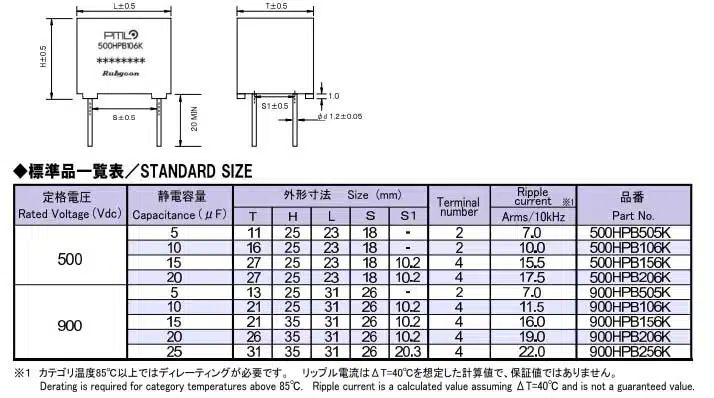
While detailed numerical values (capacitance, voltage ratings, ESR, ESL and ripple current) must be taken directly from the Rubycon HPB datasheet, the series is characterized by several important technical updates and positioning points according to the manufacturer documentation:

  • Voltage and capacitance range suitable for DC‑link operation in typical mains‑connected and high‑power DC bus systems, according to the HPB datasheet.
  • Ripple current ratings that have been adjusted to match final material and process configurations in series production, with updated tables in the latest datasheet.
  • Operation up to 125°C, supporting high‑temperature environments such as compact on‑board chargers, motor drives in sealed housings and power modules with limited airflow.
  • Focus on a single 10% capacitance tolerance option, which simplifies use in parallel/series banks and ensures tighter control of bus impedance.
  • AEC‑Q200 marking temporarily removed in favor of completing extended qualification, with the intention to reintroduce the automotive status once tests are finalized.

For engineers, the key message is that the HPB series has moved from pre‑launch promotion to a mature, production‑ready platform with fully specified ripple and tolerance characteristics that can be used directly in derating and lifetime calculations.

Availability and part numbers

With start of production in January 2026, HPB parts move into mass‑production status rather than engineering samples only.
Source

This article is based on information from the official Codico news release announcing the series launch of the Rubycon HPB PMLCAP capacitor family in January 2026 and the associated manufacturer documentation, complemented with general design‑in considerations for DC‑link capacitors.
References

  1. Series Launch of the RUBYCON HPB Series in January 2026 – CODICO
  2. Rubycon HPB series datasheet (HPB.pdf)
  3. RUBYCON’s Game Changer HPB Series – CODICO

Related

Recent Posts

April 2026 Interconnect, Passives and Electromechanical Components Market Insights

22.4.2026
1

KYOCERA AVX Introduces Traction‑Grade DC Link Film Capacitors

21.4.2026
13

When More Capacitance Hurts Reliability: The Role of the Metallic Skeleton in Tantalum Anodes

20.4.2026
23

YAGEO Introduces High‑Current Y2/X1 Film Capacitors for Wide-bandgap Power Systems

17.4.2026
20

Amphenol Explanded Liquid Cooling Connectors for AI, ESS and EV Systems

17.4.2026
10

Hirose Introduced BGA connector for PCIe Gen6 for AI and Edge Computing

17.4.2026
6

YAGEO Introduces High Rel MLCCs Beyond MIL-Spec Limits

16.4.2026
47

Samsung Introduces Ultra-High-Voltage 1500 V MLCCs for xEV Powertrains

16.4.2026
26

YAGEO Q1 2026 Results: AI Servers and Pricing Power Behind a Moderate Q2 Outlook

16.4.2026
67

Upcoming Events

Apr 29
10:00 - 11:00 CDT

SEPIC Design Done Right

May 5
16:00 - 17:00 CEST

Understanding and Selecting Capacitors – Fundamentals, Technologies and Latest Trends

May 12
16:00 - 17:00 CEST

Accelerating Power Supply Design with Wurth Elektronik and STMicroelectronics

View Calendar

Popular Posts

  • Buck Converter Design and Calculation

    0 shares
    Share 0 Tweet 0
  • Boost Converter Design and Calculation

    0 shares
    Share 0 Tweet 0
  • Flyback Converter Design and Calculation

    0 shares
    Share 0 Tweet 0
  • LLC Resonant Converter Design and Calculation

    0 shares
    Share 0 Tweet 0
  • MLCC and Ceramic Capacitors

    0 shares
    Share 0 Tweet 0
  • Dual Active Bridge (DAB) Topology

    0 shares
    Share 0 Tweet 0
  • Capacitor Charging and Discharging

    0 shares
    Share 0 Tweet 0
  • Ripple Current and its Effects on the Performance of Capacitors

    3 shares
    Share 3 Tweet 0
  • MLCC Case Sizes Standards Explained

    0 shares
    Share 0 Tweet 0
  • What Electronics Engineer Needs to Know About Passive Low Pass Filters

    0 shares
    Share 0 Tweet 0

Newsletter Subscription


Passive Components Blog

© EPCI - Leading Passive Components Educational and Information Site

  • Home
  • Privacy Policy
  • EPCI Membership & Advertisement
  • About

No Result
View All Result
  • Home
  • Knowledge Blog
  • PCNS

© EPCI - Leading Passive Components Educational and Information Site

This website uses cookies. By continuing to use this website you are giving consent to cookies being used. Visit our Privacy and Cookie Policy.
Go to mobile version